

Key Takeaways
Make survival the mission, not defeating the dead
Survive, do not conquer. The book's central promise is protection, not a fantasy of becoming a professional zombie hunter. Its imagined enemy cannot be reasoned with, frightened, or permanently stopped by ordinary bodily injury. The practical aim is to stay alive, avoid infection, and preserve enough judgment to make the next decision. In one account, a six-year-old boy escapes an attack on his village by hiding on a roof and moving away at dawn. His advantage is not strength or heroism. It is choosing an exit instead of a fight.
Risk beats bravado. Across the manual, preparation matters because panic, fatigue, and false confidence can turn a survivable encounter into a fatal one. The book repeatedly warns against treating combat as a test of courage.
What's striking is how firmly the book resists the action-hero payoff. Its idea of competence is not defeating an enemy but refusing unnecessary exposure. That makes the survival premise less about violence than decision-making under pressure: knowing when to stay put, when to leave, and when a plan has stopped serving its purpose. The limit is that relentless caution can become paralysis. A useful reading keeps the distinction clear: restraint is valuable when it preserves options, not when it prevents action that is genuinely necessary.
Treat zombie physiology as a rulebook, not a power fantasy
Learn the fictional rules. The guide names its imagined infection Solanum, a virus that travels through bodily fluids, kills a human host, and then reanimates the body. In its account, infection is not airborne or waterborne, and symptoms progress to reanimation in roughly a day. The decisive vulnerability is the brain: damage elsewhere may slow or dismember a zombie, but does not destroy it. The undead feel no pain, do not heal, and can continue until their muscles fail. They are slow and unintelligent, yet their persistence makes them dangerous.
Use limits, not legends. The manual rejects supernatural powers, retained memories, and humanlike emotion. Its monster is frightening precisely because it is physically constrained but impervious to ordinary deterrents.
The physiology works as a compact model of adversarial thinking: identify what an opponent depends on, what it ignores, and which assumptions fail. Here, the familiar human body becomes a misleading guide because the infected brain has changed the rules. The book also gains tension from combining weakness with persistence. Still, its biological explanations belong to an invented horror world, not medicine. Readers can appreciate the method of reasoning without mistaking fictional precision for scientific evidence.
Read odd deaths and official silence as early-warning signals
Notice the pattern. The book describes outbreaks that begin with a few isolated cases, then spread when people misread bites, unexplained deaths, or sudden violence as unrelated events. Its proposed warning signs include missing people, attacks involving biting, mysterious disease clusters, and unusual restrictions on reporting. A small outbreak may be hidden or mistaken for ordinary crime; a larger one becomes harder to conceal as witnesses and casualties multiply. The guide classifies outbreaks by scale, from a handful of infected people in a limited area to a global collapse.
Connect reports carefully. Its advice is to track where incidents occur and whether authorities' responses change, rather than react to one strange story in isolation. In the book's fictional history, delay and denial repeatedly let local emergencies grow.
The useful idea is not suspicion for its own sake, but attention to how separate events can form a meaningful pattern. The manual dramatizes a familiar institutional problem: an unfamiliar danger may be forced into familiar categories until those categories stop working. Yet its proposed clues are deliberately broad. In real life, unexplained illness, violence, or restricted information can have many causes, so treating such signs as proof would invite false alarms. The strongest lesson is to verify, compare, and update, not leap from anomaly to certainty.
Aim for the brain, and avoid noise that summons more danger
Precision beats spectacle. Within the book's rules, only destruction of the brain definitively stops a zombie. Damage to the torso or limbs may leave an attacker moving, crawling, or biting, so impressive-looking force can fail to solve the actual problem. The manual favors simple, maintainable tools over elaborate displays of firepower, and repeatedly stresses practice and restraint. Loud weapons create another problem: sound can attract additional undead. Fire may destroy a body, but a burning zombie can keep moving and ignite its surroundings.
Choose for the situation. The book distinguishes between defending a fixed position, escaping, and deliberately clearing an area. A tool that seems powerful in one context can be a liability in another, especially when it is heavy, noisy, or unreliable.
The section's memorable reversal is that more force does not necessarily mean more control. Success depends on matching a method to the enemy's actual vulnerabilities and accounting for what the method brings with it. Noise, fire, weight, and mechanical failure all create secondary consequences. That is a sharper lesson than simply choosing a stronger weapon. The book's specific combat advice is fictional and should not be treated as real-world instruction, but its underlying critique of spectacle over disciplined judgment remains clear.
Build a refuge that can feed and steady people through a siege
Security is only step one. A barricade buys time; it does not supply water, sanitation, food, power, health, or a way out. The guide treats a defended home as a siege environment, where supplies and routine matter as much as walls. It recommends planning for a long wait, maintaining a garden where possible, rationing finite fuel, disposing of bodies, exercising, and keeping an escape route ready. It also warns that constant noise and boredom can wear down people who are physically protected.
Choose the building strategically. The book considers upper floors, apartments, warehouses, and other structures more defensible than obvious gathering places. Hospitals may become outbreak centers, while police stations and malls can draw panicked crowds. A refuge must be judged by its entrances, supplies, communication, and fallback options.
The strongest insight is that shelter is a social and logistical system, not merely a wall. Food, water, hygiene, information, and morale are linked: a failure in one can undermine the others. The manual gives boredom and relentless noise the same seriousness as physical threats, a useful correction to stories that treat survival as purely muscular. Its assumptions about buildings and outbreaks are part of the fiction, though. The transferable point is to evaluate a refuge by what people can sustain inside it, not by how imposing it looks.
Travel light, stay quiet, and leave cities out of your escape route
Movement costs attention. When a refuge fails, the guide says to choose a destination before setting out, gather information about the route, and prepare alternatives. A journey through infected territory is not an invitation to scavenge or investigate. Every detour consumes time and creates another chance to be detected. The manual favors a small, coordinated group, light packs, quiet communication, rest, and awareness of nearby threats. It presents bicycles as a useful alternative to cars because they are quiet and can navigate around blocked roads.
Avoid the urban trap. Dense districts offer more hiding places for attackers, more obstacles, and more potential hazards. Vehicles can become stranded, while engine noise announces a group's presence. The goal is to reach a known safer place, not to travel quickly at any cost.
This is a lesson in mobility as a combination of speed, discretion, and flexibility. The most impressive vehicle is not necessarily the most useful if it depends on clear roads, fuel, and quiet conditions. Likewise, a destination matters because movement without a destination is merely exposure. The warning against cities follows the book's premise of concentrated danger, though the absolute framing leaves little room for local variation. As fiction, that severity creates urgency; as a general planning principle, route knowledge and backup options matter more than a blanket rule.
Trust disciplined small teams over crowds or lone heroes
Coordination is force. The book argues that neither a well-equipped individual nor a panicked crowd is a reliable defense. Small groups can share lookout duties, carry one another, and assign roles, provided members follow a clear plan. One historical episode in the guide tells of enslaved people on St. Lucia organizing into disciplined teams, communicating by drum, and clearing an outbreak with basic tools after authorities failed to respond. Their coordination, not superior equipment, is presented as the decisive advantage.
Practice before crisis. The manual recommends agreeing on leadership, using plain instructions, learning each member's abilities, and rehearsing how the group will respond. It portrays confusion, conflict, and separation as dangers that can undo even a well-armed team.
The St. Lucia account makes the book's argument unusually concrete: competence is collective, and people excluded from formal power can still organize an effective response. The story also challenges the popular image of the solitary savior. Yet clear leadership has its own risk if authority becomes unquestionable or a leader misjudges the situation. The book's strongest version of discipline is shared understanding and practiced roles, not blind obedience. A group becomes capable when its members can coordinate without surrendering their judgment.
For catastrophe, choose harsh remoteness and practice self-sufficiency beforehand
Prepare before the emergency. For its most extreme scenario, the guide imagines people leaving civilization and rebuilding in a remote place. It urges readers to assemble a group with complementary skills, study the intended environment, plan routes and alternatives, and learn how to produce food and obtain water. It estimates that even minimal preparation would take at least 1,500 hours. The point is not to pack a bag at the last minute; it is to practice the skills and test the location before depending on them.
Balance isolation with resources. The book's rule of thumb is that remoteness reduces contact with both zombies and hostile people, but a safe location still needs reliable water and food. Deserts, mountains, islands, and polar regions each offer protection alongside distinct hazards.
The imagined retreat is less an escape fantasy than a test of dependency. The guide asks readers to consider how much ordinary life relies on systems they do not personally maintain, then to practice alternatives while those systems still exist. That preparation is compelling because it turns vague readiness into knowledge of a specific place and a capable group. Isolation is not automatically safety, however. It can also remove access to help and make every environmental mistake more costly. The book itself recognizes this tension by insisting that resources matter as much as distance.
Keep watch through winter's thaw; frozen zombies can outlast the war
Decay has no fixed deadline. The guide estimates that an ordinary zombie remains functional for three to five years, but cold and dry conditions can preserve some for decades. In its history, frozen specimens thaw and rejoin the threat when temperatures rise. That makes a quiet season or an apparently empty landscape unreliable evidence that danger has passed. A survivor community might remain isolated for years, then send cautious scouts only after weighing the risk of discovery and the possibility that the outside world is still unsafe.
Rebuild slowly. The book rejects dramatic mass returns to abandoned cities. It favors gradual expansion from a secure base, careful checks for remaining undead, and treating protection as an ongoing responsibility rather than a victory parade.
The final warning gives the book a long memory: danger is not measured only by what is visible today, but by what local conditions have preserved. The thaw becomes a recurring test of whether a community has mistaken temporary quiet for durable safety. That logic also makes recovery a problem of verification, not celebration. The fictional timeline should not be read as a forecast, but it sharpens a broader question raised by the story: when evidence is incomplete, what observations are sufficient to justify reopening a world?
Analysis
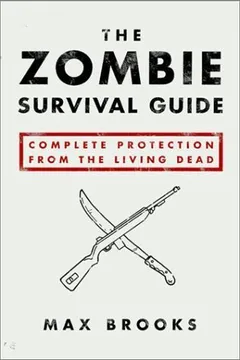
The Zombie Survival Guide disguises a story about social failure as a reference book for an impossible emergency. Its mock-scientific voice, elaborate classifications, equipment lists, and purported historical records make the fantastic premise feel administratively manageable. That contrast is the main comic engine: the narrator applies checklists to a threat that exposes how little ordinary institutions understand their own dependencies.
The manual's strategic logic rests on a deliberately narrow monster. Zombies cannot think, feel pain, heal, or tire in the human sense; they are slow but persistent, and the brain is their decisive vulnerability. This combination reverses conventional action logic. Human advantages are not superior force or technological sophistication, but judgment, preparation, coordination, and the ability to withdraw. The structure follows those principles from immediate recognition, to defense, escape, organized attack, and finally long-term survival after social collapse.
Its outbreak stories deepen the argument by showing that the dead are only half the danger. Denial, panic, prejudice, bad leadership, and institutional secrecy repeatedly magnify the crisis. The account of the organized response in St. Lucia stands against episodes where authorities or crowds make matters worse. In this sense, the book's strongest subject is not zombie anatomy but collective behavior under stress.
The pseudo-history is invented, and the biology and tactical claims are not reliable real-world guidance. Some prescriptions also depend on unusually consistent rules about zombie perception, strength, and behavior. Those limits are part of the genre's design: the book creates a self-contained world in which planning can be tested. Its durable value is therefore conceptual rather than practical. It asks readers to think in terms of bottlenecks, second-order consequences, group discipline, and the difference between a barrier and a sustainable refuge. The final bleakness is balanced by a modest proposition: even after institutions fail, knowledge and cooperation can preserve fragments of civilization.
Review Summary
Reviews of The Zombie Survival Guide are mixed, averaging 3.86/5. Many praise its surprisingly serious, detailed approach to zombie survival, covering weapons, tactics, and historical outbreaks. Fans of zombie culture appreciate its depth and creative premise. However, critics note it becomes repetitive, overly list-like, and regionally specific, favoring North American readers. Some find the humor too dry, while others argue the concept outshines the execution. The historical accounts section receives consistent praise, with many viewing the book as a precursor to Brooks' superior follow-up, World War Z.
People Also Read
Glossary
Solanum
Fictional reanimating virusSolanum is the fictional virus that causes the book's zombie infection. It enters through direct contact with infected bodily fluids, travels to the brain, and transforms the host after death. The guide describes it as fatal to humans and other animals, but says only infected humans reanimate. These claims belong to the book's invented world, not real virology.
Class 1-4
Outbreak severity scaleClass 1-4 is the guide's classification for zombie outbreaks, ordered by scale and social impact. Class 1 describes a small, localized incident; Class 2 involves a larger or more densely populated area; Class 3 is a major regional crisis; and Class 4 is a global, civilization-threatening catastrophe. The classes organize the book's advice by the severity of the imagined emergency.
Aggressive defense
Defensive lure strategyAggressive defense is the guide's name for a tactic in which people hold a prepared position and draw zombies toward it rather than charging into an infested area. The idea exploits the fictional undead's instinctive pursuit and lack of planning. The defenders aim to control where contact happens, while maintaining an escape route and support outside the danger zone.
Voodoo zombie
Living person with brain damageA voodoo zombie, as the guide distinguishes it from its fictional virus-created undead, is a living person rendered severely impaired by a neurotoxin and oxygen deprivation. The book argues that such a person may still feel pain, show emotion, recognize surroundings, and respond to speech. This distinction is used to separate human beings with brain damage from the mindless, reanimated creatures in the manual.
Download PDF
Download EPUB
.epub digital book format is ideal for reading ebooks on phones, tablets, and e-readers.








