Key Takeaways
1. The Inadequacy of Language in Extreme Loss
There is no good way to say this: words fall short.
Profound silence. The author recounts the chilling phrase "There is no good way to say this," used by police to preface news of her sons' suicides. This sentence, though a cliché, accurately captures the profound inadequacy of language when faced with unimaginable loss. The familiar words for pain—aching, wrenching, shattering—become useless in their familiarity, failing to convey the unique sensation of a mother losing both children.
Unspeakable truth. The repeated experience of receiving such news highlights how certain truths defy articulation. The author notes that even after Vincent's death, she believed she had experienced the worst, only to be surprised by James's death. This second loss further exposed the limitations of her existing vocabulary and understanding, necessitating a "new alphabet" that remains elusive.
Beyond words. The author's struggle to describe her feelings underscores a universal challenge: how to communicate an extremity of experience that lies beyond common understanding. This inability to fully articulate her sorrow is not a personal failing but a testament to the sheer magnitude of her loss, where even a seasoned writer finds words insufficient.
2. Life's Unflinching Facts vs. Fiction
Life, however, does not follow a novelist’s discipline. Fiction, one suspects, is tamer than life.
Reality's starkness. The author observes that life's facts often present themselves with a brutal, unadorned truth that would be deemed too coincidental or melodramatic in fiction. For instance, Vincent died on the very day the family put down a deposit for a new house, a detail a novelist would typically avoid for its "shoddy poignancy."
Beyond narrative control. Unlike the controlled world of a novel, life's events unfold without regard for narrative discipline or artistic convention. The author's personal tragedies—the precise dates and intervals between her sons' births and deaths—are carved into her mind, yet convey little of the actual experience, demonstrating how facts can be both unalterable and profoundly insufficient.
Tamer than truth. The comparison between fiction and life reveals that some realities are far more intense and illogical than anything an author might invent. The author's own life, with its double loss, makes some fiction "feel pale and feeble," suggesting that the raw, untamed nature of existence often surpasses the boundaries of human imagination and narrative construction.
3. The Abyss as a Permanent Habitat
If an abyss is where I shall be for the rest of my life, the abyss is my habitat. One should not waste energy fighting one’s habitat.
A new reality. The author describes her state after losing both sons as being "found in an abyss," a permanent habitat rather than a temporary fall. This is not a feeling of being lost, but a stark, lucid awareness of her new existence. She emphasizes that this is not a place she strayed into or was thrown into, but simply is.
Radical acceptance. This concept becomes central to her survival. Instead of asking "whys" or "what-ifs," which she views as useless counterarguments against fact, she embraces radical acceptance. This means acknowledging that her sons chose death, and particularly that James chose the same way as Vincent, without seeking alternatives or softening the truth.
Coexisting with extremity. The abyss is not a place to escape but to inhabit on her own terms. This involves a profound indifference to external judgment and a refusal to engage in conventional "grieving" processes that imply an end point. Her life now is about coexisting with this extremity, making it her permanent dwelling.
4. Parental Intuition: A Double-Edged Sword
The real tragedy is not death itself, but a mother’s difficulty in knowing when to trust her intuitions and when to let them go.
Foresight and helplessness. For six years before Vincent's death, the author lived with a dread that he might choose not to live, an intuition confirmed by his therapist. Yet, this foresight did not equip her to prevent the outcome. She questions the utility of intuition when it cannot alter the course of life and death, highlighting the paradox of knowing without being able to act.
The nature of intuition. Intuitions are described as "narratives about potentials, possibilities, and alternatives"—a form of fiction until confirmed by life. The author's distrust of narratives extends to her own intuitions, which she avoids pinning down with words, recognizing their shape-shifting, uncompletable nature.
Limits of understanding. Despite her deep connection to her children, the author acknowledges the vast, incommunicable strangeness of their inner worlds. She could sense Vincent's despair but was "even more limited" with James, only reaching for his mind without grasping it. This highlights the ultimate boundary of parental understanding and intervention.
5. The Framework for Living Amidst Catastrophe
A mother’s job is to provide a framework for living: things to do, places to go, days that never fail to break, and nights that always fall.
Sustaining routine. Even after profound loss, the mundane tasks of daily life persist, forming a "framework for living." This includes cooking specific meals, tending a garden, and engaging in routine activities. These actions are not distractions but essential anchors that prevent a complete descent into unreality.
Care in details. The author meticulously describes her efforts to create a structured and caring environment for her children, from perfectly sliced apples for Vincent to uniquely shaped pancakes for James. These details reflect a mother's dedication to honoring her children's individual needs and peculiarities, even if the world outside their "bubble" was not always kind.
Placeholder for memory. This framework for living also serves as a framework for memory. Objects and routines become placeholders, imbued with meaning through connection to her sons. The author's continued engagement with these activities, even after their deaths, is a way to keep her children present in her life, transforming the mundane into acts of remembrance.
6. Understanding Children's Paths to Death
Vincent lived through his feelings, deep, intense, and overwhelming feelings, and he died from his feelings: a life worth living, in the end, did not prove livable; an acutely artistic and sensitive soul might not always have the means to prevail in this world.
Distinct temperaments. The author draws a sharp contrast between her two sons' approaches to life and death. Vincent, flamboyant and feeling, lived and died from intense emotions, seeking perfection in beauty and courage. James, calm, dispassionate, and intellectual, lived by thinking and died from thinking, concluding that a "livable life" might not be worth the trouble.
The role of intellect. James's deep engagement with philosophy, particularly Camus and Wittgenstein, suggests a reflective, logical path to his decision. His stoicism, which the author once hoped would make life livable for him, ultimately meant that death, like life, could be endured. This intellectual journey contrasts with Vincent's emotional one.
Unanswered questions. Despite her deep reflections, the author acknowledges the ultimate unknowability of her sons' final thoughts. She can only conjecture about James's motivations, particularly how Vincent's death influenced his own decision. This highlights the profound mystery that often surrounds suicide, even for those closest to the deceased.
7. The Persistence of "Now"
There is no now and then, now and later; only now and now and now and now.
Time's transformation. After James's death, the author's perception of time fundamentally shifts. The linear progression of "now and then and later" is replaced by an eternal, indivisible "now." This "now" is not merely a part of her life but encompasses its entirety, a permanent beginning and end.
Indivisible extremity. Drawing on Aristotle's comparison of a point in geometry to the "now" in time, the author emphasizes that this present moment is an extremity—definite, concrete, yet ineffable. It is a single point that eclipses all past and future possibilities, making her life "pinned to that all-encompassing point."
Living with absence. This persistent "now" means that her children's absence is not a fading memory but a constant, present reality. The activities of daily life, like baking or gardening, become ways of marking this unchanging time, acknowledging that the dead, not going anywhere, do not need to mark time, nor do they necessarily help the living do so.
8. The Uncategorized Nature of Loss
A child who loses his or her parents is called an orphan; a wife sometimes becomes a widow; a husband, a widower. But there are no such words made for those who have lost their siblings, or their best friends, or their children.
Linguistic void. The author points out a significant gap in language: while there are specific terms for those who lose parents or spouses, there are none for those who lose children or siblings. This absence of a word underscores the unique, isolating, and uncategorizable nature of such profound losses.
Beyond societal recognition. The lack of a specific term reflects a societal discomfort or inability to fully acknowledge the depth of this particular grief. It implies that some losses are so extreme they fall outside conventional understanding and linguistic frameworks, leaving those who experience them in a state of profound otherness.
The personal impact. For the author, this linguistic void mirrors the personal void left by her sons. James's loss of Vincent, his "brother and closest friend," is described as "beyond my fathom," emphasizing how deeply this uncategorized grief affected him and, subsequently, her.
9. Discerning Pebbles from Boulders
If one is destined to live as a Sisyphus in an abyss, there is good sense in distinguishing a meaningful boulder from insignificant pebbles.
Prioritizing suffering. In the face of overwhelming loss, the author learns to scrutinize her thoughts and worries, distinguishing between "pebbles" (insignificant concerns or self-pitying questions) and the "boulder" of her unanswerable questions about her sons' deaths. This discernment is crucial for navigating the abyss without succumbing to trivialities.
Avoiding self-pity. When she blurts out "Am I not the worst mother in the world?", her friend Brigid dismisses it as a "pebble of a question," urging her to kick it aside. This advice highlights the importance of not letting minor, unproductive thoughts derail one's focus from the true, inescapable weight of her situation.
Focused endurance. Living as a Sisyphus in the abyss means coexisting with the boulder of insoluble questions. The author's revised goal, "do things that make sense to me," reflects this focus on meaningful actions and thoughts, rather than being swayed by external expectations or internal "pebbles" that would only turn her tragedy into a "comedy."
10. The Cruelty and Kindness of the World
True compassion takes courage.
Unthinking reactions. The author observes a spectrum of reactions from others to her tragedy, ranging from profound understanding to thoughtless insensitivity. Many friends faded away, rationalizing their absence as "not wanting to intrude," while others offered clueless comparisons of her loss to a lost pet or parent.
Clichés and self-centeredness. She criticizes the use of clichés and self-centered messages that cheapen her grief, such as those offering "silver linings" or advice based on their own "triumphant experience." These responses, she notes, are often more for the consoler's own psychology than for genuine support.
Courageous empathy. In contrast, the most comforting messages were those that expressed shock, confusion, and helplessness, mirroring her own feelings. Friends like Christiane and Deborah, who dared to ask difficult questions or articulate her unique experience, demonstrated "true compassion" and the courage to meet her in the starkness of her reality.
11. Marking Time in the Abyss
The phrase “to mark time” is defined in the OED this way: “Originally Military, to march on the spot, without moving forward; (figurative) to act routinely, to go through the motions, esp. while awaiting an opportunity for something.”
Existence without progression. The author embraces the military definition of "marking time" to describe her life in the abyss. It signifies marching on the spot, engaging in routines without moving forward, and going through motions while awaiting nothing specific. This contrasts with the idea of "overcoming grief" or reaching an "end of the tunnel."
Routine as endurance. Daily activities—piano practice, gardening, reading Euclid, cooking—become ways of marking time. These are not distractions but essential actions that keep her body moving and her mind focused on the immediate present. They are a means of existing in an unchanging state of loss, without seeking resolution or transformation.
Life's absoluteness. The author acknowledges the "absoluteness of life," even in the abyss, where each day demands to be marked before the next arrives. This acceptance of life's unyielding demands, without the expectation of a future "opportunity for something," defines her chosen way of living in the permanent reality of her sons' absence.
Last updated:
Review Summary
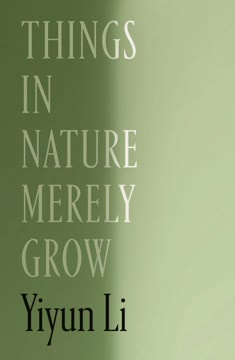
Things in Nature Merely Grow is Yiyun Li's devastating memoir about losing both her sons, Vincent (16) and James (19), to suicide seven years apart. Reviewers praise Li's austere, intellectually rigorous prose that emphasizes "radical acceptance" over traditional grief narratives. She focuses on thinking rather than feeling, presenting facts without sentimentality. While most find the restraint powerful and moving, some criticize her emphasis on intellectual credentials and lack of emotional vulnerability. The memoir explores language's inadequacy in expressing profound loss, the autonomy of her sons' decisions, and continuing to live without seeking closure or healing.