

Key Takeaways
Only 2% ever reach purpose by removing themselves from the equation
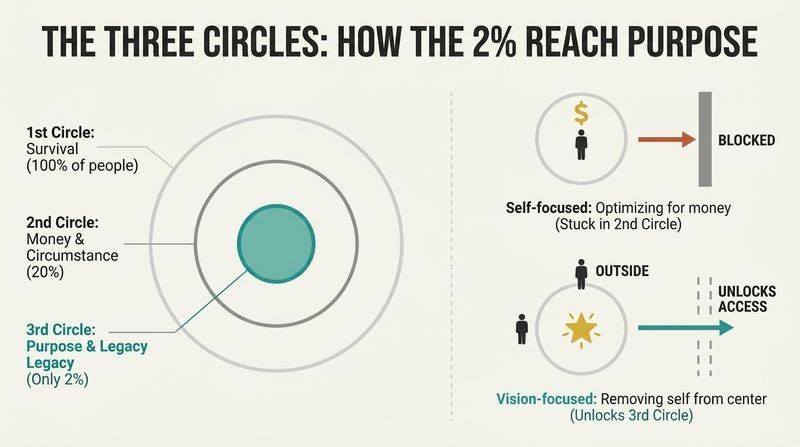
Purpose is the finish line, and almost nobody crosses it. Ghadimi's central claim is that human minds progress through three circles of awareness. Everyone is born into the First Circle, roughly 20% break into the Second, and only about 2% enter the Third, where purpose lives. The gatekeeping move is counterintuitive: you find your purpose not by asking what you want but by removing yourself from the center of your own story.
The difference is visible in who history remembers. Steve Jobs and Walt Disney are idolized decades after death, while the CEOs of Sony or Citigroup are forgotten despite equal or greater wealth. The forgotten ones optimized for money. The remembered ones optimized for a vision larger than themselves, using money merely as fuel.
The framing echoes Maslow's self-actualization and Viktor Frankl's logotherapy, which argued meaning comes from serving something beyond the self. What's distinctive here is Ghadimi's blunt hierarchy and the 2% figure, which functions more as motivational provocation than measured statistic. Skeptics will note survivorship bias: we canonize Jobs partly because Apple won, not purely because he was selfless (he was famously ruthless). Still, the core insight is durable and supported by research on eudaimonic versus hedonic well-being, which consistently finds purpose-driven people report deeper life satisfaction than pleasure-chasers, even at identical income levels.
You are a byproduct of your environment, but not its prisoner

Your baseline was chosen for you. Before you could reason, you absorbed your family's religion, money habits, fears, and definition of success. Children imitate behavior far more than they obey words, so your operating system was installed by watching, not choosing. Ghadimi argues this is why wealth is less about the money itself than the inherited behaviors: kids raised around people who cracked the code of success absorb better habits, not just bigger bank accounts.
Awareness is the escape hatch. The advantage isn't understanding your own environment, which you already know. It's studying environments you never lived in: how the poor actually survive, how the wealthy actually operate. Understanding other perspectives lets you manipulate your environment instead of being manipulated by it.
This maps neatly onto Bourdieu's concept of habitus, the deeply ingrained dispositions we inherit from our social class, and onto Bandura's social learning theory, which showed children imitate modeled behavior automatically. Ghadimi's practical twist is valuable: deliberately expose yourself to foreign environments to expand what you believe possible. The claim that religious upbringing is a disadvantage because it teaches you not to question authority is provocative and overstated; plenty of rigorous thinkers emerged from religious homes. The stronger, defensible point is that unexamined inheritance of any belief system, secular or sacred, narrows vision.
Opportunity favors the prepared eye, not the lucky or the faithful

Luck is mostly recognition. When you decide you want a specific car, you suddenly see that model everywhere. Ghadimi argues opportunities work identically: they surround you constantly, but you miss them because you haven't defined what you're looking for. Successful people don't get better odds from destiny. They train their awareness to spot and seize openings others walk past.
Confidence is the seizing mechanism. Recognizing an opportunity is half the equation; acting requires confidence, which he defines as self-belief earned through track record, distinct from arrogance (feeling superior without merit). When you blame faith for a missed break, the more honest diagnosis is often that you weren't prepared or lacked faith in yourself. He reframes the old formula: success is hard work meeting opportunity, and opportunity is a skill of perception.
Psychologist Richard Wiseman's decade-long luck research supports this directly. He found self-described lucky people were simply more observant and open, noticing chance opportunities that unlucky people, fixated on narrow goals, missed entirely. This is also the reticular activating system at work, the brain's filter that surfaces what you have primed it to notice. Ghadimi's confidence-versus-arrogance distinction is useful but slippery in practice, since the arrogant rarely diagnose themselves accurately. The framework risks minimizing genuine structural barriers: perception cannot conjure capital or dismantle discrimination. Preparation improves odds; it does not equalize a rigged starting line.
The First Circle traps followers who dream instead of act
Three stages keep most people stuck. The First Circle, where everyone starts, contains the Settler (complacent with small wins), and the Dreamer (chasing instant gratification without action). The Dreamer is where midlife crises and get-rich-quick scams thrive, because the mind wants shortcuts to a life it spent decades ignoring. Ghadimi argues most people never graduate this circle, remaining self-centered followers who believe the world revolves around them yet take no action.
Eight levers govern the exit: environment, belief, choice, fear, confidence, goals, entourage, and time. The decisive one is choice, especially the choice to stop being a survivor (living to see tomorrow) and become a builder (making each day count). A dream and a goal can be identical in content; the only difference is that a goal is backed by action and belief in your ability to reach it.
The Settler and Dreamer archetypes resemble Seligman's learned helplessness and the psychology of what researchers call maladaptive daydreaming, where fantasy substitutes for effort and quietly drains motivation. Ghadimi's insistence that inaction is itself a choice echoes existentialist Sartre: refusing to decide is a decision. The framework's weakness is its harshness toward the majority, labeling billions as passive followers, which underweights how poverty, trauma, and cognitive load genuinely sap the bandwidth required for long-term action. Research by Mullainathan and Shafir on scarcity shows scarcity itself taxes decision-making, complicating the tidy claim that anyone can simply choose to build.
Fear paralyzes because it is really fear of the unknown
Every fear traces back to missing information. Ghadimi distills fear into two types, rejection and failure, and argues both are ultimately fear of the unknown. A mechanic panics over a strange rash until a doctor names it; then the fear evaporates even though the rash remains. Reverse the roles and the doctor panics when his BMW breaks down. Fear isn't about the thing. It's about not knowing.
The cure is information, which builds confidence. Because fear feeds on the unknown, you dissolve it by gathering knowledge and practicing the feared act until it becomes routine. Public speaking terrifies until repetition makes the stage familiar. He notes fear also shapes life paths: those raised watching parents take bold risks inherit boldness, while the privileged often fear jeopardizing what was built, taking overly cautious paths.
Framing fear as an information deficit aligns with modern exposure therapy, the gold-standard treatment for phobias and anxiety, which works precisely by making the unknown known through repeated safe contact. It also resonates with the neuroscience of prediction error: the brain calms once it can accurately forecast outcomes. The model is elegant but incomplete. Some fears are hardwired and adaptive (heights, snakes) and no amount of information erases them, nor should it. And trauma-based fear often intensifies with certain kinds of exposure. Information is a powerful lever, yet Ghadimi underplays the somatic, bodily dimension of fear that pure knowledge cannot always reason away.
Curate your entourage: surround yourself with doers, never talkers
Your circle recalibrates what you believe is possible. As your goals grow, Ghadimi observes that your existing friends often can't follow, creating a painful but natural separation. This vulnerable gap is exactly where self-help gurus and multi-level-marketing schemes pounce, offering false friendship and shortcuts to people desperate to belong. The antidote is deliberately choosing an entourage of people who live the life you actually want.
Attitude matters more than shared interest. Many people love cars, but a Ferrari club and a classic-truck club attract different attitudes toward the same passion. Seek people whose approach to success mirrors what you want yours to be, and prioritize doers over talkers. A brilliant but arrogant mentor who always chooses himself may teach you as much damage as wisdom. The right circle lets you observe correct behaviors and graduate faster.
This is Jim Rohn's famous claim that you are the average of the five people you spend the most time with, and it has empirical backing. The Framingham Heart Study found that behaviors like obesity, smoking, and even happiness spread measurably through social networks, sometimes three degrees out. Ghadimi's refinement, that shared attitude trumps shared interest, is sharp and underappreciated. The caution worth adding: aggressively pruning friends who cannot keep up can curdle into instrumental, transactional relationships where people are valued only for their utility. Growth-oriented networks are powerful; treating humans purely as ladders is corrosive to the selflessness the book ultimately champions.
Money buys time, and chasing it endlessly is a hamster wheel
Reframe money as stored time. Ghadimi argues you never actually trade money for goods; you trade it for the time someone spent creating them, including the time they spent learning to create. Understanding this reveals what your own time is worth. The person who grasps money's relationship to time gains enormous leverage; the person who worships the paper itself becomes its prisoner.
Score-keeping reveals the circle. He contrasts Donald Trump, constantly publicizing his wealth, with Bill Gates and Richard Branson, who rarely appear to flaunt money. All are wealthy, but Trump keeps score with dollars (Second Circle) while Gates and Branson use money as fuel for a larger purpose (Third Circle). If $10 million didn't bring fulfillment, $20 million won't either. Roughly 20% of happiness comes from money; the other 80% comes from fulfillment.
The time-for-money reframe anticipates the popular philosophy of Your Money or Your Life, which teaches valuing purchases in hours of life energy. The 20/80 happiness split is directional rather than precise, but it rhymes with Kahneman and Deaton's finding that emotional well-being plateaus past a certain income while life evaluation keeps climbing, a nuance suggesting money's role is more layered than a single ratio. The Trump-versus-Gates contrast is rhetorically clean yet dated and debatable; philanthropy can itself become reputation-laundering and score-keeping by other means. The enduring insight is that money pursued as an end state never satisfies, because it was always a proxy for something deeper.
Master your emotions and you become dangerous to everyone around you
Emotional control is the Second Circle's central gate. Ghadimi treats uncontrolled emotion as the primary weakness that keeps people stuck. His prescription is radical: treat all incoming information, insults, bad news, criticism, as neutral data rather than personal attack. When someone bumps you in a crowd and you feel compelled to retaliate, that reflex is your ego, not your logic. The person who processes information without emotional reaction stays analytical, sees the full board, and cannot be easily manipulated.
Detachment reveals true value. He applies this even to love: if you would still support someone's cause when they were no longer your partner, your commitment is logical rather than merely selfish satisfaction. Controlling how emotionally hurt you allow yourself to become, he argues, is the single most valuable trait a person can possess, worth more than money, education, or raw ability.
This overlaps heavily with Stoicism, which Ghadimi nods to via Marcus Aurelius, and with the ancient distinction between events and our judgments about them. Modern cognitive behavioral therapy operationalizes the same move: the space between stimulus and response is where freedom lives. Emotional intelligence research by Salovey and Mayer frames this as regulation, one of EI's core branches. The danger in Ghadimi's framing is its coldness; describing the emotionally controlled person as dangerous and prizing detachment risks tipping from healthy regulation into suppression or alexithymia. Neuroscientist Antonio Damasio showed emotions are essential to good decision-making, not obstacles to it. The goal is integration, not amputation.
True leadership benefits followers first; manipulation benefits only you
The fork in the road is who benefits. At the leadership stage, Ghadimi says everyone learns to shape environments, which is a form of manipulation. The moral distinction is not whether you influence people but who gains. He points to military basic training: it breaks recruits down and rebuilds them stronger, and that manipulation serves the soldier. Effective leaders help followers lead themselves; manipulators mine their followers for profit.
Influence requires a shared platform. People only follow those who achieved something from a starting point similar to their own, which is why rags-to-riches stories inspire while inherited wealth bragging repels. Ghadimi describes hiring people who shared his values so he could predict and accelerate their growth, then admits this was still Second Circle behavior because he benefited first. Genuine leadership means putting people you once considered beneath you ahead of yourself.
The benefit-test cleanly separates servant leadership, a concept coined by Robert Greenleaf, from exploitation, and it dodges the naive pretense that leaders never manipulate. James MacGregor Burns drew a parallel line between transformational leadership, which elevates followers, and transactional leadership, which merely trades. Ghadimi's honesty about his own mixed motives is refreshing and rare in the genre. The unresolved tension is that the same techniques, reading people, shaping environments, building belief, are available to saints and con artists alike. Intent is invisible and self-reported, so followers are left judging leaders by long-run outcomes rather than stated motives, which is precisely how demagogues slip through.
Self-help books fail because they never change your environment
Awareness is transferable; transformation is not. Ghadimi, himself writing a self-help book, argues the industry mostly fails by design. A workout DVD helps people lose the first 10 pounds on motivation alone, but nine weeks later most have regained it because their fridge, habits, and environment never changed. Shows like The Biggest Loser work precisely because they remove people from toxic environments, impose a controlled one, and add a coach who reinforces missing habits.
A book can only trigger, never transform. He concedes his own pages cannot move anyone through the circles; they can only spark awareness. Real change requires someone in the Third Circle willing to enter your environment, expose their own vulnerability, and stay while you rebuild habits, one person at a time. Most gurus, he charges, are more excited about monetizing their program than about whether it works.
This is an unusually self-aware admission for the genre and it aligns with behavior-change science. B.J. Fogg and James Clear both argue environment design beats willpower, and Wendy Wood's habit research shows roughly 43% of daily actions are context-triggered automatic behaviors, not deliberate choices. Change the context, change the person. The critique of information-only interventions is well founded; meta-analyses of self-help reading show modest, often fleeting effects absent structural support. The irony Ghadimi embraces, selling a book that says books don't work, is disarming but also convenient, positioning his broader platform and coaching as the necessary next purchase. Readers should note the funnel even as they accept the underlying truth.
Break your comfort zone every few years by becoming a small fish again
Observation dulls with familiarity, so engineer disruption. Ghadimi notes Parisians aren't thrilled by the Eiffel Tower but love the Empire State Building; curiosity dies through repetition. Comfort and routine flatten your awareness and keep you stuck. His personal remedy: every four to five years he manufactures an unnecessary change, of city, job, home, or country, to force himself back into discomfort and sharpen his perception.
The pond metaphor. You start as a small fish, grow to dominate your pond, and then face a choice: stay big in a small world, or move to a larger pond and become small again, which forces new growth. He moved from Washington, DC, where he was a recognized big fish, to Boca Raton, Florida, one of the densest concentrations of wealth, instantly shrinking himself and expanding what he believed possible.
The deliberate discomfort strategy is backed by research on hedonic adaptation, the well-documented tendency to return to a baseline of satisfaction as novelty fades, and by the concept of desirable difficulty in learning, where added challenge improves long-term growth. Voluntary environmental change also correlates with cognitive flexibility; studies of people who live abroad show measurable gains in creativity and problem-solving. The obvious tension is with takeaway six's emphasis on cultivating a stable, aligned entourage: uprooting every few years strains exactly those deep relationships. Ghadimi's model suits a mobile, unattached striver more than someone anchored by family or community, a scope limit worth naming.
Ask what the world needs from you, then match your ability
The final act is subtraction of self. Reaching the Third Circle requires a genuinely uncomfortable disconnection: seeing that your problems are minuscule against the world, that if you died tomorrow the machine of society would replace your role within days. Ghadimi's test question is stark: if you died tomorrow, what would people remember you for, and who beyond family would tell your story? Finding purpose becomes asking what you can do to serve the world, then locating where your specific abilities meet that need.
Legacy is built, not inherited. He rejects the common belief that children are your legacy; they will build their own. He also distinguishes false fulfillment (writing a tax-deductible charity check) from real fulfillment (personally changing a life, like stopping to help a stranger fix a blown tire). Purpose cannot be proven right or wrong, but the energy of believing you've found it transforms how you live.
The framing recalls Ikigai, the Japanese concept of purpose at the intersection of what you love, what you are good at, and what the world needs, though Ghadimi tilts heavily toward the world's needs over personal passion. His distinction between writing checks and personal impact overstates the case: effective altruism research argues a well-directed donation can save more lives than hands-on volunteering ever could, so dismissing it as mere social responsibility undersells its power. Still, the psychological claim holds. Studies on generativity, Erik Erikson's term for the midlife drive to contribute to future generations, link it robustly to late-life well-being. Serving beyond the self is not just noble; it measurably heals the server.
Analysis
Third Circle Theory is a philosophy-flavored self-help manifesto built around a single developmental ladder: the First Circle (self-centered follower), the Second Circle (successful but money-driven achiever), and the Third Circle (purpose-driven visionary who removes the self from the equation). Ghadimi, a former banking executive turned entrepreneur, writes from lived experience rather than credentials, and openly disclaims scientific rigor. That honesty is both the book's charm and its limitation.
Structurally, the book is stronger as a diagnostic lens than as a prescriptive manual. Its most valuable moves are the reframes: opportunity as trained perception, fear as an information deficit, money as stored time, emotion as processable data, and leadership judged by who benefits. Each rhymes with established research the author never cites, from Wiseman's luck studies to Stoic philosophy to habit science, which suggests his intuitions were tracking real phenomena even without academic scaffolding.
The book's intellectual weaknesses are worth flagging. The 2% and 20% figures are rhetorical, not empirical. The three-circle hierarchy can feel elitist, dividing humanity into an enlightened few and a passive majority, which underweights structural barriers like poverty, trauma, and cognitive scarcity that genuinely constrain agency. Its celebration of emotional detachment flirts with cold instrumentalism, and its dismissal of religious upbringing is a blunt overreach. The recurring canon of Jobs, Disney, Edison, and Gates leans on survivorship bias.
Yet the central thesis is durable and unusually self-aware for the genre: lasting fulfillment comes from serving a vision larger than yourself, and no book or seminar can transport you there because transformation requires changing your environment, not just your information. Ghadimi even turns this critique on his own product. For a reader willing to separate the motivational hyperbole from the genuine insights, the framework offers a coherent, memorable map for interrogating why you do what you do, and whether it is what you would want to be remembered for.
Review Summary
Third Circle Theory receives mostly positive reviews, with readers praising its unique perspective on success and personal growth. Many appreciate the focus on purpose and selflessness rather than monetary gain. Reviewers find the book thought-provoking and life-changing, with concepts that challenge conventional wisdom. Some criticize the writing style and find it repetitive, while others consider it a must-read for entrepreneurs and those seeking personal development. The book's emphasis on self-awareness and serving others resonates with many readers, who find it a refreshing departure from typical self-help literature.
People Also Read




Glossary
Third Circle Theory
Three-stage model of mind evolutionGhadimi's central framework describing how the human mind evolves through three circles of awareness from birth to purpose. Everyone starts in the First Circle, roughly 20% reach the Second, and about 2% reach the Third. Each circle contains a distinct world, perspective, vision, and cycle, and progression comes through observation, experience, and mastering specific attributes.
First Circle
Self-centered follower stageThe starting circle everyone is born into, comprising three stages: the Birth, the Settler (complacent with small achievements), and the Dreamer (chasing instant gratification without action). Governed by eight attributes including environment, belief, choice, fear, confidence, goals, entourage, and time. Its residents are self-centered followers who believe the world revolves around them yet take little meaningful action.
Second Circle
Successful but money-driven achieverThe circle roughly 20% of people reach, comprising the Awakening, the Leader, and the Achiever. Marked by broadened perspective, self-education, leadership, and mastery of emotions. Its residents are accomplished, often wealthy professionals who keep score through money and remain self-focused, never defining their existence beyond accumulation.
Third Circle
Purpose-driven selfless visionaryThe circle only about 2% reach, comprising the Vision, the Purpose, and the Rebirth (its stages run in reverse because it is not about the self). Its residents remove themselves from the equation of life, use money as fuel rather than a goal, and pursue a vision larger than themselves. This is where purpose, defined as belief in something greater than oneself, is found.
Settler
Complacent First Circle stageA First Circle stage describing someone satisfied with modest achievement who accepts their situation and stops growing. Settlers maintain inherited beliefs, respect authority without question, show apathy toward wider society, and are easily influenced by advertising and commercial messaging.
Dreamer
Instant-gratification First Circle stageA First Circle stage where dreams and reality never meet. Dreamers grow bitter comparing themselves to more successful peers, chase quick fixes and instant gratification, and are prime targets for scams and self-help programs. They fantasize about accomplishments rather than taking action toward them.
Survivor versus Builder
Passive versus active life stanceGhadimi's contrast between two ways of living. A survivor spends each day merely hoping tomorrow improves and settles into comfort with small, quickly reached goals. A builder makes each day count more than the last, takes ownership of outcomes, and pursues high goals through action. Choosing to shift from survivor to builder is essential to graduating the First Circle.
FAQ
1. What is "Third Circle Theory: Purpose Through Observation" by Pejman Ghadimi about?
- Framework for Self-Discovery: The book introduces the "Third Circle Theory," a framework for understanding how individuals progress through different stages of awareness and purpose in life.
- Three Circles of Growth: It explains three distinct "circles" or phases—First Circle (self-centered survival), Second Circle (achievement and leadership), and Third Circle (vision and selfless purpose).
- Purpose Through Observation: The core message is that by observing oneself and the world, one can find their true purpose and move beyond self-interest to make a meaningful impact.
- Critique of Self-Help Industry: Ghadimi critiques the self-help industry’s focus on money and quick fixes, advocating instead for deep, personal transformation.
- Practical and Philosophical: The book blends practical advice with philosophical insights, aiming to help readers understand their environment, beliefs, and actions to achieve fulfillment.
2. Why should I read "Third Circle Theory: Purpose Through Observation" by Pejman Ghadimi?
- Find Your Purpose: The book offers a systematic approach to discovering your life’s purpose, moving beyond superficial success.
- Understand Human Potential: It provides insights into why some people become innovators and visionaries while others remain stuck in cycles of mediocrity.
- Self-Reflection Tools: Readers are given tools and frameworks to analyze their own beliefs, fears, and choices, leading to greater self-awareness.
- Break Free from the Rat Race: Ghadimi explains how to escape the endless pursuit of money and instead focus on fulfillment and legacy.
- Applicable to All Stages: Whether you’re just starting your journey or seeking deeper meaning, the book’s concepts are relevant to anyone interested in personal growth.
3. What are the key takeaways from "Third Circle Theory: Purpose Through Observation"?
- Three Circles Model: Personal evolution occurs in three circles—First (self-survival), Second (achievement/leadership), and Third (vision/purpose).
- Observation Drives Growth: Awareness and observation of your environment, beliefs, and actions are crucial for advancement.
- Purpose Over Money: True fulfillment comes from finding and living your purpose, not just accumulating wealth or status.
- Selflessness is Key: The highest level of existence is reached when you remove yourself from the center and focus on helping others.
- Action and Choice: Progress is determined by conscious choices and consistent action, not by luck or external circumstances.
4. How does Pejman Ghadimi define the "Three Circles" in the Third Circle Theory?
- First Circle – Survival and Self: This stage is about self-centeredness, survival, and being a product of your environment, with limited vision and goals.
- Second Circle – Achievement and Leadership: Here, individuals awaken to broader perspectives, seek achievement, lead others, and often focus on money and recognition.
- Third Circle – Vision and Purpose: The final stage is characterized by selfless vision, a drive to create lasting impact, and the removal of ego from decision-making.
- Progression is Not Linear: Not everyone moves through all circles, and progression depends on awareness, experience, and willingness to change.
- Few Reach the Third Circle: Only about 2% of people reach the Third Circle, according to Ghadimi, where true purpose and legacy are realized.
5. What are the main components and obstacles of the First Circle in "Third Circle Theory"?
- Environment Shapes You: Your upbringing, surroundings, and early influences largely determine your beliefs and behaviors.
- Belief and Choice: Beliefs are formed from observed experiences, and making conscious choices is essential for growth.
- Fear and Confidence: Fear of failure and rejection are major obstacles; building confidence through experience is necessary to move forward.
- Goals and Entourage: Setting goals and surrounding yourself with the right people are critical steps, but many remain stuck due to complacency.
- Time Perception: Misunderstanding the value of time leads to wasted potential and keeps individuals trapped in the First Circle.
6. How does the Second Circle differ from the First Circle in "Third Circle Theory"?
- Awakening and Curiosity: The Second Circle begins with an awakening—questioning previous beliefs and seeking new knowledge.
- Leadership and Achievement: Individuals become leaders, achieve success, and often influence others, but may still be self-centered.
- Mastering Habits and Emotions: Success in this circle requires developing proactive habits, emotional intelligence, and self-motivation.
- Manipulation vs. Helping: Leadership can take the form of manipulation for personal gain or genuine help for others; intention matters.
- Perception Management: Understanding how others perceive you and managing that perception becomes important for influence and progress.
7. What characterizes the Third Circle in Pejman Ghadimi’s "Third Circle Theory"?
- Vision Beyond Self: Individuals in the Third Circle develop a vision that transcends personal gain, focusing on broader societal impact.
- Purpose and Legacy: Purpose is defined by selfless action and the desire to leave a meaningful legacy, not just personal achievement.
- Rebirth and Selflessness: The "rebirth" stage involves removing oneself from the center, acting for the greater good, and achieving inner peace.
- Emotional Mastery: Complete control over emotions and detachment from ego are hallmarks of this stage.
- Very Few Attain It: Only a small percentage of people reach this level, as it requires deep self-awareness and consistent selfless action.
8. How does "Third Circle Theory" by Pejman Ghadimi critique the self-help industry?
- Focus on Money: Ghadimi argues that most self-help programs focus on making money, not genuine personal transformation.
- Short-Term Motivation: These programs often provide temporary motivation but fail to create lasting behavioral change.
- Preys on Dreamers: The industry targets those stuck in the First Circle, offering quick fixes that rarely work.
- Lack of Environmental Change: True change requires altering one’s environment and habits, which books and seminars alone cannot provide.
- Real Help is Rare: Genuine help comes from those who have reached the Third Circle and are willing to invest in others’ growth selflessly.
9. What practical advice does Pejman Ghadimi offer for progressing through the circles in "Third Circle Theory"?
- Increase Awareness: Continuously observe and question your environment, beliefs, and actions to gain new perspectives.
- Embrace Change: Regularly break your comfort zone by changing routines, environments, or social circles to stimulate growth.
- Develop Emotional Intelligence: Learn to control your emotions, make logical decisions, and detach from ego-driven reactions.
- Take Consistent Action: Progress is achieved through deliberate choices and persistent effort, not by waiting for opportunities.
- Focus on Helping Others: Shift your motivation from self-gain to serving others, which accelerates advancement to the Third Circle.
10. How does "Third Circle Theory" by Pejman Ghadimi define the difference between fulfillment and purpose?
- Fulfillment is Temporary: Fulfillment can come from achievements, donations, or helping others, but may not be lasting or deeply meaningful.
- Purpose is Selfless and Enduring: Purpose is found when actions are driven by a vision greater than oneself, leading to lasting impact and inner peace.
- False Fulfillment: Acts like donating money may create a fleeting sense of fulfillment but do not equate to living with purpose.
- Personal Impact Matters: True fulfillment and purpose arise from direct, personal impact on others’ lives, not just financial contributions.
- Purpose Validates Existence: Living with purpose gives meaning to one’s life and legacy, beyond material success.
11. What are the most important quotes from "Third Circle Theory: Purpose Through Observation" and what do they mean?
- “Purpose is ultimately the catalytic energy we need to see our vision and ideas come to life.” – Purpose fuels action and innovation, making ideas a reality.
- “You are the sum of your values, beliefs, and the environments you absorb.” – Your identity is shaped by what you observe and internalize from your surroundings.
- “There is no right or wrong here, but rather only two different ways to look at the exact same thing.” – Perspective is subjective; understanding this is key to growth.
- “Success = Good Choices or Failure = Bad choices” vs. “Choice + Action = Success” – The first is a passive, reflective mindset; the second is proactive and empowering.
- “Only those individuals who become legendary will end up establishing their purpose as entertainers, icons, role models, etc.” – True legacy is built by those who act selflessly and impact society.
12. How can readers apply the lessons from "Third Circle Theory: Purpose Through Observation" by Pejman Ghadimi to their own lives?
- Self-Assessment: Regularly evaluate which circle you are in by examining your motivations, actions, and level of self-awareness.
- Seek Diverse Experiences: Expose yourself to new environments, people, and ideas to expand your perspective and break limiting beliefs.
- Prioritize Selfless Action: Shift your focus from personal gain to helping others and contributing to something greater than yourself.
- Practice Emotional Mastery: Work on controlling your emotions and making decisions based on logic and long-term vision.
- Commit to Lifelong Growth: Understand that progression through the circles is ongoing, requiring continuous observation, learning, and adaptation.
Download PDF
Download EPUB
.epub digital book format is ideal for reading ebooks on phones, tablets, and e-readers.








