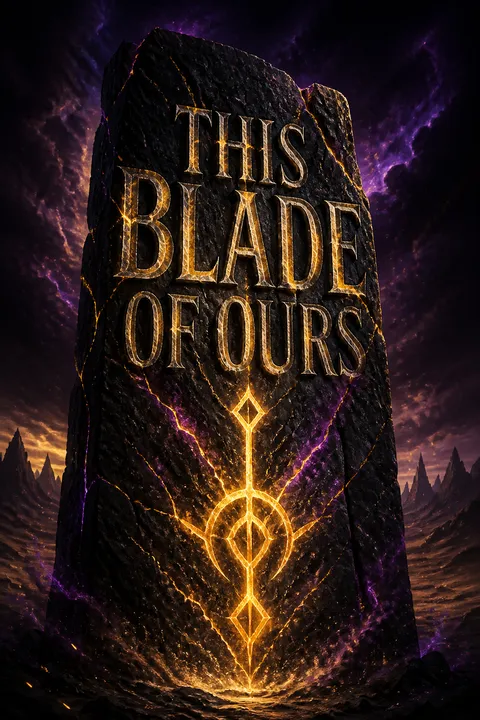


Plot Summary
Prologue
A woman rides through the Xārōmand Desert to find a hidden temple where the Seers once read possible futures. She cuts her palms and draws the dangerous rune for Time, forcing open the mountain entrance before the magic drains her life.
Inside, she summons Faragathe, a goddess once burned for her prophecies, and offers her a chance to reclaim the recognition history denied her. The woman asks Faragathe to bring Edessa to ruin. The goddess accepts her allegiance, setting a buried grievance loose upon the living world.
The prologue makes political resentment feel both intimate and cosmological. The summoner does not seek power merely to rule; she wants a forgotten woman restored to history and a corrupt capital made to answer for its choices. Yet her demand turns recognition into vengeance, inviting a goddess whose sense of justice may not distinguish the guilty from everyone caught nearby. The scene also plants the novel’s central danger: a mortal can call on history’s wounds, but cannot control what answers.
The Hearing Turns
Eight months after the Great Unraveling, Petitor Sarai stands before an Inquisitorial Hearing demanded by Aelius’s supporters. They accuse her of killing the former Head Tetrarch unlawfully, serving Ruin, and relying on her lover, Magus Supreme Kadra. Sarai counters by exposing the wealth Aelius diverted to his own Quarter and the Order’s forbidden probing of witnesses’ memories.
When an Inquisitor loses his temper and denounces her, she examines him with magic, proving that his accusations conceal political greed. The Hearing ends with the Order acknowledging that her account of the Unraveling is true. Sarai wins the room, but the crowd’s shifting support leaves her exhausted and newly aware that justice can become another performance.
Sarai wins not by making the audience morally wiser, but by turning the Order’s own methods into evidence against it. Her success depends on understanding public attention as a political resource, a skill she has gained without formal education. Yet the Hearing’s outcome does not dissolve the conditions that produced the accusation. The crowd follows a persuasive display, not a settled principle, and Sarai understands that its approval may reverse with the next crisis. Her victory is therefore both a demonstration of agency and a warning that truth must keep competing for an audience.
Scholarships And Shadows
The morning after the Hearing, Inquisitor Silvus warns Sarai that the Order had prepared to force an exorcism on her if she lost. Later, a man in gray-green robes appears near Kadra’s tower and speaks with a voice that makes her forget their encounters. Sarai senses something missing but cannot hold on to the memory.
At the Academiae’s winter graduation, Kadra breaks with Cassandane’s cautious plan to preserve appearances. He announces free entrance exams, scholarships for successful applicants, and money for every graduate. The change earns cheers from students and fury from the Guilds. Kadra sends Sarai evidence of a secret grain store, giving them a reason to meet after weeks of strain and making reform an immediate, dangerous act.
The section places two forms of power beside each other. Kadra uses wealth and public office to widen access to education, while the unseen Coercer quietly interferes with Sarai’s ability to know what has happened to her. One expands choice; the other removes it without leaving a visible wound. Kadra’s announcement also reveals the cost of gradualism: Cassandane wants to preserve the government long enough to change it, while Kadra accepts the risk of provoking its enemies now. Sarai is caught between these strategies, carrying the consequences of both.
Grain Under Blood
Sarai and Kadra approach the Grains Guild’s hidden horreum, expecting to find supplies withheld from the starving north. Instead, footprints lead into the building but none back out. Inside, they discover Guild workers dead in a corridor, their faces fixed in terror and their bodies drenched in blood. A woman with a shattered skull is still alive long enough to blame Sarai for a coming reckoning before dying.
Sarai examines the corpse and finds the woman’s heart and brain destroyed, with traces of whitesleep but no clear cause. Kadra identifies a possible link to the dangerous drug, while the scene’s unnatural violence leaves them without a usable explanation. The first investigation becomes a crisis the city cannot quietly contain.
The horreum overturns the expected shape of a political investigation. The Guild’s hoarded grain is a concrete injustice, but the dead workers turn it into something more difficult than proof of corruption. Sarai is confronted with victims who belong to an institution she opposes, and their dying accusation immediately makes public blame part of the crime scene. Her decision to investigate the body despite her trauma shows that compassion and professional duty remain active even when others exploit them. The unexplained damage to heart and brain also marks a limit: Sarai can examine evidence, but not yet interpret the force behind it.
The Plague Crosses South
At a public court session, Sarai and Kadra hear a case involving Junia and Lucanus, who admits that he brought boil beetles back from a visit north. Their larvae have spread through a whitesleep den, and the disclosure sends the marketplace into panic.
Soon afterward, more infected people and corpses appear, their bodies marked by welts and beetles. Sarai recognizes that the northern riots, plague reports, and grain shortages may share a source, while a letter from her abusive hometown demands aid.
She decides to travel north with the Bridger Méherre, whose portals can shorten the journey. Kadra stays in Edessa to investigate the drug dens and protect the government. Their separation is strategic, but it deepens the strain already growing between them.
The plague makes geography political. The south has treated northern suffering as distant until infected people and frightened crowds carry it into Edessa. Sarai’s departure is not a retreat from her work but a correction to its narrow focus: she recognizes that governing only the capital has allowed the wider country’s crises to connect beyond anyone’s notice. At the same time, her choice exposes a painful habit in both lovers. Sarai assumes she should carry danger alone, while Kadra tries to protect her by withholding what he knows. Their intimacy is strong, but their methods of care keep producing distance.
Arsamea’s Borrowed Justice
In Arsamea, Sarai finds that eleven men have died after taking whitesleep. The villagers blame poor people hiding in tunnels, then reveal that they threw those people from a mountain road.
Sarai realizes the supposed poisoning is impossible: the drug must be rubbed on the eyelids, and the town’s women have been dosing their tormentors. The perpetrators show the same blank, enlarged eyes seen among Edessa’s victims.
In Sal Flumen, former Cleric and Praetor Florus describes similar killings across the upper north, carried out by ordinary people retaliating against those who abused them. He argues that the law has failed them. Sarai rejects his defense of murder, but his account confirms that the deaths are spreading beyond the beetle plague.
The northern murders force Sarai to distinguish understanding from approval. The women of Arsamea have reasons for their actions, and the victims had power over them, but their retaliation also killed people who were not responsible for the original harms. Florus’s defense makes the law’s failures visible without making violence harmless. Sarai’s old belief that better process can repair injustice begins to weaken, though she refuses the opposite conclusion that only killing can correct it. The recurring blackened eyes suggest an influence that exploits real grievances, turning an understandable desire to resist into a machinery of indiscriminate punishment.
Noceo’s Stolen Face
In Komis, Sarai enters an infected farmer’s memory and sees a pale man named Noceo order Guild magi to call down lightning, destroying a market and concealing the event from witnesses. She later recognizes the same man posing as Inquisitor Silvus. Noceo identifies himself as Kadra’s brother and takes Sarai through a portal to the ruined Clan Kader manor.
He offers her power, then uses Coercion to force her to kneel, crawl, and repeat that she is worthless. When he returns her to the market, he compels Guild magi to strike again. Sarai warns Méherre and escapes the worst of the blast, but a collapsing section of Komis’s wall pins her beneath rubble. The attack leaves hundreds dead and Sarai’s whereabouts unknown.
Noceo weaponizes the very wound Sarai has spent the novel trying to outgrow: the belief that power is the only way to make others listen. His offer is seductive because it names a real need, but his method reproduces the coercion he claims to oppose. Making Sarai crawl is not merely physical domination; it is an attempt to dictate the meaning she assigns to herself. Her warning to the market, even under compulsion, shows that her care for others survives the assault. The rubble then makes vulnerability literal, leaving her alive but unable to control whether anyone will find her.
The Aequitas Falls
Believing Sarai may be dead, Kadra accepts the power offered by Wrath, the god of violence, in exchange for service after death. Sarai is rescued from the rubble and arrives in Edessa as the Order attempts to depose the Tetrarchy. She identifies Noceo as the northern leader behind the coup, and he reveals his connection to Kadra before compelling the crowd to kneel.
Then he orders lightning magi to attack the Aequitas. Kadra uses his new strength to shield the tiers and hold the courthouse together while people escape. Gaius is gravely wounded by falling marble, and Kadra and Sarai work together to keep him alive. The courthouse finally collapses, but Kadra carries Gaius out and finds Sarai alive.
Kadra’s choice is made under grief, not ambition. He accepts a bargain with a god because he cannot bear the possibility of losing Sarai again, yet the power he gains is immediately tested against a public duty that could consume him. The courthouse becomes the physical form of the government’s crisis: it is both a site of political legitimacy and a structure collapsing under the violence staged inside it. Kadra’s rescue of the crowd matters more than preserving the building. His alliance with Sarai in saving Gaius also briefly replaces the pattern of protection at a distance with shared action.
A Name Beneath The Ash
After the destruction, Sarai tells Kadra that she knows his real name is Drenevan and that he belonged to Clan Kader. He admits he was raised by the violent Clan, began killing as a child, and created whitesleep as an analgesic while trying to ease his back pain. Their painful conversation brings them closer, though not every secret is settled.
They return to the Grains Guild horreum and find a hidden staircase beneath the bloody corridor, leading to a secret ibez den where the first victims appear to have been terrorized before dying. At a hospital, a wounded attacker wakes screaming about eyes and a reckoning. Sarai and Kadra realize the madness seizes people after unconsciousness, whether caused by drugs, injury, or sleep.
Kadra’s confession reframes his severity without erasing his responsibility. His violence began as adaptation to a world that punished weakness, and his drugmaking began as an attempt to relieve pain, but origins do not settle the moral meaning of what followed. Sarai’s willingness to hear him depends on her seeing him as a person rather than a symbol of guilt. Their investigation likewise shifts from identifying a substance to identifying a condition: unconsciousness is the point at which the unknown force takes hold. The clue links private nightmares to public catastrophe and makes sleep, normally a refuge, an exposed threshold.
The Brother’s False Memory
Sarai meets Dalvia, a guarded northern heir and healer, who helps arrange a private encounter with Noceo. At the morgue, Sarai probes his memories and discovers that their shared past is built on a lie. Their father killed Parvine, the girl Noceo loved, and Noceo later murdered her sister Finaze when she demanded answers.
He then tried to kill Kadra during their escape, convinced his brother had abandoned him. Kadra survived and left him behind, while Noceo reshaped the memory until he could see himself only as the betrayed victim. Sarai confronts him with the evidence. Noceo cannot sustain his claim or his ambition, and he abandons his coup. The truth does not undo his crimes, but it breaks the story that kept them alive.
Noceo’s memories reveal how self-justification can function as emotional anesthesia. He has turned a chain of choices, grief, and fear into a single account in which he is always the person acted upon. Sarai does not excuse him once she understands his pain; instead, she insists that understanding must include the moments when he chose to harm others. Her use of the Petitor’s power becomes an ethical intervention, forcing a private fiction into public reality. The reversal is significant because it ends Noceo’s political certainty without pretending that insight alone can repair the people he damaged.
The Institute’s Prisoners
Noceo gives up the stimulant that has amplified his Coercion and leads the group to the Am Semni Institute. Sarai finds the hospital’s wards unused despite the reports that Dalvia has been treating plague victims. In the basement, she discovers those patients locked in cells with swarms of beetles, many already dead.
The group realizes that Dalvia has been cultivating the infection rather than curing it. Her apparent ally Méherre vanishes, and the others are driven into a supernatural crisis as Faragathe’s influence spreads through Edessa. The evidence links the drug supply, the beetle plague, and the mass nightmares, while Noceo’s power proves to have been only one part of a larger design.
The Institute transforms care into its opposite. A hospital, trusted because it promises treatment, has been made into a site where vulnerable people are kept alive only as instruments. This revelation complicates the novel’s repeated distinction between power and helplessness: Dalvia’s access to healing and travel has not freed her from the past, but she has used those abilities to inflict harm. The group’s discovery also corrects its assumptions about Noceo. His coup is brutal, yet it cannot explain every catastrophe. The mystery’s remaining force is not merely political, and the characters must face a threat that operates through human pain and supernatural terror.
Faragathe’s Offer
Faragathe draws Sarai and Kadra into visions of Sidran Tower, where Sarai once fell and nearly died. The goddess offers Kadra a life for Sarai’s, promising her safety if he gives up Edessa. Kadra refuses and tears his way out of the dream. Faragathe then offers Sarai overwhelming magical power in exchange for the city; Sarai rejects it because security purchased with other people’s lives would make her another tyrant.
The Bridger Méherre is revealed as Dalvia, a True Illusionist who has acted as Faragathe’s partner and used the beetle victims to strengthen Noceo. Dalvia releases Anek, refuses the possibility of a new life, and asks Faragathe to take her. When goddess and woman vanish, the mass nightmares stop.
The climax gives each central character a choice that exposes the desire beneath their public actions. Kadra must decide whether love authorizes him to abandon a city; Sarai must decide whether safety justifies taking power without limits; Dalvia must face the gap between her longing to repair the world and the violence she has chosen. Sarai’s refusal is not a rejection of power itself, but of power detached from accountability. Dalvia’s departure ends the immediate terror, though it does not convert her into an innocent victim. The novel preserves the discomfort of compassion when accountability and suffering occupy the same person.
A Formula In Flames
With the madness-struck waking and the immediate crisis ending, Sarai returns to Dalvia’s abandoned study. There she finds the formula for the stimulant that could raise her magical strength, but she sees that using it could make the desperate pursuit of security harder to resist. Sarai burns the pages rather than inherit a power built from beetle venom and suffering.
Kadra, newly honest about his past and his bargain with Wrath, asks her to bind her future to his. She accepts, not because the world has become safe, but because their relationship can now make room for truth rather than guilt-driven protection. Their private commitment arrives amid the wreckage of the political order they are still responsible for rebuilding.
Burning the formula is a decision about the kind of person Sarai wants to remain, not a declaration that strength is inherently corrupt. She knows the appeal of an ability that could end arguments and force respect, especially after years of being dismissed. The danger lies in the gradual conversion of protection into control. Her choice therefore gives concrete form to a hard-won distinction between agency and domination. Kadra’s proposal answers the same problem relationally: he offers himself without asking Sarai to carry his guilt or prove her loyalty. Love becomes a commitment to shared knowledge, not a cure for political violence.
A Country Rebuilt
In Komis, the Tetrarchy puts Guildmasters on trial for worsening northern shortages and refusing to share resources fairly. They are found guilty, but Kadra turns them over to the furious crowd, which kills them in a burst of vengeance that echoes the violence the new government claims to restrain. Noceo awaits trial for his own crimes.
Kadra visits him in prison, hears his fear that he does not know how to live, and promises to keep track of him. The Tetrarchy is then dissolved in favor of a council representing northern and southern interests. Harion wins election, Cassandane becomes Head Councilor of the South, and Kadra retains a council seat. Noceo receives twenty-five years in the mines.
The political settlement is deliberately imperfect. The Guildmasters’ crimes are finally prosecuted, but the crowd’s killing of them demonstrates how quickly public justice can become spectacle and revenge. Kadra’s decision to yield them to the mob leaves that contradiction unresolved rather than disguising it as a clean victory. The new council changes representation and resource rules, but it cannot instantly erase centuries of extraction or mistrust. Noceo’s prison conversation offers a different model of consequence: he must live with what he has done rather than receive an easy death. Rebuilding is shown as institutional work, not moral purification.
Epilogue
At the spring equinox, a year after Sarai’s Robing, the new Council of Ur Dinyé is still wrestling with Guild reform and north-south distrust. Sarai and Kadra plan to travel, while their friends gather at Cato’s tavern. Noceo has been sentenced to twenty-five years in the mines, and Gaius has recovered enough to join them.
Their lives remain public, difficult, and unfinished. Yet Sarai and Kadra can now call each other partners without hiding the histories that shaped them, and Kadra finds a home not in office or power but among the people who chose to stay.
The closing gathering makes political repair visible at human scale. Elections, laws, and Guild reforms matter, but the final measure of change is whether people who have survived violence can eat together without pretending their past has vanished. Kadra’s authority remains intact, yet his sense of belonging no longer depends on controlling a country or earning absolution. Sarai’s future likewise includes work and ambition without surrendering her judgment to the promise of effortless power. Their friends’ ordinary company is not a perfect peace; it is a practice of trust, renewed after public catastrophe.
Analysis
This Blade of Ours treats political violence not as a sudden rupture but as an inheritance that moves through institutions, families, and private habits. The north’s poverty, the Guilds’ monopoly, the Order’s authority, and Kadra’s history within Clan Kader all show how systems teach people what kinds of coercion are acceptable. Noceo’s command magic makes domination literal, but the novel repeatedly shows less spectacular forms of it: a hearing designed to discredit Sarai, a resource contract that keeps northern workers dependent, and a lover’s protective silence that denies someone the knowledge needed to choose.
Sarai’s development turns on separating care from self-erasure. She repeatedly takes the burden of public blame, investigates suffering even when it retraumatizes her, and risks her life to keep others from being abandoned. Yet she learns that empathy does not require excusing harm, and that power cannot be judged only by the good its holder intends. Her refusal of the stimulant is therefore not passivity. It is a decision to preserve judgment when the promise of immediate control is most appealing.
Kadra and Noceo form a dark parallel. Both were shaped by abuse, both learned to survive by anticipating violence, and both struggle to imagine a life not organized around the next threat. Their difference lies less in suffering than in how each handles responsibility. Kadra tries to make institutions serve people, though guilt can make him secretive and self-punishing. Noceo turns his grievance into permission to control others. Sarai’s love does not absolve Kadra; it gives him a relationship in which truth and accountability might replace isolation.
The ending refuses a clean political cure. The Tetrarchy gives way to broader representation, but Guildmasters are killed by a crowd, exposing how readily justice becomes revenge when trust has collapsed. Noceo’s sentence, the council’s reforms, and the friends’ final gathering offer different kinds of unfinished repair. The book’s hard lesson is not that people simply deserve or do not deserve another chance. It is that change requires limits, truthful memory, and institutions that do not ask the injured to bear the entire cost of everyone else’s transformation.
Review Summary
Characters
Sarai
Northern truth-seekerA former northern barmaid who serves as a Petitor, Sarai can detect lies, enter memories, and make those memories visible. She is observant, stubborn, and deeply responsive to other people’s pain, though she often treats self-sacrifice as the price of being useful. Her work brings her into conflict with religious authorities, powerful Guilds, and the public whose trust she is trying to earn. Sarai’s central struggle is to defend her own agency without mistaking force for safety. She loves Kadra, but wants partnership rather than protection that keeps her in the dark.
Kadra
Fearsome reforming magistrateKadra is Magus Supreme, a formidable lightning magus, and a leader whose harsh reputation sits beside a private capacity for tenderness. He is strategic, controlled, and accustomed to using violence when he believes the law protects the powerful. His damaged body and guarded past shape a habit of enduring pain rather than asking others to share it. Sarai unsettles that habit by seeing both his brutality and his vulnerability. Kadra wants to rebuild a country that rewards injustice, but his instinct to protect Sarai through silence risks repeating the control he opposes.
Noceo
Ambitious northern CoercerNoceo is a powerful Coercer, able to use his voice to compel others, and an ambitious figure with deep roots in the north. His intelligence and charm make him dangerous in rooms where trust is already scarce. He wants influence that cannot be taken away, and he believes fear can produce the order ordinary politics cannot. Beneath that drive lies a history of loss and betrayal that he struggles to face honestly. Noceo’s capacity to understand pain does not guarantee compassion; he can recognize another person’s weakness and still choose to exploit it.
Dalvia Am Semni
Guarded northern healerThe last Clan daughter of Am Semni, Dalvia is a healer with access to the medical learning of her family’s institute. She is quiet, watchful, and uncomfortable with attention, traits shaped by a life in which security has depended on staying useful to more powerful people. Her experience gives her a sharp understanding of how institutions neglect the vulnerable, but it also leaves her uncertain whether freedom can exist without control. Dalvia’s relationship with Noceo is marked by loyalty, fear, and an old desire to escape the conditions that formed them both.
Cassandane
Cautious Head TetrarchCassandane is the first woman to lead the Tetrarchy as Head Tetrarch. Shrewd and politically disciplined, she understands that public confidence can determine whether reform survives. Her caution is not simple timidity: she has to govern while others question her right to do so. She values Sarai and Kadra, yet pressure from the Guilds and religious authorities often forces her to choose between immediate justice and keeping the government intact.
Anek
Neutralis justice-seekerAnek is a neutralis Petitor and one of Sarai’s closest allies. Their sharp humor helps puncture the self-importance of officials, while their investigative skill makes them a steady presence in dangerous situations. Anek cares about fairness but has little patience for those who use principles as a cover for cruelty. They are also attentive to the personal costs of political life, offering Sarai support without treating her as fragile.
Harion
Insecure elected TetrarchHarion is a young Tetrarch whose wit often serves as cover for insecurity and hunger for status. He has learned to mimic the manners of people who hold power, even while resenting their control over him. His political instincts can be self-serving, but he is capable of recognizing practical truths when the country’s survival is at stake. His presence keeps the governing circle from becoming a simple contest between heroes and villains.
Gaius
Kadra’s steadfast right handGaius leads Kadra’s vigiles and serves as his trusted adviser. Practical, loyal, and attentive to the people around him, he is one of the few figures who can speak to Kadra without ceremony. His steadiness is built from years of working in a violent political system without surrendering his sense of honor. Gaius also recognizes that the Tetrarchy’s limited information about the north is a serious weakness.
Faragathe
Wretched Seer of SleepFaragathe is a goddess associated with sleep, fear, and visions. Once a human devotee of Time, she survives in religious memory as a figure condemned for speaking truths powerful people wished to suppress. Her vast distance from ordinary human feeling makes her difficult to approach through familiar ideas of mercy. Faragathe regards nightmares as a means of exposing what people hide from themselves, but her sense of judgment is not constrained by the limits mortals place on justice.
Silvus
Veiled InquisitorSilvus is a northern Inquisitor whose intelligence and restraint distinguish him from the more openly dogmatic members of the Order. He understands the institution’s influence across the country and speaks with the confidence of someone who has learned to read political patterns. His warnings to Sarai complicate her view of the Order, but his insight does not make him an uncomplicated ally.
Florus
Praetor and former ClericFlorus governs Sal Flumen after serving as a Cleric. His long experience with both religious authority and civic law has made him skeptical that official remedies can repair every wrong. He is gracious in manner and unsettling in his willingness to defend private vengeance as divine judgment. Through Florus, Sarai sees how easily an injured population can decide that the law no longer deserves its loyalty.
Marus
Abusive hometown chieftainMarus leads Arsamea and treats Sarai’s ambition as an insult to the village’s hierarchy. His hostility reflects a community that expects women and the poor to accept the limits imposed on them. He uses the language of obligation to demand service from someone he has never respected.
Cato
Kadra’s loyal guardianCato is an Illusionist and a warm, protective presence in Kadra’s household. He offers practical care without demanding explanations, and his loyalty gives Kadra a rare connection that is not based on political exchange. Cato’s calmness also helps others see the human costs beneath Kadra’s severe public manner.
Telmar
Sarai’s demanding mentorTelmar is a former alcoholic, lightning magus, and teacher who trains Sarai in magic and self-defense. Blunt and exacting, he treats her as a capable student rather than a political symbol. His lessons give her practical tools, while his historical knowledge helps her recognize how conflicts grow from long-standing systems rather than sudden omens.
Parvine Poxtan
Komis baker’s daughterParvine is the daughter of a baker in Komis and a young woman who forms a connection with Noceo. Her presence offers a glimpse of the tenderness he wants but cannot protect from the violence surrounding his family. Her sister Finaze is fiercely protective of her.
Plot Devices
Petitor magic
Truth made visiblePetitors can test whether someone is lying, enter a person’s memory, and project memories for others to see. Sarai uses these abilities to expose false political accusations, examine victims, identify Noceo in a farmer’s recollection, and force Noceo to confront his own distorted account of the past. The magic gives her unusual access to truth, but it does not tell her what truth means or what justice should require. Probing is also invasive, so each use places her in a conflict between public accountability and a person’s right to their own mind.
Runes and Thresholds
Magic has a bodily costMagi draw on life-linked power by activating runes, often through blood and a runic armilla. Thresholds regulate how much power they can use; opening a higher one can make a spell possible but risks exhaustion, injury, or death. This system shapes Sarai’s investigations, Kadra’s lightning, Noceo’s Coercion, and the stimulant that temporarily amplifies magical ability. It keeps power from being abstract: every act of force is paid for by a body, and characters must decide whether the immediate advantage is worth the damage it may leave behind.
Bridging and Illusion
Distance and identity bendBridgers open portals only to places they have previously visited, making them valuable for travel and dangerous during a fight. True Illusionists can alter their appearance convincingly, allowing a person to pass through political and social spaces under another face. Together, these powers accelerate Sarai’s journey north and complicate her ability to know who is helping her. Their strategic value becomes especially important in a country whose information travels slowly and whose guarded locations are protected by wards.
Whitesleep and beetles
Pain relief becomes a vectorWhitesleep is a drug rubbed on the eyelids, used for relief or euphoria, and made with boil beetle venom. Its circulation through northern settlements and Edessan dens connects addiction, the spread of larvae, and the mysterious deaths. The drug is not simply a villainous substance: diluted whitesleep can help people endure pain, while concentrated use can destroy them. Its history also ties Kadra’s childhood to the present crisis, turning a remedy he once devised into evidence of how inventions become entangled with the systems that distribute them.
Summoning and incursion
A god leaves a woundA Summoning draws a god into the mortal world through costly runic magic. The act can leave the surrounding place vulnerable to further supernatural influence, even after the god departs. Sarai’s earlier Summoning of Death therefore matters beyond the moment it saved Kadra: it helps establish the possibility that divine attention can linger and alter ordinary reality. The novel uses this device to make past choices active in the present, while warning that a mortal can invite a power without controlling its consequences.
Download PDF
Download EPUB
.epub digital book format is ideal for reading ebooks on phones, tablets, and e-readers.








