

Key Takeaways
Train yourself to notice the realities your routine makes invisible.
The fish missed the medium. Wallace begins with a short parable: two young fish pass an older one, who asks how the water is. Only after swimming on do they wonder what water means. The point is not that the young fish are foolish. The surroundings they live inside are so constant that they barely register them. Human beings also overlook the assumptions, habits, and conditions shaping their experience, especially when those conditions feel ordinary.
Attention reveals the obvious. The speech treats noticing as a practical skill, not a clever idea. A day can be full of familiar irritations and unnoticed opportunities for kindness. Education, in this sense, begins by making the familiar visible again, so a person can respond deliberately instead of running on reflex.
What's powerful about the fish parable is its account of attention as a form of knowledge: some facts are hard to see not because they are hidden, but because they are everywhere. This connects with perception research, which shows that expectation and habit shape what people notice. The metaphor also suggests a useful question: what has become so normal that it no longer seems chosen? Still, noticing alone does not guarantee wise action. Awareness is a beginning, not a moral achievement; its value depends on what a person does with what comes into view.
Education matters most when it helps you choose what deserves attention.
Thinking includes selection. Wallace challenges the familiar claim that college teaches people how to think. The deeper task, he argues, is deciding what to think about and how to interpret experience. A capable mind can still spend its energy on resentment, fear, or self-importance. The question is not only whether someone can reason, but what their reasoning is serving.
Interpretation shapes experience. In another story, an atheist survives a blizzard after asking God for help, then credits nearby Inuit guides rather than divine intervention. A religious listener sees the same rescue as evidence of God. The episode shows that facts do not interpret themselves. Education is valuable when it makes people aware of the lenses they bring to the facts, rather than simply supplying more facts to defend those lenses.
This account gives education a demanding civic purpose: intellectual skill should include examining the habits that direct attention, not merely acquiring arguments. It resonates with metacognition, the ability to observe and revise one's own thinking. The blizzard story also captures a real limit of evidence: one event rarely settles a large metaphysical question, because competing explanations can fit the same observation. Yet interpretation is not pure whim. Evidence, coherence, and openness to revision still matter. Choosing a lens should mean taking responsibility for one's reasoning, not treating every reading as equally warranted.
Hold your interpretation lightly, especially when one event seems conclusive.
Certainty can hide its source. In the blizzard story, the atheist and the religious man each treat a different explanation of the rescue as obvious. Wallace's concern is not simply that one is wrong. It is that either person can mistake a familiar worldview for reality itself, without asking how that worldview was formed. The danger is a closed certainty that does not recognize itself as limited.
Question the automatic verdict. Wallace calls for critical awareness of one's own assumptions. This does not require abandoning conviction or pretending that all beliefs are equally sound. It means noticing when confidence outruns what an experience can establish. A person can ask: What did I observe? What did I infer? What would make me reconsider? That small pause creates room for humility without demanding indecision.
The speech's strongest contribution here is turning skepticism inward. People often scrutinize an opponent's assumptions while experiencing their own as plain fact. That asymmetry is familiar in cognitive psychology: prior beliefs influence which explanations feel persuasive. A disciplined pause can expose the difference between an observation and the story built around it. But humility should not collapse into indiscriminate doubt. Some interpretations are better supported than others, and moral questions sometimes require action before certainty arrives. The practical goal is calibrated confidence: enough commitment to act, with enough openness to correct course.
Interrupt the self-centered script before ordinary frustration hardens into contempt.
Routine activates self-importance. Wallace makes the argument concrete with an exhausting post-work grocery trip: traffic, crowded aisles, slow lines, and a tired clerk. The automatic response is to experience every delay as an offense against one's own needs. Other shoppers become obstacles, and the worker becomes part of the inconvenience rather than a person doing a difficult job.
The default setting is Wallace's term for this automatic, self-centered way of seeing. He argues that it can turn mundane events into recurring misery unless a person deliberately chooses how to interpret them. This is not a command to feel cheerful. It is an invitation to notice the reflex, then consider whether the situation is truly only about one's own fatigue and frustration.
The supermarket scene works because it locates ethical practice where it is most likely to be neglected: in low-stakes, repetitive moments. Contemporary psychology describes a related tendency to center one's own intentions while reading other people through their visible behavior. A deliberate pause can soften that imbalance. The limit is important, though: a reframing practice cannot make chronic overwork, bad service systems, or unsafe conditions acceptable. Attention may change the meaning of a delay, but it should not be used to excuse preventable burdens or shift responsibility away from institutions.
Imagine another person's hidden burden without claiming to know their story.
Make room for alternatives. In traffic, the driver who cuts someone off might be rushing an injured child to care. A person behaving sharply in a checkout line might be coping with a private crisis. Wallace does not claim these explanations are likely or knowable. He asks readers to recognize that their first judgment is not the only possible account.
Compassion begins with uncertainty. The exercise is not to invent a sympathetic backstory and treat it as fact. It is to remember that strangers have inner lives unavailable to an observer, just as one's own inner life is hidden from them. That recognition can reduce the certainty that everyone else is being inconsiderate on purpose, and make patience possible without requiring proof of anyone's innocence.
This is a useful practice of perspective-taking, particularly because it is framed as possibility rather than diagnosis. The mind often fills gaps in another person's behavior with quick judgments; imagining an unseen context can loosen that reflex. But invented explanations can also become a form of projection, and some harmful behavior should be named rather than excused. The most balanced application is modest: uncertainty should reduce contempt, not erase boundaries. No stranger needs to be secretly noble to deserve basic regard, and compassion does not require surrendering one's judgment about consequences.
Choose what you serve, because every source of meaning makes demands.
Values organize attention. Wallace uses worship broadly, not only to mean religious devotion, but to describe whatever a person treats as the ultimate measure of worth. Money and possessions can make security feel permanently out of reach. Beauty and sexual appeal can turn aging into a repeated verdict. Being admired for intelligence can make every mistake feel like exposure.
The hidden risk is unconscious devotion. These pursuits are not presented as evil in themselves. The danger is allowing them to set the terms of a life without noticing. A person can ask what gets the most attention, what failure feels unbearable, and what standard never feels satisfied. The speech suggests choosing an ethical or spiritual commitment deliberately, rather than drifting into a narrow measure of success.
The broader idea is that values function like measurement systems: they determine what counts as gain, loss, or a life well spent. This resembles research on materialism, which links strong emphasis on possessions and status with persistent dissatisfaction, though the relationship is complex and varies by context. The speech's language of worship makes the stakes memorable, but it can overstate personal choice. Economic insecurity, social pressure, and discrimination can constrain what people prioritize. A useful reading distinguishes chosen values from adaptive strategies people adopt to survive within conditions they did not choose.
Practice freedom as sustained attention and everyday care, not mere choice.
Autonomy is not the whole story. Wallace contrasts the freedom to pursue one's own comfort and success with a harder freedom: directing attention, resisting reflex, and caring for other people through repeated, often unglamorous acts. The crowded store and traffic jam matter because they reveal whether a person can see others as more than obstacles when tired and inconvenienced.
Culture shapes the default. The speech observes that a world organized around money, status, and achievement can reward craving, contempt, and self-absorption. Those rewards can feel like independence while leaving people isolated inside their own concerns. Wallace's alternative is not grand self-sacrifice on demand. It is the daily effort to notice other people and choose responses that do not make one's immediate wants the only priority.
This distinction echoes a long-standing philosophical split between freedom from interference and freedom as the capacity to govern oneself. Wallace emphasizes the second: attention gives agency over the meaning assigned to an experience. That idea also has a social dimension, since consumer culture can train people to equate choice with freedom while narrowing the goods they learn to desire. Still, care should not be confused with limitless self-denial. Healthy freedom includes boundaries and reciprocal obligations. The strongest version of the argument makes attention a resource for humane action, not a demand that individuals absorb every cost around them.
Keep learning to direct your mind before routine directs your life.
The work continues after graduation. Wallace warns that an educated person can become trapped in abstraction, intellectualizing experience while remaining inattentive to what is happening inside and around them. A mind is useful as an instrument, but destructive when its constant inner monologue dictates every interpretation. Learning to think therefore means gaining some control over both attention and meaning.
The stakes are daily. The speech describes adult life as a succession of work, errands, fatigue, and repetition, where automatic self-focus can make existence feel bleak and isolating. Its stark references to suicide underline the danger of living without awareness, but they are rhetorical warnings, not a clinical account of suicide or a substitute for mental-health care. The practical claim is smaller and steadier: conscious attention must be practiced throughout life.
The closing insight is compelling because it treats education as an ongoing discipline rather than a credential. It also usefully warns that intelligence can become avoidance when analysis replaces contact with lived experience. Contemporary mindfulness practices share this emphasis on noticing thoughts without automatically obeying them, though Wallace's approach is more explicitly moral and relational. The speech's grave imagery should be read carefully: suicidal distress has complex causes and may require professional support, not simply a change in perspective. Attention can help people meet life more consciously, but it is not a cure-all for suffering.
Analysis
This short commencement address is built around a deceptively simple claim: experience is not merely received; it is interpreted through habits of attention, and those habits can be examined. Its fish parable gives the argument a memorable image, while the grocery-store sequence makes the stakes ordinary rather than abstract. The structure moves from perception, to interpretation, to daily practice, and finally to the values that quietly organize a life.
The speech's central strength is its account of agency at the scale where people often feel least powerful. A traffic jam cannot be wished away, but the meaning assigned to it can shift. Imagining that another driver may have a serious reason for rushing does not establish that story as true. It interrupts the reflex that treats one's own inconvenience as the only relevant fact. This is a practical form of epistemic humility: recognize the limits of what is visible, then act with less unnecessary hostility.
The argument is strongest when it invites possibilities and weakest when it risks making conscious choice sound more available than it is. Poverty, disability, trauma, workplace demands, and discrimination shape attention and constrain action. A person cannot privately reframe away every real burden, and compassion should not become a reason to tolerate harmful conduct. The speech's moral insight works best alongside structural analysis: individual awareness can improve how people meet a situation, while institutions remain responsible for conditions they create.
Its critique of worship is similarly productive when understood as a question about measurement. Whatever becomes the dominant scorecard, whether wealth, appearance, or intellectual prestige, can narrow attention and make satisfaction difficult. The speech does not offer a formal doctrine for choosing values. Instead, it asks readers to notice what their lives already reward. That open-endedness is both its invitation and its limitation. The advice is memorable, but it depends on repeated practice rather than a single conversion. Its deepest educational promise is not certainty or serenity. It is the ability to catch a familiar interpretation before mistaking it for the whole world.
Review Summary
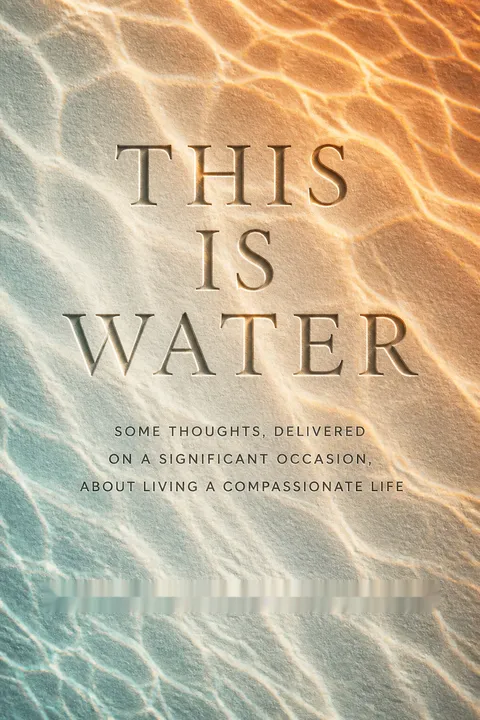
This Is Water is a highly praised speech by David Foster Wallace, later published as a book. Readers find it profound, inspiring, and thought-provoking, praising its insights on empathy, awareness, and the importance of choosing how to think. Many consider it a must-read for its life-affirming message. The book's format, with one sentence per page, receives mixed reactions. Some reviewers also discuss Wallace's other works and his struggle with depression, adding depth to their appreciation of the speech.
People Also Read


Glossary
default setting
automatic self-centered perspectiveWallace's name for the unexamined habit of experiencing events as if one's own needs, feelings, and priorities were the central facts. It describes an automatic way of interpreting daily life, not a fixed personality trait. The speech argues that people can notice this perspective and deliberately consider other ways of understanding a situation.
critical awareness
scrutiny of personal assumptionsA practice of noticing the beliefs, interpretations, and certainties that shape how a person understands experience. In the speech, it means examining one's own worldview rather than only criticizing other people's beliefs. It does not require abandoning conviction; it requires recognizing that confidence can be mistaken for knowledge.
worship
ultimate measure of worthWallace uses worship broadly for whatever a person treats as the deepest source of meaning and value, whether religious belief, money, appearance, or intellectual status. The term describes an organizing commitment that directs attention and shapes judgments. The speech warns that unexamined commitments can make satisfaction depend on standards that remain perpetually out of reach.
real freedom
chosen attention and careWallace's redefinition of freedom as the effort to direct attention, resist automatic self-absorption, and care for others in ordinary situations. It contrasts with a narrower idea of freedom as simply pursuing personal preference. In the speech, this form of freedom is demanding because it requires repeated discipline rather than a one-time declaration.
FAQ
What's "This Is Water" about?
- Commencement Speech: "This Is Water" is a commencement speech delivered by David Foster Wallace at Kenyon College in 2005. It explores themes of awareness, choice, and the importance of a liberal arts education.
- Everyday Realities: The speech uses everyday scenarios to highlight how the most obvious and important realities are often the hardest to see and talk about.
- Self-Centeredness: Wallace discusses the natural human tendency towards self-centeredness and the importance of consciously choosing how to think and perceive the world.
- Meaning and Worship: The speech delves into the concept of worship and how what we choose to worship can shape our lives and happiness.
Why should I read "This Is Water"?
- Practical Wisdom: The speech offers practical wisdom on how to live a more conscious and meaningful life, making it relevant for anyone seeking personal growth.
- Insightful Perspective: Wallace provides an insightful perspective on the value of education beyond academic achievements, focusing on critical thinking and awareness.
- Relatable Examples: Through relatable examples, the speech encourages readers to reflect on their own lives and the choices they make daily.
- Universal Themes: The themes of awareness, choice, and self-centeredness are universal, making the speech applicable to a wide audience.
What are the key takeaways of "This Is Water"?
- Awareness and Choice: The importance of being aware of our default settings and consciously choosing how to think and perceive the world.
- Self-Centeredness: Recognizing and overcoming our natural self-centeredness to live a more compassionate and meaningful life.
- Value of Education: Understanding that the true value of a liberal arts education lies in learning how to think critically and choose what to focus on.
- Worship and Meaning: The idea that everyone worships something, and the choice of what to worship can significantly impact our lives.
What are the best quotes from "This Is Water" and what do they mean?
- "This is water": This phrase emphasizes the importance of recognizing the obvious realities around us that we often overlook.
- "Learning how to think": This quote highlights the essence of education as the ability to choose what to think about, rather than just acquiring knowledge.
- "Everybody worships": Wallace suggests that everyone has something they prioritize or value, and this choice can shape their life experience.
- "The freedom of real education": This quote underscores the idea that true education provides the freedom to decide what has meaning and what doesn't.
How does David Foster Wallace use parables in "This Is Water"?
- Fish Story: Wallace begins with a parable about fish to illustrate how the most obvious realities are often the hardest to see.
- Bar Story: He uses a story about two men in a bar to demonstrate how different belief systems can lead to different interpretations of the same experience.
- Purpose of Parables: These parables serve to make complex ideas more relatable and understandable for the audience.
- Engagement Tool: Parables engage the audience by presenting philosophical concepts in a narrative form that is easy to digest.
What is the significance of the title "This Is Water"?
- Metaphor for Awareness: The title serves as a metaphor for the awareness of the everyday realities that surround us but often go unnoticed.
- Central Theme: It encapsulates the central theme of the speech, which is about recognizing and understanding the obvious yet overlooked aspects of life.
- Call to Consciousness: The phrase is a call to live consciously and to question the default settings of our perceptions and thoughts.
- Repetition for Emphasis: Wallace repeats the phrase to emphasize the importance of this awareness in leading a meaningful life.
How does "This Is Water" address the concept of self-centeredness?
- Default Setting: Wallace describes self-centeredness as a natural default setting that everyone has, which places oneself at the center of the universe.
- Awareness and Choice: He argues that being aware of this tendency allows us to choose to think differently and consider others' perspectives.
- Impact on Perception: Self-centeredness affects how we perceive everyday situations, often leading to frustration and unhappiness.
- Overcoming Self-Centeredness: The speech suggests that overcoming this default setting requires conscious effort and is key to living a compassionate life.
What does David Foster Wallace mean by "teaching you how to think"?
- Beyond Knowledge: Wallace suggests that education is not just about acquiring knowledge but about learning how to think critically and make conscious choices.
- Choice of Focus: It involves choosing what to pay attention to and how to construct meaning from experiences.
- Critical Awareness: The phrase implies developing a critical awareness of one's own thoughts and certainties.
- Lifelong Process: Wallace views this as a lifelong process that begins with education but continues throughout adult life.
How does "This Is Water" explore the theme of worship?
- Inevitable Worship: Wallace argues that everyone worships something, whether it's money, power, beauty, or a higher power.
- Consequences of Worship: The choice of what to worship can have profound effects on one's happiness and fulfillment.
- Unconscious Worship: Many forms of worship are unconscious default settings that people slip into without realizing.
- Conscious Choice: The speech encourages making a conscious choice about what to worship to avoid being consumed by it.
What role does liberal arts education play in "This Is Water"?
- Critical Thinking: Wallace emphasizes that a liberal arts education teaches critical thinking and the ability to choose what to think about.
- Value Beyond Material: He argues that the value of such an education lies in its human value, not just material payoff.
- Awareness and Freedom: The education provides the freedom to decide what has meaning and to live a more conscious life.
- Lifelong Learning: Wallace suggests that the lessons of a liberal arts education are applicable throughout one's life, beyond academic settings.
How does "This Is Water" address the challenges of adult life?
- Routine and Frustration: Wallace discusses the mundane routines and petty frustrations that characterize much of adult life.
- Choice in Perception: He emphasizes the importance of choosing how to perceive these challenges to avoid misery and frustration.
- Awareness of Others: The speech encourages considering others' perspectives and experiences to foster empathy and understanding.
- Living Consciously: Wallace argues that living consciously and making intentional choices can transform the experience of adult life.
What is the "real freedom" according to "This Is Water"?
- Attention and Awareness: Real freedom involves the ability to pay attention and be aware of one's thoughts and surroundings.
- Discipline and Effort: It requires discipline and effort to care about others and make sacrifices in everyday situations.
- Beyond Default Settings: Real freedom is about breaking free from unconscious default settings and living a more intentional life.
- Meaningful Life: Wallace suggests that this kind of freedom leads to a more meaningful and fulfilling life, as opposed to being trapped in the "rat race."
About the Author
Other books by David Foster Wallace



Download PDF
Download EPUB
.epub digital book format is ideal for reading ebooks on phones, tablets, and e-readers.








