

Key Takeaways
Judge the Gaza invasion against its blockade and history, not a single trigger
The invasion had a long prelude. Finkelstein begins with Gaza’s history as a crowded refuge for Palestinians displaced in 1948. By 2008, he writes, about 1.5 million people lived in a strip roughly 25 miles long and five miles wide; most were refugees or their descendants, and more than half were under 18. He traces decades of occupation, resistance, and military repression, arguing that the 2005 withdrawal of Israeli troops from inside Gaza did not end Israel’s control over its borders and essential systems.
A crisis before the war. Israel tightened its blockade after Hamas won the 2006 Palestinian election. A U.N. report cited in the book described severe shortages, unemployment, unsafe water, and restricted access to medical care. Finkelstein’s point is that the December 2008 assault cannot be understood apart from this pressure on civilian life.
The historical frame is essential because a war’s immediate trigger can obscure the conditions that shape it. The refugee history and blockade make Gaza more than a battlefield on a map: they explain why people had few avenues of escape and why damage to infrastructure had lasting effects. At the same time, a history of occupation does not by itself settle the legality of any particular attack. Context clarifies the stakes; incident-level evidence is still needed to judge conduct.
Treat the ceasefire's breach as part of the self-defense test
Sequence changes the argument. Israel said Operation Cast Lead was necessary to stop Hamas rocket fire. Finkelstein challenges that account by tracing the six-month ceasefire brokered in June 2008. Israeli sources cited in the book said Hamas largely upheld it and tried to restrain other armed groups, while the promised easing of the blockade did not take place.
The rupture came first. On 4 November, Israeli forces killed six Palestinian militants in a raid. Amnesty International reported that the ceasefire then broke down, after which Hamas resumed rocket fire. Finkelstein argues that Israel could have renewed the truce and pursued negotiations rather than launch the invasion. This chronology does not make attacks on Israeli civilians acceptable. It does make the events that preceded them relevant to assessing the claim of self-defense.
A self-defense claim is stronger when it accounts for the options available before force is used, not only the danger that follows. Finkelstein’s chronology asks readers to examine whether the truce was viable and who ended it. That is a useful test of official narratives, which often begin at the moment most favorable to the speaker. But chronology alone cannot prove intent: evidence that leaders chose to provoke a response requires careful scrutiny, not merely a sequence that appears suspicious.
Distinguish defeating an armed enemy from terrifying a civilian population
Fear was a strategic objective. Finkelstein argues that Israel sought to restore its deterrence capacity after the 2006 war with Hezbollah damaged its reputation for military dominance. In his account, deterrence meant making adversaries fear the costs of defying Israel, not simply preventing an imminent attack. He links this thinking to the Dahiya strategy, a military approach named after a Beirut district heavily damaged in 2006 and described by Israeli officials as using overwhelming force against communities associated with armed groups.
Gaza was radically outmatched. Israel flew nearly 3,000 sorties and dropped about 1,000 tons of explosives. Palestinian armed groups fired roughly 570 rockets and 200 mortars. Finkelstein argues that the destruction demonstrated the scale of force Israel was prepared to use, rather than a conventional contest between comparable armies.
The distinction between battlefield success and coercive spectacle is central to the book. If an operation is meant to teach a population a lesson through destruction, civilian harm is not simply an unfortunate side effect in the ordinary sense. The argument is persuasive where military leaders explicitly discuss punishment and deterrence. Still, declared doctrine, operational choices, and actual effects are different kinds of evidence. Each can support an inference about purpose, but no single one should substitute for the others.
Test the war's stated aim against the political alternatives it foreclosed
Negotiation was part of the context. Finkelstein argues that the invasion also served a political purpose: weakening Hamas as a potential negotiating partner and obstructing a settlement based on a Palestinian state in territories occupied in 1967. He notes that the United Nations, the Arab League, and many states supported a two-state framework that included withdrawal, Palestinian self-determination, and a resolution of the refugee question.
Hamas's position was changing. The book cites Hamas leaders saying they would accept a state on the 1967 lines and a negotiated agreement approved by Palestinians. Finkelstein argues that Hamas’s ceasefire and political pragmatism threatened Israel by making it harder to exclude the movement from diplomacy. He draws a parallel with Israel’s 1982 invasion of Lebanon, which, he argues, also followed a ceasefire and a Palestinian diplomatic initiative.
This is the book’s most consequential claim about motive, and also one of its most inferential. The diplomatic record complicates the idea that military action was the only response to an intractable enemy. It also highlights a recurring political danger: negotiations can threaten leaders who benefit from defining an opponent as impossible to negotiate with. Yet statements of willingness are not equivalent to an agreement, and Finkelstein’s account would be stronger still with more attention to the limits and divisions within each political camp.
Weigh independent investigations against official military claims
A press release is not an investigation. Finkelstein examines a military analysis by Anthony Cordesman that relied heavily on Israeli briefings and army statements. He contrasts it with reports from Amnesty International, Human Rights Watch, U.N. investigators, and Israeli soldiers who described their conduct after the invasion. Among the cases he cites: Israel initially said a vehicle carried rockets, while later investigations and the military’s own account indicated it carried oxygen canisters; a precision strike killed eight civilians.
Corroboration matters. Investigators documented extensive damage to homes, schools, factories, farms, and medical facilities. The book reports that human rights organizations counted nearly 1,400 Palestinian deaths, while Israeli officials offered a lower total and classified most of those killed as fighters. Finkelstein’s method is to compare claims with physical evidence, independent testimony, and later admissions.
The book models a valuable habit: assess a source’s access, incentives, and track record before treating its account as neutral. Multiple forms of evidence can correct errors that survive in early official statements. The same standard should apply to every institution, including human rights groups and the author himself. A report’s reputation helps establish credibility, but readers should still ask how it gathered evidence, what it could not verify, and whether its conclusions match the cases it documents.
Question human-shield allegations with evidence from both sides
Test the accusation case by case. Israel and its defenders said Hamas used civilians as human shields. Amnesty International reported that it found no evidence that Hamas forced civilians to stay near military targets or used them to deter attacks. It did report that Palestinian fighters sometimes used empty homes or positions near civilian houses, putting nearby residents at risk. Finkelstein emphasizes the difference between endangering civilians and deliberately using them as shields.
Investigators reported Israeli violations too. Amnesty and other inquiries described Israeli soldiers forcing Palestinian civilians, including children, to remain in or near buildings used as military positions, and making some carry out dangerous tasks. Human Rights Watch also documented civilians shot while displaying white cloth. The book treats such findings as evidence that allegations should be tested against specific incidents, rather than accepted as a blanket explanation for civilian deaths.
The distinction between civilians caught in danger and civilians deliberately used to shield a target is morally and legally important. It prevents a vague accusation from becoming a universal excuse. The book’s careful phrasing of Amnesty’s finding, no evidence in the cases investigated, is stronger than claiming that abuse could never have occurred. That precision should be maintained for both sides: evidence of one kind of violation does not erase evidence of another.
Read casualty ratios as evidence of asymmetry, not moral arithmetic
The scale was profoundly unequal. The book cites estimates of nearly 1,400 Palestinians killed, with up to four-fifths classified as civilians and about 350 as children. Israel reported 13 deaths: 10 soldiers, including four killed by friendly fire, and three civilians. Finkelstein uses these figures to show how different the parties’ capacity to inflict harm was, not to suggest that any civilian death is irrelevant.
Both sides faced legal scrutiny. The Goldstone Mission found that Hamas’s indiscriminate rocket attacks endangered Israeli civilians and could constitute war crimes. It also concluded that Israeli forces committed serious violations, including attacks on civilians and extensive destruction of property. Finkelstein rejects treating the parties as equivalent simply because both used force, while maintaining that violations by either side require investigation.
Casualty ratios illuminate power and exposure, but they cannot by themselves determine whether a particular strike was lawful or what an individual commander intended. The book is strongest when it uses scale to challenge false equivalence, then turns to evidence about specific acts. Its own account recognizes that Hamas rocket attacks on civilians were unlawful. That recognition matters: a standard of civilian protection is only credible when it does not depend on which side is being judged.
Turn documentation into accountability through independent investigations
The Goldstone Mission made a public record. Led by jurist Richard Goldstone, the U.N. mission examined violations by all parties, after Goldstone insisted that its mandate not be limited to Israel. Its 2009 report concluded that many Israeli attacks and the destruction of civilian infrastructure were deliberate, and that Hamas’s indiscriminate rocket attacks were also unlawful. These were findings of a fact-finding mission, not criminal convictions issued by a court.
Evidence needs consequences. The report recommended that Israel and Gaza authorities conduct credible investigations and that states consider criminal cases under universal jurisdiction where evidence justified them. It also proposed referral to the International Criminal Court if adequate investigations did not occur. Israel declined to cooperate with the mission and strongly attacked its conclusions. Finkelstein argues that documentation matters when it creates pressure for scrutiny beyond a military’s own internal review.
Independent investigations do more than assemble facts: they establish a common record against which official denials can be tested. Their legitimacy depends on transparent methods, a mandate broad enough to examine all parties, and a willingness to revise claims when evidence changes. A commission’s conclusions are not the same as a court’s judgment, however. Preserving that distinction strengthens accountability rather than weakening it, because it keeps evidentiary findings and legal verdicts from being confused.
Keep Gaza's residents visible as people rebuilding ordinary lives
The trip puts faces beside the statistics. Six months after the invasion, Finkelstein visited Gaza and describes an 11-year-old girl recalling the school that had been destroyed, a university administrator mourning a demolished science building, and a library where children continued to study. A young woman told him that her fiancé had been killed on the final day of the assault. These scenes make clear what the loss of schools, workplaces, and homes meant in daily life.
The blockade continued the damage. Residents were trying to resume ordinary routines while reconstruction materials and other goods remained restricted. Finkelstein describes people as determined rather than theatrically despairing. Their composure is not proof that the suffering was small; it shows how life continues under conditions that outsiders can too easily reduce to a headline or a political argument.
Personal testimony restores dimensions that totals cannot capture: interrupted education, lost livelihoods, and the persistence of daily life. The scenes also resist portraying Gazans only as victims or as extensions of a political organization. A personal account is not a representative survey, and it should not be treated as one. Its value is different: it makes abstract consequences tangible and invites readers to ask what recovery requires, not merely who prevailed.
Build coalitions around equal rights, not ideological membership tests
Public support was changing. Finkelstein presents the invasion as a turning point in criticism of Israeli policy, citing protests, dissent within Jewish communities, and a U.S. poll in which support for Israel among voters fell from 69 percent before the assault to 49 percent by June 2009. He argues that the shift reflected growing public access to historical and human rights documentation, rather than a sudden change in the underlying record.
Make the principle wider than the camp. The book’s closing argument is to organize around rights and equal treatment, not require people to adopt a particular identity or ideology before they can oppose occupation, discrimination, or attacks on civilians. Drawing on Gandhi’s term satyagraha, Finkelstein frames political action as holding to truth while seeking justice without turning the cause into a cult of belonging.
A rights-based coalition can reach people who disagree about history, identity, or nationalism but oppose specific abuses. That breadth is strategically useful and ethically consistent: equal rights are not a prize reserved for ideological allies. The approach also asks for discipline. Public outrage can motivate action, but it can harden into group loyalty or collective blame. A coalition is more durable when it condemns conduct precisely and refuses to transfer responsibility from governments and armed groups to entire peoples.
Analysis
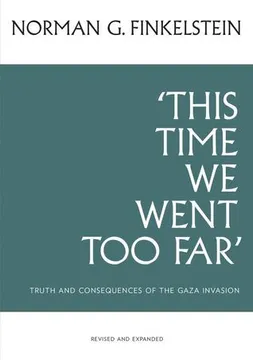
This book is a polemical investigation, not a neutral survey. Its architecture moves from the history of Gaza and the disputed self-defense rationale, through competing accounts of military conduct, to public opinion and a political appeal for accountability. The central thesis is that Operation Cast Lead was not adequately explained as a response to rockets: Finkelstein argues it also aimed to restore Israeli deterrence and prevent Palestinian political pragmatism from strengthening calls for a negotiated settlement.
The book’s strongest method is documentary juxtaposition. Official Israeli statements are placed beside human rights investigations, U.N. findings, Israeli soldiers’ testimony, and the visible damage to civilian life. This makes the reader compare sources rather than accept a government’s account on authority alone. Its acknowledgment that Hamas’s rocket attacks were unlawful also distinguishes criticism of Israeli conduct from a claim that Palestinian armed groups committed no violations.
The main analytical vulnerability is the gap between evidence of destruction and certainty about motive. Statements about punishment and deterrence, the timing of the ceasefire’s collapse, and the scale of damage support Finkelstein’s interpretation, but they do not independently prove every decision-maker shared one purpose. The argument also presents diplomatic openings in a way that can make negotiation seem more settled than it was. Statements of willingness, a political platform, and a workable agreement are not identical.
The Goldstone Report is central to the narrative, but it should be read accurately as a fact-finding report that made serious legal conclusions and recommendations, not as a criminal court judgment. The book is most useful when its forceful thesis prompts close examination of evidence, power, and civilian protection. It is less persuasive when its prosecutorial voice leaves little room for uncertainty about causation. Readers can retain its central challenge while applying the same evidentiary standard to every party and every claim.
Review Summary
Reviews for This Time We Went Too Far are largely positive, averaging 4.21 out of 5. Readers praise Finkelstein's meticulous research, extensive documentation, and use of credible sources like the Goldstone Report and Amnesty International. Many consider it essential reading for understanding the Israeli-Palestinian conflict, particularly the 2008-2009 Gaza War. Some critics find the heavy reliance on citations and quotations makes for dry reading, and note the book assumes prior knowledge of the conflict. Many reviewers find the book's hopeful conclusions bittersweet given subsequent events in Gaza.
Glossary
de-development
Undermining an economy's capacityA term used by political economist Sara Roy for policies that deprive a population of the resources and institutions needed to develop its own economy. In the book, it describes Israeli policies in Gaza that restricted access to land, water, labor, and economic infrastructure, weakening local capacity rather than simply slowing growth.
Dahiya strategy
Overwhelming force against communitiesA military approach named after the Dahiya district of Beirut, which was heavily damaged during the 2006 Lebanon War. Israeli officers cited in the book describe using disproportionate force and inflicting extensive destruction on places associated with armed groups, with the aim of deterring future attacks by imposing severe costs on the surrounding population.
hasbara
Israeli public diplomacyA Hebrew term for explanation or public diplomacy, used in the book to describe Israeli efforts to shape international perceptions of its policies and military actions. Finkelstein discusses official messaging, media restrictions, and coordinated public relations efforts as parts of this effort, while arguing that the evidence of civilian harm overwhelmed many of those messages.
Goldstone Report
U.N. Gaza fact-finding reportThe 2009 report of a United Nations Human Rights Council fact-finding mission led by jurist Richard Goldstone. Its mandate covered violations by all parties during the Gaza conflict. It found evidence of serious Israeli violations and also condemned Hamas rocket attacks on civilians, then recommended investigations and possible legal action. It was an investigative report, not a criminal court ruling.
satyagraha
Truth-based nonviolent resistanceMahatma Gandhi’s term for a form of political resistance grounded in holding to truth. Finkelstein invokes it as an ethical and strategic guide: document injustice, mobilize public opinion, and pursue accountability without making hostility toward an entire people the basis of the movement.
About the Author
Other books by Norman G. Finkelstein


Download PDF
Download EPUB
.epub digital book format is ideal for reading ebooks on phones, tablets, and e-readers.








