

Plot Summary
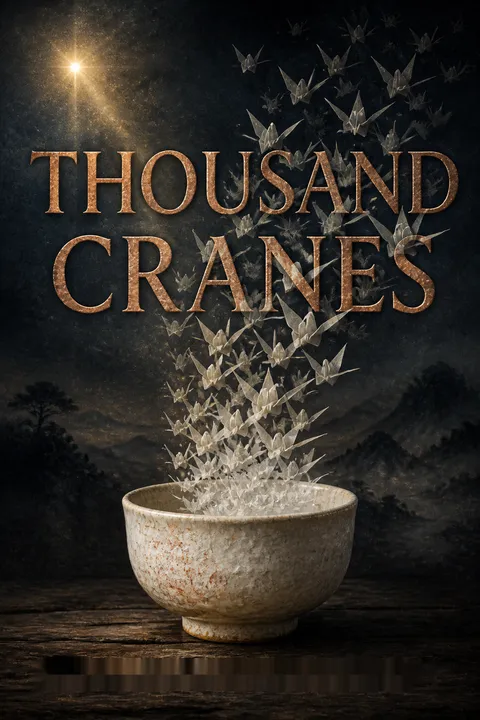
Cranes Above the Teabowl
Kikuji, the son of a tea-loving father, has avoided Chikako since childhood, when he accidentally saw the large birthmark on her breast. Her invitation promises an introduction to Yukiko Inamura, whose pink kerchief bears a thousand white cranes. At the ceremony, Kikuji also faces Mrs Ota, his father’s former lover, and her daughter Fumiko.
Chikako has Yukiko make tea in an Oribe bowl once owned by Mrs Ota’s husband, then passed to Kikuji’s father and Chikako. Kikuji finds Yukiko’s practiced grace a clean contrast to the adults’ tangled histories, but Chikako’s matchmaking has already drawn him into them.
The tea gathering makes courtship inseparable from inheritance. Kikuji is not simply choosing between women: the objects and people around him carry the emotional residue of his father’s choices. His childhood fixation on Chikako’s birthmark turns adult intimacy into something he experiences as contamination, while Yukiko’s cranes offer an image of freshness he can admire without yet having to act.
A Father’s Old Embrace
After the ceremony, Mrs Ota waits for Kikuji and tells him how Fumiko once risked air raids to escort his father home. Her story softens his distrust, and he follows her to an inn. Their sexual encounter feels to Kikuji less like a betrayal than a strange, intimate awakening.
Then he tells Mrs Ota that Chikako arranged the gathering so he could consider marrying Yukiko. Mrs Ota breaks down, ashamed that she has slept with him while he was being introduced to another woman. Her tears bring Kikuji’s own sense of wrong into focus, though he cannot separate his desire for her from his father’s past.
Kikuji’s attraction grows through identification: Mrs Ota’s tenderness makes him imagine the happiness his father found in her. That identification also erases boundaries between generations. His mention of Yukiko punctures the intimacy, exposing how readily he used the young woman’s presence to wound Mrs Ota and how little control he has over the inherited story he is repeating.
Rain in the Tea Cottage
Fumiko visits Kikuji and asks him to forgive her mother and stop seeing her, revealing that she prevented Mrs Ota from keeping a planned meeting with him. Soon after, Chikako takes over Kikuji’s house and summons Yukiko for another matchmaking visit.
During a rainstorm, Mrs Ota arrives alone at the tea cottage, distressed by Fumiko’s vigilance and Chikako’s claim that Kikuji’s marriage to Yukiko is settled. Kikuji comforts her, and she leaves in a cab. That night Fumiko calls to say her mother has died after taking sleeping medicine. Kikuji understands the death as suicide and helps Fumiko summon a doctor without exposing it.
Fumiko tries to interrupt the cycle by naming its cost, but her appeal cannot undo the attraction between Kikuji and her mother. Chikako’s matchmaking sharpens that pressure, whether or not she understands its consequences. The secret around Mrs Ota’s death then binds Kikuji and Fumiko through shared concealment, replacing a simple question of guilt with a burden they cannot safely discuss in public.
The Shino Keepsake
At the memorial visit, Kikuji finds Fumiko arranging his flowers in her mother’s Shino water jar. She gives him the vessel, and the two struggle to decide whether Mrs Ota died from guilt or love. Fumiko insists that Kikuji should not claim responsibility for her mother’s death, though she too has spent the week blaming herself.
Chikako later calls the death a suicide and suggests Mrs Ota hoped to draw Kikuji toward Fumiko. She also condemns the dead woman and warns that her influence threatens the planned match with Yukiko. Kikuji rejects Chikako’s attack, but her theory unsettles him.
The Shino jar gives grief a physical form that can be held, used, or refused. Fumiko’s attempt to release Kikuji from blame is compassionate, but it also risks simplifying a death neither of them can explain. Chikako supplies a deliberate, self-serving explanation; because Kikuji already suspects his own motives, her accusation gains force even as he distrusts her.
Lipstick on the Rim
Fumiko moves from her family home and tells Kikuji she plans to find work, while Chikako continues pushing him toward Yukiko. When Fumiko visits, she brings a small Shino tea bowl her mother used every day. A brown-red trace on its rim may be the lipstick Mrs Ota could never scrub away.
Kikuji feels both fascination and revulsion, while Fumiko seems unsure whether to give him the cup. Chikako uses the meeting to press the marriage and disparage Mrs Ota. Fumiko absorbs the insults without answering, leaving Kikuji unable to tell whether she is quietly resisting or simply exhausted.
The lipstick mark turns an ordinary cup into evidence of intimacy, though its origin remains uncertain. Kikuji’s response reveals how strongly he depends on objects to approach feelings he cannot name directly. Fumiko, meanwhile, is caught between preserving her mother’s memory and refusing to let that memory dictate her future. Chikako’s insults make the room a contest over who gets to interpret the dead.
The Bowl Breaks
Chikako tells Kikuji that both Yukiko and Fumiko have married, blaming his hesitation. Fumiko later calls to correct the claim that she is married; Kikuji meets her at home, where she tears up a letter she had meant to send. She asks him to compare her mother’s Shino bowl with a Karatsu bowl from his father’s tea chest.
As the pair sit side by side, Fumiko breaks the Shino, then leaves. Kikuji searches for her the next day and learns she has gone away with a friend. He cannot find her and fears that grief may have driven her to harm herself. The story ends with that fear unresolved.
Chikako’s false report forces Kikuji to confront what his indecision has cost, though the truth about Yukiko remains uncertain. The broken bowl interrupts his habit of turning desire and guilt into comparison between inherited objects. Yet the gesture does not secure a future with Fumiko: she disappears, and Kikuji is left unable to distinguish a temporary absence from danger. The ending refuses the reassurance he has repeatedly postponed.
Analysis
Thousand Cranes makes inheritance intimate and material. Kikuji does not receive only his father’s house and tea collection; he inherits unresolved affairs, rivalries, and ways of treating women as extensions of male memory. The tea objects offer a means of touching that past without explaining it, but they also let Kikuji hide inside aesthetic judgment. He can debate a bowl’s quality more easily than the harm his desire may cause.
Chikako and Mrs Ota embody competing responses to vulnerability. Chikako converts it into control, using matchmaking and accusation to manage the people around her. Mrs Ota approaches it through affection and confession, sometimes at the expense of Fumiko’s security. Fumiko sees the cost more clearly, yet cannot simply free herself from the family story. Her mother’s death leaves both her and Kikuji searching for a moral certainty the narrative withholds.
The ending’s broken bowl offers no clean release. Kikuji stops comparing the women through their inherited objects, but Fumiko’s disappearance leaves the consequences of their intimacy unknown. His final fear is not transformed into wisdom or resolution. The novel instead shows how evasion can become its own form of harm: by refusing to choose, Kikuji allows others to make choices around him, then discovers that regret cannot recover what was never secured.
Review Summary
Thousand Cranes explores themes of tradition, guilt, and complex relationships through the lens of Japanese tea ceremonies. Readers appreciate Kawabata's lyrical prose and subtle symbolism, though some find the plot slow and characters underdeveloped. The novel's portrayal of women and its commentary on changing Japanese society divide opinions. Many reviewers note the book's focus on objects and rituals as vehicles for exploring human emotions and the passage of time. Overall, the novel is seen as a beautifully written but challenging work that rewards careful reading.
People Also Read



Characters
Kikuji Mitani
The hesitant heirKikuji is a bachelor shaped by his father’s affairs and by the tea utensils that preserve their traces. Introspective but not reliably self-aware, he often mistakes passivity for innocence, then uses sarcasm or desire to avoid admitting what he wants. His childhood memory of Chikako’s birthmark colors his ideas about sexuality and shame. He is drawn to tenderness, especially in Mrs Ota and Fumiko, but struggles to distinguish affection from repetition of his father’s life.
Kurimoto Chikako
The meddling tea teacherChikako is a forceful tea instructor who has long been attached to Kikuji’s family. She arranges introductions, takes liberties in Kikuji’s home, and treats personal history as something she can manage. Her resentment toward Mrs Ota and her complicated past with Kikuji’s father sharpen her need to control the story around them. Beneath her practical confidence lies a sensitivity to rejection that she disguises with bluntness and strategic helpfulness.
Mrs Ota
The father’s former loverMrs Ota is the widow of a tea enthusiast and the mother of Fumiko. Warm, emotionally expressive, and drawn to memories, she treats Kikuji as someone with whom she can revisit her bond with his father. Her tenderness can comfort others, but it also blurs boundaries and makes it difficult for her to see how her choices affect her daughter. Chikako views her as a rival, while Kikuji finds himself both moved by her and unsettled by their shared past.
Fumiko Ota
The grieving daughterFumiko is Mrs Ota’s quiet, watchful daughter. Her loyalty to her mother is mixed with anger and shame about the damage surrounding the older generation’s relationships. She approaches Kikuji directly when she believes her mother needs protection, yet she also carries her own grief without easily asking for help. Tea vessels connect her to family history, but she is not merely its keeper: she wants the freedom to define what those memories mean.
Yukiko Inamura
The prospective brideYukiko is the young woman Chikako hopes to introduce to Kikuji. She carries a pink kerchief patterned with white cranes and performs the tea ceremony with composure. Kikuji remembers her through those visual impressions, while Chikako treats her as the solution to his bachelorhood. Yukiko’s own wishes remain mostly outside his view, a silence that exposes how little the proposed match is built on mutual knowledge.
Plot Devices
Tea utensils
Objects carry old intimacyBowls, jars, and kettles pass between families and lovers, carrying histories that their current owners do not always acknowledge. The Oribe bowl links Mrs Ota’s husband, Kikuji’s father, and Chikako; the Shino vessels connect Mrs Ota to Fumiko and Kikuji. Their repeated use lets characters approach grief and desire indirectly, while their uncertain stains and origins keep memory from becoming proof.
Chikako’s birthmark
A childhood memory becomes fixationKikuji saw Chikako’s breast birthmark as a child and later learned how deeply it affected her sense of herself. The memory resurfaces whenever he thinks about sex, shame, or his father’s former lovers. It also shows how one startling image can distort later relationships: Kikuji treats the mark as a hidden source of fate, although much of that power comes from his own imagination.
The thousand-crane kerchief
A fleeting image of possibilityYukiko’s pink kerchief, patterned with white cranes, marks her first appearance and becomes the clearest image Kikuji retains of her. He recalls it when he imagines a cleaner future, especially as his involvement with the Ota family grows more painful. Its visual brightness contrasts with the inherited histories surrounding the tea ceremony, but Kikuji’s idealized memory of Yukiko also reflects how little he truly knows her.
FAQ
Synopsis & Basic Details
What is Thousand Cranes about?
- Complex family entanglements: The novel explores the intricate relationships of Kikuji Mitani, a young man haunted by his father's past affairs, particularly with two women, Chikako and Mrs. Ota, and their daughters.
- Tea ceremony as backdrop: The traditional Japanese tea ceremony serves as a recurring setting, where past and present connections are revealed and tensions escalate.
- Search for personal identity: Kikuji's journey involves navigating his father's legacy, his own desires, and the possibility of finding a future free from the past's shadows.
Why should I read Thousand Cranes?
- Subtle emotional depth: The novel masterfully portrays complex emotions and unspoken tensions through nuanced character interactions and internal monologues.
- Exploration of Japanese culture: It offers a glimpse into the traditions and aesthetics of Japanese culture, particularly the tea ceremony, and its symbolic significance.
- Meditative and thought-provoking: The story prompts reflection on themes of guilt, memory, inheritance, and the search for personal identity, leaving a lasting impact on the reader.
What is the background of Thousand Cranes?
- Post-war Japan setting: The novel is set in post-World War II Japan, a period of social and cultural change, which influences the characters' sense of displacement and search for meaning.
- Traditional Japanese aesthetics: The story is deeply rooted in Japanese artistic traditions, such as the tea ceremony, and the appreciation of beauty in nature and objects.
- Influence of Zen Buddhism: The novel's themes of impermanence, the interconnectedness of all things, and the search for enlightenment reflect the influence of Zen Buddhist philosophy.
What are the most memorable quotes in Thousand Cranes?
- "The tea bowl was like a mirror reflecting the past.": This quote highlights the symbolic weight of the Shino bowl and its connection to Mrs. Ota's memory and the past.
- "He felt as if he were walking through a dream, a dream that was both beautiful and terrible.": This quote captures Kikuji's emotional state, caught between the allure of the past and the uncertainty of the future.
- "The morning star was fading, and with it, the shadows of the past.": This quote symbolizes the potential for renewal and the possibility of moving beyond the burdens of history.
What writing style, narrative choices, and literary techniques does Yasunari Kawabata use?
- Fragmented and impressionistic: Kawabata employs a fragmented narrative style, focusing on sensory details and fleeting impressions, rather than a linear plot progression.
- Symbolism and imagery: The novel is rich in symbolism, using objects, colors, and natural elements to convey deeper meanings and emotional states.
- Internal monologue and stream of consciousness: The narrative often delves into the characters' inner thoughts and feelings, revealing their psychological complexities and unspoken motivations.
Hidden Details & Subtle Connections
What are some minor details that add significant meaning?
- The lipstick stain on the Shino bowl: This seemingly small detail connects the bowl directly to Mrs. Ota, making it a tangible symbol of her presence and the past's lingering influence.
- Chikako's birthmark: The birthmark is not just a physical feature but a symbol of her past relationship with Kikuji's father and her manipulative nature.
- The description of the tea room: The specific details of the tea room, such as the arrangement of objects and the quality of light, reflect the characters' emotional states and the overall atmosphere of the scene.
What are some subtle foreshadowing and callbacks?
- Kikuji's initial reluctance to attend the tea ceremony: This foreshadows his internal conflict and the complex relationships he will encounter.
- The recurring mention of Kikuji's father's affairs: This foreshadows the central theme of the novel, which is the impact of the past on the present.
- The shattered Shino bowl: This is a callback to the initial description of the bowl and a symbolic representation of the breaking of ties with the past.
What are some unexpected character connections?
- Fumiko's plea for forgiveness: Her request to Kikuji on behalf of her mother reveals a deeper connection between the two families and a shared burden of the past.
- Chikako's role as a matchmaker: Her attempt to connect Kikuji with Yukiko is not just a social gesture but a way to exert control and influence over his life.
- The shared history between Kikuji and Mrs. Ota: Their intimate encounter reveals a complex bond rooted in their shared connection to Kikuji's father and their own vulnerabilities.
Who are the most significant supporting characters?
- Chikako Kurimoto: Her manipulative nature and her connection to Kikuji's father make her a catalyst for the unfolding drama and a symbol of the past's enduring influence.
- Mrs. Ota: Her vulnerability and tragic fate highlight the destructive power of unresolved guilt and the complexities of love and loss.
- Fumiko Ota: Her desire for forgiveness and freedom from her mother's shadow makes her a poignant reminder of the past's impact on the present.
Psychological, Emotional, & Relational Analysis
What are some unspoken motivations of the characters?
- Kikuji's desire for absolution: He seeks to reconcile with his father's past and find a way to move forward, free from the burden of guilt and inherited trauma.
- Chikako's need for control: She manipulates the lives of those around her, possibly to compensate for her own past experiences and insecurities.
- Fumiko's yearning for liberation: She seeks to break free from her mother's legacy and forge her own path, independent of the past.
What psychological complexities do the characters exhibit?
- Kikuji's ambivalence and passivity: He struggles with conflicting emotions and often avoids making decisive choices, reflecting his internal turmoil.
- Chikako's manipulative and controlling behavior: Her actions reveal a complex personality driven by a need for power and a desire to shape the lives of others.
- Mrs. Ota's vulnerability and despair: Her emotional fragility and eventual demise highlight the destructive impact of unresolved guilt and the complexities of love and loss.
What are the major emotional turning points?
- Kikuji's encounter with Mrs. Ota: This intimate moment forces him to confront his father's past and his own desires, leading to a deeper understanding of his emotional state.
- Fumiko's plea for forgiveness: This interaction reveals the shared burden of the past and the desire for reconciliation, marking a shift in the relationship between Kikuji and Fumiko.
- The shattering of the Shino bowl: This act of destruction symbolizes the breaking of ties with the past and the potential for new beginnings, representing a major emotional release.
How do relationship dynamics evolve?
- Kikuji and Chikako: Their relationship is marked by tension and manipulation, as Chikako seeks to control Kikuji's life and he struggles to break free from her influence.
- Kikuji and Mrs. Ota: Their relationship is characterized by a complex mix of guilt, nostalgia, and desire, reflecting the lingering impact of the past.
- Kikuji and Fumiko: Their relationship evolves from one of shared burden to one of mutual understanding and a desire for liberation from the past.
Interpretation & Debate
Which parts of the story remain ambiguous or open-ended?
- Kikuji's future: The novel ends with Kikuji contemplating the future, but it remains unclear whether he will truly be able to move beyond the shadows of the past.
- The nature of Kikuji's feelings for Yukiko: While Yukiko represents the possibility of a new beginning, the depth of Kikuji's feelings for her is left ambiguous.
- The true motivations of Chikako: Her manipulative actions and her underlying reasons for orchestrating events remain open to interpretation.
What are some debatable, controversial scenes or moments in Thousand Cranes?
- Kikuji's intimate encounter with Mrs. Ota: This scene raises questions about the nature of their relationship and the ethical implications of their actions.
- Chikako's manipulative behavior: Her attempts to control the lives of those around her are controversial and raise questions about her motivations and character.
- The shattering of the Shino bowl: This act of destruction can be interpreted as both a release and a loss, sparking debate about its symbolic significance.
Thousand Cranes Ending Explained: How It Ends & What It Means
- Fading morning star symbolism: The fading morning star symbolizes the end of an era and the potential for new beginnings, suggesting that Kikuji is moving towards a future free from the past.
- Shattered bowl as liberation: The shattered Shino bowl represents the breaking of ties with the past and the possibility of healing and transformation.
- Open-ended conclusion: The ending is not a definitive resolution but rather a moment of contemplation, leaving the reader to ponder the complexities of the characters' journeys and the enduring impact of the past.
Download PDF
Download EPUB
.epub digital book format is ideal for reading ebooks on phones, tablets, and e-readers.








