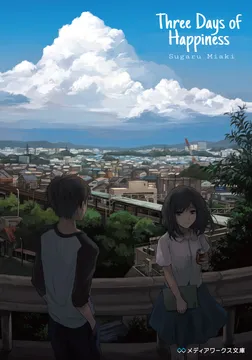


Plot Summary
Ten Years on the Shelf
As a child, Kusunoki1 believes his intelligence marks him for an extraordinary future. His classmates reject him, and his closest companion, Himeno,3 is equally isolated, proud, and sharp-witted. They compete at school but understand each other in ways no one else does.
During a summer festival, they watch the crowd from the shrine steps rather than joining it. Himeno3 predicts that ten years later, something wonderful will happen and they will finally be glad to have lived.
She also proposes that if neither has found someone to marry by twenty, they should be together. Kusunoki1 treats the suggestion as a promise. When Himeno3 moves away, he keeps himself emotionally unavailable, expecting their imagined future to justify the years they spend apart.
The childhood pact offers Kusunoki a private alternative to belonging. Rather than risk the ordinary vulnerability of making new friends, he and Himeno turn their exclusion into evidence that they are exceptional and destined for a later triumph. Their promise is both tender and defensive: it gives them a shared future while sparing them from having to act in the present. Kusunoki’s long fidelity to it becomes less a measure of love than a structure for postponing disappointment. The festival steps establish the story’s central tension: he wants to join the living world, but first wants the world to prove that he deserves it.
Thirty Years for Cash
At twenty, Kusunoki1 is broke enough to faint during a summer job and sell his books and CDs for food money. Two shopkeepers independently direct him to a hidden business that buys lifespan. He expects his years to be worth millions, but the evaluator2 prices them at the minimum rate: 10,000 yen per year.
With thirty years and three months remaining, he can receive 300,000 yen for all but the final three months. The shop says the estimate reflects the happiness, achievements, and contributions his future is expected to contain.
Kusunoki1 accepts the offer without seriously negotiating, relieved to have his hopeless future judged and closed. Outside, he spends some of the money on beer and food, then begins what he believes will be his last three months.
The transaction makes Kusunoki’s private self-contempt look like an objective fact. He has built his identity around being special, yet the market gives him the lowest possible valuation, exposing the distance between imagined potential and lived relationships. His decision is not simple despair. By accepting a definite ending, he escapes the exhausting obligation to keep waiting for a miraculous reversal. The sale also turns time into a scarce material resource, changing the emotional weight of routine choices. The strange economy literalizes a familiar psychological trap: Kusunoki has treated future possibility as proof of present worth, and now the future itself has been priced.
The Observer Arrives
The next morning, Miyagi,2 the young woman who evaluated Kusunoki,2 arrives at his apartment with a suitcase. Because he has less than a year to live, she must observe him and report any dangerous behavior. Kusunoki1 adds a list of final wishes to his notebook, including seeing Himeno3 again. Miyagi2 warns that Himeno3 has had a child, married young, divorced, and is raising the child with help from her parents.
She also describes a possible future in which Himeno3 dies by suicide, while insisting that the sale has changed what may happen. Kusunoki1 bristles at Miyagi’s2 interference, but her warning makes his old promise feel urgent. Miyagi2 remains in the corner of his room, watching him as he begins to imagine how to use his remaining time.
Miyagi turns the observer system into an intimate form of pressure. She is not merely monitoring Kusunoki’s conduct; her knowledge forces him to confront how little he knows about the people he has kept alive in memory. Her warning about Himeno collapses the safe distance between nostalgia and consequence. Kusunoki’s list is revealing because it mixes basic bodily pleasures with a desire to reconnect, yet he cannot initially distinguish what he truly wants from what a dying person is expected to want. Miyagi’s presence makes private evasion harder, while her limited, uncertain forecasts leave room for choices neither of them can fully predict.
Friends Who Let Go
Kusunoki1 tries to contact Wakana,5 a college student who once showed interest in him, but his message fails because she has changed her phone number. When Wakana5 calls back, he claims the call was accidental, unable to admit that he wants company.
Miyagi2 explains that Wakana5 had once hoped for a relationship, but Kusunoki’s1 silence allowed her feelings to fade. He then meets Naruse,4 an old high-school friend, hoping to recover their easy banter. The reunion initially feels warm, until Naruse4 casually jokes about Kusunoki1 having stopped drawing.
Kusunoki1 hears the remark as contempt for the one talent he could not bear to lose. He throws a glass, leaves the restaurant, and exhausts himself hitting baseballs at a batting center, recognizing that he has changed less than the people around him.
Both encounters reveal the cost of Kusunoki’s habit of waiting to be chosen. Wakana’s affection cannot survive his refusal to risk a direct answer, while Naruse’s joke hurts because Kusunoki has never processed the abandonment of art. He treats silence as a way to avoid rejection, but it also prevents others from knowing what matters to him. The glass he throws is an ugly, concrete interruption of his usual withdrawal, not a triumph of self-assertion. His later reflection that Naruse has changed while he has not reframes the scene: Kusunoki’s disappointment in others may partly be grief for his own stalled life.
The Capsule's Verdict
Kusunoki1 returns to his hometown to retrieve a time capsule buried by his fourth-grade class. Before reaching the school, he finds an old bus that once served as his and Himeno’s3 secret base; an umbrella drawn there still bears both their names.
At night, he digs up the capsule and reads his classmates’ letters, discovering that none named him as a best friend. Himeno’s3 letter is missing, and he takes his own letter without yet reading it closely.
The following morning, exhausted and drawn to Miyagi,2 he nearly uses her as an outlet for his anger and desire, but stops when he sees her fear. Miyagi2 then explains that her mother sold decades of time, left a debt, and died after becoming an observer. Miyagi2 sold her own time to inherit and repay that debt.
The capsule supplies a brutal record of the social reality Kusunoki had tried to revise through memory. He and Himeno may have experienced one another as a private alliance, but the class’s letters reveal that his isolation was not simply a misunderstanding. The missing letter preserves uncertainty rather than giving him the comfort he wants. Miyagi’s story then shifts the meaning of observation: her detached manner is a survival strategy shaped by inherited obligation, not evidence that she lacks vulnerability. Kusunoki’s interrupted attempt to hurt her marks a moral boundary. For the first time, he responds to another person’s fear instead of treating his own desperation as permission.
A Thousand Paper Cranes
After his conversation with Miyagi,2 Kusunoki1 spends several days folding a thousand paper cranes, finding comfort in a task that is pointless yet beautiful. While checking his clothes, he discovers the letter he wrote to his future self for the time capsule. It asks his twenty-year-old self to meet Himeno,3 because each of them had once believed the other was essential.
Kusunoki1 chooses to honor that request, even though Miyagi2 has advised against the meeting. He researches Himeno’s3 address, rides his moped there with Miyagi2 seated behind him, and finds no one at home. While waiting, he reads and eats at a local festival. Himeno3 unexpectedly arrives at the shrine, recognizes him, and agrees to meet for dinner two days later.
The cranes and the letter offer two different ways of handling helplessness. Folding gives Kusunoki a modest, repeatable act that does not pretend to change his fate; the letter gives his younger self authority over the present. His decision to visit Himeno is not based on confidence that she will welcome him. It is an attempt to stop letting fear make every choice in advance. The accidental reunion at the festival feels like fulfillment, but its timing is deliberately unstable: Kusunoki mistakes chance for confirmation that his childhood story still governs both of them. The section lets hope return, while showing how readily he turns hope into certainty.
Himeno's Vanishing Letter
At dinner, Kusunoki1 tells Himeno3 about his stalled studies, his abandoned art, and the sale of his lifespan. Himeno3 explains that she left school, married a graduating student, and divorced after the relationship failed. She says she has not matured much since their childhood separation.
When Kusunoki1 describes his impending death, she believes he is telling the truth, then leaves for the restroom and never returns. A waiter gives Kusunoki1 a note she left behind.
In it, Himeno3 reveals that she had despised him for failing to answer her need for help and had planned to kill herself in front of him as revenge. Seeing how desperate he has become changes that plan, and she chooses to disappear instead. Kusunoki1 learns that Miyagi2 had concealed the depth of Himeno’s3 anger.
The reunion breaks because Kusunoki brings a private mythology to a person who has lived through events he never knew. Himeno’s note recasts his long loyalty as an absence she experienced as abandonment. Her planned suicide is not a romantic proof of their connection but an act shaped by resentment and a wish to make him witness her pain. Miyagi’s withholding of that information protected Kusunoki’s fragile hope, though it also allowed him to misread Himeno until the moment of contact. The scene refuses the comfort of a clean villain: Kusunoki failed to recognize a plea, Himeno nurtured a retaliatory fantasy, and both were shaped by isolation.
Machines in Summer
After Himeno3 leaves, Kusunoki1 throws away her letter and gives the 300,000 yen to strangers on the street. He and Miyagi2 spend a rain-soaked night in an abandoned community center, then return to his apartment and begin sharing the bed.
Searching for something that feels genuinely his, Kusunoki1 discovers that he loves vending machines and starts photographing them around town. The modest project gives him reasons to travel, notice places, and share ordinary hours with Miyagi.2
In his hometown, he speaks with the elderly former candy-store owner11 who once sheltered him as a child. Recalling Himeno’s3 unusual letter from when he was seventeen, Kusunoki1 realizes it was likely a plea for help. He had failed to understand it, and the revelation deepens his regret.
Kusunoki’s new rituals do not erase the damage of the dinner; they give him a way to remain present after it. The money he scatters cannot repair a relationship, and his photography does not claim to be useful. Yet both acts loosen his fixation on grand achievement. Vending machines become a fitting subject because they are ordinary, dependable, and encountered in specific places, unlike the abstract future he once expected to redeem him. The former shopkeeper’s memory exposes another failure of attention: Himeno’s letter was meaningful not for its content alone, but because she had reached out at all. Kusunoki begins to see that love requires noticing signals in time.
Stars Over the Lake
While riding through the countryside, Kusunoki1 follows Miyagi’s2 directions to Starry Lake, a place she remembers from before becoming an observer. She leads him across a pier with his eyes closed, then lets him see the immense spread of stars above the water. Lying beside him, Miyagi2 describes her own childhood companion,8 the person she once relied on as Kusunoki1 relied on Himeno.3
After Miyagi2 vanished from that person’s8 life, he adapted quickly, and she has never returned to find out whether he is happy. She admits that she still wants to see him before she dies. Kusunoki1 recognizes the same fear of being forgotten in her story. The next morning, Miyagi2 is gone from the apartment, leaving only her notebook behind.
The lake gives Miyagi a place to be more than Kusunoki’s monitor. By guiding him without sight, she asks him to trust her before he can verify what awaits him, a reversal of his usual demand for certainty. Her story about her childhood companion mirrors Kusunoki’s attachment to Himeno, but it also exposes the possessive wish beneath both loyalties: each wants to matter so much that the other cannot simply move on. Miyagi’s disappearance interrupts the intimacy they have built and leaves Kusunoki with a sharper awareness of her separate life. The stars are not an answer to either person’s loneliness; they are an experience they chose to share.
Thirty Yen, One Confession
A substitute observer6 takes Miyagi’s2 place for two days and criticizes Kusunoki’s1 photographs and paper cranes. Kusunoki1 uses the time to write a detailed account of his life, then hears the observer6 laugh at the idea that his lifespan truly cost 300,000 yen.
When Miyagi2 returns, Kusunoki1 asks directly. She admits his real valuation was only thirty yen, and that she supplied the rest herself because she wanted to give him something. She also reveals that the threats about observers ending his life were lies meant to protect herself.
Kusunoki1 thanks her rather than condemning her. Miyagi2 explains that being treated as present, through meals, walks, and conversation, mattered deeply to her, then admits she loves him. Kusunoki1 decides to use his remaining time to help free her from her debt.
The thirty-yen revelation punctures the last illusion that an institution can measure a human being without distortion. Miyagi’s lie is an act of care, but not an uncomplicated one: it hides the truth and makes Kusunoki’s decision to sell his life partly depend on false information. His response matters because he does not turn her admission into another reason to retreat. Miyagi names what their relationship has given her: recognition in daily acts rather than a grand rescue. Kusunoki’s promise to repay her debt risks repeating his old fantasy of saving someone through a spectacular achievement. The section marks a real emotional change, but not yet a reliable plan.
The Invisible Becomes Public
Kusunoki1 first tries to repay Miyagi’s2 debt, but quickly sees that earning such a sum in two months is impossible. Advice from the bookstore owner9 and a CD clerk10 helps him understand that he cannot force a grand success into existence.
Instead, he asks Miyagi2 what would make her happy and begins doing activities that are usually embarrassing alone, including riding a swan boat, visiting an aquarium, and sharing a picnic with her. His insistence on Miyagi’s2 presence gradually becomes a public performance.
Neighbor Shinbashi7 intervenes when men harass Kusunoki,1 then introduces Miyagi2 to friends by playing along with Kusunoki’s1 account. The town begins to join in. Kusunoki1 also accompanies Miyagi2 to her hometown, where she watches her childhood friend Enishi8 meet the woman he loves, then accepts Kusunoki’s1 comfort.
Kusunoki’s public foolishness converts private recognition into a social experiment. He cannot make strangers literally see Miyagi, but he can ask them to respond to her as someone who matters. Shinbashi’s participation gives that invitation a community, and the change is not simply proof that Kusunoki has become popular. It shows how social reality depends partly on what people are willing to acknowledge together. Miyagi’s visit to Enishi complicates the fantasy of being irreplaceable: her childhood companion has built a life without her. Kusunoki stays beside her through that disappointment, offering the kind of attention he once failed to give Himeno.
Thirty Days of Art
Kusunoki’s1 public life with Miyagi2 leads him back to drawing. A nighttime sketch of her sleeping unlocks the landscapes and imagined places he has carried since childhood. At a fireworks display, he tells Miyagi2 that she helped him make friends with the world, then asks her to forget him after he dies.
Miyagi2 understands that he intends to shorten his life again and begs him to stay for his remaining month. The next day, Kusunoki1 sells thirty of his thirty-three remaining days, keeping the final three.
The evaluator warns that he is surrendering a future in which his paintings would become historically important. He accepts the trade anyway. The paintings he creates during the last month bring in enough money to pay most of Miyagi’s2 debt, though she will still have years of work remaining.
Art returns only after Kusunoki stops trying to make it universal or historically important. Miyagi’s presence lets him draw from particular memories and private images rather than from the demand to prove that he is exceptional. His choice at the shop therefore rejects both his original dream of immortality and the later fantasy of buying Miyagi’s whole future back. He converts talent into practical help, but accepts that even this cannot solve everything. Miyagi’s plea makes the cost visible: his sacrifice is not automatically noble because he is dying. The section’s emotional force comes from their competing care, each trying to protect the other by accepting less life.
Three Days Together
With only three days left, Kusunoki1 returns to the places he visited with Miyagi,2 trying to hold onto their shared routines. Alone at first, he pretends to hold her hand, but the gesture breaks him. Local people gather and ask what happened.
Then Miyagi2 appears, visible to everyone, and explains that she sold all but three days of her own lifespan after learning Kusunoki1 had sacrificed thirty days for her. Her sale pays her debt and leaves them with more money than they can spend.
Kusunoki1 is devastated that she has thrown away the life he tried to preserve, yet relieved that she has returned. Together, they accept that their time is nearly over. Kusunoki1 no longer needs fame or a future without Miyagi;2 her presence makes his brief life feel complete.
The ending completes the book’s reversal of value. Kusunoki once wanted an eternal name because he believed being forgotten would prove that his life had amounted to nothing. By the final days, he measures meaning through reciprocal presence, not duration or public recognition. Miyagi’s decision is both an act of love and a defiance of the role that has governed her life: she chooses her own final time rather than continuing to exist as an invisible worker. The community’s ability to see her makes their private bond publicly legible, but does not rescue them from death. The resolution offers no cure for mortality, only a shared choice that makes their remaining time their own.
Analysis
Three Days of Happiness begins with a question that seems philosophical but becomes painfully material: what is a human life worth if it can be sold? Kusunoki1 assumes that his life must be valuable because he is destined for greatness. The shop’s judgment destroys that assumption, but the novel does not simply replace it with a comforting claim that every life has equal monetary or social value. Instead, it shows how easily a person can mistake an external measurement for the whole truth about being alive.
Kusunoki’s1 central defense is postponement. He waits for fame, for Himeno,3 and for an eventual reversal that will make his unhappy years seem necessary. That waiting protects him from immediate risk, yet it also makes him miss the moments when other people ask to be met. His failure to respond to Himeno’s3 earlier plea is not redeemed by the intensity of his later longing. The book allows affection and harm to coexist, insisting that memory can preserve a bond while distorting what the other person actually experienced.
Miyagi2 offers a counterpoint. She has learned to survive by becoming an observer, someone whose work depends on being unseen and emotionally controlled. Kusunoki’s1 everyday attention changes the terms of that existence. Meals, walks, shared photographs, and physical care do not erase their unequal circumstances, but they make recognition an action rather than a sentiment. The town’s gradual willingness to play along extends this recognition outward, showing that social belonging can begin when people choose not to humiliate someone for an unusual way of living.
Art completes Kusunoki’s1 change. He can create again when he stops trying to prove that he is exceptional and draws from particular memories and relationships. The resulting fame has real value, but he refuses to confuse future recognition with present happiness. The novel’s final measure is not how long a person lives or how many people remember them. It is whether, in the time available, they can meet another person without turning that person into a promise, a rescue, or proof of their own worth.
Review Summary
Three Days of Happiness is a deeply moving Japanese light novel that explores themes of life's value, happiness, and human connection. Readers praise its thought-provoking narrative, compelling characters, and emotional impact. The story follows a young man who sells his lifespan, keeping only three months to live. Many find the book's philosophical questions and bittersweet romance deeply affecting. While some criticize certain aspects, most reviewers consider it a masterpiece that leaves a lasting impression, encouraging readers to reflect on their own lives and what truly matters.
Characters
Kusunoki
The reluctant dreamerKusunoki is an intelligent young man whose childhood confidence in his special destiny has hardened into isolation and self-disappointment. He measures himself against peers, resists ordinary attachments, and uses books, music, and imagined futures to avoid the risks of participation. His bond with Himeno3 shapes his idea of love, while his encounters with Miyagi2 force him to notice how differently he behaves when another person is truly present. Kusunoki is neither simply cynical nor secretly confident; he swings between grand ambition and the belief that he deserves nothing. His development comes through concrete acts of attention, from sharing meals to drawing, as he learns to value experience without first demanding that it prove his exceptional worth.
Miyagi
The unseen observerMiyagi is a young observer assigned to monitor people who have sold nearly all their lifespan. Formal, watchful, and often blunt, she initially keeps Kusunoki1 at a professional distance. Her restraint masks a history of hardship and a fierce need for security, while her careful attention to people suggests a tenderness she does not easily display. She is drawn to small, dependable details: food, places, gestures, and the private habits of the people she watches. Kusunoki’s1 willingness to address her as a person rather than an invisible duty unsettles the boundaries she has learned to maintain. Miyagi’s central tension is between protecting herself through detachment and wanting to be recognized without having to disappear.
Himeno
The childhood confidanteHimeno is Kusunoki’s1 childhood friend, academic rival, and closest counterpart during years when both feel rejected by their classmates. Proud and perceptive, she shares his belief that they are unlike the people around them, yet she can also be playful and vulnerable. Their childhood promise gives Kusunoki1 a lasting image of mutual devotion, but Himeno has her own life and private interpretation of their separation. She represents the difference between remembering someone and truly knowing what they need. Her intelligence does not make her immune to immaturity or pain; it can instead give her sharper language for defending herself and hiding how much she wants to be understood.
Naruse
The high-school friendNaruse is Kusunoki’s1 former high-school companion, quick-witted and socially at ease. Their friendship once centered on mocking everyday life together, which made Naruse feel like a rare person who understood Kusunoki’s1 humor. He represents the ordinary passage of time: people change, develop new assumptions, and may no longer know which subjects remain painful to an old friend. Naruse is not presented as a deliberate antagonist; his casualness exposes how much Kusunoki1 has withdrawn from sharing his ambitions and disappointments.
Wakana
The missed possibilityWakana is a younger college student Kusunoki1 meets in a used bookstore. She shares his interest in books and music and approaches him with an open, encouraging warmth. Her interest offers him a chance at connection outside his childhood fixation, but Kusunoki’s1 fear of compromising his imagined promise to Himeno3 keeps him from responding. Wakana’s role shows how affection can fade without a dramatic rejection, simply because one person never answers it.
The substitute observer
The blunt replacementThe unnamed substitute observer temporarily takes over Miyagi’s2 assignment. Rough in manner and quick to mock Kusunoki’s1 hobbies, he is less guarded than Miyagi2 and speaks plainly about the work. His questioning of Kusunoki’s1 spending and valuation forces a truth into the open that Kusunoki1 might not have asked about on his own. He also offers a contrast to Miyagi’s2 restrained style of care.
Shinbashi
The skeptical neighborShinbashi is Kusunoki’s1 tall, imposing neighbor, whose wary glances initially make him seem hostile. He remains skeptical about Miyagi’s2 existence, yet becomes curious about the way Kusunoki1 insists she is present. His willingness to play along, protect Kusunoki1 from harassment, and bring friends into the strange social arrangement gives the pair a bridge to the town around them. Shinbashi’s role is shaped by the gap between what he believes and what he is willing to honor.
Enishi
Miyagi's childhood friendEnishi is the childhood companion Miyagi2 once relied upon. Kusunoki1 accompanies Miyagi2 to her hometown so she can see how Enishi lives now. His quiet presence and relaxed confidence offer a glimpse of a life shaped by mutual affection, though he does not know that Miyagi2 is nearby. Enishi matters because he embodies a past relationship that continues to carry emotional weight even after the people involved have grown apart.
The bookstore owner
The wary booksellerThe old owner of the used bookstore is taciturn, attentive to books, and more perceptive than his guarded manner suggests. He notices Kusunoki’s1 hardship when the young man sells a collection he clearly values, then points him toward the lifespan shop. Later, his reflections on reliability and failure give Kusunoki1 practical advice without pretending to offer a guaranteed route to success.
The CD clerk
The music-shop regularThe blond clerk at the CD store recognizes Kusunoki’s1 musical taste and is visibly affected when Kusunoki1 sells his collection. Friendly and informal, he helps direct Kusunoki1 toward the lifespan business and later offers a grounded thought about relying on other people when a task exceeds one person’s capacity. His advice is shaped by practical humility rather than authority.
The candy-store owner
The childhood refugeThe elderly former candy-store owner once sheltered Kusunoki1 when he ran away from home as a child. She protected him from an immediate return to a household conflict and offered a quiet place to wait. Years later, Kusunoki1 visits her to remember that kindness and recount the history he shares with Himeno3. Her faded memory underscores how a small act can remain vivid to the person who received it.
The photo-studio owner
The attentive witnessThe modest owner of a local photo studio develops Kusunoki’s1 film each day and notices his unusual photographs of vending machines. Rather than dismissing the project, he becomes curious about Kusunoki’s1 companion and accepts the possibility that someone is beside him. His openness helps make the pair’s private world less isolated.
Kusunoki's younger brother
The family benchmarkKusunoki’s1 younger brother is handsome, accomplished, athletic, and academically successful. Kusunoki1 sees him as the sibling who naturally wins their parents’ attention, making him a constant measure of his own perceived inadequacy. The brother’s role is mostly indirect, revealing how Kusunoki1 turns comparison into proof that he is unworthy of affection.
The elementary-school teacher
The value-question teacherKusunoki’s1 elementary-school teacher asks her students to imagine what a human life would be worth if it could be bought. She also organizes the class time capsule, asking children to write to their future selves and name a best friend. Her lessons and projects later give Kusunoki1 concrete ways to reconsider value, memory, and the distance between a child’s hopes and adult life.
Plot Devices
The lifespan shop
A market for remaining yearsA hidden business buys lifespan, time, and health, assigning each person a value based on the expected happiness, achievement, and contribution of what remains. Kusunoki1 visits it after poverty leaves him desperate for money and accepts an evaluation that reduces his future to a small sum. The shop makes an abstract question about human worth into a transaction with immediate consequences. Its estimates are institutional judgments, not universal truths, but characters initially treat them as if they can settle the matter of who deserves to live.
The observer system
A witness with limited accessPeople with very little lifespan remaining are assigned observers, who monitor them and watch for dangerous conduct. Observers cannot ordinarily be perceived by anyone except the person they follow, creating an intimate but isolating arrangement. Miyagi’s2 duty places her in Kusunoki’s1 home and makes her both a witness to his choices and a person he must learn to recognize. The system also shapes her own life, since observers have histories, obligations, and desires beyond their work. Its invisibility becomes a practical mechanism for exploring who counts as present when others cannot see them.
The time capsule
A record of childhood hopesKusunoki’s1 class buries letters written by ten-year-olds to their future selves, including a survey of whom each child considers a best friend. When Kusunoki1 digs it up, he finds evidence of how isolated he was and recovers a request from his younger self to meet Himeno3 at twenty. The capsule turns memory into an artifact that can contradict nostalgia. It also gives Kusunoki1 a reason to act, though honoring the child’s request does not guarantee the adult Himeno3 will share the same feelings.
Vending-machine photographs
A practice of attentionKusunoki1 photographs vending machines around town, recording not only the machines but the places and conditions surrounding them. The project begins as an apparently trivial hobby, then becomes a way to travel and notice details alongside Miyagi2. Its repeated subject lets differences in location, light, weather, and human presence come forward. Photography helps Kusunoki1 engage with the world without first demanding that his work be important or universally admired, and it opens a path back toward drawing.
The final paintings
Art exchanged for freedomAfter years away from art, Kusunoki1 begins drawing Miyagi2 and the imagined landscapes he has carried since childhood. The renewed work reveals a talent that, in the future he gives up, would have made him famous. By selling thirty days of lifespan, he trades the time in which he would have created those paintings for money that can repay most of Miyagi’s2 debt. The paintings connect private attention with measurable value, while his decision rejects fame as a substitute for the person whose presence made the work possible.
Download PDF
Download EPUB
.epub digital book format is ideal for reading ebooks on phones, tablets, and e-readers.








