

Key Takeaways
Keep Arab and Jew joined: national labels do not cancel cultural belonging.
A boy learns to blush. In the opening scene, ten-year-old Avi feels ashamed when his father speaks Arabic to him in front of Israeli classmates. The family had moved from Baghdad to Israel, where Hebrew marked belonging and Arabic was treated as the enemy’s language. Avi gradually understands that his embarrassment was learned, not proof that his Iraqi heritage was inferior. He uses Arab-Jew to describe a shared language and culture, not a pan-Arab national identity. For his family, Jewish faith and Iraqi Arab life had fitted together before political nationalism made the combination seem impossible.
The hyphen matters. It joins identities that national stories often demand be kept apart. Avi’s family story gives that claim a personal face, while also showing how easily a child absorbs a society’s contempt.
What's striking is how quickly a language hierarchy becomes a hierarchy of people. Sociolinguistics calls this linguistic stigma: speakers learn that some accents and languages carry less status, then may police themselves before anyone else does. The hyphen in Arab-Jew challenges that internalized sorting by treating identity as layered rather than exclusive. It is not a claim that every Iraqi Jew felt Arab in the same way, or that culture erased religious difference. Its force is narrower and more persuasive: political labels should not erase the lived combinations they fail to describe.
Treat Baghdad's coexistence as real, not as a lost utopia.
Everyday contact was ordinary. Avi remembers a comfortable Jewish household in Baghdad, close Muslim friends, mixed social circles, and music shared across religious lines. Jewish musicians performed Iraqi maqam, a traditional musical form, for Jewish and Muslim audiences. In the family’s neighbourhood, the synagogue stood across from their house, while friendships and business ties crossed communal boundaries.
Comfort was not universal. Avi’s family was affluent, and their experience cannot stand in for poorer Jews or other vulnerable groups. Nor was Baghdad free of danger: the 1941 farhud, a violent pogrom, killed Jews and wrecked homes and businesses. The memoir resists two easy pictures at once, both an unbroken history of Muslim persecution and a perfect pre-national harmony. Coexistence existed, but it was neither equal for everyone nor immune to political shocks.
The memoir's strongest use of nostalgia is as evidence that another social arrangement was possible, not as proof that the past was innocent. Family memory can recover ordinary relationships omitted from national histories, especially shared music, work, and friendship. It can also overrepresent the security of families with money and connections. This distinction matters: a plural society need not be a utopia to be historically significant. The more useful question is what institutions and political pressures enabled everyday cooperation, and what changed when national loyalties began to outweigh local ones.
Track empire and nationalism before blaming timeless religious hatred.
Iraq was made by politics. After the Ottoman Empire fell, Britain received mandates over Iraq and Palestine. British officials installed Faisal as king of Iraq in 1921, assembled three Ottoman provinces into one state, and backed a political order that privileged a Sunni elite over a Shi'i majority. The country's borders and institutions served imperial interests as much as local ones.
Old pluralism faced new pressures. Under the Ottoman millet system, religious communities had room to manage some of their own affairs. Iraqi Jews later became prominent in commerce and public life, but British rule, rising Iraqi nationalism, European antisemitic propaganda, and the struggle over Palestine reshaped how they were seen. The memoir argues that the resulting rupture is better explained through specific political history than through an eternal clash between Islam and Judaism.
This account replaces cultural essentialism with historical mechanism. Instead of treating hostility as a fixed trait of a religion, it asks how institutions, imperial interests, and nationalist competition change who counts as a loyal citizen. That approach aligns with a basic insight in political sociology: identities become politically consequential when states classify, privilege, or exclude people through them. Still, colonial state-making is not a complete explanation of later violence. Iraqi leaders and movements made choices of their own, and the memoir's framework works best when it keeps those local actors visible alongside British power.
Read the farhud as a political rupture, not proof of eternal hatred.
A power vacuum turned deadly. In 1941, after a pro-Nazi coup failed, British forces retook Iraq. British ambassador Kinahan Cornwallis ordered troops to remain outside Baghdad, while armed Iraqi forces were allowed into parts of the city where most Jews lived. During two days of violence, 179 Jews were killed, several hundred were injured, and hundreds of shops and homes were looted.
Saida saw more than attackers. Avi’s mother recalled the terror, but also Muslim neighbours who sheltered Jews or guarded their homes. Her account supports an interpretation of the farhud as a convergence of anti-British anger, Nazi propaganda, political disorder, and anti-Jewish violence. This does not excuse the perpetrators or erase antisemitism. It challenges the claim that the pogrom simply continued an unchanging history of Muslim hatred.
The episode shows why explanation and exoneration must be kept separate. Political context can account for how violence became possible without making the victims' experience less real or the assailants less responsible. Saida's recollections also reveal the importance of rescuers and bystanders, details that a simple communal story tends to flatten. Oral testimony is especially valuable here because it records social relationships under pressure. Its limits remain: one family's memory cannot establish the motives of every participant, so it gains strength when read alongside other testimony and records.
Do not call an exodus voluntary when persecution narrows every option.
The choices kept shrinking. After the 1948 war, Iraq criminalized Zionist activity, dismissed Jews from public jobs, restricted trade, and staged the trial and execution of prominent Jewish businessman Shafiq Ades. In March 1950, the Denaturalisation Law allowed Jews to leave permanently if they surrendered Iraqi citizenship. More than 110,000 left between June 1950 and June 1951. A year later, the government froze the property of Jews who had registered to depart.
Leaving split families. Avi’s mother took the children to Israel in 1950, while his father stayed to protect his business, employees, and remaining assets. He followed later through Iran. The family had not wanted to abandon Baghdad, but the danger and restrictions made staying increasingly difficult. Calling migration a choice does not settle whether it was free of coercion.
Migration histories are often forced into a binary: either people fled freely or were expelled outright. This case shows why a spectrum of constraint is more accurate. A legal exit option can coexist with surveillance, discrimination, fear, and the loss of citizenship or property. The comparison with Palestinian displacement must also preserve differences: the memoir notes that Palestinians were largely driven from their homes by Israeli forces, while most Iraqi Jews were formally offered the option to stay or leave. Shared suffering does not mean identical causes or equivalent responsibility.
Investigate rescue stories with the same rigor as accusations.
The bombs altered the decision. As few Iraqi Jews registered to leave, explosions at Jewish-associated sites were followed by a sharp rise in registrations. Avi presents evidence that Zionist operative Yusef Basri, directed by Israeli intelligence officer Max Binnet, carried out three attacks intended to frighten Jews into departing. The fatal grenade at the Mas'uda Shemtob synagogue is attributed in testimony to a criminal hired through a bribed Iraqi police official. The account of another attack remains uncertain.
The evidence has edges. An informant's testimony and an extract from a Baghdad police file support Zionist involvement, but they do not resolve every detail or establish that Israel's top leaders ordered the bombings. The Israeli state and its emissaries denied responsibility. Avi's claim is a serious challenge to the heroic rescue narrative, not a license to treat every disputed point as settled.
What's valuable here is the historian's refusal to treat an official denial as the end of inquiry, or a suggestive document as total proof. Archival work depends on provenance, corroboration, and attention to what a source cannot show. The reported police file matters because another researcher linked its extract to a larger investigative record, yet the reader still sees only part of that record. That gap is not a reason to dismiss the claim. It is a reason to distinguish well-supported conclusions from unresolved questions, especially when participants and governments have strong incentives to shape the story.
A refuge can shelter newcomers while humiliating them into assimilation.
Arrival meant a social descent. Many Iraqi Jews reached Israel as penniless immigrants and were sent to ma'abarot, temporary camps with tents or metal shacks, scarce water, and limited work. New arrivals were sprayed with DDT, a humiliating procedure Avi compares with treatment for pests. Officials often directed families to remote settlements without consulting them and expected them to adopt an Ashkenazi, European-oriented culture.
The Shlaims had more resources. Avi's family avoided the worst camp conditions, but lost much of its wealth and social standing. His father struggled to find work and never recovered his former position. Arabic was stigmatized, and Iraqi customs were treated as backward. A country can offer safety while still demanding that newcomers abandon the languages, status, and habits that made them who they were.
The distinction between physical refuge and social recognition is crucial. States can provide shelter while using schools, housing systems, and public language to rank newcomers and pressure them toward cultural conformity. This is not unique to Israel, but the memoir makes the contradiction concrete through its contrast between Baghdad's household and the family's reduced circumstances in Ramat Gan. A further caution is that immigrant experiences varied by class, gender, and timing. The memoir is strongest when it presents its own family as one positioned case, not as a complete portrait of every Iraqi arrival.
Internalized inferiority can silence talent before anyone formally excludes it.
Shame shaped the classroom. In Israel, Avi felt lesser because he was Iraqi and avoided speaking Arabic in public. He was quiet at school, performed poorly, and absorbed the assumption that European Jews were naturally more capable. A teacher dismissed his success on a national exam as the result of a lower threshold for Mizrahi pupils, even though she could not know why he had passed.
One classmate complicates the story. Arlette, another Iraqi student, remembered the same teacher as protective and supportive. She suggested Avi's silence and disengagement may have shaped their relationship. Her perspective does not disprove his experience, but it warns against reducing a complex school history to prejudice alone. In London, rigorous teaching and steady encouragement helped Avi discover that sustained study could change his prospects.
This section connects structural bias to a quieter psychological pathway: people can absorb social ranking and withdraw before a gate is visibly closed. That possibility should not turn every setback into evidence of discrimination, nor should personal motivation be used to deny institutional inequality. The contrasting memories of Avi and Arlette are a strength because they preserve disagreement rather than forcing one definitive account. Their stories also point to the importance of supportive teaching and intellectually engaged homes, resources that can counter stigma without making the stigma imaginary.
Let mixed inheritance unsettle the stories your side tells itself.
The historian began as a nationalist. As a teenager, Avi was drawn to the Israeli right and absorbed the belief that force was the only language Arabs understood. Military service deepened his sense of belonging to Israel. Studying in England after 1967, then working as a historian, gave him distance from the national story he had learned in school and the army.
Background helped, but did not guarantee balance. His childhood in Iraq made it possible to see Arabs as people rather than simply enemies, yet he admits that his views changed over time and were shaped by experience. The memoir uses family history to test political narratives against lived complexity. Identity can open a route to empathy, but it does not automatically make anyone impartial.
The book treats intellectual independence not as an innate virtue but as a difficult achievement. Distance from one's home society can loosen familiar assumptions, while personal ties to more than one community can make competing accounts emotionally legible. Neither condition guarantees neutrality. In historical scholarship, positionality is most useful when it makes assumptions visible and prompts stronger checks on evidence, rather than being offered as a badge of authority. Avi's account of his own earlier nationalism gives the later critique credibility because it shows the beliefs being examined from the inside.
Replace dead-end partition with equal citizenship across the whole land.
The proposed horizon is one state. Avi argues that continued Israeli settlement expansion has made a viable Palestinian state in the West Bank increasingly unlikely. He therefore favors one democratic state between the Jordan River and the Mediterranean, with equal rights regardless of religion or ethnicity. He sees this arrangement as a way to replace permanent domination and separation with shared citizenship.
The vision revives a buried possibility. The Arab-Jew identity in the memoir stands for a past in which Jewish and Arab belonging were not mutually exclusive. That history cannot simply be restored, and the book does not offer a detailed institutional blueprint for one state. Its political claim is that peace requires more than managing borders: it requires ending ethnic supremacy and granting Palestinians and Jews equal standing.
The conclusion draws a clear line from a history of plural identities to a political principle of equal citizenship. Its moral appeal is strong: a settlement that permanently subordinates one population cannot plausibly promise a durable peace. The hardest question is institutional, not rhetorical. A shared state would need credible protections for both collective identities, security, representation, and minority rights, none of which follows automatically from abolishing separation. The memoir presents equality as a necessary destination, while leaving the design and political route there largely open.
Analysis
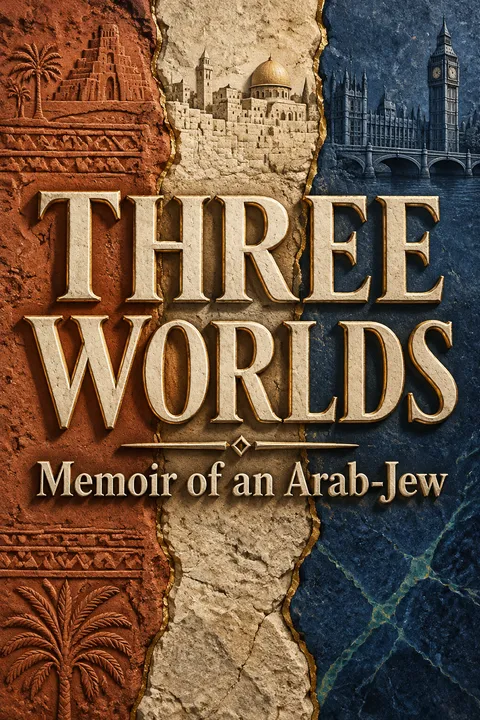
Three Worlds works at once as family memoir, historical argument, and critique of how nations turn complicated lives into usable stories. Its most important conceptual move is to treat the Arab-Jew not as a contradiction to be solved, but as evidence that cultural belonging can cross the borders nationalism later makes feel natural. The three settings in the title, Baghdad, Ramat Gan, and London, reveal how identity is not merely inherited. It is reshaped by schools, language hierarchies, state policy, and the audiences before whom a person must explain himself.
The memoir's political argument is strongest when private recollection meets public evidence. Saida's account of the farhud restores the perspectives of women and neighbours; the migration story combines family decisions with laws, property seizures, and competing political agendas. The bombings chapter is especially revealing because it models both the power and limits of historical inquiry. The evidence challenges an official rescue narrative, yet the surviving record does not establish every chain of command or settle each disputed attack. That distinction makes the argument more credible, not less.
The book also benefits from its author's willingness to expose his own former nationalism and his family's class privilege. These admissions resist the familiar memoirist's trick of turning hindsight into inevitability. At the same time, a wealthy Baghdad family cannot represent all Iraqi Jews, and remembered coexistence should not be mistaken for universal equality or security. The text generally acknowledges both limits.
Its final appeal to one democratic state follows from the insistence that coexistence is possible and ethnic supremacy is unjust. But the political destination is clearer than the institutional route. Equal citizenship would require arrangements capable of protecting communities with real fears and unequal power. The memoir's enduring contribution is less a ready-made constitutional plan than a challenge to the premise that separation is the only imaginable future. Recovering a shared past makes that premise harder to defend, even if it cannot by itself build a shared state.
Review Summary
Reviews of Three Worlds praise its nuanced blend of personal memoir and political history, highlighting Shlaim's exploration of Arab-Jewish identity, the displacement of Iraqi Jews, and discrimination faced in Israel from Ashkenazi Jews. Readers appreciate his honest, self-aware storytelling and the evocative portrayal of pre-Zionist Baghdad. Some critics note the book falls between memoir and historical critique without fully satisfying either, and wish for more reflection on his ideological transformation. Overall, most find it illuminating, emotionally resonant, and deeply relevant given ongoing Middle Eastern conflicts.
Glossary
Arab-Jew
Arab culture, Jewish faithShlaim uses Arab-Jew for Jews whose language, customs, food, music, and social life were part of Arab culture. He does not mean that they necessarily identified with pan-Arab nationalism. The term challenges the assumption that Arab and Jewish identities must be mutually exclusive, while recognizing that the label is contested in both Arab and Israeli political settings.
farhud
1941 Baghdad pogromFarhud is the Arabic term used for the violent anti-Jewish pogrom that swept Baghdad on 1 and 2 June 1941, after a pro-Nazi coup collapsed and British forces retook Iraq. The violence killed 179 Jews, injured several hundred, and involved extensive looting. Shlaim presents it as a political rupture shaped by disorder, propaganda, and local violence, not as proof of timeless religious hostility.
Iraqi orientation
Jewish Iraqi civic belongingIraqi orientation describes the commitment among many Iraqi Jews, particularly from the 1920s, to live as equal citizens and contribute to the development of Iraq. It contrasted with Zionist efforts to build a Jewish state in Palestine. The phrase captures a civic and cultural attachment to Iraq, rather than a lack of Jewish identity.
Denaturalisation Law
Permanent exit through renounced citizenshipPassed by the Iraqi parliament in March 1950, the Denaturalisation Law allowed Jews to leave Iraq permanently if they surrendered Iraqi citizenship and waived the right to return. The law remained in force for a year. It did not initially specify what would happen to emigrants' property; in 1951, a separate law froze the assets of Jews who had registered to depart.
Operation Ezra and Nehemiah
Airlift of Iraqi JewsOperation Ezra and Nehemiah was the name given to the large-scale airlift that transported Iraqi Jews to Israel, principally in 1950 and 1951. The operation followed Iraq's decision to permit permanent emigration after renunciation of citizenship. Zionist accounts framed it as a rescue mission; Shlaim argues that this description obscures the political pressures, contested tactics, and losses involved.
Mizrahim
Jews from Middle Eastern communitiesMizrahim is the broad Israeli category for Jews whose families came from Middle Eastern and North African countries. Shlaim notes that Iraqi Jews were often described through other labels in the early years of Israel, including Oriental or Sephardi. The category became part of a society where Jews of Arab origin frequently faced cultural devaluation and unequal access to power.
ma’abara
Temporary immigrant transit campA ma’abara was a transit camp established in Israel to house new immigrants, including many Jews arriving from Iraq and other Middle Eastern and North African countries. Residents often lived in tents or corrugated metal structures, with limited water, sanitation, and employment. The camps were presented as temporary, but for many newcomers they embodied hardship and a loss of control over where to live.
Norma Bet
Adjusted school exam thresholdNorma Bet, also called Norm B, was a limited adjustment to the pass threshold on Israel's seker exam for children of Asian and African origins. The exam helped determine access to academic secondary education. Supporters of the adjustment argued that poverty and educational opportunity shaped performance; critics of the wider system argued that its tracking practices still directed many Mizrahi children away from academic schooling.
lachrymose conception of Jewish history
History framed as continuous sufferingHistorian Salo Baron used this phrase to criticize accounts that reduce Jewish history to an uninterrupted sequence of persecution and tragedy. Shlaim argues that such a framework is especially inadequate for the history of Jews in the Near East, where experiences included cultural achievement, social integration, and periods of coexistence as well as discrimination and violence.
About the Author
Other books by Avi Shlaim
Download PDF
Download EPUB
.epub digital book format is ideal for reading ebooks on phones, tablets, and e-readers.








