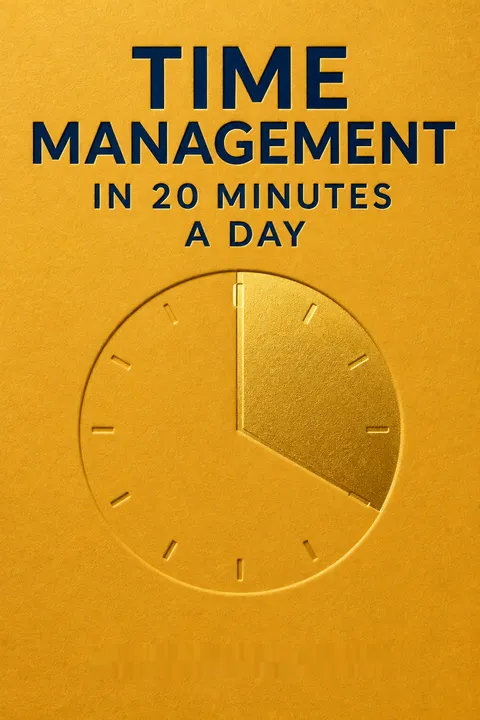


Key Takeaways
Treat time management as life design, not a contest in doing more
More than task control. Holly Reisem Hanna’s system grew out of a life that changed after she became a parent. She was caring for a young child, building a freelance business, and still trying to manage the home as she had before. One day, while she rushed between work and childcare, her daughter took a credit card from Hanna’s wallet and put it in her own purse. The card was safe, but the episode made clear that improvising everything was no longer working.
Make room for what matters. Hanna tested planners, apps, and routines until she found ways to manage obligations while preserving time for work, family, friends, and rest. The book’s title points to its practical scale: many changes can begin with a short daily planning or setup session. The goal is not to fill every hour, but to make deliberate choices about what deserves one.
The opening story makes overload concrete: a misplaced card becomes a signal that a person’s routines no longer match the demands of life. That framing is more useful than treating disorganization as a character flaw. A schedule is a design for allocating finite attention, not proof of virtue. The useful question is not how to squeeze in more, but which demands are worth building a system around. There is a limit, however, to individual optimization: care work and inflexible jobs can constrain choice. A good method should help people see those constraints clearly, not imply that every overloaded day can be fixed with better planning.
Keep email from turning your morning into everyone else's task list
Protect your best attention. Opening email first thing makes other people’s requests the day’s starting agenda. Hanna recommends checking messages at set times, ideally when concentration is less valuable for demanding work. Turn off alerts, move the phone out of reach, and use a separate channel for truly urgent matters if the job requires quick access.
Give messages a destination. Sort correspondence into folders for projects, clients, and priority levels. Use filters for newsletters, and prepare reusable replies for questions that recur. During an email session, file messages that need no action, answer simple requests, and move complex work into a task list or a later time block. Hanna favors an empty inbox, but the more important principle is that email should not quietly become an unmanaged to-do list.
Email combines communication with task assignment, which is why an inbox can feel less like a mailbox and more like a queue of other people’s priorities. Scheduled checking creates a boundary between receiving requests and deciding what to do about them. The folders and templates reduce repeated decisions, not merely visual clutter. Still, an empty inbox is a preference, not a reliable measure of productivity. Some roles require rapid response, and some messages deserve an ongoing record. The sounder test is whether each message has a clear next step, owner, or reason to remain visible.
Put real work on the calendar, not just another hopeful list
Make time visible. Time blocking means assigning specific periods to tasks and obligations, rather than listing them without accounting for how long they take. Hanna suggests planning one day at a time, often in 30-minute increments, and including routine demands such as travel, meals, and household tasks. Estimate generously. If the plan cannot fit, something must be delayed, delegated, outsourced, or removed.
Turn goals into actions. The SMART goal-planning method asks whether a goal is Specific, Measurable, Achievable, Relevant, and Time-Bound. Those criteria turn a broad wish into steps that can be scheduled. Hanna also recommends considering quarterly goals instead of relying only on annual targets, because a shorter horizon can make deadlines feel more immediate. Choose paper or digital tools according to what is easiest to maintain.
A to-do list describes demand; a time-blocked calendar tests capacity. That distinction is powerful because people routinely confuse having identified a task with having made room for it. Including meals, travel, and chores also makes a plan more honest about the infrastructure of daily life. SMART criteria can sharpen vague intentions, but measurement should not replace judgment: a goal may be measurable and achievable yet poorly chosen. Quarterly planning can create useful urgency, provided the shorter cycle does not turn every interest into a performance target. The calendar should reveal trade-offs, not disguise them.
Reduce the workload before trying to execute it faster
Shrink the task pile. Hanna’s priority process starts by getting obligations out of your head, separating what must happen today from what can wait, attaching realistic deadlines, and then scheduling the most urgent and valuable work. The next question is whether every remaining task needs to be done in its current form.
Choose a lighter route. Simplify a recurring job, automate it, batch similar tasks, delegate it, or delay it. Hanna describes grouping errands on Fridays to reduce repeated trips. Automatic bill payments and recurring household orders reduce routine administration. Household members can share chores, while paid help may make sense when its cost is justified by the time returned. A flexible long-term list holds tasks that are not yet important enough for today’s schedule. Review it weekly, since circumstances can change.
This is a useful correction to productivity advice that treats every task as sacred and asks only how to complete it faster. The more fundamental decision is whether the task deserves to exist, and if so, who should do it and how often. Batching reduces the repeated setup involved in switching between unrelated activities, while automation can remove routine decisions altogether. Yet automation and outsourcing are not equally available to everyone, and a subscription can shift costs rather than eliminate them. A fair system includes shared household labor and makes hidden work visible, rather than assuming one person can optimize their way through an unequal load.
Make tomorrow easier by giving every object and task a home
Reduce avoidable searching. Hanna recommends storing frequently used objects near where they are needed and returning them there after use. To declutter a room, the four-box method sorts displaced items into Donate, Relocate, Sell, and Trash. For clothes, turn hangers around and reverse them only after wearing an item; after six months, review what remains, allowing for seasonal needs.
Prepare before the rush. A short evening routine can include reviewing tomorrow’s schedule, choosing clothes, packing a bag, preparing lunch, and returning keys and other essentials to their places. A tidy workspace and simple digital folders serve the same purpose: they reduce the time spent locating what matters. The point is not a spotless home. Small, repeatable resets prevent disorder from becoming tomorrow’s extra assignment.
Organization pays off when it lowers the effort needed to begin, not when it produces a beautiful room. The method of storing objects according to where and how often they are used treats the environment as a memory aid. Evening preparation does something similar for decisions that would otherwise compete with a rushed morning. These systems are especially helpful when attention is already divided. The caution is that tidying can become its own form of avoidance or perfectionism. A useful reset should be bounded, practical, and proportional to the time it saves.
Make every meeting justify the hours it consumes
Decide why people are gathering. A useful meeting has an objective, an agenda, necessary participants, a time limit, and preparation that is shared in advance. Hanna cites research suggesting that engagement drops noticeably after about 30 minutes, so organizers should match the agenda to the available attention and start on time rather than waiting for late arrivals.
Leave with ownership. Keep discussion tied to the agenda. The Parking Lot Method records relevant but off-topic ideas for later consideration, rather than letting them derail the meeting. Before closing, recap decisions, assign action items, and send a short follow-up so each person knows what happens next. Virtual meetings also benefit from tested technology and active roles for participants, since remote attendees can more easily drift into other work.
Meetings consume several people’s time at once, so their cost is collective. An agenda and a deliberate participant list are not bureaucratic extras; they are ways to protect that shared resource. The Parking Lot Method is particularly useful because it acknowledges an idea without allowing it to seize the whole conversation. But structure alone cannot make a meeting worthwhile. Some problems need discussion, disagreement, or shared interpretation, and a strict clock can suppress useful complexity. The better standard is a clear purpose, an appropriate format, and a visible result, whether that result is a decision, a next step, or a reason not to meet again.
Say no before borrowed obligations crowd out chosen priorities
Protect capacity without hostility. Hanna calls people and requests that drain time time vampires. Saying no can be easier if the response is delayed until availability is clear, paired with an alternative time, or delivered as a brief and courteous decline. This prevents a reflexive yes from becoming a commitment that produces stress and resentment.
Retire unnecessary standards. After becoming a parent, Hanna found that keeping a spotless home and preparing elaborate meals could not remain the default. She adopted a more forgiving standard and gave greater weight to time with her daughter. The same judgment applies to work and volunteering: a task may be possible but still not deserve the hours it takes. Choosing a simpler version, such as store-bought treats instead of homemade ones, can preserve the priority without taking on unnecessary labor.
A gracious refusal is not simply a boundary around the calendar. It is a way to align commitments with actual values rather than with the desire to appear agreeable or capable. Hanna’s shift away from perfect housekeeping is persuasive because it shows that standards have opportunity costs: time spent polishing one domain is time unavailable elsewhere. This does not mean that every demanding duty is optional, especially when care or employment obligations are involved. It does mean that optional perfection should not be mistaken for responsibility. A useful question is whether the task serves a real need or mainly protects an image of how things ought to look.
Practice staying with one hard task when your brain begs for novelty
Let concentration deepen. Hanna draws on Cal Newport’s advice to tolerate boredom instead of escaping difficult work through a quick check of social media or email. She recommends removing distractions and working on one task at a time. The Pomodoro Technique supports this by setting a 25-minute period for focused work, followed by a short break.
Plan backward from the result. For a long-term project, backward planning begins with the desired outcome and identifies the milestones and actions needed to reach it by a deadline. Hanna cites a 2017 study comparing forward and backward planning, which found advantages for backward planning in motivation, confidence, time pressure, and goal-relevant performance. In jobs that genuinely require rapid task-switching, written checklists and frequent reprioritization can help prevent important details from being lost.
The section links attention to planning: a task is easier to focus on when its next step and destination are clear. Short, protected work intervals lower the psychological barrier to starting, while backward planning turns a distant ambition into a sequence of nearer commitments. The advice to tolerate boredom is also a reminder that discomfort is not always evidence that a task should be abandoned. Still, uninterrupted focus is not available in every role, and some work depends on responsiveness. The practical distinction is between switching that the work requires and switching that a notification merely invites.
Build a system that fits your energy, values, and imperfect days
Design around the person. Hanna tried different planners and apps before finding a format she could keep using. She notes that morning people and night owls may have different periods of alertness, so demanding work should be scheduled when an individual is most capable of doing it. Her conclusion is not to enforce one ideal routine, but to test methods and keep the ones that work.
Protect the source of effort. The book treats sleep, food, movement, relaxation, and brief restorative breaks as part of time management, not as prizes for finishing every task. Hanna also recommends restarting after a lapse instead of treating a missed planning session as failure. A written list of habits to stop, such as purposeless scrolling or overcommitting, can make room for activities that better reflect a person’s own definition of success.
This closing principle keeps the book’s tools from hardening into another standard of perfect performance. A planner is useful only if it fits a person’s rhythms and circumstances, and a routine that collapses after one missed day is poorly designed. Rest matters here not as a decorative wellness add-on but as part of the capacity required for sustained attention and sound decisions. The deeper challenge is to define success before adopting efficiency measures. Otherwise, better systems can simply help someone pursue a life they never deliberately chose.
Analysis
Hanna’s book is a practical guide organized around the everyday points where time leaks away: messages, unclear goals, excessive obligations, disorder, meetings, and fractured attention. Its unifying claim is not that people need more hours, but that their hours need clearer boundaries and better destinations. The progression is meaningful. First, control incoming demands. Then specify desired outcomes, decide what matters, and make the physical and social environment support those decisions. Focus becomes possible when the surrounding system stops generating unnecessary interruptions.
The book’s strongest move is its attention to ordinary friction. A missing card, overflowing inbox, messy workspace, or chaotic morning is not treated as a personal failing. Each becomes a prompt to alter the process that produced it. That makes the advice more humane and more actionable than exhortations to exert greater willpower. Time blocking, batching, automation, delegation, and meeting agendas are modest techniques, but together they externalize memory and reduce repeated choices.
Its central tension is that time management can be framed either as greater output or as greater agency. The title and many tools could support an endless productivity project, yet Hanna repeatedly argues that the point is to make space for family, leisure, and self-care, and to accept that some tasks should be dropped or done imperfectly. That value-based standard is essential. Without it, efficiency can intensify the very overload it is meant to relieve.
The advice also varies in feasibility. A worker with control over email and meetings can change those systems more easily than someone in a service role or an unpredictable caregiving situation. The book acknowledges this difference when it discusses multitasking jobs, but its most transferable lesson is broader: adapt the method to the actual constraints. Its tools are not a universal schedule. They are a menu for noticing where time goes, deciding what deserves it, and building a repeatable path from intention to action.
Review Summary
Time Management in 20 Minutes a Day receives generally positive reviews, with readers praising its concise, practical approach to improving productivity. Many find the book's tips and strategies easy to implement, particularly for beginners. Reviewers appreciate the book's focus on small, actionable changes and its accessibility. Some critics note that the content may be familiar to those already well-versed in time management techniques. Overall, readers find the book helpful for those looking to enhance their time management skills without feeling overwhelmed.
People Also Read








Glossary
Time blocking
Scheduling tasks into timeA planning method that assigns tasks and obligations to specific periods on a calendar. It makes available time visible, encourages realistic estimates, and exposes when a person has committed to more than can fit. Hanna suggests planning one day at a time and including routine activities, not only major work.
SMART goal-planning method
A test for clear goalsA goal-setting framework in which a goal is Specific, Measurable, Achievable, Relevant, and Time-Bound. Hanna uses the criteria to clarify what someone intends to accomplish, why it matters, how progress can be assessed, and by when. The goal is then broken into concrete action steps that can be scheduled.
Pomodoro Technique
Timed focused work intervalsA method for concentrating on one task for a set period, commonly 25 minutes, followed by a short break. Hanna presents it as a way to make focused work feel manageable and to create a clear boundary against distractions. A person completes an interval on one task before choosing what to work on next.
backward planning
Planning from the desired resultA method for pursuing a long-term goal by starting with the intended outcome and deadline, then identifying the milestones and actions needed to reach it. Hanna describes it as a form of reverse engineering: the end point provides a structure for working out what must happen, and in what order.
Parking Lot Method
Saving off-topic meeting pointsA meeting facilitation technique for capturing useful ideas that fall outside the agenda. The facilitator records the point, often with the contributor’s name, and returns the discussion to the planned topic. The saved items can be addressed if time remains or handled afterward, without dismissing the person who raised them.
Stop Waiting Around method
Using brief idle momentsHanna’s name for using small pockets of waiting time to complete a modest task or make progress on something useful. Her examples include doing a quick household chore while a microwave runs or reviewing schoolwork while waiting for a bus. The method treats brief pauses as optional opportunities, not as time that must always be filled.
time vampires
Requests that drain available timeHanna’s term for people, invitations, favors, or other demands that consume time and energy. The idea is not that every request is unreasonable, but that unexamined agreement can crowd out chosen priorities. She suggests delaying a decision, offering a different time, or declining politely when a commitment does not fit.
Relative Effects of Forward and Backward Planning on Goal Pursuit
Study comparing planning directionsA 2017 study cited by Hanna that compared planning from the beginning of a goal with planning backward from its desired outcome. The book reports that backward planning was associated with greater motivation and goal expectancy, less time pressure, and better goal-relevant performance. Hanna uses the finding to support mapping long-term goals from their endpoint.
Download PDF
Download EPUB
.epub digital book format is ideal for reading ebooks on phones, tablets, and e-readers.








