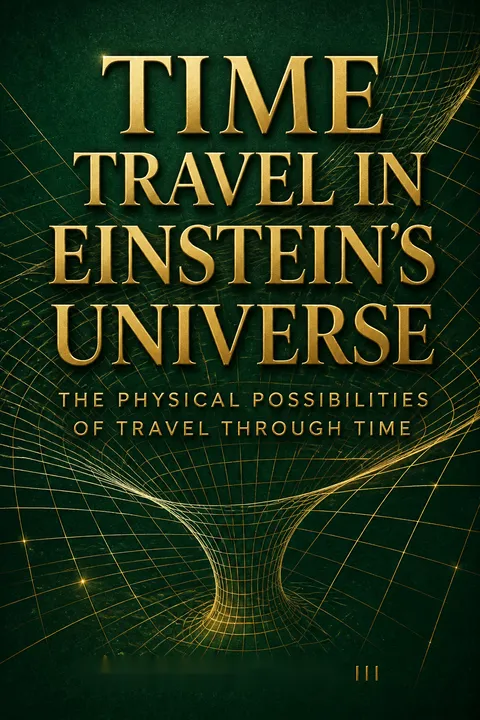


Key Takeaways
Relativity makes future travel real, but leaves past travel uncertain.
Time has a path. H. G. Wells imagined time as a fourth dimension, and Einstein’s relativity gave that idea mathematical force. An event needs three spatial coordinates and a time coordinate. An object’s history through this four-dimensional spacetime is its world line: the route from its birth through its life. Ordinary motion carries that route forward in time. A traveler to the past would need a world line that loops back to an earlier event, perhaps even crossing its own path.
Time is not just space. Unlike the three spatial dimensions, time has a different role in the equations of relativity. The speed of light separates events that can affect one another from those that cannot. So time travel is not simply turning around and walking in another direction. Relativity permits a one-way journey into the future; returning to the past requires far more unusual spacetime geometry.
What's striking is how a familiar science-fiction image becomes a precise question about paths through spacetime. The world-line picture replaces the idea of a traveler moving through a universal clock with a geometric account of what different observers can experience. It also guards against a common confusion: time being called a dimension does not mean it behaves like another direction in a room. The crucial issue is causal structure, not human imagination. This distinction gives the book its intellectual tension: future travel follows directly from tested physics, while past travel depends on exotic conditions.
Use speed or gravity to let your own clock fall behind.
The future is reachable. Special relativity says that a fast-moving clock ticks more slowly than a clock at rest relative to it. In the twin paradox, one sister stays on Earth while the other travels to Alpha Centauri at 80 percent of light speed and returns. The traveler ages six years while her sister ages ten. The difference is not a contradiction: the traveler accelerates and turns around, so the twins follow different paths through spacetime.
The effect is measured. At 99.995 percent of light speed, an astronaut could age ten years while Earth ages a thousand. Such travel is far beyond current human engineering, but the underlying time dilation has been observed. Fast-moving muons last longer than their stationary counterparts, and atomic clocks flown around Earth returned 59 nanoseconds behind ground clocks. Cosmonaut Sergei Avdeyev accumulated about one fiftieth of a second of future travel in orbit.
The twin example works because it makes a counterintuitive result personal: the traveler’s body, not only a clock, records less elapsed time. It also shows why relativistic effects are not a trick of perspective. When the sisters reunite, they agree about how much each has aged. The limit is practical rather than conceptual. The book’s near-light-speed itinerary demands immense energy, shielding, and propulsion, so the same mathematics that makes time travel possible also reveals its staggering price.
A past visit must branch history or fit history exactly.
Paradoxes demand a rule. The Grandmother Paradox asks what happens if a traveler prevents their own birth. One proposed answer is the many-worlds interpretation: changing the past creates a different history, while the traveler’s original history remains intact. Another is the principle of self-consistency: a visitor may enter the past, but events must unfold without contradiction. In this view, the traveler was already part of the history they remember.
Fiction makes the rules vivid. In Back to the Future, the hero’s interference with his parents’ courtship threatens his existence, but his fading hand does not resolve the logical loop. Bill and Ted’s Excellent Adventure offers a self-consistent alternative: the boys find jail keys hidden where they will later place them. In Somewhere in Time, a watch passes through a closed loop without a clear maker, an example Novikov called a jinn.
These alternatives separate two questions that popular stories often blur: can the past be visited, and can it be changed? Branching histories preserve the traveler’s origin by multiplying outcomes. Self-consistency instead treats the known past as a constraint, not a blank page. Both approaches have costs. Branching raises questions about what counts as a distinct world, while self-consistency can make choice feel scripted. The key insight is that paradoxes do not automatically refute time travel, but any physical account must explain how contradictions are avoided.
General relativity offers shortcuts, not a practical time machine.
Curved spacetime changes routes. A closed timelike curve is a path through spacetime that returns to an event in its own past, even though the traveler moves forward locally. Einstein’s gravity permits mathematical geometries with such paths. Gott’s proposal uses two cosmic strings, extraordinarily dense strands whose spacetime geometry creates shortcuts. If the strings moved in opposite directions at more than 99.999999996 percent of light speed, a traveler could circle them and return to an earlier event.
Other routes have costs. A traversable wormhole would connect distant regions through a short tunnel, but it needs negative-energy material to stay open. A warpdrive bends space to create a shortcut and also requires exotic matter. String loops risk collapsing into black holes, and travelers could be trapped inside. These are solutions to equations, not machines anyone knows how to build.
The book’s strongest distinction is between mathematical permission and physical availability. General relativity can describe a route that defeats an ordinary light path, but that does not establish that the required strings, wormholes, or energy conditions exist in nature. The shortcut metaphor is useful because it shows how a causal loop could arise without a traveler locally outrunning light. Yet the extraordinary requirements are not incidental engineering annoyances. They may be clues that the universe prevents these geometries from forming.
Use light's delay as a telescope into the universe's past.
Seeing is not visiting. Light takes time to travel, so looking at a distant object means seeing it as it was when its light began the journey. Alpha Centauri appears four years in the past; the Andromeda galaxy appears roughly two million years in the past. The cosmic microwave background, leftover radiation from the early universe, reaches us from when the universe was about 300,000 years old.
Even Earth leaves echoes. Stand five feet from a mirror and the reflected light shows you as you were ten nanoseconds earlier, because the light travels to the mirror and back. Scientists can bounce lasers off reflectors left on the Moon and receive the signal 2.6 seconds after sending it. In principle, a sufficiently distant reflector and huge telescope could return an image of Earth from years ago. That would reveal the past, not transport anyone into it.
This distinction turns astronomy into a concrete lesson about evidence: observation always arrives from an earlier state. A telescope is therefore not a window onto the universe as it is now, but a collection of delayed records at different distances. The same logic helps prevent confusion between seeing history and entering it. The imagined Earth-reflector system is a useful limit case, but its scale makes clear that a physical possibility can remain functionally inaccessible.
Quantum theory may block time machines, but the verdict is unsettled.
The vacuum is not simple emptiness. Quantum physics allows vacuum states with different energy densities and pressures. Hawking’s chronology protection conjecture proposes that quantum effects may always disrupt a developing time machine. In Misner space, a simplified model where space loops back on itself, calculations using one vacuum state found energy becoming infinitely large near the boundary between ordinary time and time travel.
A different state changes the result. Gott and Li-Xin Li found a self-consistent alternative by using the Rindler vacuum, the vacuum associated with accelerated observers. In their Misner-space model, its negative energy and pressure cancel positive contributions from the wrapped geometry, leaving zero overall energy density and pressure. The result challenges a proposed universal ban, but it is a theoretical construction, not an experiment. A complete theory of quantum gravity is still missing.
This episode shows why the choice of quantum vacuum matters: a calculation that seems to forbid a geometry may depend on an assumption about the state of empty space. The deeper standard is self-consistency. The geometry determines the quantum state, and that state must in turn support the geometry. This is a powerful methodological lesson, though not a final verdict. A mathematically consistent solution can still fail once omitted effects, such as the traveler’s own gravitational influence, are included.
A tiny time loop could make the universe its own origin.
The beginning remains a puzzle. The hot big bang explains the universe’s expansion and the cosmic microwave background, while inflation offers an account of why the early universe was nearly uniform. But a beginning raises a first-cause question: what explains the initial state? Gott and Li proposed a speculative answer in which an extremely short time loop at the universe’s beginning connects to an expanding branch of cosmic history. A baby universe on that branch could grow into the universe that produced it.
The loop also sets direction. Their model’s loop is about 5 × 10⁻⁴⁴ seconds long. The authors argued that its low-energy, ordered state could help explain why entropy increases and signals travel toward the future. The universe would have no earliest event, although its history would be finite in a geometric sense. This proposal depends on quantum conditions that remain unresolved.
The proposal reframes first cause as a boundary-condition problem rather than a demand for a first event. That is conceptually fertile: a finite structure need not have an edge in the ordinary sense, just as a finite loop has no first point. But self-creation is not the same as creation from nothing, and the model does not explain why its laws or quantum state exist. Its value is therefore partly scientific and partly diagnostic: it exposes what a satisfying account of cosmic origins would need to explain.
Use random observation to bound a lifespan, not name its ending.
The observation date matters. Gott’s 95 percent Copernican argument assumes that an observation occurs at an ordinary, effectively random point during something’s lifetime. Under that assumption, there is a 95 percent chance that the future duration lies between one thirty-ninth and thirty-nine times the duration already observed. In 1969, after the Berlin Wall had stood for eight years, Gott estimated that it had a 50 percent chance of lasting another two and two-thirds to 24 years. It fell 20 years later.
The estimate is broad. Applying the 95 percent rule to Homo sapiens, which the book estimates had existed for 200,000 years, gives a future range of about 5,100 years to 7.8 million years. The method estimates duration, not cause or exact date. It should not be used when the observation point is special, such as the first minute of a marriage or the beginning of a new project.
The method’s memorable power comes from asking whether the observer’s timing is special, not from claiming to foresee a mechanism. Its wide bounds are a feature: the argument can constrain extreme expectations without pretending to predict a particular ending. However, the result depends on a defensible reference class and unbiased sampling. People often observe institutions precisely because they are in crisis or at a milestone, so random timing cannot simply be assumed. The Berlin Wall example illustrates the logic, not a guarantee for every case.
Make a self-supporting off-world colony a second branch of human survival.
Earth is a vulnerable address. Gott argues that intelligence has not made humanity immune to extinction. The species has existed for about 200,000 years on one planet, while epidemics, ecological change, war, and other risks could threaten the whole population at once. A colony beyond Earth would provide a separate chance of survival, like preserving copies of a library in different places.
The proposal is deliberately concrete. The book sketches a Mars settlement beginning with eight people and roughly 400 tons of life-supporting habitat materials, delivered by about 18 Saturn V-class launches. Its founders would need to live off local resources and grow the settlement. Gott’s larger warning is that spaceflight may be a brief opportunity, not an inevitable march of progress: expensive programs can end when their political purpose disappears. A colony is a proposal, not a demonstrated survival guarantee.
The resilience argument is stronger than the book’s precise timetable. A second habitat reduces the chance that one planetary disaster ends the lineage, much as distributed backups protect information from a single failure. But separation alone is not enough. A settlement that depends indefinitely on Earth, or cannot maintain its ecosystem and social systems, is not an independent backup. The proposal usefully shifts spaceflight from spectacle toward redundancy, while leaving the hardest question open: what level of self-sufficiency would make a colony genuinely resilient?
Analysis
The book’s central achievement is to make time travel a tool for thinking about physics rather than a promise of futuristic engineering. Its argument moves from the familiar, experimentally tested effects of special relativity to increasingly speculative structures in general relativity, then to cosmology and the limits of prediction. The sequence matters. Readers first learn why clocks can disagree, then see how curved spacetime might turn that disagreement into a loop. The same geometric reasoning is finally applied to the universe’s origin and the direction of time.
The narrative is especially effective when it distinguishes a mathematical solution from a physically buildable device. Cosmic strings, wormholes, and time-loop cosmologies are not presented as ordinary technologies. They are extreme cases that expose assumptions in the laws of physics. Still, the book’s language sometimes lets possibility sound nearer to feasibility than the evidence warrants. No observation in the text establishes that the relevant cosmic strings or traversable wormholes exist, and the quantum-gravity problem remains central to its strongest claims. The self-creating universe is best read as a model worth testing, not an account of established cosmic history.
The Copernican argument is the book’s most portable idea, and its most vulnerable. It derives broad bounds from the premise that an observer is not specially placed in a timeline. That premise is illuminating, but the result depends on how the reference class is chosen and whether observation times are genuinely unbiased. A person studying an institution may arrive precisely because it is unusually stable or visibly failing. The method is therefore more persuasive as a discipline against unjustified certainty than as a stand-alone forecast. The final spaceflight argument extends the same humility into policy. Humanity is not guaranteed to realize its technological potential, and historical achievements do not ensure continuation. The book’s most durable message is not that time machines are around the corner, but that the laws of nature can make common sense unreliable, and that survival depends on treating possibility, evidence, and risk as separate questions.
Review Summary
Time Travel in Einstein's Universe explores the possibility of time travel through physics, offering explanations of Einstein's theories and more speculative ideas. Readers found it engaging and accessible, praising Gott's clear explanations and use of metaphors. Some criticized the broad predictions and reliance on unproven theories. The book covers topics like relativity, quantum mechanics, and cosmic strings. While some sections were challenging, many appreciated the blend of science and imagination. Overall, it's considered a thought-provoking read for those interested in time travel and physics.
People Also Read
Glossary
World line
An object's path through spacetimeA world line traces an object's location through both space and time. It includes every event in the object's history, from its beginning to its end. Ordinary motion produces a path that advances toward the future. In a time-travel model, a world line may curve back and intersect an earlier part of its own history.
Closed timelike curve
A path returning to its pastA closed timelike curve is a possible path through spacetime that returns to an event in its own past. A traveler following it can move forward locally at every moment yet arrive at an earlier event. Such curves appear in some mathematical solutions of general relativity, but their existence in the physical universe is unconfirmed.
Principle of self-consistency
Past events cannot contradict themselvesThe principle of self-consistency says that events involving a time traveler must fit into one coherent history. A visitor may participate in the past, but cannot cause a contradiction such as preventing their own birth. The traveler’s actions must be among the events that already formed the history they remember.
Jinn
An object with a closed historyGott uses Novikov’s term jinn for a particle or object whose world line forms a closed loop in time. The object appears to have no ordinary point of origin because it is passed around the loop rather than manufactured or created at a distinct first event. Information can also circulate in such a loop.
Chronology protection conjecture
Physics prevents travel to the pastStephen Hawking’s chronology protection conjecture proposes that physical laws prevent time machines from forming. In the book, one motivation is that quantum effects near the boundary of a time-travel region might grow without limit and disrupt the spacetime geometry. Gott and Li present a theoretical counterexample, but the issue remains unresolved.
Rindler vacuum
Vacuum for accelerated observersThe Rindler vacuum is a quantum vacuum state associated with accelerated observers. The book contrasts it with the normal vacuum, which an accelerating observer may perceive as containing thermal radiation called Unruh radiation. Gott and Li use a Rindler vacuum in a model of Misner space to construct a self-consistent state that does not develop the predicted energy blowup.
Copernican principle
Assume your position is not specialThe Copernican principle is the assumption that an observer’s location is not privileged. In Gott’s applications to time, it means treating the moment of observation as an ordinary point within the period being studied. This supports statistical bounds on how long something may remain observable, but only when the observation point is not selected for being unusual.
95 percent Copernican argument
A statistical lifespan boundThis argument estimates an object’s remaining duration from how long it has already lasted. If an observation occurs at a random point in the object’s observable lifetime, there is a 95 percent chance that its future duration is between one thirty-ninth and thirty-nine times its past duration. The result gives broad probability bounds, not a date or explanation of the ending.
FAQ
1. What is "Time Travel in Einstein's Universe" by J. Richard Gott III about?
- Exploration of time travel: The book investigates the physical and theoretical possibilities of time travel, grounded in Einstein’s theories of relativity and modern cosmology.
- Science meets science fiction: Gott connects real physics with science fiction concepts, showing how fiction has inspired scientific inquiry into time travel.
- Cosmology and universe origins: It covers models of the universe, including the Big Bang, inflation, and the idea of a self-creating universe via time loops.
- Philosophical implications: The book discusses the nature of causality, the arrow of time, and what time travel means for our understanding of the universe.
2. Why should I read "Time Travel in Einstein's Universe" by J. Richard Gott III?
- Accessible explanations: Gott makes complex physics concepts understandable for readers interested in both science and science fiction.
- Authoritative perspective: The author shares personal research and collaborations with leading physicists, offering an insider’s view of cutting-edge debates.
- Bridges imagination and reality: The book demystifies time travel paradoxes and theoretical models, showing their relevance to real physics.
- Expands your worldview: Readers gain a deeper understanding of space, time, and the universe’s structure, challenging common sense and expanding perspectives.
3. What are the key takeaways from "Time Travel in Einstein's Universe" by J. Richard Gott III?
- Time travel is physically plausible: Under certain solutions to Einstein’s equations, time travel to the future and past is theoretically possible.
- Paradoxes can be resolved: The book explains how self-consistency principles and quantum mechanics can avoid classic time travel paradoxes.
- Universe may be self-creating: Gott and Li propose a model where the universe creates itself via a time loop, sidestepping the need for a first cause.
- Humanity’s future is uncertain: Using the Copernican principle, Gott predicts the likely duration of human civilization and stresses the urgency of space colonization.
4. How does "Time Travel in Einstein's Universe" by J. Richard Gott III explain the scientific basis for time travel?
- Four-dimensional spacetime: Time is treated as a fourth dimension, allowing for world lines that can, in theory, loop back on themselves.
- Special and general relativity: Time dilation (from high speeds or gravity) enables travel to the future, while curved spacetime allows for closed timelike curves and potential travel to the past.
- Exotic structures: The book discusses cosmic strings, wormholes, and warpdrives as possible mechanisms for time travel within the laws of physics.
- Quantum effects: Quantum mechanics and vacuum states play a role in whether time machines can exist without causing paradoxes.
5. What are the main time travel paradoxes discussed in "Time Travel in Einstein's Universe" by J. Richard Gott III, and how are they addressed?
- Grandmother paradox: Changing the past to prevent your own existence creates logical contradictions, challenging the possibility of time travel.
- Self-consistency principle: Proposed by Novikov and others, this principle states that events on a time loop must be consistent, so paradoxical changes cannot occur.
- Many-worlds interpretation: Quantum mechanics suggests that alternate timelines can branch off, allowing changes to the past in a different universe without affecting the original.
- Examples from fiction and physics: The book uses stories like "Back to the Future" and "All You Zombies—" to illustrate these paradoxes and their resolutions.
6. How does "Time Travel in Einstein's Universe" by J. Richard Gott III describe time travel to the future and the past?
- Time dilation for the future: Traveling at near-light speeds or being in a strong gravitational field slows your clock, letting you move into the future relative to others.
- Closed timelike curves for the past: Certain spacetime geometries, like those involving cosmic strings or wormholes, allow for loops in time that could enable travel to the past.
- Experimental evidence: Effects like time dilation have been confirmed with atomic clocks and particle decay, supporting the theory’s predictions.
- Practical challenges: Achieving the necessary speeds or constructing massive structures for time travel remains far beyond current technology.
7. What are cosmic strings, and how do they enable time travel in "Time Travel in Einstein's Universe" by J. Richard Gott III?
- Definition and properties: Cosmic strings are hypothetical, ultra-dense, one-dimensional defects in spacetime, possibly left over from the early universe.
- Conical spacetime geometry: The space around a cosmic string is shaped like a cone, causing unique gravitational effects such as lensing.
- Time travel mechanism: Two rapidly moving cosmic strings can create closed timelike curves, theoretically allowing a traveler to return to their own past.
- Gott’s 1991 solution: The author presents a specific solution using cosmic strings to demonstrate how time travel could be possible within general relativity.
8. How do wormholes and warpdrives function as time travel methods in "Time Travel in Einstein's Universe" by J. Richard Gott III?
- Wormholes as shortcuts: Wormholes connect distant points in spacetime, potentially allowing faster-than-light travel and, if manipulated, travel to the past.
- Exotic matter requirement: Keeping a wormhole open requires negative-energy-density matter, which may be provided by quantum effects like the Casimir vacuum.
- Warpdrive concept: The Alcubierre warpdrive warps spacetime to create a shortcut, enabling superluminal travel without locally breaking the speed of light.
- Time travel potential: Two warpdrives moving relative to each other could, in theory, enable travel to the past.
9. What is the chronology protection conjecture, and how does "Time Travel in Einstein's Universe" by J. Richard Gott III address it?
- Hawking’s conjecture: Stephen Hawking proposed that quantum effects would prevent the formation of time machines by causing infinite energy densities at Cauchy horizons.
- Quantum vacuum states: Gott and Li found self-consistent vacuum states (like the Rindler vacuum) that avoid these infinite blowups, challenging the conjecture.
- Implications for causality: If such solutions exist, time travel might be possible without violating causality or creating paradoxes.
- Ongoing debate: The book presents both sides, showing that the question of chronology protection remains open in physics.
10. How does "Time Travel in Einstein's Universe" by J. Richard Gott III connect time travel to the origin and structure of the universe?
- Universe as a four-dimensional entity: The universe is modeled as a curved spacetime manifold, possibly containing closed timelike curves.
- Self-creating universe model: Gott and Li propose that the universe could be its own cause via a time loop, resolving the first-cause problem.
- Cosmological models: The book discusses the Big Bang, inflation, and bubble universes, linking these to time travel possibilities.
- Philosophical implications: This model challenges traditional views on creation, causality, and the nature of time.
11. What is the Copernican principle, and how does J. Richard Gott III use it to predict the future of humanity in "Time Travel in Einstein's Universe"?
- Definition: The Copernican principle states that our place in time or space is not special or privileged.
- Predicting longevity: Gott applies this principle to estimate the future duration of human civilization, political regimes, and other phenomena, with probabilistic confidence intervals.
- Space colonization urgency: The principle suggests the human spaceflight era is likely brief, making off-Earth colonies critical for long-term survival.
- Real-world applications: The method has successfully predicted events like the fall of the Berlin Wall and the duration of political leaders’ terms.
12. What practical advice and predictions does "Time Travel in Einstein's Universe" by J. Richard Gott III offer about space exploration and humanity’s future?
- Urgency of Mars colonization: Gott argues that establishing self-sustaining colonies on Mars or elsewhere is vital for species survival.
- Feasibility of colonization: Sending a small group to Mars is achievable with current or near-future technology, and colonies can grow exponentially.
- Risks of inaction: Without space colonization, humanity remains vulnerable to extinction from disasters.
- Predictions on longevity: Using the Copernican principle, Gott predicts humanity will last between thousands and millions of years, but not forever.
Download PDF
Download EPUB
.epub digital book format is ideal for reading ebooks on phones, tablets, and e-readers.








