

Key Takeaways
Small mistakes change history when larger systems give them room to spread.
Small causes need context. The book uses the butterfly effect to describe how a slight change at the start of a complex process can produce a much larger outcome. The Titanic’s missing binocular key is one example: without the key, lookouts searched the dark sea without glasses. But the sinking also involved a fire, limited lifeboats, and a captain maintaining speed through ice warnings. The key matters as part of a chain, not as a complete explanation.
A chain, not a magic trick. The book moves from shipwrecks to elections, battles, and epidemics to show how modest errors can redirect events. Its central warning is practical: small oversights deserve attention because their consequences depend on what else is already vulnerable.
What's useful here is the distinction between a trigger and the conditions that make a trigger consequential. In safety engineering, disasters often emerge when several weaknesses align, rather than from one spectacular failure. That framing makes the Titanic story more instructive than a simple tale of a lost key. The scientific butterfly effect concerns sensitive physical systems; applying it to history is an analogy, not proof that any small event can produce any large result. The book's strongest cases show the links in the chain, while its more dramatic claims deserve cautious wording.
Build safeguards for fallible people, not imaginary perfect professionals.
Assume safeguards can fail. The book's account of Three Mile Island shows how routine maintenance, closed backup valves, a stuck relief valve, and a misleading indicator combined to bring a reactor close to a full meltdown. At Chernobyl, unsafe reactor design and operator errors compounded one another. In Bhopal, the gas scrubber, flare tower, and cooling system were unavailable when a dangerous reaction began.
Use layers, not faith. Defense in depth means placing multiple independent safety barriers between an error and catastrophe. If one barrier fails, another should still limit the damage. A single rule or a skilled operator cannot reliably carry the whole burden when equipment, procedures, and people are all under pressure.
The important shift is from asking who made the mistake to asking why one mistake could travel so far. This resembles the Swiss cheese model used in safety research: each protective layer has gaps, and accidents become possible when the gaps line up. Redundancy is not waste when the cost of failure is catastrophic. Still, layers must be genuinely independent. Repeating the same flawed assumption in several procedures creates the appearance of safety without much added protection.
Treat ignored warnings as a deadline to stop, not a nuisance.
Dissent can prevent disaster. Before the 1986 Challenger launch, engineers warned that cold temperatures could make the shuttle's rubber O-rings too rigid to seal properly. Managers proceeded despite those concerns, and the shuttle broke apart shortly after takeoff. Schedule and publicity pressures helped drown out a specific technical warning.
Check the facts on the ground. In 1943, General Matthew Ridgway resisted a plan to drop the 82nd Airborne near Rome. He doubted the intelligence and sent officers to assess the situation directly. They found that the Italians would not provide promised support and that roughly 24,000 German troops, including tanks, were near the target. The plan was canceled, sparing the airborne force a likely disaster.
These cases show that dissent is most valuable when it is tied to evidence and can change a decision, not merely expressed as general anxiety. Ridgway's insistence on direct verification offered a way to test claims before committing lives. Challenger shows the opposite pattern: status and schedule made it easier to discount expert concern. Organizations need clear authority to pause risky work, because inviting objections means little if raising one carries a career penalty.
Make critical messages impossible to miss and easy to interpret.
Information must reach the decision-maker. In 1776, a British warning about George Washington's planned attack on Trenton reached Hessian commander Johann Rall. Distracted, he put the letter in his pocket without reading it; it was found on his body after the battle. The American victory revived a cause that had seemed close to collapse.
Transmission is only half the job. During the Charge of the Light Brigade, unclear orders and confusion about which guns to attack sent British cavalry into a heavily defended valley. In another Civil War episode, a copy of Robert E. Lee's campaign orders was found by Union soldiers, but General McClellan moved too slowly to fully exploit the information. A message can be lost, misunderstood, or acted on too late.
The stories distinguish three failure points: a message can fail to arrive, fail to make sense, or fail to prompt action. Modern communication tools solve only the first problem. Clear wording, confirmation of understanding, and an explicit owner for the next step are equally important. These cases also caution against treating information as automatically decisive. McClellan had Lee's plan, but possession alone could not substitute for timely judgment and execution.
After a winning streak, increase scrutiny before expanding the gamble.
Success can distort judgment. The book calls this pattern victory disease: confidence after repeated wins turns into overreach and carelessness. At San Jacinto in 1836, Mexican general Santa Anna divided his forces and underestimated Sam Houston's retreating Texians. Houston attacked by surprise, and the Mexican army was routed in minutes. Napoleon's invasion of Russia offers a larger-scale example: he entered with about 600,000 men, but fewer than 100,000 remained six months later.
Warnings matter most when ignored. Custer's scouts cautioned him about the size of the Native American force at Little Bighorn, but his confidence in past success did not yield to their warning. The outcomes differ, but each episode shows how a leader's record of winning can make new risks look smaller than they are.
The pattern is psychologically credible: success can strengthen confidence while reducing attention to disconfirming evidence. But it is not a law that victory causes defeat. Leaders may win repeatedly because they are capable, and sometimes boldness is precisely what a situation requires. The practical lesson is not to distrust confidence itself, but to add deliberate checks after success: revisit assumptions, listen to less powerful advisers, and ask what has changed in the opponent or the environment.
Keep local design flaws from deciding national outcomes.
Small design choices shape behavior. In Florida's 2000 presidential election, Palm Beach County used a punch-card ballot whose layout confused some voters. Statistical analyses cited in the book estimated that 2,000 to 3,000 people who intended to vote for Al Gore instead selected Pat Buchanan. George W. Bush's statewide margin was 537 votes, and Florida decided the Electoral College result.
Test systems with real users. Election supervisor Theresa LePore introduced the ballot to make room for many candidates and help voters, including older people with impaired eyesight. The book argues that its confusing design changed the election. It also links the result to later events, including the Iraq War, but those further consequences are counterfactual claims, not established outcomes. A national process should not depend on voters interpreting a confusing local form correctly.
The case makes usability a matter of democratic legitimacy, not visual polish. Good design anticipates how hurried, unfamiliar, or visually impaired users will actually behave, rather than assuming they will infer the intended path. Yet the margin comparison alone does not prove exactly how the election would have turned out under a different ballot or recount. The sound policy lesson is stronger than the certainty of the historical claim: election materials should be tested, accessible, and consistent enough to reduce avoidable ambiguity.
Trace epidemics through the conditions that let one infection spread.
A spillover is only a beginning. The book traces HIV to a virus carried by chimpanzees. It describes how an infected hunter may have acquired it while butchering a chimp, with blood entering a cut. That initial transmission alone does not explain a global pandemic.
Social conditions amplify risk. The account identifies urbanization, new roads and railways, increased travel, and the reuse of inadequately sterilized medical syringes as factors that helped HIV spread in central Africa. Later movement between Africa, Haiti, the United States, and Europe carried infections farther. The story is therefore not just about one encounter with wildlife. It is about how changing human systems can turn a rare transmission into a public-health crisis.
This is a valuable correction to the tempting story of a single person causing a pandemic. Infectious disease emergence involves biology meeting ecology, infrastructure, and social behavior; the spillover is a starting point, while transmission conditions determine whether it remains limited or expands. The book's phrase of a tiny blunder should not imply that the hunter could have understood the risk or prevented it. The more useful lesson is to examine systems that increase exposure and make early detection or containment difficult.
Use historical what-ifs to map contingency, not manufacture certainty.
Small turns can open large paths. In 1914, Archduke Franz Ferdinand survived an earlier bombing attempt in Sarajevo. After the visit's route changed, the driver mistakenly turned back onto the original route, bringing the couple near assassin Gavrilo Princip. Their deaths helped trigger a chain of declarations and mobilizations that became World War I.
An alternative is not a fact. The book asks what might have followed if the archduke had lived, if Hitler had been killed in an earlier attempt, or if a different candidate had won an election. These questions reveal how contingent history can be. They cannot establish that a particular alternate leader would have prevented a war or saved millions. The evidence supports the event and its consequences; the imagined branch remains uncertain.
Counterfactual history is useful when it identifies decision points and tests claims that events were inevitable. Its danger is the illusion that one altered detail produces a predictable new world. Political institutions, public opinion, and other leaders continue to act in the imagined scenario, so the causal chain cannot simply be assumed. The most disciplined use of a what-if is comparative: it clarifies which conditions made an outcome more likely, while leaving room for uncertainty about what would have happened instead.
Make preparation a repeatable ritual before the stakes become fatal.
Memory is not a safety system. The book recounts a 1935 test flight in which the Boeing B-299 crashed after its pilots failed to release a flight-control lock. The aircraft was capable, and the pilots were experienced, but one overlooked step proved fatal. Boeing responded by creating a checklist for essential procedures.
Prepare before the emergency. The book also describes Navy pilot Jack “Dusty” Kleiss checking his equipment before the Battle of Midway, from charting tools to his life gear. In medicine, Atul Gawande's team introduced a short surgical checklist in eight hospitals; the book reports that complications and deaths fell when teams used the process and knew one another's names. Preparation turns attention into a routine instead of a last-minute hope.
Checklists work best as memory aids, not replacements for expertise. They protect routine steps so skilled people can focus on the unusual parts of a task, and shared checks can make it easier for team members to notice omissions. Their limits matter: a checklist cannot compensate for unsafe equipment, impossible schedules, or leaders who punish bad news. Preparation is strongest when paired with authority to stop, adapt, and speak up when the situation differs from the script.
Analysis
The book's organizing idea is that history is not only shaped by grand strategies and celebrated leaders. It can pivot on a forgotten letter, a misread warning, a badly designed ballot, or a technician's overlooked adjustment. The stories make this vivid by placing readers at moments when an ordinary act acquires consequences no one present could fully see.
Its most durable insight is systemic: mistakes become disasters when organizations lack buffers, when warnings are discounted, or when no one owns the handoff from information to action. That account aligns with modern safety thinking, including the Swiss cheese model, in which multiple safeguards each contain weaknesses and catastrophe occurs when those weaknesses align. The closing emphasis on checklists follows naturally: reliable systems do not depend on flawless memory.
The book is less secure when it turns plausible contingency into confident alternate history. The ballot may have altered Florida's result, but claims connecting that election directly to later wars require several uncertain steps. Likewise, the idea that one different leader would have prevented a conflict cannot be verified. Counterfactuals are most illuminating as tests of inevitability, not as evidence of what a different world would certainly contain.
There is also a selection effect: a collection about tiny errors naturally highlights striking mistakes while leaving out countless small errors that caused no lasting harm, and large events produced by slow structural forces. That does not undo the book's warning. It sharpens it. The practical question is not whether every oversight threatens civilization, but whether a system has enough resilience to keep a foreseeable human error from becoming irreversible. Read this as a history of vulnerability and prevention, not as proof that chance alone governs events.
Review Summary
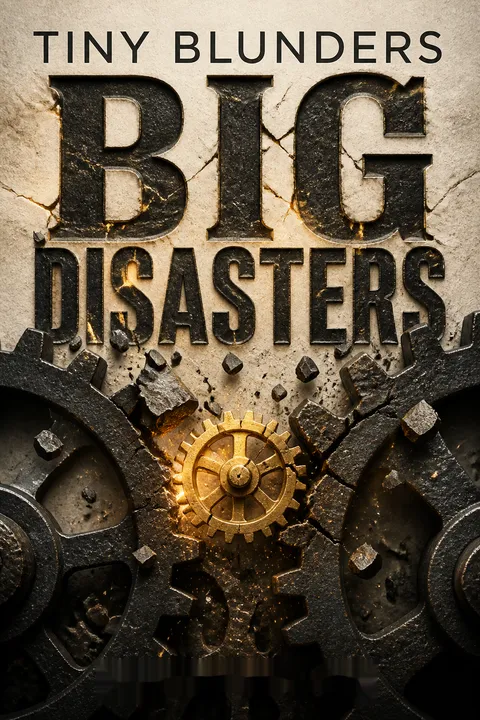
Tiny Blunders/Big Disasters by Jared Knott receives mixed reviews. Many readers find it fascinating, praising its well-researched content and engaging writing style. They appreciate the book's exploration of how small mistakes led to significant historical events. Some criticize the author's occasional bias, speculative conclusions, and organizational issues. Several reviewers note that not all stories fit the book's premise perfectly. Despite these criticisms, many find the book informative and enjoyable, particularly for history enthusiasts. The book's unique perspective on historical events is frequently commended.
Glossary
butterfly effect
small initial change, large consequenceA concept from chaos theory describing how a small difference in the initial conditions of a dynamic system can produce a much larger difference later. The book applies the idea to history, where minor errors may contribute to major outcomes. This historical use is an analogy to the scientific concept, not a claim that every small event determines a specific later event.
victory disease
overconfidence after repeated winsA pattern in which success produces excessive confidence, weaker attention to risks, and increasingly bold decisions. The book uses the term for leaders such as Santa Anna, Napoleon, and Custer, whose earlier victories or confidence contributed to serious misjudgments. It describes a recurring danger, not an inevitable consequence of winning.
Murphy's Law
foreseeable failures eventually occurAn informal saying used in the book to emphasize that a failure that is possible may occur, especially when people overlook weaknesses or cut corners. It is not a literal scientific law. The book applies it to disasters in engineering, transport, and industry where errors, poor design, or inadequate maintenance combined to produce severe consequences.
groupthink
consensus suppresses critical scrutinyA group decision-making failure in which members value agreement and conformity over independent analysis. The book uses the concept to explain how people may accept a dominant plan without challenging its assumptions, particularly when disagreement feels risky. The term highlights the need for meaningful dissent and evidence-based review before a group commits to a consequential decision.
defense in depth
multiple layers of protectionA safety approach that uses several barriers, procedures, or backup systems to prevent one error from causing a catastrophe. If one protective measure fails, another should reduce the danger. The book discusses this approach in nuclear power operations and recommends the broader principle for complex systems where human mistakes cannot be eliminated.
fog of war
uncertainty during military actionThe confusion and incomplete information that make decisions difficult during combat. The book uses the phrase for situations involving misidentification, lost communications, or poor visibility, such as nighttime naval encounters and friendly-fire incidents. It explains why even trained personnel can make serious errors when events move quickly and reliable information is limited.
Download PDF
Download EPUB
.epub digital book format is ideal for reading ebooks on phones, tablets, and e-readers.








