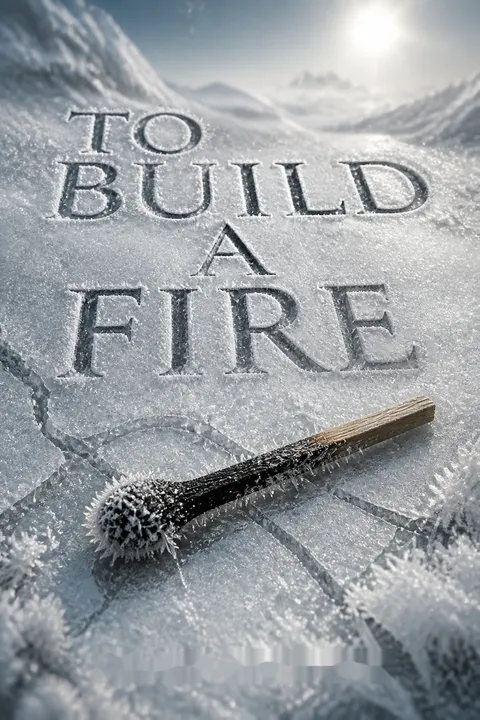


Plot Summary
A Trail Against Advice
A newcomer to the Yukon leaves the main trail for Henderson Creek, aiming to reach the camp where his companions are waiting by evening. He has traveled through cold before, but this day is far harsher than he understands: his spit crackles in the air, and the temperature has fallen far below the fifty-below mark he considers dangerous.
An old-timer from Sulphur Creek had warned him not to travel alone in such conditions, but the man trusts his pace and his gear instead. He carries only lunch, expecting a fire and supper at camp. Behind him, a native husky keeps close, instinctively uneasy and eager for shelter. The man sees the dog’s behavior as no reason to change course.
The opening makes the central danger a mismatch between knowledge and judgment. The man possesses useful facts: he knows cold can numb exposed skin, recognizes dangerous creek springs, and remembers advice. What he lacks is the imaginative capacity to connect those facts to his own vulnerability. His confidence is not simple ignorance; it is a habit of treating every warning as a manageable technical problem. The dog offers a counterpoint, responding to conditions without needing to explain them. Because the man reads its unease as irrelevant, the story establishes early that survival will depend not only on skill, but on whether he can revise his assumptions in time.
The Creek’s Hidden Traps
As the man follows the creek, he spots places where warm springs conceal water beneath snow and steers around them. When he sends the reluctant dog across a suspicious patch, the ice gives way under its forelegs. The man helps pull ice from between the dog’s toes, briefly exposing his own hand to the cold.
At the forks, he stops to eat, but his fingers lose feeling while he unwraps his food, and the ice on his mouth prevents him from taking a bite. He realizes he should have made a fire first. Stamping warmth back into his feet, he gathers dry twigs and builds one. Its heat lets him thaw his face and eat. Reassured by this quick recovery, he sets off again.
The first crisis is small enough to reinforce the man’s confidence. He meets a genuine hazard, responds competently, and sees the fire restore his comfort; the immediate success seems to confirm that his plans are adequate. Yet the scene also reveals how little margin he has. A brief exposure numbs his fingers, and an ordinary pause at lunch becomes dangerous before he notices what is happening. The dog’s wet paws make the consequences visible in advance, but the man’s aid is practical rather than relational: he treats the animal’s danger because he understands the physical problem. The fire works as a temporary correction, not a cure for the larger mistake of traveling alone.
Water Beneath the Snow
Continuing up the left fork, the man steps through a snow-covered spring and wets his feet to the knees. He knows wet footwear can become fatal in this cold, so he climbs the bank and gathers dry grass, twigs, and branches for another fire. This time he builds it beneath a spruce, where the brush offers easy fuel. As the flame grows, he expects to remove his moccasins and dry them.
His hands are already losing sensation, but he tells himself the fire has arrived in time and recalls the old-timer’s warning only to dismiss it as excessive caution. Then snow slides from the spruce’s loaded branches, knocking down the rest in a cascade. It buries the fire completely. His one working source of warmth is gone.
The spring turns a known hazard into an irreversible escalation: now the man’s feet are wet, and he cannot simply keep walking to restore circulation. He responds with careful, technically informed action, which makes the fire’s loss especially important. His error is not failure to understand that he needs heat; it is choosing convenience over the wider conditions, building beneath a snow-heavy tree. The falling snow exposes a blind spot in practical reasoning: he considers the fuel, flame, and wet feet, but not the structure above him. His earlier success has trained him to think of danger as something he can solve one step at a time, even when the environment can erase a solution without warning.
Matches Against the Cold
The man moves into the open and begins a second fire, but his fingers are too numb to grasp the birch bark or separate a match. He beats his hands for sensation, then uses his teeth to lift and strike one match; it burns out before the bark catches. Desperate, he presses the whole match bundle between his bare palms and ignites it at once.
The flames burn his skin, but he holds them to the bark until a new fire starts. With his hands nearly useless and his body shivering, he tries to feed the small flame. A piece of green moss lands on it. He reaches to dislodge it, but his shaking arm scatters the delicate kindling. Smoke lifts from the scattered twigs, then dies. The fire is gone again.
This sequence narrows survival to the body’s failing ability to carry out the mind’s instructions. The man can still diagnose what must be done, but numb fingers cannot pick up fuel, and shivering turns a deliberate movement into a destructive one. His improvised match bundle shows real ingenuity, yet the solution requires him to endure burning hands and then handle the fire with less control than the task demands. The scene dismantles the idea that willpower can compensate indefinitely for physiology. Most painfully, he now knows the old-timer was right, but recognition arrives after the conditions have deprived him of the capacities needed to act on it.
The Dog as Kindling
With no fire and his hands frozen, the man sees the dog’s warm body as a possible way to regain movement in his fingers. He calls it close, intending to kill it and warm his hands inside its body. The dog senses the threat in his changed manner and backs away. The man crawls after it, then stands and uses the commanding tone the animal has learned to obey.
When it comes within reach, he encircles it with his arms, but his rigid hands cannot draw a knife or grip its throat. He releases the struggling dog, which runs out of reach. The failure leaves him with no tool, no fire, and no animal warmth. Fear overwhelms his composure, and he starts running toward camp.
The attempt on the dog marks a stark change in the man’s relationship to the living world. Until now, he has treated the animal as a follower and a source of labor; suddenly it becomes raw material for his own survival. But his body cannot execute the plan, while the dog’s suspicion proves more effective than his command. Their relationship is exposed as obedience without trust: the animal comes when conditioned to do so, yet retreats when the man’s behavior becomes frightening. The failed act does not make the man a villain so much as reveal how survival pressure strips away his ordinary moral distance. He has reached a point where intention and capability have separated.
Running Out of Strength
The man runs along the creek, hoping movement will thaw his feet and carry him to camp. The dog follows at his heels. At first, speed steadies him; then he stumbles, falls, and cannot keep running. He tries again, but each collapse comes sooner, and the cold keeps advancing through his body. He can no longer pretend the camp is within reach.
As panic gives way to exhaustion, he stops struggling to rise and imagines the companions finding him on the trail. He also remembers the old-timer, warm by a fire, whose warning he once dismissed. Drowsiness softens his fear. The man settles into the snow and dies there, while the dog waits nearby and the daylight fades.
The man’s final change is not a triumph of courage but a collapse of the strategies that have sustained his self-image. Running first feels like action and therefore hope, but the repeated falls show that motion cannot undo the damage already done. His imagined rescue and remembered adviser bring the story’s earlier choices into one last field of awareness: the camp remains a destination he cannot reach, and the warning becomes undeniable only when it can no longer help him. His calm is psychologically ambiguous. It eases terror, but it also reflects bodily failure and a retreat from reality. The ending makes composure less a victory than the last shape his mind can give to helplessness.
The Dog Finds Its Way
The dog waits beside the motionless man, uncertain because it has never known him to remain still without making a fire. As twilight deepens, it whines and edges closer. The scent of death makes it recoil. After a brief pause beneath the cold stars, the dog abandons the trail and heads toward the camp it knows, where other people can provide food and warmth.
It does not follow the man’s planned route to Henderson Creek’s old claim, nor does it try to rouse him. Its instincts have guided it through the danger all along; now they lead it away from the body and toward the living.
The closing movement belongs to the dog, whose departure gives the story a resolution without offering human consolation. It does not understand death as an abstract event, but it recognizes its material signs and acts on them. Its choice to seek other providers is an animal’s practical answer to a world that offers no moral judgment or rescue. This return to fire and food also sharpens the contrast with the man: he possessed reasoning but misread the conditions, while the dog relied on inherited responses that kept it alert to shelter and danger. The ending does not make instinct infallible in general; it shows that, in this particular landscape, attention to bodily limits proves more reliable than confidence in control.
Analysis
To Build a Fire turns a journey into a test of what knowledge is worth when it is detached from judgment. The man is not wholly unprepared: he knows about creek springs, carries matches, understands the need to dry wet footwear, and has heard that solitary travel in severe cold is dangerous. His failure lies in treating each fact as an isolated problem that can be solved by personal competence. He never fully assembles those facts into a picture of how little time and bodily control he has.
The dog offers a contrast without becoming a moral lecturer. It does not calculate temperature or predict the future; it responds to the need for shelter, fire, and distance from danger. The difference is not simply reason versus instinct. The man’s reasoning is narrowed by pride and habit, while the dog’s attention stays close to immediate physical limits. Its relationship with the man is also shaped by coercion, making its caution difficult for him to read as anything but reluctance.
Fire concentrates the story’s argument. It is a human technology that can briefly make the wilderness habitable, but it depends on sound choices, dexterity, and conditions beyond the builder’s control. When snow erases the first flame and the man’s shaking destroys the second, the story shows that skill cannot guarantee mastery. The ending gives no rescue or moral balance. The dog turns toward the camp because it recognizes where warmth and food may be found. Survival belongs neither to deservingness nor to courage alone; it depends on recognizing limits before the body loses the ability to respond.
Review Summary
To Build a Fire is a gripping short story depicting a man's struggle for survival in the harsh Yukon wilderness. Readers praise London's vivid descriptions, capturing the intense cold and the protagonist's mounting desperation. The story explores themes of human arrogance versus nature's power, and the contrast between human intellect and animal instinct. Many find it deeply impactful, evoking a visceral sense of cold and fear. The tale's stark realism and psychological depth make it a timeless classic that continues to resonate with readers and provoke thoughtful discussions.
People Also Read

Characters
The man
Overconfident lone travelerA newcomer to the Yukon on his first winter journey, the man is observant about practical details but has trouble grasping what those details mean for his survival. He measures the cold as a discomfort to manage with clothing, pace, and fire, rather than as a force that can exceed his plans. His confidence comes partly from competence: he knows the trail, recognizes hidden springs, and can build a fire. But he also discounts counsel that conflicts with his belief in self-reliance. His relationship with the husky reflects this instrumental outlook; he expects obedience more readily than communication. The story places his intelligence and his limitations side by side, showing how practical skill can become dangerous when it is mistaken for a complete understanding of risk.
The dog
Instinctive wilderness guideThe large native husky travels at the man’s heels and reads the extreme cold through inherited instinct. It seeks shelter and fire, resists the man’s dangerous choices, and reacts cautiously when his behavior changes. Their bond is shaped less by affection than by routine and command, so the dog’s loyalty has limits: it follows the man, but it does not understand his plans or share his human assumptions. The animal’s attention to bodily danger makes it a quiet counterpoint to the man’s confidence. It survives not through abstract reasoning, but through sensitivity to the conditions that govern its life.
The old-timer from Sulphur Creek
Voice of hard-won cautionAn experienced traveler who warned the man against going alone in severe cold. He is absent from the journey itself, but his counsel remains in the man’s memory. The man initially treats that caution as excessive, revealing how he interprets experience when it challenges his independence. The old-timer represents knowledge earned through exposure to the Yukon’s risks, rather than confidence built from a few manageable encounters.
The boys at camp
Distant companionsThe men waiting at the camp on Henderson Creek are the traveler’s intended destination and his imagined source of help. They remain offstage, representing the practical support he expects to reach before nightfall.
Plot Devices
The extreme cold
A narrowing survival clockThe temperature shapes every physical action, from keeping lunch against the body to building a fire before eating. It punishes pauses, wet clothing, and exposed skin, so ordinary delays quickly acquire life-threatening consequences. The cold also tests the man’s judgment: he knows it is dangerous in measurable terms but fails to imagine how rapidly it can disable his hands and feet. Rather than acting as a human antagonist, it is an impersonal condition that makes the difference between planning and survival painfully small.
Snow-hidden springs
Invisible hazards underfootWarm springs run beneath the creek’s snow-covered surface, leaving pockets of water that can break through under a traveler’s weight. The man recognizes the danger and avoids several patches, but one concealed spring wets his feet. That accident forces him to stop and build a fire in conditions where a failed attempt may be fatal. The springs therefore turn the landscape into a source of uncertainty: a surface that looks solid can conceal the event that changes the journey from routine travel into a fight for survival.
Fire and its fuel
A fragile line to survivalFire gives the man temporary warmth, allows him to eat, and offers his only practical chance to dry wet footwear. Its value depends on precise handling and reliable fuel. The man first builds one successfully, then makes another beneath a snow-laden spruce, where falling snow buries it. His second attempt survives long enough to be lost to his numb hands and shivering. Each fire changes the balance of the journey, making the flame both an essential tool and a measure of how much control the man has left.
The husky’s instincts
A warning without wordsThe dog responds to the cold by resisting travel and seeking warmth, while the man treats the same conditions as manageable. Its behavior provides an early measure of the danger before the man accepts it. The animal’s responses are not presented as deliberate advice; they arise from experience carried in its body. This contrast helps the story examine two ways of knowing the wilderness: the man’s conscious calculations and the dog’s immediate sensitivity to conditions. The dog’s caution repeatedly makes the man’s assumptions visible.
About the Author




Download PDF
Download EPUB
.epub digital book format is ideal for reading ebooks on phones, tablets, and e-readers.








