

Plot Summary
The Cellar's Private Canon
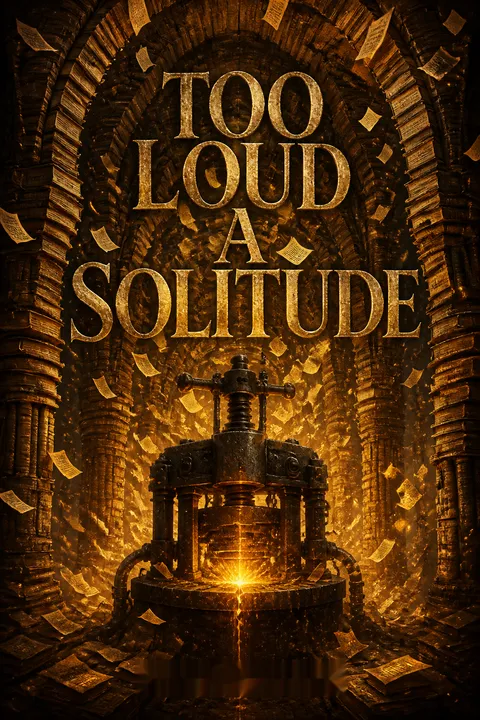
For thirty-five years, Haňťa has fed discarded paper into a hydraulic press beneath a Prague courtyard. When a rare book surfaces, he stops work to wipe it clean, read a little, and hide it in a bale among the rubbish. He carries other rescued volumes home until books crowd nearly every room and threaten to fall on him in his sleep.
Beer helps him bear the labor and sink deeper into the ideas he finds. He imagines buying his press when he retires, then making one carefully designed bale a day, an artwork that would preserve the very books his job destroys. For now, his boss sees only the growing backlog above the cellar.
Haňťa's work makes him neither simple destroyer nor uncomplicated guardian. He preserves books by removing them from circulation, then places them inside the machine that erases them. His private ritual gives meaning to labor designed to be anonymous, but it also delays the task and angers his employer. The books at home extend this contradiction into his body: they sustain his inner life while physically threatening him. His retirement plan is not an escape from the press so much as a fantasy of controlling it, transforming compulsory destruction into chosen form.
Libraries Sent West
After the Second World War, Haňťa and an army librarian discover three barns filled with books from the Royal Prussian Library. They arrange to move the volumes to Prague for safekeeping, but officials declare them spoils, and trains carry them west for sale by weight. Haňťa watches rain wash ink and gilt from the books as they leave, then sees similar libraries shipped away without protest.
Around this time, his mother dies. At the crematorium he observes her body reduced to ashes, which he later takes to his uncle's garden. His uncle scatters them over the kohlrabi his sister loved. The paired losses teach Haňťa to recognize the human remains hidden inside the routine violence of disposal.
The library episode gives Haňťa's work a political scale: a book can be lost not through fire or censorship alone, but through administrative classification and sale. His initial grief ebbs into the numbness required to keep watching, a change he recognizes as adaptation rather than wisdom. His mother's cremation makes that abstraction bodily. When her ashes are returned to the soil and food she loved, disposal becomes a cycle of intimate use, not a clean ending. The episode supplies the novel's central discomfort: preservation and destruction are not separate moral territories, and Haňťa participates in both.
A Garden Runs on Rails
After retirement, Haňťa's uncle recreates his railway life in a garden, installing a signal tower, salvaged tracks, flatcars, and a small locomotive with help from former railwaymen. Children ride the train by day; the old men take turns riding and drinking in the evenings. Haňťa visits to imagine where his own press might stand, but nobody draws him into the gathering.
He walks through the garden alone while his uncle watches from the tower, and their exchanged gestures feel like farewells between trains on separate routes. On the way home, Haňťa notices that he has grown shorter. He measures himself against an old mark on his kitchen door and blames the books stacked above his bed.
The garden is not simply a retirement idyll. The uncle has made a community by rebuilding the work that once gave his life its shape, while Haňťa is still imagining a future machine that might keep him isolated. His exclusion is quiet, not malicious, which makes it harder to resist: the old men are absorbed in a shared pleasure he cannot enter. The shrinking measurement converts that social distance into a physical image. Under the weight of books, Haňťa is literally diminished even as he treats reading as the source of his inner stature.
Manča's Shame Returns
In his youth, Haňťa falls in love with Manča, a village girl whose ribbons brush his hands as they dance. During a special dance, her ribbons have touched the overflowing latrine, and their movement scatters filth across the other couples. Manča's family leaves town, and years pass before Haňťa finds her again. He spends lottery winnings on a mountain holiday, where she skis among admiring guests.
On her return, a large smear on her ski exposes another mishap, and the onlookers' laughter humiliates her once more. Haňťa tries to comfort her, but she leaves the hotel the next morning. He keeps remembering how ordinary accidents become public shame, while his instinct to apologize cannot repair what happened.
Manča and Haňťa are joined by a shared vulnerability to accidents that acquire a life of their own in other people's eyes. His love does not protect her from humiliation; his attempts to absorb blame may even make him part of the scene she wants to escape. His compulsive apologies reveal a man who confuses responsibility with compassion, taking on guilt even when he has caused nothing. Manča's departure, by contrast, preserves a boundary. She refuses to let his need for forgiveness define what she must endure, leaving Haňťa with affection that cannot be converted into rescue.
Blood, Flies, and Visitors
A slaughterhouse truck fills Haňťa's cellar with blood-soaked cartons, and he buries books by Erasmus, Schiller, and Nietzsche in successive bales. As flesh flies swarm the press, he imagines Jesus and Lao-tze beside him, contrasting one figure's urgency to change the world with the other's acceptance of natural cycles.
Two Romani women who collect wastepaper visit, eat the food from his briefcase, and rest before returning to work. Their camera-carrying partner photographs them daily without film.
Meanwhile, a timid philosophy professor slips Haňťa money to search for old theater reviews, hiding his visits from the professor's younger companion. Haňťa's boss complains about the disruption, but the cellar keeps gathering its strange, vulnerable company.
The cellar gathers people and images that the official world would sort into separate categories: philosophy, bodily labor, erotic need, political exclusion, and refuse. Haňťa's visions do not settle the conflict between Jesus and Lao-tze; they give opposing responses to suffering a place beside the machine. The Romani women, in turn, appear not as symbols but as workers with appetites, fatigue, children, and an exploiter who controls the image of them. The professor's covert search for theater writing shows how even scholarship survives through improvised exchanges. Haňťa's workplace becomes a fragile social space inside an institution built to process things, not care for people.
The Mouse Looks Back
Haňťa's uncle dies alone in his signal tower, and his body remains undiscovered for two weeks. Haňťa scrapes what remains from the floor, places the remains in the coffin, then adds the uncle's carefully sorted collection of scrap metal as a final decoration. Back at work, he clears a six-month pile of rotted paper before inventory, feeding entire mouse nests into the press.
He has not considered what lay at the pile's bottom, where paper and flowers have become a foul, compressed mass. After the last bale, a surviving mouse leaps at his shoe and keeps returning after he brushes it away. Its stubborn struggle makes Haňťa tremble; he sees the creature as more than another thing his work has crushed.
The uncle's death makes Haňťa perform, by hand, the labor of recovering a person from what remains. The scrap-metal collection gives the funeral the form of a bale: a life arranged through objects whose value only the collector understood. Then Haňťa returns to a routine that has silently buried mice beneath waste for months. The mouse's attack interrupts his practiced detachment. Its small body does not offer a philosophical proof, but it forces a response from him that abstraction cannot: tenderness toward a creature he has helped destroy. His new awareness is painful because it does not make the damage reversible.
Ilonka's Fire Goes Out
Under the books above his bed, Haňťa remembers a Romani girl who once followed him home and quietly made a life with him. She built a fire, cooked their meals, and helped him fly a kite; neither asked much about the other's past. One evening she did not return. He later learns that the Gestapo had taken her with other Roma, and she never came back.
During the following years, Haňťa crushes stacks of Nazi publications filled with staged images of triumphant crowds and leaders. The work brings the absent woman to mind because she had wanted only shelter, food, warmth, and shared evenings. He realizes that his habitual fascination with destruction has crowded out the tenderness he once knew.
The unnamed woman is remembered through ordinary acts of care: tending a stove, cooking, and sharing the kite's cord. Those gestures resist the monumental imagery of Nazi propaganda, which turns people into a cheering mass and makes violence look like public consent. Haňťa's work places both kinds of material under pressure, but only memory can restore the particular person erased by the propaganda's spectacle. His remorse is not a clean conversion. He remains implicated in crushing the mice and the books; what changes is that he can no longer mistake endurance for innocence. The childhood-like intimacy of the kite also anticipates his final attempt to reach her.
Bubny's Giant Press
Curiosity takes Haňťa to Bubny, where a huge, bright factory press consumes whole print runs before anyone reads them. Gloved workers keep its conveyor moving, and books become enormous bales without the pauses that let him rescue a volume. He recognizes that this system will replace the slow, personal labor he has practiced.
Later he visits Manča in the woods and finds an old sculptor carving her likeness into an angel. She has built her cottage by taking lovers from one trade to the next, each helping construct a different part of the house. Now the sculptor treats her as his muse. Manča, who never cared for books, has made a life and an image without them.
Bubny makes Haňťa confront not just a faster machine but the disappearance of the human pause on which his private ethics depend. The factory does not need to hate books to destroy them; speed and division of labor make attention unnecessary. Manča's cottage offers a counterexample to Haňťa's belief that meaning must arrive through reading. She has built a home through practical bargains and now becomes the subject of another person's art. Her life is neither idealized nor condemned; it unsettles Haňťa because it reaches a kind of fulfillment without his favored route through books.
The Cellar Changes Hands
Two young workers arrive from Bubny and take over Haňťa's press, sorting the work so efficiently that they make several bales in an hour. When Haňťa rescues a book about Charles Lindbergh's first transatlantic flight, he carries it to Frantík Sturm, a sacristan who collects aviation writing. The gift brings him one last exchange of gratitude.
At the church, the philosophy professor mistakes Haňťa for the younger man he has been secretly paying to find old theater reviews; Haňťa reveals that both figures were himself. His boss has already arranged to move him to a printing works, where he will bale clean paper instead of discarded books. The old cellar's small discoveries are over, and Haňťa sees his whole city in a vision of compaction.
The transfer removes more than Haňťa's job. It eliminates the conditions under which his peculiar attention could operate: rejects, solitude, and the chance to stop the machine for a single book. His gift to Frantík is therefore a final act of connection, not simply another rescue. The professor's confusion exposes how Haňťa has divided himself into the needy young seeker and the older broker who supplies him. Once those identities collapse into one, there is no audience left for the role he has played. The vision of Prague crushed into a bale enlarges his personal displacement into a fear that the new system will make every life equally disposable.
He Enters the Bale
After wandering through the city, unable to settle into a life without his cellar, Haňťa returns to the old press. He lays waste paper in its drum, climbs inside, and brings a book with him, holding his place in a passage that has long sustained him. As the machine closes around him, he imagines the Romani girl beside him, flying their kite.
A message travels up its cord, and for the first time he knows the name he never learned while they lived together: Ilonka. His death is not a rescue from the machinery he despises. It is a final decision to remain inside his own world, where books, memory, and the girl he lost still meet.
Haňťa's last act turns the press from workplace into chosen enclosure, but choice does not erase the violence of the method. He uses the machine that has governed his life to refuse the clean-paper future and the authority that has dismissed him. The book in his hands preserves the habit that shaped him, while the kite restores a memory whose intimacy depended on silence. Ilonka's name arrives too late for reunion, yet it gives the remembered woman an identity beyond Haňťa's fantasy of her. The ending holds self-determination and self-destruction together without making either one a simple triumph.
Analysis
Too Loud a Solitude makes its central moral problem tactile. Haňťa handles wet paper, blood, mice, books, and the remains of people, so that destruction cannot stay safely metaphorical. His press turns culture into commodity, but his private reading also refuses the idea that a book's meaning disappears when its pages are pulped. He both preserves and destroys, and the novel does not let his love of literature absolve him of the work he performs. The industrial press at Bubny sharpens this conflict. Its efficiency does not depend on personal malice; it depends on eliminating individual attention. Haňťa's pauses are economically wasteful, yet they are also the only moments in which a discarded book becomes visible as something made by human effort. The book-burning and book-pulping episodes differ in motive, but both expose how easily institutions can convert human creations into material to be managed.
Haňťa's associative narration reproduces the mental labor of a reader rather than the clean sequence of a case history. A mouse can lead him to compassion, a railway garden to aging, or a press to theology. These leaps show a mind trying to connect experiences that official categories keep apart. His learning is real, but it does not automatically make him humane; insight and ethical change arrive unevenly.
Manča and the unnamed Romani woman expose the limits of Haňťa's self-image. He loves them, remembers them, and tries to understand them, yet each risks becoming a figure inside his private philosophy. His final act is at once resistance to a future that has expelled him and the most extreme consequence of his inability to imagine a life beyond the press. The novel leaves that act unsettled: it honors his refusal to be remade while showing the terrible cost of turning identity into an enclosure.
Review Summary
Too Loud a Solitude is a poignant novella about Hantá, a worker who compacts banned books in Communist Prague. Readers praise Hrabal's lyrical prose, philosophical depth, and exploration of themes like solitude, censorship, and the power of literature. The story is seen as both a critique of totalitarianism and a celebration of books. Many find the protagonist's love for literature and tragic circumstances deeply moving. While some struggle with the stream-of-consciousness style, most consider it a profound meditation on human existence and the value of ideas.
Characters
Haňťa
The cellar's book rescuerA solitary Prague laborer, Haňťa has spent decades compacting waste paper while secretly reading the books destined for the press. His mind is crowded with philosophy, art, memories, and observations that he absorbs without formal training. He treats books as companions and each bale as a personal composition, yet his attachment to them exists alongside his participation in destroying them. Beer, digression, and ritual help him endure a work life he cannot separate from his identity. His instinct to take blame for other people's pain reveals both genuine tenderness and a habit of confusing guilt with responsibility.
Manča
Haňťa's enduring first loveManča is the village girl Haňťa loves in his youth, a spirited dancer whose life is repeatedly shaped by public embarrassment and other people's judgments. She does not share his hunger for books, and her way of making a future is practical, social, and distinctly her own. Haňťa's devotion often takes the form of apology, while Manča guards her dignity by deciding when to leave and when to begin again. Her independence challenges his assumption that insight must come from reading.
The uncle
A railwayman's second lifeHaňťa's uncle spent his working life as a railway signalman and carries that identity into retirement. He builds a signal tower and miniature railway in his garden with help from fellow railwaymen, creating a place where work becomes play and shared custom. His habits of collecting and sorting scrap metal show the same attention Haňťa gives to books: both men find private patterns in discarded material. He offers Haňťa a model for retirement, though their temperaments and forms of solitude remain different.
The nameless Romani girl
A remembered companionThe young Romani woman enters Haňťa's life during the war and makes a home with him through quiet routines. She tends the stove, cooks, gathers wood, and shares his fascination with a kite. Their relationship depends more on physical closeness and repeated acts of care than on questions or explanations. Haňťa remembers her as a source of warmth and uncomplicated trust, though his recollections also reveal how much he has made her into an ideal.
The boss
The impatient supervisorHaňťa's boss measures the cellar by its backlog and the worker by his output. He complains when Haňťa pauses over books, and his efforts to hurry him expose the clash between production demands and private attention. At times he is visibly exasperated and even pleads for Haňťa to change, suggesting that the worker's habits unsettle him as well as obstruct him. He is not a grand villain; he is the human face of a system that rewards speed.
The philosophy professor
A furtive theater seekerA timid, absent-minded professor secretly searches Haňťa's cellar for old theater reviews, especially writing from the years before his politically motivated dismissal. He pays Haňťa to find material and fears being seen with the younger man who helps him. His nervousness contrasts with the persistence of his intellectual appetite. The professor's hidden search mirrors Haňťa's own private acts of preservation, though his interest centers on a vanished cultural world rather than books generally.
Frantík Sturm
The sacristan who collects flightFrantík Sturm is a church sacristan whose private passion is aviation. He collects books and magazines about aircraft while still imagining the lively newspaper writing he once hoped to pursue. Haňťa brings him rare finds, and Frantík receives them with a formality that makes each exchange feel ceremonial. His library turns technical books into objects of wonder, showing how a modest collection can give a constrained life its own direction.
The two Romani paper collectors
The cellar's visiting workersThe two women haul heavy bundles of shop waste through Prague and sometimes rest in Haňťa's cellar. They share food, cigarettes, fatigue, and a playful ease that briefly interrupts his solitary routine. Their work supports children and a partner who takes a share of their earnings. Haňťa watches their resilience without being able to change the conditions surrounding them, and their visits reveal a social world that the official workplace barely acknowledges.
The Romani photographer
A camera without filmThe women collectors' partner wears gold-rimmed glasses and carries a camera, posing them for photographs he never actually takes. They continue to anticipate the pictures. His empty camera turns their daily work into a performance and leaves the women with an image they can desire but never inspect.
The Bubny workers
The new industrial crewThe young workers at Bubny operate a vast press through divided, coordinated tasks. They wear protective gloves and work in a bright factory where books travel along a conveyor without being opened. Their ease and speed unsettle Haňťa, but they are not presented as personally cruel. They are adapting to a workplace whose design has removed the pauses and individual choices that define his labor.
The sewer scholars
Displaced academic observersTwo former Academy of Sciences researchers now work in Prague's sewers. They study the city's waste and the changing behavior of rats, continuing intellectual inquiry in an unlikely workplace. Their explanations give Haňťa a way to imagine conflict and social change beneath the ordinary streets.
Haňťa's mother
The remembered village motherHaňťa's mother appears through his memories of village life and the brief, stark account of her death. Her love of kohlrabi becomes an intimate link between family memory and the soil of her brother's garden. She is one of the people whose physical absence Haňťa can observe but cannot fully make sense of.
Hedvička
The boss's young visitorHedvička is a salesgirl who brings waste paper to the courtyard. Haňťa's boss weighs her and records the result, making her a brief example of his intrusive interest in the young women who visit the workplace.
Jesus and Lao-tze
Haňťa's cellar visionsThese figures appear to Haňťa as imagined presences while he works among blood-soaked paper and flies. He sees Jesus as ardent and oriented toward changing the world, and Lao-tze as contemplative and attuned to natural cycles. Their contrast gives his reflections a dramatic shape without resolving them.
Plot Devices
The hydraulic press
Work as moral theaterThe press is both Haňťa's livelihood and the instrument that destroys the books he reveres. Its repeated forward and backward motion gives his work a physical rhythm around which he builds philosophical associations. He stops it to rescue rare volumes, decorates bales with images, and imagines eventually using the machine as an artist rather than an employee. As industrial machinery replaces his slower method, the press also marks the shrinking space available for personal judgment. It ties the material fate of books to Haňťa's sense of self.
Books within bales
Knowledge hidden in refuseHaňťa places an opened book inside many of the bales he makes, sometimes choosing a volume in response to the paper around it. This private practice lets him preserve a trace of the ideas that the press otherwise obliterates. The books are not saved for readers, and Haňťa knows that, which makes the ritual both tender and compromised. His home library and his work ritual show different sides of the same impulse: to gather words, absorb them, and create a private order from what others discard.
Mice in the cellar
Innocence under pressureMice live in the paper piles and move through the cellar as Haňťa works. Their nests are sometimes crushed with the books and rubbish, often without his attention until the damage is done. They make the press's effects more immediate than an abstract argument about destruction: small lives share the same material fate as the books Haňťa tries to honor. When a mouse resists him, his usual philosophical distance gives way to a personal recognition of vulnerability.
Haňťa's visions
Ideas made visibleBeer, exhaustion, reading, and solitude blur the boundary between Haňťa's thoughts and what he sees. Philosophers and religious figures appear in the cellar as vivid counterparts to the physical work, while the rats and sewers become scenes for his ideas about conflict. These visions are not clues to a hidden supernatural plot. They dramatize how Haňťa processes the world: by turning intellectual arguments into bodies, machines, animals, and remembered people.
FAQ
Synopsis & Basic Details
What is Too Loud a Solitude about?
- A life in wastepaper: The story follows Haňťa, a man who has spent 35 years compacting wastepaper and books in a hydraulic press, finding solace and wisdom in the discarded texts.
- The beauty of destruction: Haňťa's work is a paradox, where the destruction of books becomes an act of creation, and his mind is a repository of unwitting wisdom.
- A changing world: The narrative explores Haňťa's internal struggles as he confronts a rapidly changing world, symbolized by a new, gigantic press that threatens to make his work obsolete.
Why should I read Too Loud a Solitude?
- Unique perspective on literature: The novel offers a unique perspective on the value of literature, exploring how books can shape a person's life and worldview, even when they are being destroyed.
- Philosophical exploration: It delves into profound philosophical themes such as the nature of progress, the impermanence of life, and the tension between tradition and modernity.
- Poetic and evocative prose: Hrabal's writing style is poetic and evocative, creating a rich and immersive reading experience that lingers long after the final page.
What is the background of Too Loud a Solitude?
- Post-war Czechoslovakia: The novel is set in post-World War II Czechoslovakia, a time of political and social upheaval, where the value of art and literature was often questioned.
- Communist regime: The story subtly critiques the communist regime's emphasis on industrialization and its disregard for intellectual pursuits, highlighting the struggle of individuals to maintain their humanity in the face of oppressive forces.
- Cultural context: The book reflects the cultural context of a society that has a deep appreciation for literature and learning, even as it grapples with the challenges of a changing world.
What are the most memorable quotes in Too Loud a Solitude?
- "Only the sun has a right to its spots.": This quote, attributed to Goethe, encapsulates the novel's theme of accepting imperfections and finding beauty in the flawed nature of existence.
- "Because when I read, I don't really read; I pop a beautiful sentence into my mouth and suck it like a fruit drop, or I sip it like a liqueur until the thought dissolves in me like alcohol...": This quote beautifully illustrates Haňťa's intimate and sensual relationship with literature, highlighting how he internalizes and embodies the words he reads.
- "For we are like olives: only when we are crushed do we yield what is best in us.": This quote, from the Talmud, reflects the novel's theme of finding meaning and value in suffering and destruction, suggesting that true understanding comes from being broken down.
What writing style, narrative choices, and literary techniques does Bohumil Hrabal use?
- Stream-of-consciousness: Hrabal employs a stream-of-consciousness narrative style, allowing readers to delve into Haňťa's thoughts and feelings, creating an intimate and immersive experience.
- Repetitive and cyclical structure: The novel uses a repetitive and cyclical structure, mirroring the repetitive nature of Haňťa's work and the cyclical nature of life, emphasizing the themes of routine and the passage of time.
- Blending of high and low culture: Hrabal seamlessly blends high and low culture, juxtaposing philosophical musings with everyday observations, creating a unique and engaging narrative voice.
Hidden Details & Subtle Connections
What are some minor details that add significant meaning?
- The mice in the cellar: The mice that inhabit Haňťa's cellar are not just pests; they are a symbol of the life that persists even in the face of destruction, mirroring Haňťa's own resilience and love for literature.
- The bloodstained paper: The recurring motif of bloodstained paper from the slaughterhouse represents the violence and brutality of the world, contrasting with the beauty and wisdom found in books.
- The Gypsy girls' skirts: The turquoise and velvet-violet skirts of the Gypsy girls are a symbol of vibrancy and life, bringing color and energy to Haňťa's otherwise drab and solitary existence.
What are some subtle foreshadowing and callbacks?
- The mention of the new press: Early mentions of a new, more efficient press foreshadow the eventual threat to Haňťa's way of life, creating a sense of impending doom.
- The recurring image of the signal tower: The signal tower in Haňťa's uncle's garden foreshadows Haňťa's own desire for a place of solitude and contemplation, a place where he can continue his work on his own terms.
- The story of Manča's ribbons: The story of Manča's ribbons at the dance foreshadows her later shame and her transformation into a saint, highlighting the novel's theme of the cyclical nature of life and the unexpected paths people take.
What are some unexpected character connections?
- Haňťa and the philosophy professor: The philosophy professor, who seeks out Haňťa for his knowledge of the "young man" and "old man," represents a connection to the intellectual world that Haňťa inhabits, highlighting the value of his unwitting education.
- Haňťa and the Gypsy girls: The Gypsy girls, who visit Haňťa in his cellar, represent a connection to the natural world and the simple joys of life, contrasting with the intellectual pursuits that dominate Haňťa's existence.
- Haňťa and Manča: Haňťa's relationship with Manča, from their youth to her transformation into a saint, highlights the novel's theme of the cyclical nature of life and the unexpected paths people take.
Who are the most significant supporting characters?
- The philosophy professor: He represents the intellectual world and the value of knowledge, highlighting the importance of Haňťa's unwitting education and his connection to the past.
- The Gypsy girls: They symbolize vitality, resilience, and the simple joys of life, offering a contrast to Haňťa's solitary existence and his intellectual pursuits.
- Manča: She represents the cyclical nature of life and the unexpected paths people take, highlighting the novel's theme of transformation and the search for meaning.
Psychological, Emotional, & Relational Analysis
What are some unspoken motivations of the characters?
- Haňťa's need for connection: Despite his solitary existence, Haňťa craves connection, which he finds through his interactions with books, the Gypsy girls, and the philosophy professor.
- The boss's desire for control: The boss's actions are driven by a desire for control and efficiency, reflecting the values of the modern world and his inability to understand Haňťa's unique perspective.
- The young workers' indifference: The young workers' indifference to the books they destroy stems from a lack of connection to the past and a focus on the present, highlighting the generational divide.
What psychological complexities do the characters exhibit?
- Haňťa's internal conflict: Haňťa experiences a constant internal conflict between his love for books and his role in their destruction, leading to a sense of guilt and a search for meaning.
- The boss's insecurity: The boss's need to weigh the salesgirls and his constant need for validation reveal his underlying insecurities and his inability to appreciate the value of human connection.
- The philosophy professor's nostalgia: The philosophy professor's obsession with the past and his inability to adapt to the present highlight his psychological struggle with a changing world.
What are the major emotional turning points?
- The discovery of the new press: Haňťa's discovery of the new press in Bubny is a major emotional turning point, as it forces him to confront the reality of a changing world and the obsolescence of his work.
- The news of his transfer: The news that he will be transferred to a new job compacting clean paper is a devastating blow to Haňťa, as it signifies the end of his connection to the books he loves.
- Haňťa's final embrace of his fate: Haňťa's decision to return to his cellar and embrace his fate is a moment of transcendence, as he finds peace in the knowledge that he has lived a life true to himself.
How do relationship dynamics evolve?
- Haňťa and the books: Haňťa's relationship with books evolves from a simple love of reading to a deep, almost spiritual connection, where the books become a source of solace, wisdom, and meaning.
- Haňťa and the boss: The relationship between Haňťa and the boss deteriorates as the boss becomes increasingly frustrated with Haňťa's lack of productivity and his inability to adapt to the modern world.
- Haňťa and Manča: Haňťa's relationship with Manča evolves from a youthful romance to a recognition of her transformation into a saint, highlighting the cyclical nature of life and the unexpected paths people take.
Interpretation & Debate
Which parts of the story remain ambiguous or open-ended?
- The nature of Haňťa's visions: The nature of Haňťa's visions of Jesus and Lao-tze remains ambiguous, leaving it open to interpretation whether they are real or a product of his imagination.
- The meaning of Manča's transformation: The meaning of Manča's transformation into a saint remains open-ended, leaving it up to the reader to decide whether she has found true enlightenment or simply a new form of escape.
- The ultimate fate of Haňťa: The ultimate fate of Haňťa is left ambiguous, with the reader left to wonder whether he has truly found peace or simply succumbed to the crushing weight of his circumstances.
What are some debatable, controversial scenes or moments in Too Loud a Solitude?
- Haňťa's acceptance of destruction: Haňťa's acceptance of the destruction of books can be seen as both a philosophical insight and a moral failing, sparking debate about the value of art and literature in a changing world.
- The portrayal of the young workers: The portrayal of the young workers as indifferent and unfeeling can be seen as a critique of modernity or as a biased perspective from Haňťa's point of view.
- The ending of the novel: The ending of the novel, with Haňťa's final embrace of his fate, can be seen as either a triumphant act of self-affirmation or a tragic surrender to despair.
Too Loud a Solitude Ending Explained: How It Ends & What It Means
- Haňťa's return to the cellar: Haňťa returns to his cellar, embracing his fate and finding solace in the familiar rhythm of his work, choosing his own fall, which is ascension.
- The final compaction: As the walls of his press close in, Haňťa experiences a moment of transcendence, a final communion with the books he has loved and lost, refusing to be driven from his Paradise.
- The vision of Ilonka: In his final moments, Haňťa sees a vision of his tiny Gypsy girl, Ilonka, and their kite, symbolizing the beauty and innocence of his youth and the enduring power of love and memory.
Download PDF
Download EPUB
.epub digital book format is ideal for reading ebooks on phones, tablets, and e-readers.








