

Key Takeaways
Trace Trump's rise from childhood deprivation to a public system that never said no
A family pattern scales up. Mary L. Trump opens with a 2017 White House dinner, where her uncle Donald sits behind the Oval Office desk beneath a photograph of his father, Fred. For her, the scene condenses the book’s argument: family habits of control, favoritism, and humiliation have followed Donald into public life, reinforced by people and institutions that keep excusing him.
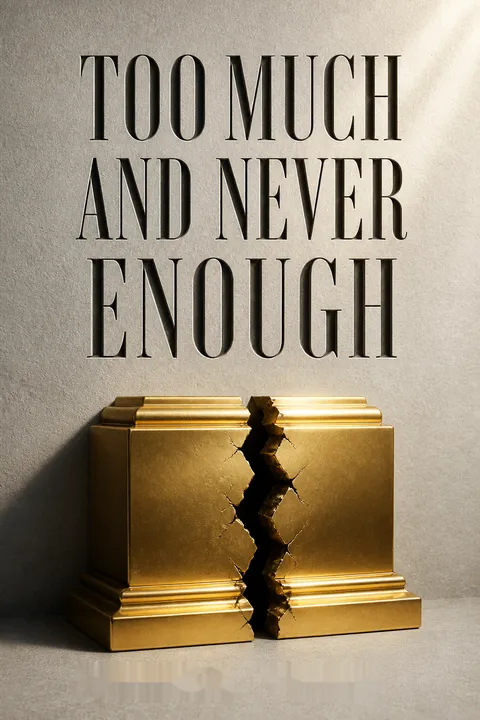
Two kinds of harm. The title’s “not enough” refers to emotional care Donald lacked as a young child. “Too much” evokes the burdens and humiliation Fred imposed on his eldest son, Freddy. Donald, meanwhile, received money, praise, and protection without meaningful limits. The book follows how that imbalance shaped the family, then argues that business, media, and politics repeated its pattern.
What's striking is the book's scale change: a family dinner becomes a lens for examining how private habits can acquire public force. Its strongest claim is not that childhood mechanically determines an adult, but that favoritism and protection can keep harmful behavior rewarded. That distinction matters. A family pattern becomes politically consequential only when other people and institutions reinforce it. The framing is vivid, though the connection between one household and national outcomes is interpretive, not a complete explanation of either Donald Trump or his supporters.
Do not mistake a child's defensive armor for proof of strength
Care teaches connection. Mary Trump explains “mirroring” as a caregiver noticing a child’s feelings, making sense of them, and responding in a way that helps the child understand those feelings. She argues that this kind of response supports security and empathy. In her account, Donald was about two and a half when his mother became gravely ill and was absent for an extended period. His father, Fred, was emotionally distant, leaving no dependable adult to soothe him.
A defense gets rewarded. Mary Trump interprets Donald’s bullying, defiance, and grandiosity as armor against abandonment and vulnerability. When Fred eventually admired those traits as signs of toughness, defenses that might have softened with care were instead reinforced. This is the author’s developmental interpretation, not a clinical assessment of Donald.
This account distinguishes visible behavior from the need it may conceal. A child who appears self-sufficient can be protecting against repeated rejection, while adults may mistake that protection for confidence. The useful implication is not to excuse harm, but to ask what a behavior accomplishes and what keeps it in place. At the same time, developmental explanations are probabilistic: neglect does not dictate one adult outcome. The book’s argument is most persuasive when it shows how Fred’s approval rewarded specific behaviors, rather than treating early deprivation as destiny.
Fred punished Freddy's sensitivity, then rewarded Donald's aggression
The brothers learned opposite lessons. Fred expected his eldest son, Freddy, to inherit the family business, but mocked his interests and publicly belittled his decisions. Freddy found purpose in flying and became one of twelve men accepted into TWA’s 1964 pilot-training class, one of only two civilians. His father disparaged the career; after Freddy returned to Trump Management, Fred blamed him for the failed Steeplechase Park project.
A different son fit the mold. Donald saw what happened to Freddy and learned that his father valued dominance over apology or sensitivity. Fred promoted Donald to president of Trump Management in 1971, after three years there, while Freddy had worked in the business for eleven. The contrast shows how parental approval can reward resemblance to the parent, not competence or effort.
Freddy’s career makes the family’s definition of success look especially narrow. He achieved an independent goal through training and disciplined work, yet his father treated that independence as betrayal. Donald’s advantage was not simply ambition; it was that Fred welcomed the traits he displayed. This contrast clarifies how a family can confuse obedience with worth and aggression with capability. It also cautions against reading the brothers as a simple morality tale: the different outcomes reflect both temperament and unequal treatment, and the family account cannot establish exactly how each factor shaped them.
In a wealthy family, control over money can manufacture scarcity
Abundance did not mean security. Fred built a valuable real-estate business and established trusts for his children, yet Mary Trump describes three of them as living with a persistent fear of asking for help. Access to money remained controlled by their father, and asking could be treated as weakness or greed. Donald was the exception, receiving support and opportunities his siblings did not.
Need became a private shame. Maryanne, Fred’s eldest daughter, struggled to feed herself and her son while her husband was unemployed. Rather than ask directly for substantial support, she quietly asked her mother for laundry change. Her mother gave her coins collected from the family buildings’ machines. The episode captures the book’s “zero-sum” family logic: help for one person seemed to threaten someone else’s share, even amid great wealth.
The story separates having resources nearby from having reliable access to them. When help is discretionary, a wealthy household can still make dependents feel precarious, and the shame attached to asking can keep that power imbalance hidden. The laundry coins are memorable because they turn an abstract family rule into a daily survival detail. The account also suggests that unequal access is not merely financial: it teaches people who is entitled to ask and who must make do. The family’s money is a powerful explanation here, but not every hardship can be reduced to money alone.
Ask who supplied the capital before calling a tycoon self-made
The image had a backer. Fred’s rental empire depended on government-supported housing finance, political relationships, and careful development work. Mary Trump argues that Donald’s early Manhattan ventures, including the Grand Hyatt and Trump Tower, also depended heavily on his father’s money, expertise, and connections, even as Donald received public credit for them. The press often repeated the self-made-dealmaker image without examining the support behind it.
Records challenged the family story. A 2018 New York Times investigation drew on financial documents and reported that Donald had received the equivalent of $413 million from his father over time, much of it through transfers the reporters described as questionable. That figure does not include the later sale of Fred’s real-estate empire. The book contrasts a visible brand with the less visible resources that helped build it.
The distinction between public reputation and underlying production is useful well beyond real estate. A founder’s story often highlights the person at the front of the deal while obscuring the capital, labor, expertise, and public support that made it possible. Here, the family’s own myth-making and outside institutions reinforce one another. The documentary reporting gives this argument firmer ground than recollection alone. Still, evidence of substantial family financing does not by itself settle every question about Donald’s business ability; it does make the claim of independence much harder to sustain.
Bailouts taught Donald that risk could be outsourced without consequence
Failure brought another rescue. In Atlantic City, Donald expanded into multiple casinos, taking on enormous debts while his properties competed with one another. The Taj Mahal’s opening hurt his other casinos, and the book reports that the three properties carried $94 million in annual debt payments. Fred tried to keep the operation afloat by having his driver buy $3.15 million in casino chips, though the driver did not gamble with them.
The banks joined in. In 1990, lenders put Donald on a $450,000 monthly allowance to preserve the lifestyle supporting his public image. Mary Trump argues that these rescues did more than delay financial consequences: they let him keep behaving as if losses were temporary problems someone else would absorb. When failure is repeatedly cushioned, a person has little incentive to learn from it.
This is a clear example of moral hazard: when decision-makers expect someone else to absorb the downside, they have weaker incentives to limit risk. The pattern is not simply that Donald failed, but that family wealth and lender exposure made the costs negotiable for him and substantial for others. The book is particularly effective when it traces this feedback loop through concrete transactions. One caution: rescue can preserve a business for reasons beyond personal indulgence, including creditors’ interests. That nuance does not erase the central point that protection can reward the conduct it is meant to contain.
A will can turn inheritance into a verdict on who counts
The family dispute exposed the hierarchy. After Fred died in 1999, his will excluded Mary Trump and her brother from the share that would have come through their father, Freddy. Their attempts to understand their rights brought threats and a second dispute over their nephew William’s medical insurance. They eventually settled rather than take the inheritance fight to trial.
Documents changed the scale of the story. The family had told Mary and her brother that Fred’s estate was worth far less than it appeared to be. Years later, Mary gave old legal and financial records to New York Times reporters investigating the family’s finances. Their 2018 article described a much larger fortune and years of transfers to Fred’s children. For Mary, the documents made the earlier fight look not only personal, but strikingly small-minded against the wealth involved.
An inheritance dispute is both a distribution of assets and a public record of family standing. That dual meaning helps explain why the exclusion felt to Mary like a judgment on her father and his children, not merely a disappointing sum. The archive also transforms the narrative: financial records allow a family memory to be tested against transactions and valuations. Yet estate conflict rarely supplies a complete measure of affection or motive. The book’s strongest case comes from the contrast between stated family principles and the documented decisions made when money and control were at stake.
Cruelty gains power when institutions sell it as confidence
Behavior became a performance. In the family Mary Trump describes, Fred humiliated Freddy and rewarded Donald’s contempt for others. Donald learned that a cutting remark or an attack could project strength and shift attention away from weakness. Outside the family, journalists and later television helped package him as a bold, successful dealmaker. The Apprentice reinforced that image even as his businesses struggled.
Permission accumulated. Mary Trump argues that people repeatedly treated lies, discriminatory conduct, and disrespect as colorful business tactics instead of reasons for scrutiny. The same pattern, she says, appeared in politics when officials and party figures tolerated behavior to gain access or advantage. The book’s point is not that every observer shared Donald’s motives, but that repeated indulgence made each new transgression easier to normalize.
The book draws attention to a social process: audiences do not merely witness a public persona, they help stabilize it through attention, repetition, and strategic silence. Calling aggression confidence can convert a warning sign into an asset. This is a strong account of how reputation is jointly produced by the person performing and the institutions framing the performance. The nuance is that normalization has multiple causes, from commercial incentives to political calculation, and does not require a coordinated plan. Naming those incentives is more useful than assuming every participant acted from the same intent.
Leaders who fear looking weak can make crisis response about themselves
The book reads denial as self-protection. In her account of the early COVID-19 crisis, Mary Trump argues that Donald minimized danger because acknowledging uncertainty or error threatened his need to appear strong and successful. She describes him shifting blame and treating help to states as something leaders had to earn through loyalty, rather than coordinating a consistent national response.
The alternative was practical. The book points to basic actions available to an administration: coordinate agencies, involve scientific and medical experts, and organize production and distribution of protective equipment and ventilators. Mary Trump’s claim is that these steps required less than the work of maintaining a reassuring public image. Whatever the precise motive, the stakes were concrete: crisis leadership required confronting bad news, taking responsibility, and adjusting course.
A crisis tests whether authority can tolerate information that damages its preferred story. The useful distinction is between projecting calm and suppressing reality: the first can steady people, while the second can obstruct decisions. Mary Trump’s interpretation links public behavior to fear, but motive is harder to establish than observable choices. That caution strengthens rather than weakens the practical lesson. Institutions need procedures that bring evidence and expert advice into decisions even when a leader resists them. Personal confidence is no substitute for systems that can correct a failing response.
Analysis
This book is part family memoir, part psychological interpretation, and part political indictment. Its narrative gains force from the contrast between two brothers: Freddy, whose talent and independent ambitions were punished, and Donald, whose aggression and self-promotion earned approval. The contrast gives the argument a human center, while the later financial records widen it beyond family recollection.
The evidence is not all of one kind. Childhood scenes rely partly on Mary Trump’s memory and on accounts from relatives; the author explicitly says some dialogue is reconstructed. Her account of Fred’s business and the inheritance conflict draws on documents, while the 2018 New York Times investigation supplies a substantial public record of family transfers and tax practices. Those categories should not be collapsed. Documentary evidence can establish payments and corporate arrangements more securely than it can establish a child’s inner experience or the exact motives behind a parent’s decision.
The book’s psychological argument is most helpful as a model of reinforcement, not as a diagnosis or a deterministic origin story. Early neglect may shape defenses, but developmental science treats childhood effects as probabilistic, not destiny. Many people experience deprivation without becoming domineering; institutions and later choices matter. Mary Trump’s own account sometimes moves quickly from family dynamics to political consequences, so readers should distinguish documented conduct from interpretations of Donald’s internal life.
The business narrative offers a more structural insight. Repeated rescue can create moral hazard: when someone expects others to absorb losses, risk-taking becomes easier to sustain. The same pattern appears in the book’s family hierarchy, where money, status, and protection flow unevenly. Media attention and political accommodation then extend the system beyond the household. The book’s most durable contribution is this combined view: character matters, but so do the people and institutions that turn a person’s weaknesses into advantages. Its warning is less that one family explains a nation than that private patterns can become public systems when nobody imposes consequences.
Review Summary
Too Much and Never Enough provides readers with an intimate look at the Trump family dynamics from an insider's perspective. Mary Trump's psychological expertise adds depth to her observations, offering insights into Donald Trump's behavior and motivations. While some readers found the book enlightening and well-written, others felt it lacked new revelations. Many appreciated the author's courage in speaking out, though some questioned her motivations. Overall, the book is praised for its unique blend of personal anecdotes and professional analysis.
People Also Read



Glossary
too much or not enough
Two forms of childhood harmMary Trump uses this contrast to describe damaging extremes in the family. “Not enough” refers to inadequate care, comfort, and emotional attention. “Too much” refers to excessive pressure, humiliation, and expectation. She applies the contrast to Donald’s early emotional deprivation and Freddy’s experience of his father’s demands and belittlement. It is an interpretive frame, not a clinical diagnosis.
mirroring
Caregiver reflects a child's feelingsIn the book, mirroring is the process by which an emotionally attuned caregiver notices a child’s feelings, makes sense of them, and responds in a way that helps the child recognize and understand those feelings. Mary Trump describes it as important to emotional development and empathy. The term is used in developmental psychology, rather than coined by the author.
the House
The Trump family homeThe House is Mary Trump’s name for Fred and Mary Trump’s large home in Jamaica Estates, Queens. It is the central setting for her account of childhood, family hierarchy, and the rules governing affection, discipline, and money. The home becomes more than a location: it represents the tightly controlled environment in which the siblings learned their different roles.
institutionalized
Shielded from ordinary consequencesMary Trump uses this word metaphorically, not to mean psychiatric confinement. She argues that Donald was repeatedly surrounded by systems that insulated him from independent failure, including family wealth, business staff, lenders, media attention, and the presidency. In her account, this protection reduced the need to develop expertise or face consequences on ordinary terms.
FAQ
What's Too Much and Never Enough about?
- Family Dynamics: The book explores the complex relationships within the Trump family, focusing on Mary Trump's experiences as Donald Trump's niece. It highlights the psychological impact of familial expectations and dysfunction.
- Character Analysis: Mary Trump provides a critical analysis of Donald Trump's personality, suggesting that his behaviors stem from childhood trauma and a need for validation.
- Political Context: The narrative connects personal family history to Donald Trump's political rise, illustrating how his familial relationships influenced his approach to leadership and governance.
Why should I read Too Much and Never Enough?
- Unique Insider Perspective: As a member of the Trump family, Mary Trump offers a rare and personal insight into the dynamics that shaped Donald Trump.
- Psychological Insights: The book combines personal anecdotes with psychological analysis, making it compelling for those interested in psychology, family dynamics, and political behavior.
- Cultural Relevance: Given the ongoing discussions about Donald Trump's presidency, the book is timely and encourages reflection on the intersection of personal history and public life.
What are the key takeaways of Too Much and Never Enough?
- Impact of Upbringing: The book emphasizes how childhood experiences shape adult behavior, particularly in Donald Trump's case.
- Narcissism and Power: Mary Trump discusses the traits of narcissism and how they manifest in Donald's behavior, suggesting these traits are detrimental to both his family and the country.
- Family Loyalty vs. Truth: The narrative explores the tension between family loyalty and the need to speak the truth, illustrating Mary Trump's struggle with this dynamic.
What are the best quotes from Too Much and Never Enough and what do they mean?
- “If the soul is left in darkness, sins will be committed.”: This quote underscores the theme of neglect and its consequences, suggesting that without proper guidance, individuals may act destructively.
- “Donald’s ego has been and is a fragile and inadequate barrier between him and the real world.”: It highlights the fragility of Donald Trump's self-image and how it affects his interactions with others.
- “I can’t let him destroy my country.”: Mary Trump expresses her motivation for writing the book, emphasizing her concern for the nation’s future under Donald Trump's leadership.
How does Mary Trump describe her childhood in Too Much and Never Enough?
- Dysfunctional Environment: Mary describes her childhood as marked by emotional neglect and dysfunction within the Trump family.
- Isolation and Fear: The book conveys a sense of isolation among the Trump siblings, particularly Donald and Freddy, who struggled for their father's approval.
- Lack of Support: Mary discusses the absence of nurturing relationships, which hindered her and her cousins' emotional development.
What psychological concepts are discussed in Too Much and Never Enough?
- Narcissistic Personality Disorder: Mary Trump identifies traits of narcissism in Donald Trump, explaining how they manifest in his behavior and decision-making.
- Childhood Trauma: The book explores the impact of childhood trauma on adult behavior, particularly in the context of the Trump family.
- Family Systems Theory: Mary Trump applies concepts from family systems theory to analyze the dynamics within the Trump family.
How does Too Much and Never Enough connect personal history to political behavior?
- Influence of Family Dynamics: Mary Trump argues that the dysfunctional dynamics of the Trump family directly influenced Donald Trump's approach to politics and leadership.
- Public Persona vs. Private Reality: The book contrasts Donald Trump's public persona with the private reality of his family life.
- Consequences for the Nation: Mary Trump warns that the traits and behaviors fostered in the Trump family have broader implications for the country.
What role does Fred Trump play in shaping Donald Trump's character in Too Much and Never Enough?
- Authoritarian Parenting Style: Fred Trump is depicted as an authoritarian figure whose parenting style emphasized toughness and success at all costs.
- Favoritism and Competition: The book illustrates how Fred's favoritism towards Donald created a competitive environment among the siblings.
- Modeling Behavior: Mary Trump discusses how Fred's own sociopathic tendencies influenced Donald's behavior.
How does Mary Trump differentiate between her father and Donald Trump in the book?
- Different Parenting Styles: Mary contrasts her father's nurturing nature with Donald's need for dominance and control.
- Impact of Family Dynamics: The book highlights how the different experiences within the Trump family shaped their personalities.
- Consequences of Their Choices: Mary discusses the differing paths her father and Donald took in life.
What does Mary Trump hope to achieve with Too Much and Never Enough?
- Expose Family Dysfunction: Mary Trump aims to shed light on the toxic dynamics within the Trump family and their impact on Donald's behavior.
- Encourage Critical Reflection: The book encourages readers to critically reflect on the implications of Donald Trump's presidency.
- Protect Democracy: Mary Trump expresses a desire to protect democracy from the potential dangers posed by her uncle's leadership.
How does Too Much and Never Enough address the theme of loyalty within the Trump family?
- Conflict Between Loyalty and Truth: Mary Trump explores the tension between loyalty to family and the need to speak the truth.
- Silence and Complicity: The book highlights how many family members remain silent out of loyalty or fear.
- Breaking the Cycle: Mary Trump hopes to break the cycle of silence and complicity by sharing her story.
How does Mary Trump’s professional background influence her perspective in the book?
- Psychological Expertise: Mary’s background in psychology informs her analysis of her family dynamics and Donald's behavior.
- Critical Lens: Her training allows her to approach her family's dysfunction with a critical lens.
- Empathy and Understanding: Mary’s professional experience fosters a sense of empathy for her family members, even as she critiques their actions.
Download PDF
Download EPUB
.epub digital book format is ideal for reading ebooks on phones, tablets, and e-readers.








