

Key Takeaways
Treat frustration as market data: your once-profitable edge may have expired.
Markets change their customers. Emil bought a suburban restaurant whose traditional menu no longer suited the neighborhood. He listened to diners, redesigned the experience around social eating, and used customer orders and feedback to keep adjusting. The lesson for traders is not to polish an approach simply because it once worked. A strategy is an answer to a particular market environment, and that environment can change.
Question the old frame. Maxwell had earned a living fading panicked traders, but fewer inexperienced participants and more algorithmic trading weakened the behavior he had relied on. His losses did not automatically mean he had lost discipline. Reviewing his winning trades showed that his quick reading of immediate market behavior remained strong, while longer-range prediction had become a poor fit. His path forward began with identifying what had changed and what still worked.
What's useful here is the distinction between a psychological problem and a business problem. A skilled trader can become frustrated because the market no longer rewards the same behavior, not because the trader has suddenly become emotionally defective. That reframing directs attention toward evidence and adaptation. The caution is that a losing stretch alone does not prove an edge has vanished. Random outcomes can mimic structural change, especially in small samples. The disciplined response is neither automatic persistence nor reflexive reinvention, but a review that asks what market behavior the strategy depends on and whether that behavior is still present.
Build your trading around the strengths that actually produced your best work.
Fit shapes performance. Charles had traded successfully in a setting where conversation and collaboration helped him read other traders and develop ideas. At a new firm, he worked largely alone. His methods looked similar, but the social information that had supported his market judgments was gone. When he rebuilt a working network and added an assistant, he regained access to a central strength.
Different minds need different markets. The book distinguishes rapid pattern recognition from slower, research-heavy reasoning. A scalper who switches to long-horizon analysis may mistake useful short-term cues for noise; an investor pushed into rapid trading may lose the depth that makes the investor effective. Reviewing peak experiences, including successful trades, can reveal recurring talents and the environments that bring them out. Strengths can also complement each other: a researcher and an intuitive executor may form a stronger unit than either alone.
The strongest implication is that performance depends on the match between a person, a task, and an environment, not merely on traits considered in isolation. This aligns with person-job fit: the same capability can be valuable in one setting and irrelevant in another. The idea also discourages copying a mentor's style without testing whether it suits the learner. Still, strengths should not become a permanent excuse to avoid development. A useful distinction is between adapting the use of a strength and refusing to build a necessary skill. The first protects an edge; the second may preserve a limitation.
Let core motivations pull new habits instead of pushing yourself with discipline.
Purpose changes the effort. Steenbarger struggled to exercise despite knowing it mattered. The routine felt dull until he let his cats join him. The activity became a way to care for them as well as train, and he began looking forward to it. The behavior did not change through tougher self-talk; it changed when it connected with a motive that already had emotional force.
Well-being supports self-management. The book treats well-being as a mix of positive feeling, satisfaction, energy, and connection. When a trader's relationships, sleep, physical health, or sense of purpose deteriorate, market decisions can deteriorate too. Calvin responded to a personal slump by working longer, which depleted him further. Time with his son, exercise, and renewed social ties helped restore the energy needed for sounder trading. The aim is not constant cheerfulness, but a life that does not make trading the only source of self-worth.
This is a persuasive alternative to the familiar idea that success mainly requires more willpower. Motivation research often distinguishes autonomous action, which feels connected to personal values, from controlled action, which is driven by pressure or obligation. The cat-filled workout illustrates how a behavior can become easier when it serves an existing attachment. The broader point is that performance systems include life outside work. One limitation is that purpose cannot erase practical constraints or make every necessary task enjoyable. It can, however, reduce needless internal resistance and help make demanding routines sustainable.
Create ideas through deep preparation, deliberate distance, and evidence-based testing.
Creativity has a sequence. The book describes creative work as preparation, incubation, insight, and verification. Preparation means gathering observations and learning a field deeply. Incubation is time away from direct analysis, allowing ideas to recombine. Insight is a fresh connection; verification tests whether it is useful. A trader who jumps from reading charts straight into trading may collect many clues without seeing how they fit together.
Change the question. Creativity can begin by reframing a problem, comparing markets, drawing a map, discussing an idea, or writing thoughts without editing them. Such methods let information be handled in different forms and expose connections that routine analysis can miss. The book also cites research finding that only 13 percent of day traders in one study earned positive returns after fees, and just 0.13 percent did so across multiple years. It argues that constant trading without time for idea development is a poor route to durable expertise.
The model's strength is its refusal to treat creativity as a mysterious flash. It ties novelty to accumulated knowledge, varied representations, and time for recombination. That resembles scientific work, where good questions and validation matter as much as bold hypotheses. The day-trading figures sharpen the warning against confusing activity with learning, though they do not establish that weak idea generation alone causes poor returns. Costs, competition, and selection effects also matter. The practical lesson remains robust: an appealing pattern is a hypothesis, not proof of an edge, and should be tested before confidence becomes position size.
Turn isolated good trades into an adaptive process you can inspect and improve.
Routines are not yet processes. A best practice is a specific action associated with strong performance. A best process links such actions into a repeatable sequence, then uses results to improve that sequence. A trader might gather market information, synthesize an idea, choose a risk-reward expression, manage the position, and review the outcome. If these activities occur randomly, a good trade may remain a one-off rather than a practice that can be reproduced.
Measure the work, not just profit. Steenbarger recommends reviewing performance by instrument, market conditions, time frame, setup, trade frequency, position size, and personal state. Winning trades can be poorly executed, and losing trades can follow a sound plan. Reviewing both types helps separate process quality from short-term luck. A flowchart of decisions, including when to stand aside and how to respond to changing conditions, makes the method easier to inspect and adapt.
This is a useful synthesis of operations management and deliberate practice. A process can be examined at its component stages, making it easier to locate where errors or lost opportunities arise. It also resists the seductive simplicity of judging skill by the latest profit figure. Measurement is not automatically objective, however. Traders can cherry-pick categories, overfit small samples, or mistake correlation for causation. Process metrics are most valuable when definitions are set in advance, sample sizes are respected, and changes are introduced gradually enough to learn which adjustment mattered.
Protect survival without shrinking every opportunity into a timid bet.
Risk and opportunity are paired. Oversizing can turn ordinary uncertainty into a damaging loss, while undersizing can prevent a genuine edge from contributing meaningfully. The book argues that position size should account for the plausible adverse move over the intended holding period, market volatility, and correlations with other positions. Two different positions may behave like one concentrated bet when markets become stressed.
Plan for being wrong. Joe's large resting orders became vulnerable as market-making algorithms responded to visible supply and demand. His issue was not insufficient conviction; the order size and execution method exposed him to a market regime he had not adapted to. Scenario planning helps traders define what would invalidate an idea, what they would do next, and when they should stop trading. Losses are part of probabilistic decisions, but poorly bounded losses can damage both capital and subsequent judgment.
The central insight is that risk management is not simply a brake on performance. It preserves the ability to participate after a bad sequence and keeps one position from dictating the trader's next decisions. The opportunity side matters because excessive caution can quietly erase the expected value of a sound method. In practice, estimating worst cases is difficult: historical volatility can understate rare events, and correlations can rise precisely when diversification is most needed. That makes conservative assumptions and periodic stress testing more credible than confidence alone.
Use other minds to widen your market view without copying their trades.
Isolation narrows the picture. Traders have limited attention, yet markets transmit information across instruments, participants, and time frames. The book describes teams that combine macroeconomic research, sector expertise, execution knowledge, and quantitative analysis. One trader's observation can prompt another to notice a connection neither would have found alone. Effective collaboration expands the group's view while letting each person contribute a distinct strength.
Culture determines whether ideas travel. Cara's first team talked frequently but did not engage seriously with her research. A later group shared an analytical approach and discussed evidence, giving her ideas a useful audience. Structured meetings, respectful disagreement, and room for junior members to challenge senior views help turn conversation into learning. Independent traders can build smaller peer networks as well. The aim is to exchange observations, test assumptions, and discover opportunity, not to follow a crowd into the same position.
The book makes a valuable distinction between social contact and intellectual collaboration. A busy chat room can amplify consensus rather than improve judgment; diversity of expertise matters only when people can actually question one another. This connects to psychological safety, the shared sense that dissent will not invite humiliation or punishment. Yet teams can also create correlated errors and crowded trades. The best collaboration therefore combines trust with independent analysis: members bring different evidence, explain their reasoning, and retain responsibility for their own decisions.
Reserve money, time, and attention for rebuilding when today's advantage fades.
Design for renewal. A sustainable trading business needs more than execution. It needs time for research, idea generation, risk review, self-management, and learning. Steenbarger recommends separating these roles rather than trying to research, trade, and evaluate performance simultaneously. A selective trading style can make this possible for an individual who lacks a firm's staff and tools.
Keep the ability to start again. The book's final practical emphasis is to preserve capital during strong periods rather than assume success will last. Financial reserves can support the learning curve when an edge weakens. Traders can also protect their attention with routines, breaks, and nontrading relationships, reducing the risk that market results become their sole source of energy or identity. The goal is not to follow a fixed script forever, but to build a working system that can detect when it needs revision.
This closing principle treats resilience as an operational resource. Money buys time to learn, while protected attention makes learning possible; without either, adaptation can arrive only after the trader is already under severe pressure. The broader connection is to organizational slack: spare capacity can look inefficient during stable periods but becomes valuable when conditions shift. The challenge is to avoid turning preparation into an endless refuge from decision-making. Renewal needs deadlines, experiments, and evidence, not just an appealing plan to improve someday.
Analysis
The book's central move is to redefine trading psychology as the design of a learning business. Emotional control still matters, but it is not the master explanation for failure. A trader may lose because a market regime changed, because a working style no longer fits the trader's strengths, because the firm suppresses useful dissent, or because its routines never generate feedback. The most valuable consequence is diagnostic: before prescribing more discipline, ask whether the method is still suited to the market and whether the trader can execute it with the capacities that produced past success.
The argument's strength is its integration of levels that are often separated. Market structure, cognition, motivation, relationships, physical energy, teams, and operational routines all influence the same outcome. The restaurant, the isolated portfolio manager, and the trader whose personal life drains his energy are variations on one problem: a system keeps repeating a once-useful response after its context has changed. The book's emphasis on review and creative renewal makes adaptation concrete rather than inspirational.
Its claims also require careful handling. A sequence of losses does not prove an edge is dead, and a winning record does not prove an edge is real. Small samples, regime shifts, transaction costs, and hindsight can all distort conclusions. Likewise, strengths-based coaching should not imply that traders should only do what feels natural. Some essential tasks may be unappealing but still necessary, while others can be delegated, routinized, or learned. The most useful reading is therefore neither trust your instincts nor obey a rigid plan. It is to build hypotheses about what works, track them with appropriate skepticism, and revise them without confusing random noise for a new market law.
The practical standard is demanding but clear: identify the conditions under which the trader performs well, determine the behaviors and market features that accompany that performance, and create a process for checking whether those conditions persist. A trading edge is not a permanent possession. It is a provisional advantage that must be maintained, tested, and sometimes replaced.
Review Summary
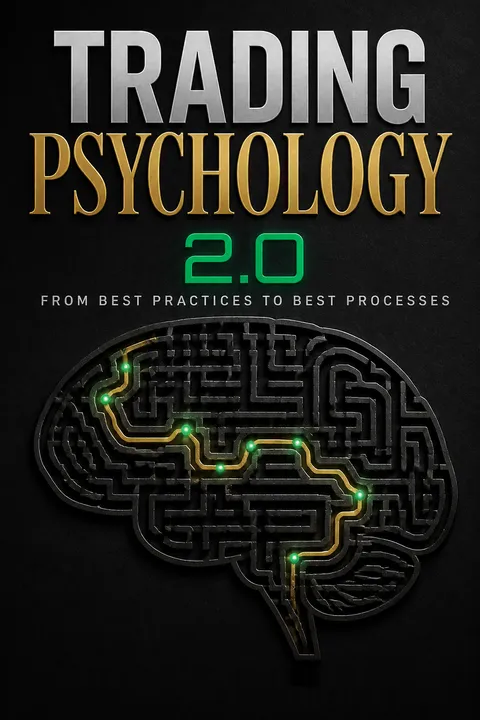
Trading Psychology 2.0 receives high praise for its comprehensive approach to trading and psychology. Readers appreciate its insights on adapting to market conditions, improving oneself, and following best practices. The book is lauded for its depth and valuable advice, particularly the section on 57 best practices. Some critics note its length and repetitiveness, suggesting it could be condensed. Despite these concerns, many readers consider it one of the best books on trading psychology, offering practical strategies for enhancing trading performance and personal growth.
People Also Read









Glossary
Best processes
Linked, improvable routinesBest processes are coordinated sequences of actions that turn effective individual practices into repeatable work. In trading, this can include gathering information, forming and expressing an idea, managing risk, and reviewing outcomes. A process is not merely a routine: its performance is measured, and its steps are revised when evidence shows that the routine is no longer effective.
Functional fixedness
Seeing only familiar usesFunctional fixedness is the tendency to perceive an object or method only in terms of its familiar purpose. Steenbarger uses the candle problem, in which people overlook using an empty tack box as a candle holder, to illustrate how assumptions can block new solutions. Traders can become fixed on one kind of analysis or strategy and fail to imagine how it might be combined with other methods.
See-feel-change
Emotion fuels actionSee-feel-change describes a route to behavior change in which an experience first makes a possibility or consequence vivid, creating an emotional shift that supports action. It contrasts with relying on analysis alone to produce change. Seeing a small success, an inspiring example, or a genuine cost of inaction can create urgency or hope, helping a person move from considering change to taking steps.
Subjective well-being
Positive life experienceSubjective well-being refers to the quality of a person's experienced life, including positive emotion, life satisfaction, energy, and affectionate connection. Steenbarger argues that it influences attention, motivation, and performance, rather than serving only as a reward after success. It can be cultivated through meaningful work, relationships, exercise, gratitude, rest, and other activities suited to a person's strengths.
Multiplier effects
Strengths amplified by environmentsMultiplier effects occur when a person's existing talents lead them toward environments that further develop those talents. A strength encourages the choice of activities, relationships, and work settings that exercise it, and that exposure builds the strength further. The same cycle can work negatively when an environment fails to use a person's capacities or repeatedly divides attention and energy.
Sisu
Cultivated second windSisu is a Finnish term discussed in the book for a reserve of persistence and focused energy that becomes available during exceptional effort. It is presented as more than simply enduring difficulty: repeated challenges may help people access this renewed capacity. In the context of performance, it suggests that resilience can be trained through demanding practice rather than treated as a fixed personal trait.
Event time
Time measured by activityEvent time organizes observations by meaningful events rather than equal intervals on a clock. In markets, an event might be a price change, a volume threshold, or a series of transactions. Steenbarger describes replacing ordinary time intervals on charts with event-based intervals to expose patterns that can be obscured when market activity varies greatly from one period to another.
NYSE TICK
Broad buying-selling gaugeNYSE TICK measures, at a given moment, the number of New York Stock Exchange stocks trading on upticks minus those trading on downticks. It offers a view of whether buyers or sellers are acting more urgently across a broad set of shares. Steenbarger uses extreme readings and cumulative patterns to assess participation, market breadth, and possible shifts in short-term pressure.
FAQ
What's Trading Psychology 2.0 about?
- Focus on Adaptation: The book emphasizes adapting to changing market conditions rather than relying solely on fixed strategies or emotional control.
- Integration of Strengths: It discusses leveraging personal strengths and character traits to enhance trading performance.
- Creativity and Processes: Creativity is highlighted as a vital component, and the book introduces structured processes to link best practices effectively.
Why should I read Trading Psychology 2.0?
- Enhance Trading Performance: Offers actionable insights to improve trading by understanding psychological aspects and adapting to market changes.
- Research-Based Strategies: Draws on extensive psychological research, providing credible and practical strategies for traders.
- Personal Development: Encourages self-awareness and personal growth, making it valuable beyond trading.
What are the key takeaways of Trading Psychology 2.0?
- Adaptability is Crucial: Emphasizes the need for flexibility in trading strategies to succeed in dynamic markets.
- Strengths and Creativity: Identifying and leveraging personal strengths and creativity are essential for trading success.
- Structured Processes: Linking best practices into structured processes enhances decision-making and performance.
How does Trading Psychology 2.0 define emotional intelligence in trading?
- Understanding Emotions: Involves recognizing and managing emotions to make better trading decisions.
- Flexibility in Approach: Emotionally intelligent traders adjust strategies based on market signals, not rigid preconceptions.
- Interpersonal Skills: Includes reading and responding to others' emotions, enhancing market anticipation and decision-making.
What specific methods does Trading Psychology 2.0 recommend for adapting to change?
- Dynamic Adaptation: Develop processes for dynamically adjusting strategies based on market conditions.
- Self-Assessment Exercises: Use exercises to identify strengths, weaknesses, and areas for improvement.
- Building a Support Network: Engage with other traders to share insights and foster a sense of community.
How does Trading Psychology 2.0 address the issue of cognitive biases in trading?
- Awareness of Biases: Emphasizes understanding cognitive biases to make more rational trading decisions.
- Strategies to Mitigate Biases: Suggests maintaining a trading journal and seeking peer feedback to counteract biases.
- Encouraging Diverse Perspectives: Engaging with diverse perspectives helps balance decision-making and reduce biases.
What role does creativity play in trading according to Trading Psychology 2.0?
- Generating Unique Ideas: Creativity is essential for developing unique trading strategies and ideas.
- Adapting to Market Changes: Creative thinking allows for strategy adaptation in response to market shifts.
- Enhancing Problem-Solving Skills: Creativity improves problem-solving, crucial for navigating complex market scenarios.
What are some practical exercises suggested in Trading Psychology 2.0?
- Emotion Journals: Track daily emotional experiences related to trading to identify patterns and manage responses.
- Mind Mapping: Use mind mapping to organize thoughts and generate new ideas, enhancing analytical skills.
- Daily Quotas for Ideas: Set daily quotas for generating new trading ideas to foster creativity and engagement.
How does Trading Psychology 2.0 suggest handling setbacks and losses?
- Embrace Losses as Learning: View losses as growth opportunities, analyzing mistakes for future insights.
- Mindfulness Practices: Use mindfulness techniques to manage emotions during setbacks, preventing impulsive decisions.
- Developing a Growth Mindset: Maintain a positive outlook and growth mindset to stay resilient and motivated.
What is the significance of the "see-feel-change" approach in Trading Psychology 2.0?
- Emotional Engagement: Emphasizes emotional engagement in the change process, inspiring action through new possibilities.
- Catalyzing Action: Encourages finding small wins to build momentum and foster a sense of accomplishment.
- Overcoming Complacency: Helps move beyond complacency by creating urgency and emotional connection to goals.
What are some best practices mentioned in Trading Psychology 2.0?
- Daily Trading Reviews: Conduct structured reviews to assess decisions and encourage continuous improvement.
- Scenario-Based Preparation: Prepare for various market scenarios to anticipate outcomes and maintain control.
- Using Meditation: Incorporate meditation to enhance focus and emotional regulation, crucial for decision-making.
What are the best quotes from Trading Psychology 2.0 and what do they mean?
- "A different restaurant every day": Highlights adaptability in trading, akin to a restaurant meeting customer demands.
- "We cannot achieve excellence...": Stresses consistent effort and practice as key to achieving success.
- "Frustration is the mother of adaptation": Suggests setbacks can prompt reassessment and necessary strategy adjustments.
About the Author



Download PDF
Download EPUB
.epub digital book format is ideal for reading ebooks on phones, tablets, and e-readers.








