

Plot Summary
Malli's Bangles in Jugga's Yard
Partition has not yet broken Mano Majra's familiar rhythm of prayers, fields, and trains. One night, Malli and four armed companions force their way into moneylender Ram Lal's home, beat him, and stab him when he will not reveal his safe's keys. The villagers hear the shots but stay behind their doors.
On their way out, Malli's gang throws a packet of glass bangles into Jugga's courtyard, mocking the giant outlaw for being absent. Jugga is across the river with Nooran, the Muslim weaver's daughter he secretly meets despite his probation. He recognizes Malli when the gang passes, but does not report him. When Jugga returns, villagers are gathered at his house, and he slips away again before the police can find him.
The opening makes the village's habits feel like a fragile shelter: trains mark the hours, and shared routines briefly outweigh religious difference. The dacoity breaks that shelter through familiar local violence, not an invading army. Malli's planted bangles turn an intimate rivalry into misleading evidence, while Jugga's silence leaves the village without the truth he could provide. His night with Nooran matters because it places him outside the murder, but also reveals a more private allegiance than the police register can capture. The neighbors' refusal to intervene foreshadows how fear will later make silence look like consent.
The Magistrate's Blind Eye
Before the murder, district magistrate Hukum Chand arrives at the riverside rest house and hears from the subinspector that refugees are crossing the border while reports of massacres multiply. He wants Muslims removed without bloodshed, yet speaks of evacuation as an administrative problem and tolerates the police's routine corruption.
That evening, he summons a troupe of performers and fixates on its young singer, Haseena, who is barely older than the daughter he lost. He drinks to suppress his discomfort and treats the girl's silence as permission.
When shots and shouting rise from Mano Majra, the disturbance interrupts his private indulgence. The contrast establishes the kind of authority the village will face: a man capable of recognizing suffering, but accustomed to putting conscience aside when action becomes difficult.
Hukum Chand's authority is neither simple villainy nor principled leadership. He can identify the danger of mass retaliation and still reduce people to administrative categories, while his treatment of Haseena exposes the entitlement that privilege makes ordinary. His grief for his lost daughter surfaces as discomfort, then gets buried under drink and self-excuse. That pattern matters later: he is not numb to suffering, but his compassion repeatedly arrives after harm has become unavoidable. The rest house places the magistrate physically near the village and morally apart from it, a witness who can issue orders but cannot easily imagine himself accountable.
Iqbal and Jugga Arrested
The morning after Ram Lal's murder, Iqbal arrives by train carrying books, canned food, and a plan to organize villagers against communal violence. At the gurdwara, Bhai Meet Singh welcomes him, but Iqbal's lecture on politics and social reform lands awkwardly with people more concerned about immediate safety.
Police arrest him the next morning, although he reached the village after the killing. At the same time, they surround Jugga's home and take him in because he broke probation by leaving after dark.
The bangles strengthen suspicion against Jugga, while his mother insists they were thrown there by his enemies. As the two men are marched away together, Iqbal expects his education to command respect; instead, the police begin deciding what his name and body mean.
Iqbal and Jugga enter custody with opposite kinds of confidence. Iqbal trusts education, political language, and legal rights to distinguish him from the people around him; Jugga treats arrest as another predictable encounter with authority. The police collapse those differences into suspicion, using a thin alibi and a planted object against one man, and an ambiguous name against the other. Their pairing challenges the assumption that social status protects anyone equally. Iqbal's wish to be seen as a political figure already makes him perform dignity, while Jugga's familiarity with punishment leaves him less invested in the police's version of justice.
The Train of Ashes
As September brings erratic schedules and soldiers to the railway station, a train from Pakistan stops in daylight with no passengers visible. Officials clear the platform and keep Mano Majra away while police and soldiers inspect the carriages.
The villagers cannot see what is inside, but that night the northern sky glows with a fire and the wind carries the smell of burning flesh. They understand that the train held murdered refugees. Hukum Chand has seen the bodies before they are burned; their faces and wounds return to him in a nightmare, and whisky cannot restore his usual distance.
The next morning, he learns that more than a thousand people were cremated. The mass killing turns distant border news into a physical fact the village can neither ignore nor explain away.
The sealed train makes violence legible first through absence: no visible passengers, no official explanation, only the fire and its smell. This delay lets the villagers' imagination work before the truth becomes undeniable. For Hukum Chand, the corpses defeat the fatalism that normally helps him live with death; deliberate massacre is not the same as mortality. The event also alters the function of the railway. What once regulated village life now carries evidence of a world that has abandoned its old timetable. The train does not merely connect Mano Majra to the border. It brings the border's violence into the village's senses.
The Police Rewrite the Case
Under interrogation, Jugga identifies Malli and his four companions as the men who robbed Ram Lal. The subinspector confirms that the bangles were a taunt, yet Hukum Chand orders Malli's gang released without a proper record.
He wants their presence and a fabricated story about a Muslim League worker to inflame Sikh suspicion against Mano Majra's Muslims. The police consequently label Iqbal a Muslim despite his Sikh identity, and villagers are encouraged to connect him to the murder.
At the same time, Hukum Chand instructs the subinspector to arrange trucks for the Muslim families' removal. He believes that getting them out will save lives. His strategy protects no one through truth or trust; it depends on manipulating the same fear that threatens to destroy the village.
The state does not simply fail to establish the truth. It deliberately reshapes facts to make its chosen solution easier to carry out. Hukum Chand sees evacuation as a way to prevent a massacre, but his manipulation of Iqbal's identity and the murder investigation helps turn neighbors into suspects. This is a consequential moral compromise: public safety is pursued through the very communal suspicion that has made safety precarious. The subinspector's obedience shows how bureaucracy can distribute responsibility until no single person appears to own the harm. The police do not create the violence from nothing, but they give rumor an official frame.
Mano Majra Says Goodbye
When villagers argue over the Sikh refugees sheltering at the temple, Meet Singh defends the Muslim tenants, but fear of outside retaliation wins ground. The lambardar, Banta Singh, finally advises Imam Baksh to take the Muslim families to a refugee camp, promising that their homes and cattle will be protected.
Nooran, Imam Baksh's daughter, goes privately to Jugga's mother and reveals that she is carrying Jugga's child; her father does not know. The next morning, soldiers order the Muslims into trucks with only what they can carry.
Sikh neighbors weep and refuse to take responsibility for the abandoned property, but Malli and the refugees loot it once the convoy leaves. Nooran and Imam Baksh are carried toward Pakistan, while Jugga remains jailed and the village's promise of reunion grows uncertain.
The evacuation is framed as protection, yet it breaks a community that had depended on ordinary, practical loyalties. The lambardar can promise care for houses and cattle but cannot control armed outsiders or guarantee that the exiles will return. Nooran's private disclosure makes the separation more than a political displacement: she is carrying a future that her father cannot accept and Jugga cannot presently defend. The neighbors' tears are sincere, but sincerity does not stop Malli from taking what they leave behind. The scene distinguishes affection from power. Mano Majra's bonds are real, yet vulnerable when decisions are made under armed pressure.
The River Brings the Dead
Days of rain swell the Sutlej until villagers sent to watch the river hear cries beyond the bank. At first, they see a dead cow and floating bundles; dawn reveals bodies of men, women, and children, many bearing wounds that prove they were murdered rather than drowned. While the village recoils, another unlit train arrives from Pakistan and is surrounded by soldiers.
A bulldozer cuts a trench beside the station, and troops carry bodies from the carriages into it before covering the grave. That evening, Mano Majra crowds into the gurdwara for shelter and prayer. The presence of refugees and the deserted Muslim homes deepen their unease, but the next threat comes from armed Sikhs who arrive after dark with a plan for the train bound west.
The river defeats the hope that violence can be contained by distance or official silence. It delivers the dead directly to the village, making the human cost visible without naming the killers or offering a useful explanation. The mass grave repeats the earlier burning in a different register: the authorities dispose of bodies efficiently, while the village has to absorb what the disposal cannot erase. Gathering in the gurdwara offers refuge, but not moral certainty. Its sacred space becomes a place where frightened people can be recruited as well as comforted, and the coming attack will exploit that vulnerability.
The Bridge Becomes a Trap
A young, armed Sikh leader arrives at the gurdwara with Malli, refugees, and other outsiders. He shames the villagers for failing to avenge massacres across the border, then proposes killing Muslims in equal measure.
His target is a train carrying evacuees from Chundunnugger and Mano Majra to Pakistan. The plan is specific: stretch a rope across the bridge high enough to sweep people from the train roof, station gunmen beside the tracks, and attack anyone who falls. Malli volunteers, eager to repair his standing after Jugga humiliated him.
More than fifty men join the scheme, including some villagers who had recently wept as their Muslim neighbors left. The same community that promised protection now faces a coordinated attempt to turn grief into revenge.
The firebrand gives grief a simple arithmetic: one atrocity demands two in return. That formula is psychologically potent because it turns helplessness into a task and disguises vengeance as prevention. The gurdwara lends the plan borrowed authority, even though Meet Singh objects that local Muslims have committed no crime. His protest cannot compete with the leader's demand for proof of courage. Malli's participation adds a personal motive beneath the political language: he wants to recover status after a public humiliation. The scene shows how communal violence recruits through overlapping needs, including fear, belonging, and the desire to appear powerful.
Two Prisoners Go Home
The subinspector tells Hukum Chand that the Chundunnugger refugees will travel that night and that an attack on their train is planned. Hukum cannot command the armed mob, so he orders Iqbal and Jugga released and sent back to Mano Majra, hoping they might affect events.
The men return by tonga to a village changed by empty homes, looted belongings, and refugees gathered at the gurdwara. Meet Singh tells Iqbal about the rope and guns; Iqbal imagines intervening, then persuades himself that dying unseen would accomplish nothing.
Jugga learns that the Muslim families have gone and seeks a verse from the Sikh scripture before leaving the gurdwara. Hukum, meanwhile, is tormented by the thought that Haseena has returned to Chundunnugger and may be on the train.
The release gives both men a chance to act, but it does not grant them equal freedom. Hukum Chand can open prison doors, yet cannot openly stop the people preparing the attack. Iqbal's reasoning exposes a central weakness: he values moral action partly through its public recognition, so the prospect of an unseen death paralyzes him. Jugga's response is less articulate. He seeks religious guidance without demanding that it guarantee an outcome, then moves toward the danger. Hukum's concern for Haseena complicates his belated intervention; personal attachment finally gives urgency to the lives he has treated as abstractions.
Jugga Cuts the Killing Rope
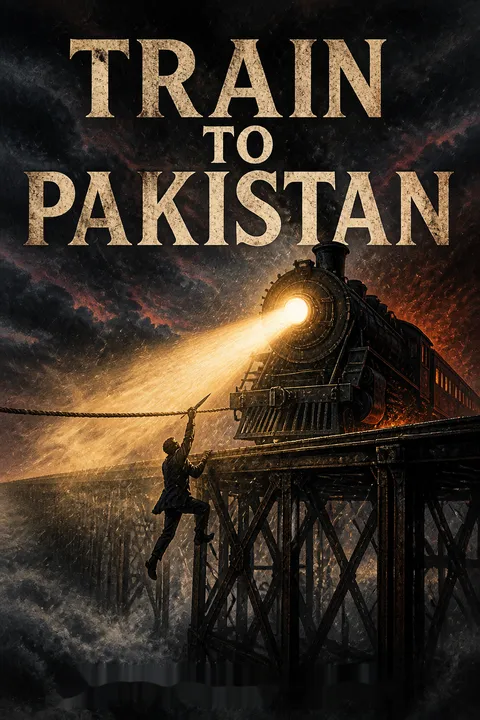
At night, the armed men take their positions beside the tracks, and the rope is secured across the bridge. A train approaches with people packed onto its roof. Jugga climbs the steelwork and begins cutting the rope with his small kirpan.
The leader fires; a bullet knocks one of Jugga's legs loose, but he clings on and keeps hacking, using his teeth when the blade cannot finish the job. The remaining strand snaps just as the engine reaches him. Jugga falls, and the train passes over him toward Pakistan.
The planned sweep of passengers is disrupted, though the book does not confirm what happens to Jugga afterward or whether every passenger survives. His action answers the village's paralysis without repairing the losses that brought the train there.
The climax makes resistance bodily and immediate. Jugga does not debate the attackers' logic or claim that one brave act can heal Partition; he puts his weight against the instrument designed to kill the passengers. His use of a kirpan, a weapon associated with Sikh identity, reverses the communal story told by the firebrand: religious belonging can be invoked for protection rather than revenge. Iqbal's political theories have not produced action, while Jugga's attachment to Nooran and his sense of obligation propel him onto the bridge. The ending preserves uncertainty about survival, refusing to turn sacrifice into a clean victory.
Analysis
Train to Pakistan places the upheaval of Partition inside a village small enough for neighbors to recognize one another's habits, debts, and family histories. That scale prevents communal violence from remaining an abstraction. The dead arrive by train, the displaced arrive on foot, and familiar Muslim neighbors become vulnerable not because their conduct has changed but because political categories have hardened around them. The novel's recurring question is whether shared life can withstand stories imported from elsewhere.
Its answer is deliberately unsentimental. The villagers' affection is real, but it cannot by itself stop armed outsiders, state decisions, or the pressure to prove communal loyalty. Banta Singh's promise to protect Muslim property collapses when Malli is appointed to take it. Hukum Chand tries to preserve lives through evasive administration, yet his manipulations also deepen suspicion. Meet Singh's moral protest is clear but weak against organized violence. Good intentions matter, but they do not substitute for action or power.
The novel also distinguishes knowledge from courage. Iqbal can analyze inequality and police corruption, yet worries that an unobserved sacrifice would be meaningless. Jugga has no theory of history and little faith in official justice, but his attachment to Nooran gives him a concrete reason to act. His final intervention does not restore the village or promise that every refugee survives. It interrupts one planned massacre at its most immediate point. The ending therefore offers neither a political solution nor a consoling moral victory. It insists instead that individual action matters even when its results remain uncertain, and that the price of treating human beings as interchangeable members of rival groups is paid in bodies, homes, and futures that cannot be returned.
Review Summary
Train to Pakistan is a powerful novel about the Partition of India in 1947, set in a fictional border village. Readers praise Singh's vivid portrayal of communal violence, complex characters, and exploration of human nature. The book is lauded for its raw, unbiased depiction of historical events and thought-provoking themes. While some found the writing style challenging, many consider it a must-read for understanding the Partition's impact. The novel's emotional depth, philosophical insights, and portrayal of religious tensions resonated with readers, making it a classic of Indian literature.
People Also Read






Characters
Juggut Singh
The village strongmanKnown as Jugga, he is the towering son of a man hanged for dacoity and is himself listed by the police as a habitual offender. His size and temper make him frightening, but his habits are less orderly than the village's moral labels suggest: he is loyal to people he loves, quick to anger at humiliation, and largely untroubled by official judgment. His relationship with Nooran draws him beyond the masculine bravado he performs for other men. Jugga has little education and does not analyze his motives in political language. He responds through bodily presence, loyalty, and a direct sense of what must be done, making him a counterpoint to characters who can explain injustice more readily than they can confront it.
Iqbal
The cosmopolitan reformerA politically engaged social worker educated abroad, Iqbal comes to Mano Majra believing that organized reform and reason can interrupt communal violence. He is secular in outlook and uncomfortable with the village's religious customs, yet his own ideas often remain theoretical. He wants to be recognized as courageous and politically significant, a desire that complicates his stated commitment to ordinary people. Police suspicion exposes how little control his education gives him over the identity others assign him. Iqbal is perceptive about class, state power, and the machinery of prejudice, but those insights do not automatically make him brave. His character tests the gap between diagnosing a crisis and accepting personal risk within it.
Hukum Chand
The compromised magistrateThe district magistrate is experienced in managing officials and accustomed to treating morality as secondary to practical administration. He sees the danger of retaliation and wants to preserve order, but often reaches for concealment, manipulation, and compromise rather than direct confrontation. Beneath his polished authority lies a persistent fear of death, sharpened by the losses in his private life. His attention to Haseena reveals both his loneliness and his willingness to use the power imbalance between himself and a young performer. Hukum Chand is neither indifferent nor reliably courageous. He represents a conscience that remains active but is repeatedly delayed by self-protection, habit, and the belief that a small administrative adjustment can contain a vast human catastrophe.
Nooran
The weaver's daughterNooran is the daughter of Imam Baksh, the village mullah, and the beloved of Jugga, a Sikh landowner's son. She is young, alert to the dangers created by their religious difference, and more practical than Jugga about what their secret relationship could cost her. Their intimacy gives her a private life that the village's social rules cannot comfortably accommodate. Nooran's loyalty to her father and her attachment to Jugga pull her in different directions, while the upheaval around her makes ordinary choices newly dangerous. She is not simply a symbol of communal harmony: she has her own fears, pride, and hopes, and those personal stakes make the political division of the village intimate.
Bhai Meet Singh
The village's gentle priestThe Sikh priest at the gurdwara is an untidy, good-natured peasant who offers Iqbal a place to stay and treats Imam Baksh as a friend. He is less learned than the mullah, but his loyalties are grounded in years of shared village life. Meet Singh resists the idea that Muslims should be punished for crimes committed elsewhere, even when his neighbors grow suspicious. His decency is genuine, though he is not a forceful organizer and often falls back on prayer when faced with armed men. He represents a local ethic of coexistence that has real emotional strength but limited institutional power.
Imam Baksh
The village's trusted elderNooran's father is the blind, widowed mullah of the mosque and a respected voice among Mano Majra's Muslims. The villagers know him as an uncle, not merely as a religious authority. He survives through small offerings and the goodwill of his Sikh neighbors, and his stories and proverbs give him a valued place in village life. Imam Baksh's attachment to his home is inseparable from his belief that he belongs among the people who have known him for generations. His dignity and affection for the community are tested by a crisis he cannot control.
Banta Singh
The burdened headmanKnown chiefly as the lambardar, Banta Singh collects revenue and serves as the village's point of contact with officials. He is a modest working farmer rather than a commanding leader, but crises force him to speak for his neighbors. He believes in the bonds between Sikh landowners and Muslim tenants, while recognizing that outsiders may overwhelm those bonds. His decisions come from practical fear as much as affection, leaving him burdened by the gap between the protection he promises and the protection he can actually provide.
The Subinspector
The obedient police operatorThe local police officer serves Hukum Chand and manages arrests, reports, and the movement of refugees. He is adaptable, careful about his career, and skilled at shifting his manner to suit a superior or a suspect. He can recognize when an arrest is mistaken, but that recognition rarely overcomes his willingness to manufacture a convenient explanation. His actions show how an ordinary official can help turn rumor into policy while thinking of himself as merely carrying out instructions.
Malli
The rival dacoitMalli leads the gang that robs Ram Lal and has a history of hostility with Jugga. He is calculating enough to exploit their rivalry, using the bangles to make suspicion fall on his absent rival. His desire for status becomes especially visible when Jugga humiliates him in custody. Malli's opportunism lets him move between private crime and public communal violence, where other people's fear can serve his interests.
Haseena
The young traveling singerHaseena is a Muslim performer who travels with an older woman and musicians. Her youth and economic vulnerability place her at the mercy of wealthier patrons, though she retains a lively sense of humor and a capacity to challenge Hukum Chand's assumptions. She treats singing as her profession and resists being reduced to the sexual role he expects her to accept. Her brief connection with the magistrate reveals how private dependence and political power can overlap.
Ram Lal
The village moneylenderRam Lal is Mano Majra's sole Hindu householder and its moneylender. His brick home distinguishes him from the surrounding mud dwellings, and his loans connect him to the Sikh families who farm the land. His position makes him locally prominent but does not protect his household from violence.
The Sikh Refugee Leader
The revenge preacherThis young, armed outsider arrives with a confident performance of religious and military authority. He exploits Sikh refugees' grief and the villagers' shame, presenting revenge as a test of courage and communal loyalty. His force lies less in personal history than in his ability to turn a crowd's fear into a plan with practical steps.
Jugga's Mother
The fiercely protective motherShe worries over her son's police restrictions and the danger his reputation brings to their household. Her first response to Nooran is harsh, shaped by fear of scandal and the danger of sheltering a Muslim girl, but beneath it is a protective instinct she struggles to express. Her loyalty to Jugga makes her an important connection between him and Nooran.
Plot Devices
The railway timetable
Trains as village clockIn Mano Majra, trains have long organized the day more reliably than any clock. Their whistles wake villagers for prayer, their passage marks pauses in farm work, and the night goods train signals that households can sleep. As Partition disrupts schedules and brings crowded refugee trains, this familiar system turns into a source of dread. The railway makes distant events physically present, carrying refugees, soldiers, and reports of violence through the village. It is both an ordinary part of local life and the channel through which that life is transformed.
The glass bangles
A planted false trailMalli's gang leaves broken red and blue bangles in Jugga's courtyard after robbing Ram Lal. The gesture is meant as an insult to Jugga, who was not with the dacoits, but it also gives police a convenient reason to arrest him. His mother's explanation cannot overcome the authority of physical evidence once the police choose which story to believe. The bangles connect personal rivalry to the machinery of suspicion, showing how an object can be both a private taunt and a public accusation.
Names and religious signs
Identity as police evidenceIqbal's name can belong to people of different religions, and his appearance does not settle the matter for the police. Officials use his circumcision to label him a Muslim and then attach a Muslim League identity to him, despite his own account and his Sikh background. In a period when strangers may be stripped and inspected at checkpoints, the body becomes a dangerous document. This device exposes the gap between personal identity and the categories institutions impose for convenience, suspicion, or survival.
The railway bridge rope
A chokepoint turned weaponThe bridge over the Sutlej carries every train through a narrow, predictable passage. The Sikh attackers exploit that geography by planning to stretch a rope across the route and use the train's movement against the people crowded on its roof. The same structure that has connected Mano Majra to the wider world becomes a place where passengers can be trapped. The rope converts communal vengeance into a precise mechanism, making the bridge a test of whether anyone will oppose the plan once it has been set in motion.
FAQ
Synopsis & Basic Details
What is Train to Pakistan about?
- Partition's human impact: The novel portrays the effects of the 1947 partition of India on a small, previously harmonious village, Mano Majra, focusing on the breakdown of relationships and the eruption of violence.
- Love amidst chaos: It explores the love story between Juggut Singh, a Sikh, and Nooran, a Muslim, set against the backdrop of increasing communal tensions and forced migration.
- Loss of innocence: The story follows the villagers as they grapple with the arrival of trains filled with corpses, the evacuation of Muslims, and the moral dilemmas they face, ultimately leading to a tragic climax.
Why should I read Train to Pakistan?
- Historical significance: The novel offers a raw and realistic depiction of the human suffering and social upheaval caused by the partition of India, a pivotal event in South Asian history.
- Compelling characters: Singh creates memorable and complex characters, such as Juggut Singh and Hukum Chand, who grapple with moral dilemmas and undergo significant transformations.
- Universal themes: The story explores timeless themes of love, loss, violence, and redemption, making it relevant to readers interested in the human condition beyond its specific historical context.
What is the background of Train to Pakistan?
- Political division: The novel is set against the backdrop of the partition of India in 1947, which divided British India into two independent nations: India and Pakistan, based on religious lines.
- Communal violence: The partition led to widespread communal tensions and mass migrations, as Hindus and Sikhs fled to India and Muslims fled to Pakistan, resulting in immense suffering and loss of life.
- Geographical context: The story takes place in Mano Majra, a village in the Punjab region, which was directly affected by the partition due to its proximity to the border between India and Pakistan.
What are the most memorable quotes in Train to Pakistan?
- "They say that is the only way to stop killings on the other side. Man for man, woman for woman, child for child.": This quote highlights the brutal logic of revenge that fueled the communal tensions during partition, reflecting the cycle of violence and retribution.
- "To add to it all, there is the police system which, instead of safeguarding the citizen, maltreats him and lives on corruption and bribery.": This quote critiques the corruption and ineffectiveness of the Indian police system, which contributed to the breakdown of law and order during partition.
- "Freedom must be a good thing. But what will we get out of it? Educated people like you, Babu Sahib, will get the jobs the English had. Will we get more lands or more buffaloes?": This quote captures the disillusionment of ordinary villagers who questioned the benefits of independence and partition, highlighting the economic disparities and social inequalities that persisted.
What writing style, narrative choices, and literary techniques does Khushwant Singh use?
- Simple and direct prose: Singh employs a straightforward and unadorned writing style, making the story accessible and impactful, focusing on the raw emotions and harsh realities of partition.
- Third-person omniscient narration: The narrative perspective allows the reader to access the thoughts and feelings of multiple characters, providing a comprehensive view of the events and the diverse perspectives within the village.
- Realistic and unflinching portrayal: Singh does not shy away from depicting the violence, brutality, and moral ambiguity of partition, offering a realistic and often disturbing portrayal of the human cost of political division.
Hidden Details & Subtle Connections
What are some minor details that add significant meaning?
- The Deo's veneration: The sandstone slab venerated by all Mano Majrans, regardless of religion, symbolizes the underlying unity and shared cultural heritage that existed before the partition exacerbated religious divisions.
- The rest house's geckos: The geckos fighting above Hukum Chand's bed foreshadow the communal tensions about to erupt, suggesting that even in seemingly peaceful environments, underlying tensions can quickly escalate.
- The broken bangles: The dacoits leaving broken bangles at Jugga's house is a calculated insult, questioning his masculinity and courage, and highlighting the societal pressures and expectations placed on men during times of conflict.
What are some subtle foreshadowing and callbacks?
- The delayed monsoon: The unusually late monsoon foreshadows the disruption of the natural order and the impending chaos that will engulf Mano Majra, suggesting that the village's peaceful existence is about to be irrevocably altered.
- Hukum Chand's advice: Hukum Chand's advice to the subinspector to "see everything and say nothing" foreshadows his own inaction and moral compromises, highlighting the difficulty of maintaining neutrality in a polarized environment.
- The train whistle: The train whistle that initially signals the start of the day later becomes a harbinger of death and destruction, symbolizing the transformation of a familiar sound into a source of fear and dread.
What are some unexpected character connections?
- Hukum Chand and Nooran: The magistrate's relationship with the young prostitute reveals his hidden vulnerability and desire for connection, highlighting the human cost of the partition on individuals in positions of power.
- Jugga and Malli: The complex relationship between the two badmash, from former allies to bitter enemies, underscores the breakdown of social bonds and the rise of opportunistic violence during times of crisis.
- Meet Singh and Imam Baksh: The priest and the mullah, despite their different faiths, share a deep respect and affection for each other, symbolizing the potential for interfaith harmony and the tragedy of its loss during partition.
Who are the most significant supporting characters?
- Meet Singh: As the village priest, Meet Singh represents the moral conscience of Mano Majra, struggling to uphold his values of peace and compassion in the face of escalating violence and communal tensions.
- Imam Baksh: The Muslim mullah embodies the shared cultural heritage and peaceful coexistence that existed in Mano Majra before partition, highlighting the tragedy of the forced displacement and loss of community.
- The Subinspector: This character represents the pragmatic and often morally ambiguous role of law enforcement during times of crisis, tasked with maintaining order amidst chaos and navigating complex political pressures.
Psychological, Emotional, & Relational Analysis
What are some unspoken motivations of the characters?
- Hukum Chand's loneliness: Beneath his cynical exterior, Hukum Chand craves connection and affection, driving his relationship with Haseena Begum and revealing his vulnerability in the face of overwhelming chaos.
- Iqbal's need for validation: Despite his intellectualism, Iqbal desires recognition and validation for his political beliefs, leading him to exaggerate his importance and downplay the dangers of the situation.
- Jugga's desire for redemption: Haunted by his criminal past, Jugga seeks redemption through his love for Nooran and his ultimate act of sacrifice, attempting to break free from the cycle of violence and reclaim his humanity.
What psychological complexities do the characters exhibit?
- Hukum Chand's fatalism: The magistrate's philosophical acceptance of death masks a deep-seated fear and anxiety, leading him to seek solace in fleeting pleasures and ultimately failing to prevent the impending tragedy.
- Iqbal's disillusionment: The social worker's initial idealism clashes with the harsh realities of partition, causing him to question his beliefs and struggle with feelings of impotence and despair.
- Jugga's internal conflict: The badmash grapples with his violent nature and his love for Nooran, torn between his loyalty to his community and his desire to protect the woman he loves, leading to his ultimate sacrifice.
What are the major emotional turning points?
- The arrival of the ghost train: This event shatters the illusion of peace in Mano Majra, instilling fear and suspicion among the villagers and marking the beginning of the community's descent into chaos.
- The evacuation of the Muslims: The forced departure of the Muslim residents severs lifelong friendships and divides the village, creating a sense of loss and betrayal that fuels the cycle of violence.
- Jugga's decision to cut the rope: This act of sacrifice represents a profound emotional transformation, as the badmash chooses love and compassion over hatred and revenge, redeeming himself in the process.
How do relationship dynamics evolve?
- Sikh-Muslim friendship to suspicion: The once harmonious relationship between Sikh and Muslim villagers deteriorates into mistrust and animosity, reflecting the broader communal tensions and the breakdown of social bonds during partition.
- Jugga's love for Nooran: Their relationship transcends religious boundaries, evolving from a simple attraction to a deep and selfless love that ultimately inspires Jugga's act of sacrifice.
- Hukum Chand and Haseena Begum's connection: The magistrate's relationship with the prostitute shifts from a transactional encounter to a more complex and tender connection, revealing his hidden vulnerability and desire for human companionship amidst the chaos.
Interpretation & Debate
Which parts of the story remain ambiguous or open-ended?
- The extent of Jugga's prior knowledge: It's unclear whether Jugga had any prior knowledge of the plan to attack the train, or if his actions were purely motivated by his love for Nooran and his desire to prevent further bloodshed.
- The long-term impact on Mano Majra: The novel ends with Jugga's sacrifice, but the long-term consequences of the partition on the village and its inhabitants remain uncertain, leaving the reader to imagine the future of the community.
- Hukum Chand's ultimate fate: The magistrate's final thoughts and feelings are left ambiguous, leaving the reader to ponder whether he truly regrets his actions and whether he finds any solace in Jugga's sacrifice.
What are some debatable, controversial scenes or moments in Train to Pakistan?
- Hukum Chand's relationship with Haseena Begum: The magistrate's involvement with a young prostitute raises ethical questions about power dynamics and exploitation, sparking debate about his moral character and the complexities of human relationships.
- The depiction of communal tensions: Singh's unflinching portrayal of the brutality and barbarity of the riots can be seen as both a necessary depiction of historical reality and a potentially sensationalized account that could perpetuate harmful stereotypes.
- Jugga's redemption: Some may argue that Jugga's past actions are too heinous to be fully redeemed by his final act of sacrifice, questioning whether a single act of bravery can truly erase a lifetime of wrongdoing.
Train to Pakistan Ending Explained: How It Ends & What It Means
- Jugga's sacrifice: Juggut Singh sacrifices himself to cut the rope stretched across the bridge, preventing the massacre of Muslim refugees on the train, showcasing his transformation from a criminal to a selfless hero.
- Redemption through action: Jugga's act redeems him from his past misdeeds, demonstrating that even those with a troubled history are capable of profound acts of compassion and sacrifice.
- Hope amidst despair: The ending offers a glimmer of hope amidst the overwhelming tragedy of partition, suggesting that individual acts of bravery and humanity can transcend the violence and hatred that divide communities.

Download PDF
Download EPUB
.epub digital book format is ideal for reading ebooks on phones, tablets, and e-readers.








