Key Takeaways
1. The Universe's Violent Birth from Chaos
From empty Chaos, somehow sea and earth and air appeared.
Primordial beginnings. The Greek cosmos began not with a creator, but with empty Chaos, from which emerged fundamental forces like Gaia (Earth), Uranus (Heaven), Pontus (Sea), Tartarus (Underworld), and Eros (Love). This initial state was one of turbulent disorder, where elements mixed indiscriminately, lacking any reliable rules or nature. Out of this primal need for order, Gaia, the mother force, solidified herself, separating land from water and air, leading to the formation of the seas and heavens.
Generational overthrow. Gaia, feeling alone, chose Uranus as her husband, and together they birthed the powerful Titans, followed by the monstrous Cyclopes and Hundred-Handed Ones. Uranus, fearing his children's strength, imprisoned them within Gaia, causing her immense pain. This act of paternal cruelty set a precedent for a cycle of generational conflict, where sons would rise to overthrow their fathers, driven by fear and a desire for freedom.
Cronus's rebellion. The youngest Titan, Cronus, emboldened by his suffering mother Gaia, took up an adamantine sickle and castrated his father Uranus, stripping him of his power. This violent act, while freeing the Titans, also splattered Uranus's blood across Gaia, giving birth to new entities like the vengeful Erinyes, the lumbering Giants, and the playful Nymphs. From the sea foam mixed with Uranus's parts, the beautiful Aphrodite emerged, marking a new era of divine beauty born from brutality.
2. Zeus Establishes Olympian Dominance Through Force
As Zeus saw it, the war amounted to old against young, and the young gods won, as they had to. That is the nature of things.
Cronus's fear and deception. Cronus, having overthrown his father, became consumed by the prophecy that he too would be deposed by his own son. In a desperate attempt to prevent this, he swallowed each of his children—Hestia, Demeter, Hera, Hades, and Poseidon—as they were born. However, his wife Rhea, mirroring Gaia's earlier defiance, tricked Cronus into swallowing a stone instead of their sixth child, Zeus, who was secretly raised on Crete.
The Titanomachy. Upon reaching adulthood, Zeus, with Gaia's help, forced Cronus to disgorge his swallowed siblings. These newly freed Olympians, along with Zeus, waged a brutal, decade-long war against Cronus and the other Titans. The tide turned when Zeus liberated the Cyclopes and Hundred-Handed Ones from Tartarus, who, in gratitude, gifted Zeus his thunderbolt, Poseidon his trident, and Hades his helmet of invisibility.
Undisputed rule. Armed with these powerful weapons and aided by his monstrous uncles, Zeus led the Olympians to victory, sealing the defeated Titans in the deepest part of the Underworld, Tartarus. Gaia, angered by Zeus's vengeful act, birthed the monster Typhon, but Zeus conquered him too, solidifying his position as the undisputed king. The Olympian brothers then divided the universe: Poseidon claimed the seas, Hades the Underworld, and Zeus, the king, took everything else, establishing a new, albeit unequal, divine order.
3. Gods Mirror Humanity's Flaws and Passions
In reading the myths, we begin to understand that the ancient Greeks must have wanted more than just the big answers from their gods. They must have also wanted their gods to be a reflection that could help them understand themselves.
Divine imperfections. Despite their immense power and immortality, the Greek gods are portrayed with strikingly human flaws and emotions. They are not distant, perfect beings but rather passionate, jealous, and often petty figures who engage in constant squabbles, infidelities, and acts of vengeance. Zeus, the king, is a prime example, constantly pursuing mortal and immortal women, inciting Hera's furious jealousy.
Emotional complexity. The myths delve into the full spectrum of human emotion, from the deep love of Demeter for Persephone to the burning rage of Hera against Zeus's lovers and illegitimate children. Ares embodies murderous cowardice, while Hermes revels in mischievous trickery. These divine narratives provided the ancient Greeks with a framework to explore and understand their own complex inner lives and the consequences of unchecked emotions.
Moral ambiguity. The gods' actions often lack clear moral boundaries, reflecting a world where power frequently dictates right and wrong. They bless and curse, aid and hinder, often based on personal whims or perceived slights, rather than universal justice. This portrayal allowed the Greeks to grapple with the inherent ambiguities of existence and the unpredictable nature of fate, seeing their own struggles mirrored in the divine realm.
4. Nature's Mysteries Personified by Divine Actions
The ancient Greeks looked at seasons and used myths to explain their mystery. In many ancient cultures, myth originated to account for other baffling natural phenomena.
Explaining the seasons. The myth of Demeter and Persephone provides a poignant explanation for the changing seasons. Demeter, the goddess of the harvest, doted on her daughter Persephone. When Hades abducted Persephone to the Underworld, Demeter's inconsolable grief caused the Earth to wither, leading to famine. Zeus intervened, but because Persephone had tasted a pomegranate seed in the Underworld, she was bound to spend a third of the year there. Her annual return to her mother brings spring, summer, and autumn, while her absence plunges the world into barren winter.
Celestial bodies and natural forces. The sun, moon, and dawn are personified by the Titan children Helios, Selene, and Eos, respectively. Helios tirelessly drives his golden chariot across the sky each day, bringing light and warmth. Selene, the shy moon goddess, waxes and wanes, offering soft light and inspiring calm, her sadness linked to her mortal love, Endymion. Eos, with her rosy fingers, heralds the dawn, and her union with Astraios produces the stars and the three winds: Zephyr, Boreas, and Notos.
Earthly phenomena. Other natural occurrences are also attributed to divine actions. Poseidon, god of the seas, wields his trident to smite seabeds, raise massive waves, and shake the Earth, causing earthquakes and tsunamis. Volcanoes are often associated with Hephaestus's forge. These myths provided a narrative framework for understanding the powerful and often unpredictable forces of the natural world, making them relatable through divine personalities and stories.
5. Women's Power and Suffering in a Male-Dominated World
The only power unique to women was childbearing. In the Athena myth, Athena is born from Zeus’ forehead. Certainly the Greeks knew men don’t give birth. But maybe they wished men did, for Uranus, Cronus, and Zeus, each in his own way, tried to take this power from womanhood.
Maternal suffering and defiance. From Gaia's agony at her children's imprisonment to Rhea's desperate deception to save Zeus, female figures often bear the brunt of male fear and ambition. Demeter's profound grief over Persephone's abduction highlights the vulnerability of motherhood. Yet, these women also exhibit fierce agency: Gaia instigates Uranus's overthrow, Rhea saves Zeus, and Hera, in a fit of rage at Zeus's "solo" birth of Athena, independently gives birth to Hephaestus, asserting her unique power.
Diverse forms of power. Goddesses like Athena embody wisdom, strategy, and battle prowess, challenging traditional gender roles. Aphrodite wields immense power through her beauty and charm, influencing gods and mortals alike. Sorceresses like Medea demonstrate formidable magical abilities, capable of both great aid and terrible vengeance. These figures show that female power, while often expressed differently from male physical dominance, is a potent force in the mythological world.
Vulnerability and tragedy. Despite their power, many female characters endure significant suffering. Danaë is imprisoned and cast to sea, Andromeda is offered as a sacrifice, and Iphigenia is tragically sacrificed by her own father. Helen's unparalleled beauty, while a source of power, also makes her a pawn in divine and mortal conflicts, leading to the devastating Trojan War. These narratives underscore the precarious position of women, even powerful ones, in a world shaped by male desires and divine whims.
6. Heroes: Extraordinary Strength, Fated Destinies, and Moral Ambiguity
The Greeks revered him, but they laughed at him, too.
Demigod strength and divine interference. Greek heroes, often demigods born from unions between gods and mortals, possess superhuman strength and abilities. Heracles, son of Zeus, is the epitome of brawn, capable of incredible feats like strangling the Nemean Lion or slaying the Lernaean Hydra. However, their lives are frequently dictated by prophecies and divine interference, particularly from jealous gods like Hera, who relentlessly tormented Heracles from birth.
Flawed and complex characters. Unlike modern heroes, Greek heroes are rarely morally perfect. Heracles, despite his immense strength and eventual immortality, is prone to fits of rage and thoughtlessness, leading him to accidentally kill his music tutor and, in a Hera-induced madness, his own family. Perseus, while clever in slaying Medusa, is also described as "heartless" for his methods and later abandons Ariadne. Jason's quest for the Golden Fleece is marked by betrayals and atrocities, including Medea's brutal murder of her own brother.
Quest for glory and redemption. Heroes often embark on arduous quests, not just for personal gain, but to fulfill prophecies, atone for sins, or achieve lasting fame. Heracles' Twelve Labors are a journey of purification, while Jason's voyage seeks to reclaim his rightful throne. These journeys are fraught with monsters, cunning enemies, and moral dilemmas, forcing the heroes to confront their own limitations and the harsh realities of their fated paths.
7. Justice and Retribution Drive Cycles of Violence
Wickedness deserves to crawl through the slime.
Divine punishment. The Greek myths are replete with instances of divine retribution, often meted out with severity and without mercy. Cronus's imprisonment in Tartarus for his cruelty to his children, and Hades' satisfaction in ruling over the wicked, exemplify this. Niobe's boast of having more children than Leto leads to the slaughter of all her children by Apollo and Artemis, and her transformation into a weeping stone, a stark warning against hubris.
"Eye for an eye" mentality. Early forms of justice, particularly among mortals and younger heroes, often reflect a direct, retaliatory approach. Theseus, in his youth, dispatches robbers by subjecting them to their own cruel methods, believing that "each was served with his own crime." This reflects a societal value where punishment was seen as a direct consequence mirroring the offense.
The unending cycle. However, this focus on retribution often perpetuates cycles of violence rather than ending them. The generational overthrow of primordial gods, the Titanomachy, and the endless feuds among the Olympians demonstrate that vengeance, even when justified, can lead to further conflict. The Trojan War, sparked by Paris's abduction of Helen, becomes a prolonged and devastating conflict fueled by honor, revenge, and divine meddling, highlighting the destructive nature of unending retribution.
8. Love's Dual Nature: Creation and Destruction
Eros was beautiful, but not ordinary beautiful. Eros’ beauty made the others quiver.
Primordial force. Love, personified by Eros, is a fundamental force in the Greek cosmos, present even in the earliest moments of creation. It is Eros's beauty that makes Night and Erebus fall in love, leading to the birth of Day, and it is love that draws Gaia to Uranus, initiating the first divine unions. This highlights love as a powerful, irresistible force that drives connection and creation.
Divine and mortal passions. Love in Greek mythology spans the spectrum from tender affection to obsessive passion. Poseidon's deep love for the mortal Gorgon Medusa, despite her monstrous appearance, shows love transcending conventional beauty. Selene's profound love for the mortal Endymion leads her to beg Zeus for his eternal youth, resulting in his perpetual sleep—a bittersweet testament to love's enduring, yet often tragic, nature when divine and mortal worlds intertwine.
Destructive consequences. While love can be a source of immense joy and creation, it is equally capable of causing chaos and destruction. Zeus's numerous affairs, driven by lust, constantly ignite Hera's furious jealousy, leading to her vengeful torment of his lovers and children. Paris's infatuation with Helen, fueled by Aphrodite's bribe, directly triggers the devastating Trojan War, illustrating how love, when selfishly pursued or divinely manipulated, can unleash catastrophic consequences upon the world.
9. The Trojan War: A Divine Game with Human Costs
See them? See these fine young people, armed to the teeth, hearts full of valor and hope, but heads knowing rivers of blood would flow. See them battle month after month, year after year—egged on by gods and goddesses who saw them as pawns in a giant game.
A wedding's ripple effect. The Trojan War, a defining epic of Greek mythology, ironically began with a wedding—that of King Peleus and the nymph Thetis. Eris, the goddess of discord, uninvited, threw a golden apple "for the fairest," leading to a beauty contest judged by Paris. His choice of Aphrodite, who promised him the most beautiful woman, Helen, set in motion a chain of events that would engulf two nations in a decade-long conflict.
Divine manipulation and human sacrifice. The gods actively participated in and prolonged the war, often treating mortals as pawns in their own rivalries and whims. Artemis, angered by Agamemnon's boast, withheld winds until he sacrificed his own daughter, Iphigenia, a horrific cost for the Greek fleet to sail. Throughout the war, gods like Apollo intervened to shift the tide, ensuring a prolonged and bloody conflict that served more to amuse them than to achieve any just outcome.
Heroic tragedy and cunning. The war saw the rise and fall of legendary heroes on both sides, such as the nearly immortal Achilles for the Greeks and the noble Hector for the Trojans. Their valor and sacrifices were immense, yet ultimately futile in the face of divine will and human cunning. The war finally ended not through direct combat, but through Odysseus's brilliant deception: the Trojan Horse, which led to the complete destruction of Troy and the slaughter of its sleeping inhabitants, a testament to the brutal realities of war.
10. The Evolution of Human Values and Governance
No more eye-for-an-eye justice; Theseus had learned humanity.
Divine gifts and human ingenuity. The myths trace the origins of human civilization and skills to both divine intervention and mortal ingenuity. Prometheus and Helios are credited with fashioning humans from clay, with other gods like Hephaestus, Athena, Aphrodite, and Hermes contributing various skills and traits. Helios even gifted fire to humanity, enabling warmth and progress. These stories highlight the belief that human capabilities were divinely inspired, yet also required mortal effort and learning.
From brute force to wisdom. The journey of heroes often reflects a progression from raw strength and "eye-for-an-eye" justice to a more nuanced understanding of humanity. Theseus, initially a ruthless killer of robbers, later evolves into a wise king who establishes democracy in Athens. He demonstrates compassion by supporting Heracles in his madness and by forcing the Thebans to bury their dead enemies, signifying a shift towards empathy and reasoned governance over pure retribution.
Foundations of society. The myths provide foundational narratives for societal structures and values. The establishment of the Olympian order, the division of realms, and the roles of various gods in overseeing aspects of life (Hestia for hearth and home, Demeter for agriculture, Dionysus for wine and revelry) reflect the ancient Greeks' understanding of a structured world. The story of Theseus founding democracy in Athens, a city renowned for its philosophers and playwrights, underscores the value placed on collective decision-making and intellectual pursuits in shaping a just society.
Last updated:
Review Summary
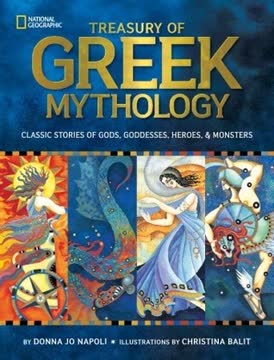
Treasury of Greek Mythology receives mixed reviews averaging 4.02/5 stars. Praise centers on stunning illustrations by Christina Balit and engaging storytelling that brings myths to life sequentially. Many appreciate the supplemental materials including timelines, character lists, and educational context. However, critics cite several issues: inappropriate modern slang, excessive detail about Zeus's infidelities and bodily functions for younger audiences, judgmental narrative tone, short or poorly researched stories, and inconsistencies with traditional myths. Some find it useful alongside Percy Jackson books, while others recommend D'Aulaires' alternative instead. The artwork consistently earns acclaim despite textual shortcomings.