

Plot Summary
Eleven Hands, One Holdout
The judge reminds the twelve New York men that first-degree murder carries a mandatory death sentence, and that their verdict must be unanimous. The accused is a sixteen-year-old whose father was stabbed after years of violence at home.
The jurors have heard three days of testimony, but most are eager to leave the sweltering room. Juror Seven has a baseball game to reach, while Juror Three treats the case as obvious and sees the boy's record as proof of character. The foreman takes a preliminary vote: eleven choose guilty.
Juror Eight alone refuses, not because he can prove the boy innocent but because the testimony has not earned certainty. He asks the others to spend an hour examining it. His restraint turns a quick verdict into a test of whether they will accept responsibility for an irreversible decision.
The opening makes procedure inseparable from consequence: a casual vote is not merely an opinion but a decision that could put a child to death. Juror Eight's position is deliberately modest. He does not claim special knowledge or innocence; he insists that uncertainty deserves time. That distinction gives the drama its moral engine. Against him, Juror Seven's schedule and Juror Three's confidence reveal how ordinary impatience can become lethal when the institution grants it authority. The jury room begins as a collection of private agendas, and the first vote shows how easily they can masquerade as shared judgment.
The Knife Has a Twin
Juror Four lays out the prosecution's sequence: the boy bought a distinctive switchblade after fighting with his father, showed it to friends, then claimed it disappeared before the killing. The jurors have been told the knife was unique, and Juror Three treats that detail as decisive.
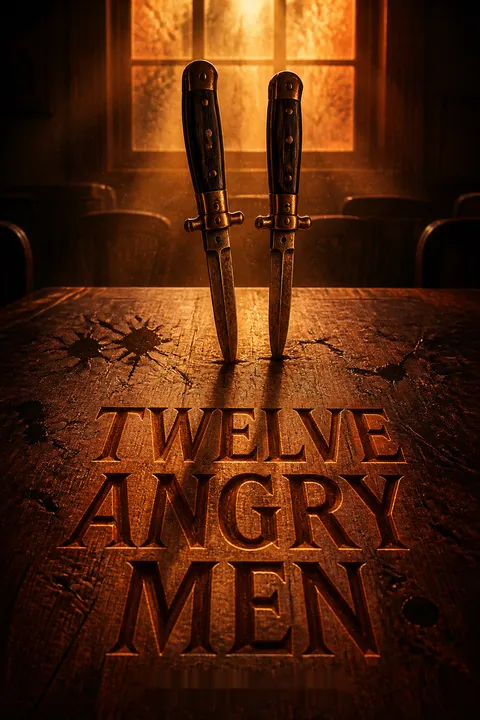
Juror Eight asks to see the exhibit, then produces a matching knife he bought at a pawnshop near the boy's home. The discovery does not prove another person committed the murder, but it breaks the claim that only the boy could have owned the weapon.
When Juror Eight proposes a secret vote, the count falls to ten guilty and two not guilty. Juror Nine explains that he joined the holdout because a man standing alone deserves to have his questions heard, not because he has reached a verdict.
The duplicate knife changes the room's standard of certainty without supplying an alternative culprit. That is important: Juror Eight is not replacing one confident story with another, but exposing how a claim of uniqueness had been mistaken for proof. The secret ballot also alters the group's social geometry. Juror Nine can support further discussion without publicly challenging the majority at first, showing how conformity may conceal private doubt. Juror Eight's method is therefore both evidentiary and interpersonal. He creates room for uncertainty by lowering the cost of expressing it, while the other jurors must confront the difference between a persuasive detail and an exclusive fact.
A Train Drowns the Threat
Juror Three returns to the elderly downstairs neighbor, who said he heard the boy threaten his father, heard a body fall, then saw the boy flee. Juror Eight compares that account with the woman's testimony across the street: she saw the stabbing through the windows of a passing elevated train.
The train would have been passing the apartment for several seconds before the body fell, placing the alleged threat beneath its noise. Even if the neighbor heard something, identifying a shouted voice becomes less certain.
Juror Nine suggests that the witness may have unconsciously filled in what he could not hear because he wanted his testimony to matter. Juror Eight also notes that people use threats casually. Juror Five changes his vote, bringing the count to nine guilty and three not guilty.
The dispute turns on the difference between sincerity and accuracy. Juror Nine does not accuse the elderly witness of deliberate deceit; he imagines how a need for recognition might shape memory without conscious intent. That psychological possibility matters because the testimony's authority rests on the witness's confidence. The train offers a concrete, testable interruption to that confidence, while the ordinary use of violent language weakens the threat's apparent meaning. Juror Five's change shows how evidence can become newly legible when someone with lived experience of knife violence and neighborhood speech is allowed to contribute. The room begins to treat testimony as human perception, not a transparent recording.
The Boy Returns at Three
Juror Eleven questions why the boy would return home three hours after the killing if he had stabbed his father. The prosecution's account requires him to flee, later realize he left the knife, and come back despite the danger. The woman across the street had screamed after seeing the murder, so the boy might also have known someone had witnessed it.
Juror Four offers possible explanations, but each depends on assumptions about panic and what the boy heard. Juror Eleven says the sequence does not fit his sense of how a guilty person would behave, and changes his vote to not guilty. The new count is eight to four. His questions do not establish what happened that night; they make the prosecution's chain of events less inevitable.
Juror Eleven's intervention shifts the debate from isolated details to behavioral coherence. Yet the play is careful not to treat intuition about how a murderer would act as conclusive evidence. Juror Four can explain the return, but only by adding conjectures about panic, timing, and perception. The exchange exposes how both sides construct narratives from gaps. Juror Eleven's civic seriousness is visible in his willingness to change position without claiming certainty, a contrast to jurors who treat consistency as a virtue in itself. The vote moves because the group is learning to ask not only whether a story is possible, but how many unsupported steps it needs.
Forty-Two Seconds, Not Fifteen
Juror Five recalls that the elderly neighbor had suffered a stroke and dragged one leg. The jurors retrieve the apartment plan and reconstruct the route from his bed to his front door. Juror Eight moves as the witness would have, slowly, through the bedroom and down the long hall. Juror Two times the trip at forty-two seconds, far beyond the fifteen seconds the neighbor said had passed before he saw someone running downstairs.
Juror Nine proposes that the witness may have heard the fall, hurried to the door, and assumed the fleeing person was the boy. Juror Three calls the demonstration dishonest and lunges at Juror Eight. When Juror Eight calmly reflects his threat back at him, Juror Three stops struggling, exposed by his own anger.
The reenactment converts an abstract doubt into a bodily measure. The old man's testimony has been granted authority through confidence, but his injured gait and the apartment's dimensions make the claimed timing physically implausible. Juror Eight's experiment is not a perfect reconstruction; it is a test that shows why certainty should be qualified. At the same time, Juror Three's lunge gives the room a second demonstration, this one psychological. His violent impulse echoes the kind of threat he has treated as proof of murderous intent in the boy. The moment does not diagnose Juror Three, but it makes visible how quickly judgment can slide from evidence into identification.
The Room Splits Six-Six
After the confrontation, the jurors take another open vote. Jurors Two and Six now join the not guilty side, leaving the room evenly divided. Juror Ten dismisses further discussion, and Juror Seven supports declaring a hung jury so the boy can face another trial. Juror Eleven objects that their oath is not a convenience they can abandon when deliberation becomes tiring.
When Juror Seven attacks him for being foreign-born, Juror Five challenges the insult. A storm darkens the room, then rain forces the windows shut and the foreman switches on the lights. The weather cools the air, but the deadlock remains. The jury's split is no longer one stubborn man against eleven; it is a visible division among men who must now explain their certainty.
The tied vote makes the group's transformation measurable: dissent has become a legitimate position rather than an eccentricity to be suppressed. The storm externalizes the pressure without resolving it. Heat has aggravated impatience, while the rain and newly switched-on lights create a pause in which the jurors can see one another more clearly. Juror Eleven's defense of the oath and Juror Five's response to xenophobia reveal that fairness is tested inside the room as well as in the verdict. The proposal for a hung jury shows how procedural escape can become a moral evasion. The men are not asked to feel compassion; they are asked to keep reasoning when convenience says stop.
Memory Fails Under Pressure
Juror Four insists that the boy's inability to remember the films he claimed to see proves the alibi was invented. Juror Eight asks him to recall a movie he watched only days earlier. Though calm and unaccused, Juror Four struggles to name its second feature and its actors.
Juror Nine points out that imperfect memory is ordinary, especially for a boy questioned beside his father's body and later tried for murder. The jurors also revisit the psychiatrist's claim that the boy had homicidal tendencies.
Juror Eleven distinguishes the capacity to commit violence from proof that this boy committed it. The arguments do not resolve the vote, but they strip two prosecution claims of their apparent force: failed recall and a predicted propensity are not demonstrations of guilt.
Juror Eight's memory test works through reversal: Juror Four must experience the very weakness he had interpreted as incriminating in the boy. The comparison does not prove the alibi, but it makes the earlier inference less secure. Juror Eleven's response to the psychiatric testimony draws a parallel distinction between possibility and action. Together, the challenges expose a recurring cognitive error: treating a trait, lapse, or prediction as though it were direct evidence of a particular event. The jurors are learning to separate what a person might do from what the evidence can establish that he did. Their doubt becomes more disciplined, not merely more sympathetic.
The Blade's Wrong Angle
Juror Two raises a problem with the downward wound: the boy was much shorter than his father. Juror Three demonstrates a downward stab, but Juror Five, who grew up around switchblades, explains that experienced users usually grip and strike with the blade moving upward. He believes the boy would not have used the knife in the manner that caused the wound.
Juror Seven, impatient with the hours of debate, switches to not guilty. Juror Eleven refuses to accept fatigue as a reason for risking a man's life and presses him to explain his vote. Juror Seven finally says he does not believe the boy is guilty. Juror Twelve and the foreman also move, bringing the count to nine not guilty and three guilty.
Juror Five's knowledge is practical rather than institutional. The courtroom's abstract description of a wound missed the embodied habits of someone familiar with the weapon, and his contribution corrects the room's assumptions about how a switchblade is used. The evidence remains inferential, but it complicates the prosecution's reconstruction. Juror Seven's change is ethically unstable at first: he wants the discussion to end, not necessarily to reach a just conclusion. Juror Eleven insists that a vote must carry a reason. This exchange distinguishes persuasion from mere exhaustion. A changed position matters only when a juror can take responsibility for the judgment behind it.
The Glasses Leave a Blur
Juror Ten answers the growing doubt with a racist tirade against people from the boy's neighborhood, and the others turn away rather than let his prejudice govern the room. Juror Four still relies on the woman across the street, who said she saw the stabbing through a passing train. Juror Nine remembers the deep marks on her nose, like those left by eyeglasses.
Juror Four confirms the marks and notes that she was in bed when she looked out; without her glasses, she may have seen only a blur across the tracks. Juror Four admits reasonable doubt, and Juror Twelve follows. Juror Ten votes not guilty while insisting he no longer cares. Juror Three is now the sole juror still certain of guilt.
The last eyewitness account is not disproved; its reliability is put into question by a detail the courtroom overlooked. The distinction preserves the play's uncertainty while showing how appearance can conceal limits in perception. Juror Four's change is especially consequential because his judgment has rested on logic and composure rather than obvious prejudice. Juror Ten's outburst, by contrast, reveals that his verdict has been shaped by group hatred rather than the case's particulars. His eventual vote carries no moral conversion because he admits indifference. The scene separates a correct decision from a sound process: a vote may align with justice even when its holder has not reasoned toward it.
The Father Behind the Verdict
Juror Three refuses to abandon his verdict, repeating that every fact supports guilt. As the other men ask him to defend the case, his language turns from the evidence to the boy's relationship with his father. Juror Eight recognizes that Juror Three is thinking of his own estranged son, who struck him during a fight years earlier.
Juror Three takes out a photograph of his son, stares at it, then tears it apart. His certainty gives way, and he changes his vote. The foreman tells the guard that the jury has reached a verdict. The men leave the room to return to court, while Juror Eight pauses beside the abandoned knife. The jury has not discovered who killed the father; it has decided the evidence cannot justify condemning the boy.
Juror Three's collapse is not a revelation about the crime but about the source of his certainty. He has fused the defendant with his own son, turning an old wound into a verdict and treating punishment as a way to settle a private conflict. The torn photograph makes that projection concrete: he destroys the image he has been using to sustain his anger. Yet the ending refuses the comfort of solved mystery. The jury reaches acquittal because the evidence fails the required standard, not because it proves the boy innocent. Juror Eight's pause beside the knife leaves the central uncertainty in place, while affirming that responsible judgment can proceed without omniscience.
Analysis
The play's central question is not whether the boy is innocent, a fact the jurors cannot establish, but whether the state's case has earned the certainty required to condemn him. That distinction gives the drama its ethical rigor. Juror Eight does not solve the murder; he makes the group examine how easily a plausible story hardens into a fact when witnesses are confident, the accused is poor, and the jurors are eager to leave.
Each challenge reveals a different failure of inference. The knife is not unique. Noise complicates what the elderly neighbor could hear. Time undermines his account of reaching the door. A juror's ordinary lapse in memory weakens the claim that the boy's failed recall proves deception. The woman across the street may have seen less clearly than she believed. None of these points independently proves innocence. Together, they expose how certainty had depended on treating human perception as flawless.
The jurors themselves become part of the evidence. Juror Five recognizes a knife's use from lived experience; Juror Nine imagines the witness's longing to matter; Juror Three projects his conflict with his son onto the defendant. Their backgrounds can sharpen judgment or distort it. The play refuses the comforting idea that reason belongs only to detached, educated, or socially powerful people. Its jury is effective precisely because different kinds of knowledge can correct one another, provided the group is willing to listen.
The unanimous verdict is therefore less a declaration of what happened than a limit placed on what the state may claim to know. The ending leaves the father's killer unresolved, but it resolves the opening's urgent question: whether twelve men will risk a life on evidence they have not tested. Their acquittal is not certainty. It is restraint.
Review Summary
Twelve Angry Men is widely praised for its powerful exploration of justice, prejudice, and human nature. Readers appreciate the tense jury room dynamics and character development. Many find the play thought-provoking and relevant today, despite being written in the 1950s. The film adaptation is often recommended alongside the play. Some readers note the difficulty of distinguishing characters by number rather than name. Overall, the work is considered a classic that effectively tackles important social issues through compelling dialogue and moral dilemmas.
Characters
Juror Eight
Patient architect of doubtAn architect and father of two, Juror Eight is the lone initial dissenter in a jury deciding whether a teenager should die for murdering his father. He does not present himself as certain of the boy's innocence. His defining impulse is to slow the group down long enough to test what it thinks it knows. He asks questions, obtains a matching knife, and turns testimony into practical demonstrations. His calm is not passivity: he confronts careless jokes and personal attacks while resisting the temptation to replace evidence with his own theory. Juror Eight embodies procedural conscience, the person willing to remain unpopular because another person's life cannot be treated as a deadline.
Juror Three
Wounded fatherA forceful businessman, Juror Three is quick to declare the case settled and treats the boy's difficult upbringing as confirmation of criminal character. He has a son with whom he has not spoken for two years after a violent quarrel, a private injury he keeps beneath a hard, combative manner. His anger makes him especially sensitive to the idea of a son turning against a father. He often frames punishment as simple justice, but his intensity suggests that the case reaches beyond the courtroom for him. Juror Three is not merely loud; he is a man whose confidence protects a painful personal story from scrutiny.
Juror Four
Disciplined skepticA stockbroker who prides himself on calm reasoning, Juror Four approaches the case through sequences, probabilities, and the consistency of testimony. He rarely raises his voice and believes emotional circumstances should not distract the jury from the evidence. His restraint gives him credibility, but it can also make an inference feel more solid than it is. He accepts the eyewitness account and the boy's failed recollection as especially persuasive. Juror Four's character is built around the tension between being rational and recognizing the limits of one's own memory and perception. He represents a sincere, orderly mind that must remain open to correction.
Juror Nine
Attentive elderThe oldest juror, Juror Nine is observant and sensitive to the need for human recognition. He is the first to support Juror Eight's request for discussion, not because he has reached a firm conclusion but because he respects the difficulty of standing alone. He notices details other jurors dismiss, including the elderly witness's clothing, gait, and desire to be heard. His empathy helps the group imagine how memory can be shaped by need without assuming deliberate dishonesty. Juror Nine is quiet, but his careful attention gives overlooked people a place in the room.
Juror Five
Neighborhood witnessJuror Five grew up in a slum and works nights as a nurse at Harlem Hospital. He is initially reserved when other jurors describe people from poor neighborhoods as inherently criminal, but the prejudice lands personally because he knows those streets from the inside. His experience with switchblades gives him practical knowledge the other men lack. Juror Five is not eager to make his past the center of the discussion; he speaks when the case touches a reality he recognizes. He brings the jury a perspective formed by survival and observation rather than courtroom theory.
Juror Eleven
Civic-minded watchmakerA German immigrant and watchmaker, Juror Eleven takes the jury's oath and the mechanics of democratic responsibility seriously. His measured politeness is not timidity; he challenges careless reasoning and insists that a juror explain a vote affecting another person's life. He notices gaps in the prosecution's timeline and is willing to reconsider his own position without treating a change of mind as weakness. His presence also exposes the prejudice directed at outsiders within a room meant to administer impartial justice. Juror Eleven's discipline comes from believing that the civic process deserves the same care as skilled work.
Juror Seven
Restless salesmanA salesman who boasts of selling marmalade and measures the afternoon against a baseball game, Juror Seven wants the deliberation finished quickly. He uses jokes and impatience to avoid sustained attention, and his first certainty depends more on the boy's record than on close analysis. He is not interested in taking responsibility for a prolonged disagreement. The other jurors' insistence that his vote must have a reason reveals how easily convenience can intrude on judgment. Juror Seven represents the ordinary temptation to treat civic duty as an obstacle to personal plans.
Juror Ten
Prejudiced garage ownerA garage owner, Juror Ten is impatient with the deliberation and repeatedly treats the boy's neighborhood as evidence of the boy's guilt. His contempt for the accused expands into sweeping claims about an entire population, exposing how prejudice can disguise itself as practical experience. He is also concerned with the businesses he has left unattended, which sharpens his desire to end the discussion. Juror Ten is forceful and socially aggressive, relying on volume when the group's questions weaken his arguments. His role shows how bias can be presented as common sense until others refuse to accept it.
Juror Two
Tentative bank employeeA mild, nervous bank employee, Juror Two is unused to taking the lead in a tense room. He initially accepts the prosecution's case because it seems obvious and struggles to explain his judgment. As the jurors examine details, he begins to notice problems others have passed over, including the boy's height in relation to the wound. His cautious manner makes his questions easy to overlook, but he is capable of helping test an argument once he feels permitted to speak. Juror Two's presence shows how quiet uncertainty can become useful when a group stops rewarding only confidence.
Juror Six
Practical house painterA house painter, Juror Six speaks plainly and values directness over polished argument. He initially accepts the prosecution's account, but he is willing to admit when a detail no longer makes sense. He reacts strongly when Juror Three insults the elderly witness, insisting that age and dignity deserve respect. His working life makes him attentive to practical matters, including how long a person could take to cross a room. Juror Six's steadiness is less about abstract principle than a straightforward sense of fairness toward the people in front of him.
Juror One
Reluctant foremanJuror One serves as foreman and works as an assistant high-school football coach. He tries to keep the discussion orderly, call votes, and distribute speaking turns, though the room's conflict sometimes overwhelms his authority. He is practical and conscientious, more comfortable managing a group than supplying the strongest arguments himself. His effort to maintain procedure matters because the deliberation could easily become a contest of volume. Juror One represents the often-unremarked labor of keeping a collective process usable while its members disagree.
Juror Twelve
Distractible ad writerAn advertising copywriter, Juror Twelve doodles slogans and often treats the case as one topic among many competing for his attention. He enjoys clever formulations and can drift toward a joke or a quick suggestion when the discussion becomes difficult. Yet he is not incapable of reflection; he recognizes that the jury has reached an impasse and sometimes admits when he does not know what to think. His shifting attention makes him vulnerable to the room's momentum, while his attempts to organize discussion occasionally help. He personifies the difference between being present in a room and fully attending to its responsibility.
The Accused Boy
Absent teenager on trialThe sixteen-year-old defendant never appears in the jury room, yet every juror's decision turns on what he may have done. His mother died when he was young, his father beat him, and his childhood included time in an orphanage while his father was imprisoned. He has a record of juvenile trouble and has learned to navigate a world in which adults often expect the worst of him. The jurors must evaluate the specific charge rather than decide whether his life makes him sympathetic or suspicious. His absence keeps him vulnerable to becoming an idea instead of a person.
The Elderly Neighbor
Downstairs eyewitnessAn elderly man living below the murder apartment, he testifies that he heard a threat, a body fall, and footsteps, then saw the boy running away. He walks with difficulty after suffering a stroke and appears conscious of his age and social invisibility. His account is central because he believes he can place the boy at the scene. The jurors must consider both the sincerity of his memory and the physical limits that may have affected what he heard or could do.
The Woman Across the Street
Passing-train witnessA woman in an apartment opposite the boy's home, she testifies that she saw the stabbing through the windows of a passing elevated train. Her account gives the prosecution its strongest claim to a direct eyewitness. She is never present during deliberations, so the jurors reconstruct her viewing conditions from details of the apartment, the train, the hour, and her appearance. Her testimony forces the men to distinguish a witness's conviction from the conditions under which she could see.
The Guard
Keeper of the locked roomThe court guard brings exhibits into the jury room, responds when the men call, and keeps the door secured during deliberations. His practical presence marks the boundary between the jury's private debate and the court waiting outside. He does not influence the evidence, but his brief appearances remind the jurors that their work is part of a formal process.
The Judge
Voice of the lawThe judge is heard at the beginning, instructing the jury on the charge, the requirement of unanimity, and the meaning of reasonable doubt. Though absent from the deliberation room, his instructions establish the stakes and the standard the jurors must apply. His voice represents the formal legal framework that the twelve men must translate into a decision.
Plot Devices
Unanimous jury procedure
Makes doubt consequentialThe law requires all twelve jurors to agree before a verdict can be returned. This rule gives each man the power to prevent a premature decision, but it also places pressure on the holdout to explain himself. As votes change, the procedure makes private reconsideration visible and forces the group to keep working rather than treating the majority as proof. The rule is not a guarantee of wisdom: jurors can still be biased, distracted, or mistaken. Its dramatic function is to make deliberation necessary and to give the act of listening real legal consequence.
The matching switchblade
Breaks the weapon's uniquenessThe prosecution presents the murder weapon as an unusually distinctive knife that the boy had bought shortly before the killing. Juror Eight obtains an identical knife from a pawnshop, challenging the claim that the weapon could only have belonged to the accused. The duplicate does not establish who killed the father, but it makes the knife a weaker link between the boy and the crime. Later, the knife's design also matters when the jurors consider how an experienced user might have struck. The object shifts from apparent proof to a source of questions.
Witness timing and reconstruction
Tests testimony against spaceJuror Eight turns the testimony into physical problems that the jurors can examine: how long an elevated train takes to pass, how much noise it makes, and how long an injured elderly man would need to reach his door. The apartment diagram and a timed reenactment make distance and movement tangible. These demonstrations cannot reproduce the night exactly, and they do not prove what occurred. They expose how much the witnesses' conclusions depend on precise timing and perception. The device makes the jury question not only what a witness remembers, but whether the stated conditions support that memory.
The locked jury room
Contains the civic conflictThe twelve men are shut together in a hot, bare room while the court waits outside. They cannot escape the disagreement by returning to their daily lives, and the confined setting allows small habits, prejudices, and personal wounds to shape the debate. The room's clock, fan, windows, and changing weather give the deliberation physical pressure. It also turns the jury into a temporary community: the men must decide how to speak, listen, and challenge one another before they can act for the state. The setting makes private judgment a shared responsibility.
FAQ
Synopsis & Basic Details
What is Twelve Angry Men about?
- Deliberation on a murder case: Twelve jurors must decide the fate of a young man accused of murdering his father, facing a mandatory death sentence if found guilty.
- Initial disagreement sparks debate: The play centers on the intense discussions and arguments that arise when one juror dissents from an initial near-unanimous guilty verdict.
- Unveiling personal biases: As the jurors re-examine the evidence, their own prejudices, backgrounds, and emotional baggage are exposed, influencing their perspectives and decisions.
Why should I read Twelve Angry Men?
- Exploration of justice system: The play offers a compelling look into the complexities and potential flaws within the American legal system, particularly the jury process.
- Character-driven drama: The story features a diverse cast of characters, each with unique perspectives and biases, creating a rich and engaging human drama.
- Timeless themes resonate: The themes of prejudice, reasonable doubt, and the power of persuasion remain relevant and thought-provoking in contemporary society.
What is the background of Twelve Angry Men?
- Post-war American anxieties: Written in 1954, the play reflects anxieties about conformity, individual rights, and the potential for injustice in a rapidly changing American society.
- Influence of McCarthyism: The play subtly critiques the dangers of groupthink and the suppression of dissenting voices, mirroring the atmosphere of fear and suspicion during the McCarthy era.
- Focus on urban social issues: The setting in a New York City courtroom highlights the social and economic disparities prevalent in urban America during the mid-20th century.
What are the most memorable quotes in Twelve Angry Men?
- "It's not easy for me to raise my hand and send a boy off to die without talking about it first.": Highlights moral responsibility: Juror Eight's statement encapsulates the play's central theme of individual conscience and the weight of making a life-or-death decision.
- "Facts may be colored by the personalities of the people who present them.": Emphasizes subjective interpretation: Juror Eleven's observation underscores the idea that truth is often filtered through personal biases and perspectives, impacting how evidence is perceived.
- "It's very hard to keep personal prejudice out of a thing like this. And no matter where you run into it, prejudice obscures the truth.": Reveals core theme: Juror Eight's quote directly addresses the pervasive influence of prejudice and its detrimental effect on achieving justice.
What writing style, narrative choices, and literary techniques does Reginald Rose use?
- Realistic dialogue drives plot: Rose employs naturalistic dialogue to reveal character and advance the plot, creating a sense of immediacy and authenticity.
- Single setting enhances tension: The confined setting of the jury room amplifies the tension and claustrophobia, forcing the characters to confront each other and their own biases.
- Character archetypes represent society: The jurors represent a microcosm of American society, allowing Rose to explore broader social and political themes through their interactions.
Hidden Details & Subtle Connections
What are some minor details that add significant meaning?
- The fan symbolizes rising tension: The broken fan in the jury room mirrors the escalating heat and discomfort, both physically and emotionally, as the deliberations intensify. The Juror Seven's repeated attempts to fix it highlight the growing frustration.
- The rain represents cleansing: The sudden downpour in Act II provides a temporary respite from the oppressive heat and symbolizes a potential cleansing of biases and a move towards clarity.
- The clock highlights time pressure: The constant references to time, especially the Juror Seven's concern about the baseball game, emphasize the pressure to reach a quick verdict, contrasting with the gravity of the decision.
What are some subtle foreshadowing and callbacks?
- Initial vote foreshadows conflict: The initial 11-1 vote immediately establishes Juror Eight as an outsider and foreshadows the intense conflict and struggle for persuasion that will follow.
- Juror Three's anger foreshadows breakdown: Juror Three's early outbursts and aggressive behavior foreshadow his eventual emotional breakdown and reluctant acceptance of the "not guilty" verdict.
- Knife discussion foreshadows revelation: The early discussion about the uniqueness of the knife foreshadows Juror Eight's surprise reveal of an identical weapon, undermining the prosecution's case.
What are some unexpected character connections?
- Juror Five and the defendant share background: Juror Five's experience growing up in a slum connects him to the defendant, providing him with unique insights into the boy's environment and potential motivations.
- Juror Three and Juror Eight as opposing forces: Juror Three and Juror Eight are connected as opposing forces, representing the struggle between personal vendettas and the pursuit of justice.
- Juror Nine and Juror Eight share empathy: Juror Nine's immediate support for Juror Eight reveals a shared sense of empathy and a willingness to challenge the majority, despite potential ridicule.
Who are the most significant supporting characters?
- Juror Four provides intellectual counterpoint: Juror Four's logical and analytical approach challenges Juror Eight's arguments, forcing him to refine his reasoning and present stronger evidence of doubt.
- Juror Five offers insider perspective: Juror Five's background provides crucial insights into the defendant's environment and the realities of slum life, challenging stereotypes and biases.
- Juror Nine embodies wisdom and compassion: Juror Nine's keen observations and empathetic nature contribute significantly to the group's understanding of the witnesses and the defendant's potential motivations.
Psychological, Emotional, & Relational Analysis
What are some unspoken motivations of the characters?
- Juror Three seeks validation: Juror Three's relentless pursuit of a guilty verdict stems from a need to validate his own parenting choices and punish the perceived disrespect of young people.
- Juror Ten fears social change: Juror Ten's bigotry is rooted in a deep-seated fear of social change and a desire to maintain the existing power structures.
- Juror Seven avoids conflict: Juror Seven's initial indifference and eagerness to conclude the deliberations reflect a desire to avoid conflict and maintain social harmony, even at the expense of justice.
What psychological complexities do the characters exhibit?
- Juror Three's repressed emotions: Juror Three's anger masks deep-seated pain and regret over his strained relationship with his son, revealing a complex emotional landscape.
- Juror Four's intellectual detachment: Juror Four's reliance on logic and reason serves as a defense mechanism against emotional vulnerability, highlighting the complexities of intellectualism.
- Juror Five's internalized shame: Juror Five's initial reluctance to speak stems from internalized shame about his background, reflecting the psychological impact of poverty and social stigma.
What are the major emotional turning points?
- Juror Three's breakdown: Juror Three's emotional breakdown, triggered by Juror Eight's accusation of being a sadist, marks a turning point in the deliberations, forcing him to confront his personal biases.
- Juror Ten's isolation: Juror Ten's bigoted tirade and subsequent rejection by the other jurors represent a significant emotional turning point, highlighting the power of collective moral judgment.
- Juror Four's admission of doubt: Juror Four's admission of reasonable doubt, prompted by the discussion of the woman's glasses, signifies a shift in his perspective and a willingness to challenge his initial convictions.
How do relationship dynamics evolve?
- Initial animosity transforms: The initial animosity and distrust among the jurors gradually give way to a sense of shared purpose and mutual respect as they engage in reasoned discussion.
- Leadership shifts dynamically: Leadership shifts from the Foreman to Juror Eight, and even to Juror Four at times, demonstrating the fluid nature of power dynamics within the group.
- Alliances form and dissolve: Alliances form and dissolve as jurors change their votes and perspectives, highlighting the complexities of group decision-making and the influence of individual conscience.
Interpretation & Debate
Which parts of the story remain ambiguous or open-ended?
- Defendant's actual guilt is uncertain: The play never definitively proves the defendant's innocence, leaving open the possibility that he may have been guilty despite the reasonable doubt.
- Juror Eight's motivations are debated: Juror Eight's motivations for initially dissenting remain somewhat ambiguous, prompting debate about whether he was driven by a genuine belief in the boy's innocence or a desire to challenge the system.
- Future impact on jurors is unknown: The play leaves the future impact of the deliberations on the jurors' lives open-ended, prompting speculation about how their experience will shape their future decisions and perspectives.
What are some debatable, controversial scenes or moments in Twelve Angry Men?
- Juror Three's knife demonstration: Juror Three's aggressive knife demonstration is controversial due to its potential for violence and its attempt to intimidate other jurors.
- Juror Ten's racist tirade: Juror Ten's racist tirade is a highly controversial moment that sparks outrage and condemnation from the other jurors, highlighting the destructive nature of prejudice.
- Juror Seven's vote change for baseball: Juror Seven's initial vote change motivated by a baseball game raises ethical questions about the responsibility of jurors and the importance of taking the decision seriously.
Twelve Angry Men Ending Explained: How It Ends & What It Means
- "Not guilty" verdict reached: The play concludes with a unanimous "not guilty" verdict, signifying the triumph of reasonable doubt and the importance of due process in the American justice system.
- Prejudice is overcome: The jurors' rejection of Juror Ten's bigotry and their willingness to challenge their own biases demonstrate the potential for individuals to overcome prejudice and arrive at a just outcome.
- System is imperfect but valuable: The ending suggests that while the justice system is imperfect and susceptible to human error, it remains a valuable safeguard against injustice when individuals are willing to engage in reasoned deliberation and uphold the principles of fairness.
Download PDF
Download EPUB
.epub digital book format is ideal for reading ebooks on phones, tablets, and e-readers.








