

Plot Summary
Tovah's Dangerous Mensch
In a Vermont trailer, seventeen-year-old Chloe grieves her mother’s sudden death while Dez, her former teacher and lover, escapes into a talk show. Its guest, bestselling memoirist Jasper Ulrickson, describes caring for his paralyzed wife and insists men can control their appetites.
Chloe recognizes him from her mother’s old photographs: Holly once had a brief affair with Jasper, a tennis instructor at a country club. Holly had wondered whether he might be Chloe’s father, though she later decided the dates ruled him out.
To Dez, Jasper’s public virtue looks like a challenge. He sees a way to punish the wealthy man, prove that all men are governed by lust, and make money. Chloe, orphaned and dependent on Dez, becomes the instrument of his plan.
The inciting event is not simply a possible paternity claim. It is the televised contrast between Jasper’s public moral confidence and Dez’s conviction that virtue is a mask. Chloe’s grief gives Dez both leverage and an audience for his grievance: she needs protection, while he needs a target who can embody his theory of male hypocrisy. The talk show supplies the plot with its public stage, turning private conduct into spectacle. From the outset, the book asks how easily moral language can be used to serve self-interest, whether by Dez’s cynical attack on restraint or by the culture that celebrates Jasper without knowing him.
The Teacher in Vermont
Years earlier, Dez had lost his legal career after sexually abusing underage girls and being convicted of statutory rape. Therapy and a teaching certificate let him return to work, but not to ordinary life.
At New Halcyon High, he singles out Chloe, a lonely student hungry for a protective father figure, and uses extra tutoring to draw her close. He frames his advances as mutual affection, and Chloe, inexperienced and eager for his approval, begins a secret affair with him. When a colleague catches him kissing Chloe at school, Dez flees before authorities can reach him.
Chloe follows him to a trailer in the woods, where their relationship continues. Then a police officer arrives to tell her that Holly has died in a car crash, leaving Chloe with no parent or relative to take her in.
Dez’s method is to make exploitation feel like recognition. He learns what Chloe longs for, presents himself as the answer, then recasts his position of authority as evidence of a special bond between equals. Chloe’s attachment is not proof of consent in any meaningful balance of power; it is the result of adult manipulation meeting adolescent need. The novel also establishes Dez’s self-serving account of himself. He calls his desires natural and society hypocritical, yet repeatedly chooses secrecy, deception, and control. Holly’s death removes the last adult buffer around Chloe and turns Dez’s private access into practical guardianship.
The Paternity Summons
In Connecticut, Jasper receives a Vermont child-support complaint naming him as the possible father of Holly Dwight’s seventeen-year-old daughter. A memory of their brief encounter at the New Halcyon country club makes the dates disturbingly plausible.
The girl’s affidavit says Holly withheld the secret because she feared the state would take Chloe from her. Jasper consults lawyer Murray Pollock, then submits a cheek swab for an official test.
He tells his wife, Pauline, who communicates through blinks after a stroke left her locked in, and she initially supports bringing the girl into their home if the test is positive. As Jasper waits, the possibility of fatherhood awakens both excitement and unease. His stalled detective novel finally gains a plot about a false heir and a stolen DNA sample.
Jasper’s first response is shaped by care rather than suspicion. He turns toward Pauline, respects her place in family decisions, and imagines taking responsibility for a child who may have been denied support. Yet the paternity process also unsettles his settled identity. A past he had treated as inconsequential could have created a daughter and an unacknowledged obligation. His fiction absorbs that uncertainty almost immediately, making the novel’s mystery a distorted mirror of the actual case. This link between authorship and life is crucial: Jasper’s imagination supplies clues about the crime even as his faith in procedural safeguards leaves him vulnerable to it.
The Swab in the Nursery
Dez studies Jasper’s memoir to learn his household routines, then poses as a furnace inspector and enters the Connecticut home while Maddy naps. He secretly swabs the five-year-old’s cheek. At Chloe’s court-ordered test in Newport, Dez bribes phlebotomist Duncan Ames to replace her sample with Maddy’s.
The lab therefore reports a 99.9 percent match between Jasper and the sample submitted as Chloe’s. A chance of sample failure has kept Dez anxious, but the result clears the way for custody.
Ames uses the bribe to buy a Ducati motorcycle and soon dies in a crash on his first ride. Dez had been considering how to silence him, but the accident removes the accomplice without Dez having to act. Chloe remains with foster parents while the state processes the result.
The forged DNA result converts a biological fact into an institutional fiction. The clinic’s chain-of-custody safeguards look authoritative, but they depend on human beings whose incentives and vulnerabilities can be manipulated. Dez understands that systems often place their trust in procedure, not in the people who carry it out. Ames’s accidental death adds grim irony: Dez’s plan seems protected by luck, allowing him to interpret coincidence as confirmation of his own brilliance. Yet the novel does not make the fraud weightless. It depends on a child’s stolen sample, a paid accomplice, and a state system that will soon place Chloe inside a family under false pretenses.
A Daughter in Court
After social workers, psychologists, accountants, and investigators assess both households, a Vermont judge transfers custody to Jasper. At the courthouse, Chloe meets him in person for the first time.
Jasper is overwhelmed by her resemblance to Holly and tries to greet her as a father, while Chloe follows Dez’s instructions to make herself alluring. Her warmth seems genuine enough to move Jasper, who is already eager to build a relationship. The court hearing is brief, and Chloe leaves with him for Connecticut.
During the long drive, Jasper tries to learn about her life and offers a picture of the home and family awaiting her. His mention of a fictional plot involving a faked paternity test alarms Chloe, but he explains it as an idea for a mystery novel, and she relaxes.
The courtroom makes the fraud socially real. The judge’s ruling, based on the false test, gives Jasper and Chloe legal roles they did not choose under truthful conditions. Their first meeting is therefore doubly charged: Jasper sees a daughter he has longed to know, while Chloe performs a seduction devised by Dez and unexpectedly encounters a man who treats her tenderly. Her confusion is not an incidental obstacle to the scheme. It is the first sign that the role she has been assigned may become emotionally impossible. Jasper’s fiction about DNA fraud briefly brushes against the truth, but the joke passes without exposing the deception.
The House's New Faultline
At home, Jasper introduces Chloe to Maddy, who is delighted to have an older sister, and to Deepti, the family’s caregiver. Pauline’s welcome is different: her gaze turns hostile, and dinner becomes painfully strained.
Chloe is frightened by Pauline’s response, yet begins to feel sympathy for her and affection for Maddy. She continues trying to seduce Jasper on the drive and later in his bedroom, but he answers her advances with hugs, reassurance, and a promise of her own room.
When Maddy interrupts them, Jasper takes Chloe to the bedroom he has prepared, complete with clothes and gifts chosen for her. Chloe cries at the thoughtfulness, and the real family connection she has begun to feel deepens. That night Jasper dreams of Chloe beside him and wakes horrified by his own desire.
The household turns Dez’s strategy into a moral conflict Chloe cannot keep abstract. Maddy’s uncomplicated welcome and Jasper’s deliberate care give her the fatherly attachment she has been seeking, while Pauline’s jealousy exposes the real costs of bringing an outsider into a vulnerable marriage. Chloe’s attempted seduction and her growing affection coexist, making her neither a simple schemer nor an innocent bystander. Jasper, meanwhile, mistakes restraint for proof that he is safe from desire. The disturbing dream breaks that confidence. The section’s tension comes from the gap between what characters believe they are doing and the emotional forces their actions have already set in motion.
Doctor Geld's Prescription
After weeks without contact, Dez returns disguised as Dr. Geld, a psychiatrist supposedly sent by Vermont officials to assess Chloe. In Jasper’s office, Chloe confesses that she cannot carry out the seduction: she has come to love Jasper as a father and feels at home with Pauline, Maddy, and Deepti.
Dez searches Jasper’s computer for financial information and discovers the diary in which Jasper records his shameful attraction to Chloe. He shows her the entries and claims Jasper will eventually abuse Maddy too, persuading Chloe that she must continue the plan to protect her little sister.
Then Dez tells Jasper that Chloe desires him and uses fabricated Freudian theory to portray incestuous contact as therapeutic. He urges Jasper to overcome emotional distance through physical affection and brings Pauline into the session.
Dez’s most effective weapon is not force but interpretation. He turns Jasper’s diary, an attempt at self-restraint, into apparent proof of an inevitable predator, then uses invented therapy to recode danger as treatment. His account of Chloe’s motives also exploits her real vulnerability: she wants a father and fears that refusing Dez will leave Maddy exposed. Each character is pushed into a false explanation of their own behavior. The scene is a satire of therapeutic authority, but also a warning about jargon used without ethics or accountability. Because Dez’s performance resembles expertise, Jasper’s honesty becomes the lever by which he is deceived.
Scotch at Midnight
During the session, Dez presses Jasper to read from his diary. Pauline suffers a seizure and is rushed to intensive care, where doctors warn Jasper that she may not recover. Returning home late, grieving and drinking, Jasper finds Chloe waiting in a revealing nightdress with Scotch prepared.
She begins the seduction Dez demanded, then tries to stop it; Jasper, manipulated by the false therapy and impaired by alcohol, rapes her. Chloe secretly records the assault on her laptop, packs her belongings, and leaves before morning.
Jasper wakes alone, recognizes what he has done, and calls the police to report the assault and Chloe’s disappearance. Officers arrive and arrest him. The recorded video, physical evidence, and diary entries make the case against him overwhelming.
The assault is the novel’s moral catastrophe, and the narrative does not treat manipulation as an excuse that cancels Jasper’s responsibility. Dez manufactures a coercive framework and Chloe is trapped between a plan she no longer believes in and a threat she has been taught to fear. Jasper still commits the crime. His immediate confession distinguishes remorse from innocence: he understands the harm without bargaining away his agency. Chloe’s recording is both evidence and a means of survival. Pauline’s collapse makes the family’s interdependence brutally visible; while Jasper is being deceived, his wife is unable to communicate the warning she has already begun trying to formulate.
The Saint on Trial
Jasper pleads guilty and receives eight years, with three suspended, for sexual assault, incest, and related charges. The court also bars him from contact with Chloe and from seeing Maddy until she turns eighteen.
A civil judgment takes his home, investments, cars, and future royalties, dividing the proceeds among his dependents and Chloe. Laura takes Maddy to San Francisco while Pauline remains in a coma. Chloe appears on Tovah and shows the recording that destroys Jasper’s public image as a devoted husband and father.
The broadcast enrages inmates at Beckford Correctional Center, and two men attack Jasper in the exercise yard. He loses an eye, suffers severe injuries, and becomes legally blind. His remaining years pass in solitary confinement, with no family contact and little sense of time.
The public fall of Jasper mirrors his earlier public elevation, but exposure cannot repair the harm done in private. The court’s penalties protect Chloe and provide for the family, yet they also sever Jasper from Maddy and Pauline. His blindness gives physical form to the failures of perception that precede his crime, though it should not be mistaken for a neat moral punishment. The prison attack is a second act of violence, not justice; the institution’s spectacle of outrage turns Jasper into a target while leaving his victims’ needs unresolved. Tovah’s broadcast completes the media arc, replacing the inspiring story Jasper once told with evidence of the contradiction between persona and conduct.
Tribeca's Golden Cage
With Chloe’s share of the civil settlement, she and Dez move from the trailer to a lavish Tribeca loft. Dez treats the money as his own, discourages Chloe’s attempts to study or pursue acting, and pressures her to appear on Tovah again. She does, reluctantly, believing her testimony may warn other girls. Behind the luxury, their relationship curdles.
Dez uses drugs, brings other young women into their life, and keeps the accounts and property under his control. Chloe eventually discovers she has no independent access to the fortune. At twenty-one, she escapes with a little cash and leaves him a note. She finds shelter, earns a GED, wins a scholarship to NYU, and begins building a life beyond Dez’s influence.
The settlement appears to reverse Chloe’s childhood deprivation, but money does not give her autonomy when Dez controls its legal and practical use. The loft becomes a gilded version of the trailer: a private space where he dictates her choices and treats her body as part of his own gratification. His moral rhetoric about protecting other girls functions as another instrument of coercion, making Chloe feel selfish when she seeks independence. Her escape is modest in material terms, but psychologically decisive. Education, shelter, and friendship offer forms of selfhood that neither wealth nor romance had provided. The section shows how an abuser can convert rescue into another dependency.
The Crayon Cipher
After serving five years, Jasper enters a residential rehabilitation center, nearly blind and still barred from contact with his daughters. Deepti brings him belongings from the old house, including Maddy’s preschool drawing pad.
With help reading the crayon marks, Jasper deciphers messages Pauline had dictated through Maddy’s alphabet game: Chloe is not his daughter, Maddy’s DNA was used, and the man in the ACE cap was connected to Dr. Geld. Jasper realizes Pauline had watched the furnace inspector steal Maddy’s sample and had tried to warn him.
At the hospital, he tells Pauline that he understands; she opens her eyes and confirms that Chloe knew. Jasper then goes to Chloe’s New York apartment, where she admits the fraud and explains Dez’s control. Police arrive and arrest Jasper for violating the restraining order.
The drawing pad turns a child’s play into forensic testimony. Pauline’s communication depends on patience, repetition, and the cooperation of Maddy, who cannot understand the danger she is helping describe. Jasper missed the warning because he was absorbed in desire and secrecy; after prison, his impaired sight makes him depend on other people to read what was always physically present. The revelation that Chloe knew does not erase her later victimization by Dez, nor does it undo Jasper’s assault. Instead, it restores the causal history that the false test concealed. Jasper’s visit to Chloe risks his freedom, but gives her the first opportunity to tell the whole story.
The Last Falsehood
As officers lead Jasper away, Chloe stops them and gives an account that exposes the conspiracy. Her cooperation helps authorities identify Dez, who had impersonated Dr. Geld and engineered the DNA fraud.
Dez is arrested after years of using Chloe’s settlement, controlling her, and planning further exploitation. The truth allows Jasper’s case to be reconsidered and the family to reunite. After his release, Deepti returns to caring for Pauline, Maddy comes back from Laura’s home, and Chloe transfers to Yale.
Jasper undergoes a successful eye operation and begins writing again. The reunion cannot restore the years lost or erase his rape of Chloe, but it brings the hidden fraud into the open and gives each survivor a chance to live beyond Dez’s design.
The final reversal is not a declaration that Jasper is innocent of everything or that Chloe’s confession makes the past harmless. It separates the crimes: Jasper is responsible for assaulting Chloe, while Dez is responsible for manufacturing the false paternity case and manipulating both of them. Chloe’s decision to stop the police from carrying Jasper away shows a new capacity to act from her own judgment rather than Dez’s commands. The family’s return is therefore a hard-won, imperfect repair, not a reset. The novel ends by contrasting two uses of storytelling: Dez’s stories conceal and control, while Pauline’s painstaking messages and Chloe’s testimony make truth survivable.
Analysis
Undone is built around two men who believe they understand desire. Dez claims that restraint is a social fiction and that every man can be exposed as selfish. Jasper believes that moral discipline can reliably govern appetite. The plot tests both convictions, but not symmetrically. Jasper’s crime is real and devastating, while Dez’s supposed proof is engineered through fraud, coercion, and false expertise. The distinction matters: the novel refuses to let an explanation become an excuse, even as it shows how a person’s choices can be shaped by a manipulator’s lies.
The book’s central irony is that Jasper writes mysteries about hidden evidence yet fails to read the clues in his own home. Pauline sees the furnace inspector steal Maddy’s DNA, but her disability traps the warning inside a laborious alphabet game. The messages survive because Maddy treats writing as play and Deepti preserves the drawings. Jasper ultimately solves the crime not through abstract brilliance but by listening to the people he once failed to hear.
Family in this novel is both a source of shelter and a vulnerable system. Chloe’s longing for a father makes her easy for Dez to direct; Jasper’s wish to welcome her makes him susceptible to Geld’s fabricated therapy; Pauline’s silence allows others to misread her; and Maddy’s dependence raises the stakes of every adult decision. The ending offers repair, not absolution. Jasper remains accountable for the assault, Chloe remains marked by the harm, and the family’s reunion cannot restore lost years. What changes is that the truth becomes shared rather than privately controlled. Against Dez’s conspiratorial authorship, the novel sets a fragile form of collective knowledge, assembled through testimony, care, and attention.
Review Summary
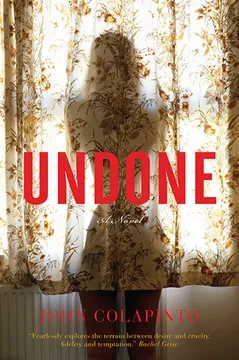
Undone by John Colapinto receives polarized reviews with an overall 3.39/5 rating. Many praise the book's compelling, page-turning narrative and excellent writing, comparing it to works like Gone Girl and Lolita. The story follows Dez, a sociopathic predator who schemes to destroy famous author Jasper using his young girlfriend Chloe. Reviewers appreciate the dark satire on celebrity obsession and taboo themes, though some find the subject matter disturbing and uncomfortable. Common criticisms include underdeveloped characters, contrived plotting, and disappointment that the content wasn't as provocative as anticipated given its 41+ publisher rejections.
Characters
Jasper Ulrickson
The conscientious novelistA successful mystery writer, devoted husband to Pauline, and father to young Maddy, Jasper has built his identity around decency, restraint, and care. He is gentle without being especially forceful, and he relies on candor with Pauline as a foundation of their marriage. His writing is methodical: he takes pride in giving readers the clues needed to solve his mysteries. That habit of rational observation coexists with a troubling confidence in his own moral self-control. Jasper wants to be a good man, but his belief in that identity can make him slow to recognize danger within himself or deception around him.
Chloe Dwight
The orphan seeking a fatherChloe is a seventeen-year-old whose mother’s death leaves her frightened, grieving, and without a stable home. She is strikingly attractive, but her deeper vulnerability is her hunger for reliable adult affection. She adapts herself to the people she depends on, which makes her both perceptive and susceptible to manipulation. Her interest in acting and modeling reflects a wish to imagine a life beyond the limited world she knows. Chloe’s emotional life is marked by a difficult tension between wanting protection and wanting independence, and between the story she has been taught to believe and what her own experience tells her.
Dez
The calculating teacherDez is an intelligent, disbarred lawyer whose charm and gift for planning serve a deeply self-centered view of the world. He sees social rules as hypocrisy and treats his own desires as proof that everyone is secretly just as selfish. His history of sexual misconduct has brought legal consequences, therapy, and professional restrictions, but he recasts these as persecution rather than warnings. Dez can be patient, observant, and imaginative, especially when constructing a scheme. Those abilities do not make him admirable; they make his manipulation more effective. He craves control, admiration, and the satisfaction of proving his bleak theories right.
Pauline Ulrickson
The silent family anchorPauline is Jasper’s wife, Maddy’s mother, and his former editor and closest creative collaborator. A stroke leaves her almost completely paralyzed and able to communicate mainly through blinks, but her intelligence, humor, and emotional awareness remain vivid. She values honesty and engagement with the world, and she continues to participate in family life despite the severe limits on her movement. Her relationship with Jasper is built on years of shared work and mutual attention. Pauline’s vulnerability is physical, not intellectual; those around her must learn to distinguish silence from absence.
Maddy Ulrickson
The curious little sisterMaddy is Jasper and Pauline’s preschool-aged daughter, affectionate, observant, and delighted by games involving letters and songs. She brings ordinary childhood needs into a household shaped by caregiving, grief, and adult secrets. Her closeness to both parents is expressed through familiar routines, especially bedtime and play. Maddy does not understand the adult conflicts around her, but she notices changes in mood and behavior. Her innocence is not a symbol detached from the plot; it is the reason the adults’ choices carry consequences beyond themselves.
Deepti
The family's steady caregiverDeepti is Pauline’s live-in caregiver and a trusted presence in the Ulrickson household. She helps with Pauline’s daily needs, drives her to physiotherapy, and also cares for Maddy. Warm and practical, she treats care as a relationship rather than a list of tasks. Her loyalty to the family does not make her unobservant; she notices when something feels wrong and remains willing to help even when doing so carries personal risk.
Holly Dwight
Chloe's troubled motherHolly is Chloe’s mother, a waitress and motel chambermaid who raised her in financial hardship. In Chloe’s memories, she is both a loving companion from childhood and a troubled adult whose drinking and instability shape their later relationship. Holly’s stories about her youth give Chloe an imagined picture of romance and possibility. Her brief past with Jasper becomes the secret around which the present-day plot turns.
Murray Pollock
Jasper's family lawyerPollock is Jasper’s experienced Connecticut attorney, consulted when the paternity complaint arrives. He is practical and alert to the possibility of fraud, and he guides Jasper through the formal DNA and custody processes. His professional skepticism offers a useful counterweight to Jasper’s emotional response, though legal procedure cannot by itself prevent the scheme from succeeding.
Duncan Ames
The compromised phlebotomistAmes supervises sample collection at the clinic handling Chloe’s paternity test. He is a family man under financial pressure, proud of his motorcycle ambitions and dissatisfied with his modest career. Those pressures make him vulnerable to a bribe. His role demonstrates how a highly technical process can depend on an individual’s private choices.
Laura Ulrickson
Jasper's supportive sisterLaura is Jasper’s younger sister, living in San Francisco with her family. She offers him clear-eyed advice when the prospect of taking Chloe into the household becomes complicated. Her confidence in Jasper and Pauline reflects years of family knowledge, while her own life gives her the capacity to help care for Maddy when the adults around the child cannot.
Tovah
The television confessorTovah hosts a popular afternoon program built around personal crises, emotional testimony, and public moral judgments. Her probing questions can expose facts that guests might otherwise keep private, but her show also turns suffering into entertainment. She embodies the uneasy border between genuine public witness and commercial spectacle.
Dr. Carlucci
Pauline's neurologistDr. Carlucci treats Pauline after her stroke and helps Jasper understand the realities of locked-in syndrome. He is medically careful, offering neither easy reassurance nor needless despair. His explanations about communication, rehabilitation, and emotional well-being shape the family’s expectations of what Pauline may still experience.
Mister Stubbs
The state caseworkerStubbs works for Vermont’s child-services office and handles Chloe’s case after Holly dies. He assesses her claim, arranges the paternity test, and oversees temporary foster placement while the state determines where she can live.
Doreen Edwards
Chloe's transition social workerEdwards prepares Chloe and Jasper for the transition into a shared household. She warns Jasper to expect grief, adjustment difficulties, and the complicated behavior of a teenager entering a new family.
The Gaitskills
Chloe's temporary foster familyThe Gaitskills are an elderly, religious couple who take Chloe in while the paternity claim is processed. Their orderly home and earnest hospitality provide her a safe, if unfamiliar, place during a period of sudden loss.
Judge Gerald Howard
The custody judgeJudge Howard presides over the hearing transferring Chloe’s custody to Jasper. He treats fatherhood as both an emotional bond and a legal responsibility, and gives the formal proceedings an unusually personal tone.
Dr. Cyril Geld
The absent sexologistGeld is a respected sexologist who once treated Dez and developed an unusual aversion-therapy case study. His professional reputation and remembered name carry authority, making him consequential even when he is not present in the current events.
Gabriella and Misty
Chloe's New York roommatesGabriella and Misty share an apartment with Chloe in Washington Heights after she leaves her earlier life behind. Their protectiveness reflects the everyday solidarity of young women building independence in the city.
Isabel
Dez's Manhattan companionIsabel is a wealthy, disaffected teenager whom Dez meets in New York. She shares his appetite for drugs and excess, and her presence helps reveal the destructive emptiness of the life he constructs around money and control.
Plot Devices
The Tovah Broadcast
Public virtue meets exposureTovah’s program gives Jasper a national platform to present himself as a devoted husband and father. Dez sees that appearance as an invitation to test the principles Jasper publicly endorses. Later, the same show becomes a stage for Chloe’s account of the assault and the evidence against Jasper. Its function is double-edged: it can help expose abuse, but it packages private suffering as an emotionally charged broadcast. The program’s repeated presence links public reputation to private conduct and asks whether television can serve as witness without turning pain into spectacle.
The DNA Chain
A test that can be forgedThe paternity test seems to offer scientific certainty because the clinic records identification, fingerprints, photographs, signatures, and sealed samples. Dez exploits the process at its human weak point: he steals cheek swabs from Maddy and bribes the clinic supervisor to substitute them for Chloe’s sample. The laboratory result is accurate about the samples it receives, but the chain connecting those samples to Chloe is false. This mechanism drives the custody decision and exposes the gap between technical precision and trustworthy procedure.
Maddy's Drawing Pad
A child's accidental evidencePauline cannot speak or move freely, so she uses Maddy’s alphabet game to communicate messages one letter at a time. Maddy writes the fragments without understanding their meaning. Years later, Jasper finds the drawing pad among belongings Deepti saved from the house. His blindness makes him depend on another person to read the crayon marks, which reveal the stolen DNA and point toward the ACE-capped intruder and Dr. Geld. The pad turns a routine childhood activity into the evidence that can expose the conspiracy.
Jasper's Digital Diary
A confession turned weaponJasper writes private entries to contain and understand his unwanted sexual thoughts about Chloe. The entries show his awareness of the danger and his attempts at restraint, but Dez uses them to persuade Chloe that Jasper is an imminent threat to Maddy. The diary later becomes evidence against Jasper in court. Its double function matters: an honest record can reveal the truth, but isolated from context it can also be manipulated to support a lie. The diary neither excuses Jasper’s assault nor proves Dez’s prediction that he would inevitably harm others.
The Geld Disguise
False authority licenses harmDez impersonates the deceased sexologist Dr. Cyril Geld to gain access to the Ulrickson household and appear credible to Jasper. He uses psychological jargon and fabricated Freudian claims to tell Jasper that sexual closeness with Chloe is a therapeutic necessity. The disguise gives Dez a borrowed professional identity while hiding his own role in the scheme. It also converts Jasper’s willingness to confess into a means of control. The deception shows how specialized language can become dangerous when authority is unverified and ethical safeguards are absent.
Download PDF
Download EPUB
.epub digital book format is ideal for reading ebooks on phones, tablets, and e-readers.








