

Key Takeaways
Build a livable home around real life, not showroom standards
Aim for comfort, not display. Glossy interiors suggest that a good home is spotless, spacious, and perfectly organized. Hoffman argues for a more useful target: a home that feels comfortable, works for its residents, and causes less stress. That goal is possible in a rented room, a shared apartment, or a home shaped by a demanding job or limited energy. It does not require expensive storage or a free afternoon every day.
Fit the method to the person. Traditional systems often assume predictable schedules, abundant time, and a household organized around conventional roles. A plan built for someone else’s circumstances can make ordinary mess feel like personal failure. The better question is not whether a home matches a magazine, but whether its routines and storage make daily life easier for the people who live there.
What's striking is the shift in the definition of success: the home is a setting for living, not a performance for imagined visitors. That is a practical form of accessibility. A system that accommodates rented rooms, illness, roommates, and irregular schedules is more likely to be used than an ideal routine that quietly excludes them. The standard still needs a floor: cleanliness and safety matter, especially around food, waste, and sanitation. But separating those needs from decorative perfection gives readers a realistic target without lowering the value of their comfort.
Trade cleaning marathons for bounded work and mandatory recovery
Work in short rounds. A 20/10 is twenty minutes of cleaning followed by a ten-minute break. The break is part of the method, not a prize earned only after finishing everything. It interrupts the familiar binge pattern: postpone chores until the mess feels intolerable, clean for hours, then avoid cleaning until the next crisis. One short round can visibly improve a sink of dishes, a bathroom, or a load of laundry without consuming the day.
Adjust the interval. The point is not to obey a magic number. Hoffman suggests changing the work and rest periods to suit the task and the person, including shorter bursts for people with limited energy. A large project may need several rounds across multiple days. A defined stopping point makes starting less daunting and helps prevent a productive session from becoming an exhausting cleaning marathon.
The technique combines task chunking with a clear stopping rule. That resembles a basic principle in behavioral design: reduce the perceived cost of starting, then make the next action concrete. The protected break also counters the temptation to treat exhaustion as proof of commitment. Its flexibility is essential, since twenty minutes may be manageable for one person and too much for another. The method is a pacing tool, not a guarantee that every task fits neatly into a timer.
Make the next step small enough for your actual capacity
Separate limits from blame. Hoffman distinguishes an excuse, a reason someone does not want to do a task, from a real constraint, such as pain that makes standing difficult. The distinction is not an invitation to judge; it is a way to stop treating illness, disability, or exhaustion as a character flaw. A plan that assumes everyone can clean a room in one sitting will predictably fail some people.
Shrink the task. During depression or overwhelm, a full 20/10 may feel impossible. The book suggests trying five minutes, two minutes, or even one small action, such as moving a single item or gathering dishes. Cleaning does not cure depression, but a manageable task can make the space less bleak and create a small success. On difficult days, protecting health takes priority over completing a checklist.
This approach sits close to behavioral activation, a therapeutic idea in which small, doable actions can support engagement when motivation is low. The useful insight is not that tidying fixes mental illness, but that the action can be scaled rather than abandoned or inflated into an all-day demand. The distinction between unwillingness and inability also needs humility: capacity changes, and outsiders rarely know the full story. A flexible minimum makes room for agency without turning productivity into a test of worth.
Treat upkeep as a repeating cycle, not a project with a finish line
Expect the reset. The messy-house cycle describes ordinary use creating mess, followed by cleanup, followed by more use. Cleaning a dish or clearing a table does not finish the job forever. If success means reaching a permanent state of cleanliness, normal life will look like failure almost immediately.
Shorten the interval. Letting dishes sit for a week creates a larger, more unpleasant job than dealing with them daily. Mail offers the same contrast: a few pieces can be sorted quickly, while months of accumulated papers may demand hours. More frequent maintenance often takes less total effort because each reset is small. Missed days do not erase the cycle; they simply create another starting point. The practical aim is to keep the interval between use and cleanup short enough that the mess stays manageable.
The cycle model reframes maintenance as a recurring service rather than a once-and-for-all achievement. That is a useful correction to projects that celebrate dramatic before-and-after transformations but say little about the ordinary days between them. It also explains why frequency can matter more than heroic effort: accumulated tasks carry more sorting, handling, and emotional friction. Still, the optimal interval varies by household, task, and resources. The model works best as a way to notice patterns, not as a universal timetable.
Give everyday objects a home before they become tomorrow's cleanup
Finish the return trip. Putting an object down in a convenient spot often creates a second task for later. Returning shoes, packaging, dishes, or laundry to their proper place takes a little effort now and prevents clutter from spreading. Hoffman estimates that many household messes come from things left out rather than from dirt itself. Laundry and dishes are especially prone to stopping halfway: they are not fully handled until clean items are put away.
Protect visible surfaces. Counters, tables, dressers, and nightstands collect clutter and make a room feel more chaotic. Choose one frequently used surface, clear it, and give every item a sensible destination. A brief daily reset keeps it from becoming a dumping ground again. Preparing a few essentials at night, such as keys, clothes, or lunch, applies the same principle to the next morning.
This is environmental design at household scale. When storage is close to where an item is used, the desired action requires fewer steps, so it is easier to repeat. A clear counter also acts as visible feedback: the effect of a short effort can be seen immediately. The challenge is that a rule to put things away only works when each item has a realistic home. If storage is inconvenient, crowded, or inaccessible, the routine needs redesign rather than more scolding.
Reduce belongings before buying elaborate storage for them
Find a workable amount. Disorganization often reflects more possessions than available storage. Hoffman sees two possible fixes, less stuff or more storage, and favors reducing possessions first because storage costs money, occupies space, and can hide indecision. But this is not a demand to own almost nothing. A practical home needs the belongings its residents use and value, and the right amount varies from household to household.
Judge items by fit. Ask when an item was last used, whether another item does the same job, whether it is being kept from guilt, and whether it brings comfort or stress. Gifts can be evaluated by the same standards as other possessions; keeping an object is not the only way to honor the giver. Donate only items an organization can use, rather than passing broken or unwanted things on to someone else.
The book avoids a common trap in decluttering advice: presenting minimalism as a moral or aesthetic ideal. Its more durable test is whether possessions have both a purpose and a place. This connects to consumer research on the burden of choice and to the practical cost of maintaining stored goods, though the right threshold remains personal. Reducing excess can help, but not every crowded space is caused by impulsive ownership. Small homes, poverty, and family obligations can limit choices, so advice to discard should never substitute for addressing those constraints.
Let visible improvement outrank the fantasy of perfect completion
Notice the all-or-nothing trap. Perfectionism can turn a modest task into a pointless one: if a room cannot become immaculate today, why start? Hoffman calls attention to the contradiction of demanding perfection while leaving useful improvements undone. A partly cleared table is better than a buried one, even if the entire room remains unfinished.
Make progress visible. Break a large job into sections, stop after a planned number of work periods, and use before-and-after pictures when the difference is hard to perceive. A small task that can be finished may help someone begin; an incomplete task can also be worth celebrating. Perfectionism is treated as a behavior or mindset, not a fixed identity. The aim is to value useful improvement without giving up on care or quality.
Photographs serve as a simple antidote to a memory problem: once a space improves, it is easy to forget how it looked before. More broadly, the passage turns progress into observable evidence rather than a feeling that must be earned through perfection. That can support experimentation: try a limited effort, compare the result, and adjust. The nuance is that some tasks do require completeness, especially those involving hygiene or safety. The useful alternative to perfectionism is not carelessness, but a standard matched to the task.
Divide household labor fairly, then make expectations explicit
Treat domestic work as shared labor. Cleaning ability is learned, not assigned by gender. Social expectations can lead one person to notice a mess as their responsibility while another assumes someone else will handle it. Strategic incompetence describes deliberately doing a task badly to avoid being asked again. That behavior shifts work onto someone else rather than solving the problem.
Agree on the actual workload. People who share a home should discuss what needs doing, how often, who will do it, and what happens when a task is missed. Fairness depends on time and effort, not simply giving everyone the same number of chores. Direct conversation is more useful than hostile notes or silent resentment. At the same time, people asking for help may need to accept competent work that differs from their preferred method.
The book links household mess to a larger question: who is expected to notice, plan, and complete domestic work? That matters because the visible chore is only part of the labor; remembering supplies, setting schedules, and tracking unfinished tasks also take attention. Explicit agreements make that work discussable. A chore chart cannot resolve every power imbalance, and one person should not have to manage the others indefinitely. But naming tasks, effort, and standards gives a household something concrete to negotiate.
Under a deadline, improve the whole visible space before deep-cleaning
Lower the overall mess. Emergency cleaning is different from routine maintenance. When a guest, landlord, or repairperson is coming soon, the goal is a broad improvement, not a perfect room. Polishing one small area while the rest remains chaotic is usually less useful than reducing clutter across the space.
Prioritize what changes the impression. Start with obvious trash and recycling, gather dishes, and get laundry off the floor. Then clear visible flat surfaces, wipe the bathroom and kitchen, and finish with a quick floor reset. Avoid side projects such as reorganizing a bookshelf or sorting every drawer. Those jobs can absorb the time without making the home noticeably more ready for a visitor. The sequence is a triage plan, not a substitute for a sustainable routine.
This is a form of triage: allocate scarce time to the actions with the broadest visible effect. It is useful because stress narrows attention, making a detailed, satisfying side project tempting even when it does not address the main problem. A short priority sequence can restore direction. There is also an important boundary: preparation for visitors should not become a standard that requires hiding normal life or sacrificing rest. The goal is a usable space and a manageable visit, not deception about how a home is lived in.
Use the same small-batch method for moves, inboxes, and projects
Transfer the method, not just the timer. The book applies short work periods, breaks, and one-section-at-a-time progress beyond housework. Before moving, start early, remove belongings that should not make the trip, label boxes clearly, and keep an essentials box for the first day or two. These steps reduce frantic decisions at the last minute.
Make digital and school tasks concrete. An overloaded inbox can be sorted by sender, unnecessary subscriptions removed, and useful messages filed under simple labels. A large school or work project can be divided into smaller steps, beginning with an approachable one rather than waiting for perfect motivation. In each case, the same logic applies: reduce the scope, work consistently, and stop before exhaustion turns the task into a new reason to avoid it.
The broadest contribution is a portable way to approach aversion: define a small unit, create a stopping point, and return to the task regularly. That structure can help with a move or a paper deadline because both create the same felt problem as a cluttered room: too many open loops at once. The method does not replace planning, money, or outside help, especially when a move is urgent or a project is unusually complex. It does, however, turn an amorphous burden into visible next actions.
Analysis
Unf ck Your Habitat is less a book about cleanliness than a book about making maintenance humane. Its central move is to reject the staged home as the benchmark and replace it with a functional standard defined by the people who live there. The practical system follows from that shift: work in short intervals, take real breaks, make storage usable, complete the return of objects to their homes, and expect upkeep to recur. The book succeeds because these are not abstract calls for discipline. They directly address the moments where people get stuck: beginning an overwhelming job, stopping before exhaustion, deciding what to keep, or negotiating chores with someone who has different standards.
Its strongest psychological contribution is the separation of a messy room from a person’s moral worth. That matters because shame often makes avoidance more attractive, while a small visible improvement can offer evidence that change is possible. The attention to disability, depression, anxiety, and childhood associations with cleaning also challenges systems built around an able-bodied person with abundant time. This is a meaningful strength, although the book’s brisk, teasing voice can sometimes sound more demanding than its flexible advice intends. The explicit reminders to adapt the task and protect health are therefore not side notes; they are essential to the method.
The framework is also candid about the limits of personal habit. One person can change their own routines, but a shared household requires fair agreements and cooperation. Time blocks cannot resolve unequal labor, inadequate storage, poverty, or illness by themselves. The most useful reading is therefore neither “try harder” nor “a timer fixes everything.” It is: reduce the task to a size that fits, arrange the environment to support it, and distinguish a changeable routine from a structural barrier. The book’s promise is modest but valuable. A home can become easier to live in without becoming immaculate, and a lapse is a reason to restart, not a verdict on character.
Review Summary
Unfuck Your Habitat receives praise for its practical, inclusive approach to cleaning and organizing. Readers appreciate Hoffman's compassionate tone, acknowledgment of mental and physical limitations, and realistic strategies like the 20/10 method. Many find it motivating and relatable, especially for young adults or those new to housekeeping. Critics note some repetitiveness and lack of novel ideas. Overall, reviewers commend the book's accessibility, humor, and emphasis on progress over perfection, though some desire more specific cleaning tips or visual aids.
People Also Read





Glossary
20/10s
Timed cleaning and restA 20/10 is twenty minutes of household work followed by a ten-minute break. The break is built into the technique to create a clear stopping point and discourage exhausting cleaning binges. The interval can be adjusted to fit a person’s energy or circumstances, such as using a shorter work period.
invisible corners
Overlooked clutter zonesInvisible corners are places where objects accumulate for so long that residents stop noticing the clutter. They can be conspicuous surfaces, under-furniture spaces, closets, or other areas that become habitual dumping grounds. Photographs or a fresh observer can help reveal them; clearing them requires assigning items a destination and preventing the pile from returning.
messy-house cycle
Use, mess, cleanup, repeatThe messy-house cycle is the ongoing pattern in which people use their home, create dirt or disorder, clean it, and then continue using it. Because everyday life resumes, no cleanup permanently finishes the work. The concept reframes maintenance as recurring care and encourages shorter intervals between use and cleanup.
strategic incompetence
Doing a task badly to avoid itStrategic incompetence is intentionally performing a household task poorly so another person will take it over or stop asking. The book distinguishes this from genuinely lacking a skill or having a physical limitation. The behavior transfers responsibility rather than resolving it, and the proposed alternative is to learn the task or discuss a workable division of labor.
floordrobe
Clothes stored on the floorA floordrobe is clothing left on the floor instead of being placed in a hamper or returned to storage. It is especially disruptive in a small room, where a few garments can make the whole space appear crowded. The term highlights a preventable clutter pattern: clean clothes need a storage destination, and dirty ones need a hamper.
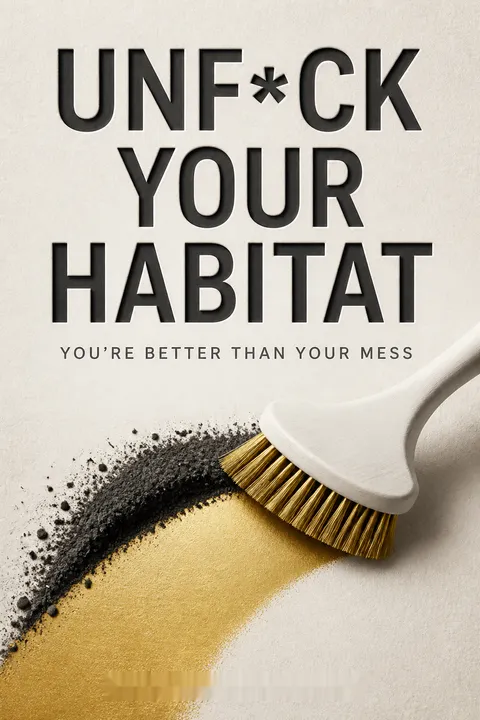
Unfuck Your Habitat (UfYH)
Flexible home-maintenance systemUnfuck Your Habitat is Rachel Hoffman’s approach to making a home more comfortable through manageable cleaning, organization, and maintenance. Its core practices include short work periods with breaks, adapting tasks to personal capacity, putting objects away, reducing excess belongings, and building routines around actual living conditions rather than an idealized household schedule.
FAQ
What's "Unf*ck Your Habitat: You're Better Than Your Mess" about?
- Purpose and Audience: The book by Rachel Hoffman is a practical guide aimed at helping people manage and organize their living spaces without feeling overwhelmed. It targets those who feel traditional cleaning systems don't fit their lifestyle.
- Realistic Approach: It acknowledges the challenges of maintaining a clean home in the real world, where time, energy, and resources are often limited.
- Flexible System: The book introduces adaptable cleaning methods that can be integrated into busy lives, focusing on small, manageable tasks rather than marathon cleaning sessions.
- Mental Health Consideration: It also addresses the impact of mental health on housekeeping, offering strategies to work around limitations.
Why should I read "Unf*ck Your Habitat"?
- Practical Solutions: The book offers realistic and achievable cleaning strategies that can be adapted to fit any lifestyle, making it accessible to a wide audience.
- Empowerment: It empowers readers by emphasizing that they deserve to live in a clean and comfortable environment, regardless of their current situation.
- Mental Health Focus: It provides insights into how mental health can affect one's living space and offers compassionate advice on overcoming these challenges.
- Inclusive Approach: The book is inclusive, considering various living situations and personal circumstances, making it relevant for a diverse readership.
What are the key takeaways of "Unf*ck Your Habitat"?
- 20/10 Method: The book introduces the 20/10 method, which involves 20 minutes of cleaning followed by a 10-minute break, making tasks more manageable.
- Habit Building: It emphasizes the importance of building small, sustainable habits to maintain a clean home without feeling overwhelmed.
- Realistic Expectations: Readers are encouraged to set realistic expectations for their living spaces, focusing on functionality and comfort rather than perfection.
- Mental Health Awareness: The book highlights the connection between mental health and one's environment, offering strategies to manage both effectively.
What is the 20/10 method in "Unf*ck Your Habitat"?
- Concept: The 20/10 method involves cleaning for 20 minutes followed by a 10-minute break, making it easier to tackle tasks without burnout.
- Flexibility: This method can be adjusted to fit individual needs, such as 5/15 for those with limited energy or mobility.
- Sustainability: It promotes consistent, small efforts over time, which are more sustainable than sporadic, intense cleaning sessions.
- Psychological Benefits: The method helps reduce the feeling of being overwhelmed by breaking tasks into manageable chunks, making it easier to start and continue.
How does "Unf*ck Your Habitat" address mental health?
- Acknowledgment of Challenges: The book recognizes that mental health issues can significantly impact one's ability to maintain a clean home.
- Strategies for Coping: It offers practical strategies to work around mental health limitations, such as starting with small tasks and celebrating small victories.
- Breaking the Cycle: The book discusses the self-perpetuating cycle of mess and depression, providing ways to interrupt this cycle.
- Compassionate Advice: It encourages readers to be kind to themselves and to set realistic goals that consider their mental health status.
What are some habit-building tips from "Unf*ck Your Habitat"?
- Daily Efforts: The book suggests doing a little bit every day to prevent the need for overwhelming cleaning sessions.
- Use Waiting Time: It encourages using short waiting periods, like while coffee brews, to accomplish small cleaning tasks.
- Put It Away, Not Down: Emphasizes the importance of putting items back in their place immediately to prevent clutter buildup.
- Nightly Preparation: Recommends preparing for the next day the night before to reduce morning chaos and stress.
How does "Unf*ck Your Habitat" suggest dealing with shared spaces?
- Communication: The book stresses the importance of open communication with roommates or family members about cleaning expectations and responsibilities.
- Setting Boundaries: It advises setting clear boundaries and responsibilities to prevent resentment and ensure everyone contributes.
- Avoiding Passive-Aggression: Encourages direct communication rather than passive-aggressive behavior to resolve conflicts.
- Flexibility and Compromise: Suggests being flexible and willing to compromise to maintain harmony in shared living spaces.
What does "Unf*ck Your Habitat" say about perfectionism?
- Perfectionist's Paradox: The book discusses how perfectionism can prevent people from starting tasks if they feel they can't do them perfectly.
- Progress Over Perfection: Encourages focusing on progress and small improvements rather than achieving a perfect result.
- Reframing Success: It suggests redefining success to include incremental progress and effort rather than only perfect outcomes.
- Letting Go: Advises readers to let go of the idea that there is only one "right" way to clean or organize.
How does "Unf*ck Your Habitat" approach decluttering?
- Less Stuff, More Storage: The book suggests reducing possessions to what is necessary and loved, rather than constantly seeking more storage solutions.
- Emotional Attachment: It addresses the emotional challenges of decluttering, especially with gifts and sentimental items.
- Practical Questions: Offers practical questions to help decide what to keep, such as the item's utility and emotional impact.
- Avoiding Extremes: Warns against the extremes of minimalism, advocating for a balanced approach that suits individual needs.
What are some of the best quotes from "Unf*ck Your Habitat" and what do they mean?
- "You deserve better than to live in filth." This quote emphasizes the book's core message that everyone deserves a clean and comfortable living space.
- "Excuses are boring." Encourages readers to move past excuses and take actionable steps toward improving their environment.
- "There is nothing that can’t be unfucked with a little bit of effort and motivation." Highlights the book's optimistic view that any mess can be managed with consistent effort.
- "Cleaning your house kind of sucks. Sorry, but it does." Acknowledges the universal dislike of cleaning, making the book relatable and honest.
How does "Unf*ck Your Habitat" suggest handling cleaning emergencies?
- Prioritize Tasks: Focus on the most visible and impactful areas, like clearing flat surfaces and dealing with trash and dishes.
- Avoid Distractions: Stay focused on the task at hand and avoid getting sidetracked by detailed projects.
- Use the 20/10 Method: Even in emergencies, use the 20/10 method to maintain energy and avoid burnout.
- Prepare for Future: Aim to reach a baseline level of cleanliness that reduces the need for emergency cleaning in the future.
What resources does "Unf*ck Your Habitat" provide for further help?
- Online Resources: The book lists websites and online communities for additional support and advice on cleaning and organizing.
- Checklists: Provides cleaning checklists for daily, weekly, monthly, and seasonal tasks to help maintain a clean home.
- Conversation Starters: Offers talking points for discussing cleaning responsibilities with roommates or family members.
- Support for Special Cases: Includes resources for those dealing with hoarding or mental health challenges related to cleaning.
Download PDF
Download EPUB
.epub digital book format is ideal for reading ebooks on phones, tablets, and e-readers.








