


Key Takeaways
Change the language of the moment, and you change what seems possible
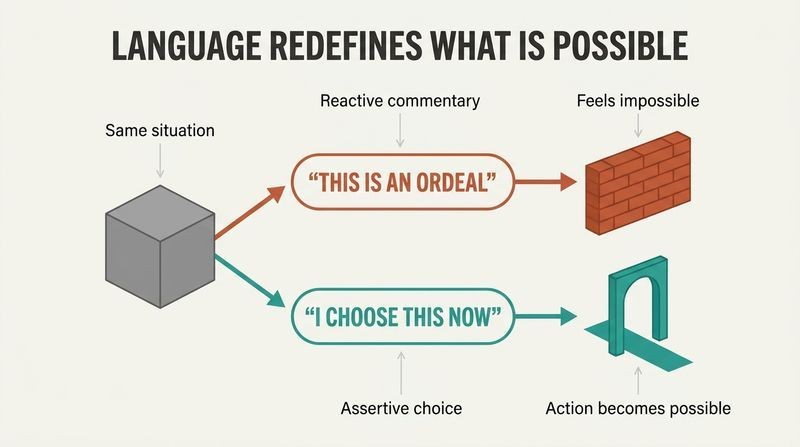
Words steer attention. The book argues that inner speech does more than describe experience: it shapes how a person interprets a task and responds to it. A dreaded chore can feel like an ordeal when repeatedly described as unbearable; naming it as a short, manageable action can make starting easier. The author contrasts this running commentary of judgments and predictions with present-focused, assertive self-talk that claims a choice now rather than postponing it to some future self.
Try it as an experiment. The book cites four experiments by University of Alabama researcher Will Hart. Participants who described a neutral event as ongoing reported more positive feelings, while describing a negative event in that way increased negative feelings. The point is not that words erase circumstances, but that language can alter the lens through which people meet them.
The useful distinction is between a thought as a report and a thought as an instruction. Cognitive behavioral approaches similarly examine how interpretations influence emotion and behavior, while language research suggests that framing can shape attention. That makes the book's invitation practical: notice the sentence that turns a task into a verdict, then test another description. Still, language is not a remote control for mood. Reframing can help someone approach a problem, but it cannot resolve material causes such as illness, unsafe conditions, or financial hardship by itself.
Judge a goal by the sacrifices you are genuinely prepared to make
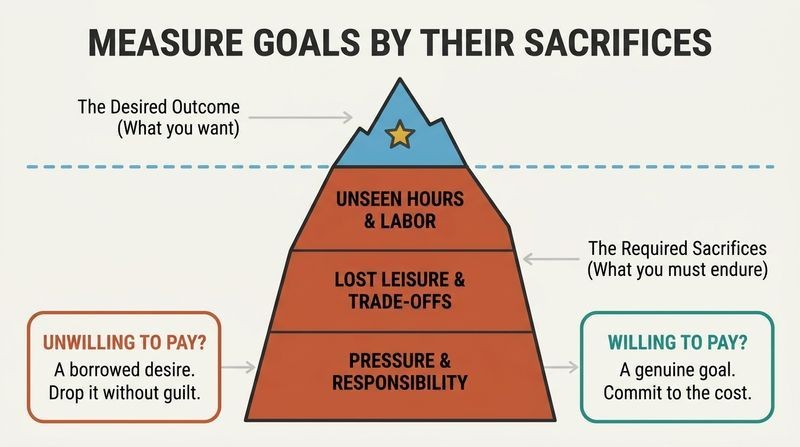
Willingness clarifies desire. The book treats willingness as readiness to take the next step, not as enthusiasm or certainty. Asking whether one is prepared to act can replace vague self-criticism about laziness with a more useful question: is this goal worth its actual costs? The author also uses declared unwillingness as a way to draw a line, such as deciding not to keep tolerating a situation that has become unacceptable.
Separate wants from borrowed aims. Wanting wealth, a particular body, or status is different from wanting the hours, trade-offs, and responsibilities that may accompany it. A person who longs for an expensive car but does not want the added work required to afford it can stop treating that choice as a personal failure. The exercise is to name what matters, accept the trade-off, and choose accordingly.
This is a strong antidote to goals absorbed from family, peers, or advertising without examining their price. Motivation research often distinguishes valued aims from externally imposed ones: effort tends to feel more sustainable when a person experiences the goal as genuinely their own. The book's willingness question helps surface that distinction. Its sharper claims about personal choice need care, however. Limited money, health, caregiving duties, and discrimination can restrict available options. Honest appraisal should clarify agency without turning constraint into blame.
Treat recurring failure as a pattern with a payoff you can expose
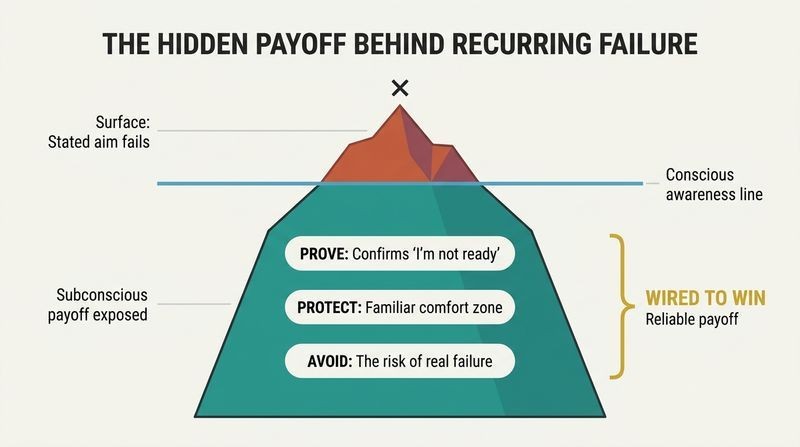
Look for the hidden win. The book's phrase "wired to win" is a reframe: repeated behavior can reliably produce an outcome, even when that outcome conflicts with a person's stated aim. Someone who delays work until a deadline may be reinforcing a story about being incapable or may be preserving the familiar pressure of last-minute effort. A person repeatedly drawn into unhappy relationships might be repeating a known pattern rather than pursuing the relationship they consciously say they want.
Investigate, do not diagnose. Ask what a recurring behavior seems to prove, protect, or help avoid. The author describes this as winning within a familiar domain, a sphere of life shaped by repeated assumptions and actions. Once the pattern is visible, define a different outcome and identify the concrete actions that would support it. The claim is a prompt for inquiry, not proof that every setback is secretly chosen.
The reframing can restore curiosity where shame usually closes it down. In behavioral science, habits persist partly because they serve functions, such as reducing immediate discomfort or preserving predictability, even when their long-term costs are high. Asking what a behavior accomplishes can reveal those functions and suggest a replacement. The caution is important: interpreting failure as a hidden victory can become overconfident storytelling. Patterns may arise from trauma, addiction, disability, or external barriers. Treat the proposed payoff as a hypothesis to test, not a verdict about motive.
Zoom out before one painful event becomes your whole life
Restore the larger picture. The book suggests imagining life as a long timeline, then recalling both its rewarding moments and its hardships. Past setbacks that once felt permanent may now look different because they were endured, resolved, or absorbed into a larger life. Looking toward the future also makes room for both possibility and difficulty, including the fact that life is finite.
Handle one problem at a time. A financial worry can spill into family life, irritability, and concentration, until one problem seems to define everything. Stepping back does not pay the bill or remove the loss. It can help distinguish the immediate issue from the emotional story surrounding it. The author recommends examining what is actually happening, then dealing with each item rather than bundling every concern into a single, overwhelming crisis.
Perspective-taking can interrupt emotional tunnel vision, a state in which distress narrows attention toward immediate threat. Recalling previous coping can also provide evidence that painful feelings change over time. The timeline exercise is valuable because it includes hardship rather than demanding forced gratitude. Yet comparison with people facing worse circumstances can backfire if it is used to dismiss legitimate pain. Perspective should widen the frame, not invalidate experience. When a problem is ongoing or traumatic, support and practical intervention may be needed alongside a broader view.
Take the step whose outcome you cannot guarantee
Uncertainty is unavoidable. The book argues that the search for certainty can keep people inside familiar routines, although new relationships, work opportunities, and skills require entering situations with unknown outcomes. Asking for a raise, approaching someone new, or trying an unfamiliar setting may lead to rejection or embarrassment, but avoiding every risk also forecloses possible gains.
Practice tolerating the unknown. The author recommends beginning with manageable departures from routine, such as choosing an unfamiliar route or starting a conversation. These small experiments challenge the assumption that discomfort signals danger. The point is not to take every risk or ignore consequences. It is to stop treating guaranteed success as a prerequisite for action, and to focus effort on what can be influenced rather than trying to forecast every result.
This insight aligns with exposure-based learning: approaching a feared but reasonably safe situation can teach that uncertainty is tolerable, even when anxiety remains. It also counters the common illusion that extensive prediction can eliminate risk. The practical distinction is between uncertainty and recklessness. A new conversation or career application is not equivalent to an impulsive financial gamble, and careful preparation still matters. The book is most persuasive when it recommends proportionate experiments, where potential costs are understood and the person learns from the outcome.
Let doubtful thoughts speak, but do not let them choose your actions
Thoughts are not orders. The author challenges the idea that a person must first feel confident, calm, or motivated before acting. A worker might dread a task, drift into browsing, and conclude that low energy proves the task cannot be done. The alternative is to recognize the thought, then take a relevant step despite it. In the book's view, repeated action can also change how a person sees their own abilities.
Use action to gather evidence. Starting work, exercising, or having a difficult conversation creates information that rumination cannot provide. The author points to focused activities such as sport, music, and running, where attention to the task can quiet internal commentary. This is not a demand to suppress thought. It is a way to let thoughts be present without making them the sole basis for a decision.
This is close to cognitive defusion, a concept in acceptance-based therapy: a thought can be noticed as a mental event rather than accepted as a fact or command. It also resembles behavioral activation, where planned action can precede improved mood instead of waiting for mood to arrive first. That is a valuable correction to endless introspection. But action is not always the complete answer. Persistent depression, anxiety, or exhaustion can require clinical care, and pushing through every signal may worsen harm. The principle is to loosen thought's authority, not ignore all internal warning signs.
Make persistence focused: solve the obstacle in front of you
Discomfort comes with progress. The book presents relentlessness as continuing purposeful effort when confidence, clarity, or immediate evidence of success is missing. It illustrates the idea through Arnold Schwarzenegger's path from a small Austrian town toward bodybuilding, American films, and public office. The point is not that ambition guarantees those outcomes, but that long-range goals were pursued through repeated, specific work.
Keep moving and adjust. Persistence is not simply repeating the same failed move. The author advises giving attention to the next obstacle, finding a way through or around it, and then addressing the next one. That keeps a person from becoming paralyzed by the size of the entire journey. Progress can be difficult to see while it is happening, so the practical test is whether current actions are still moving toward a worthwhile aim.
The distinction between persistence and rigidity is crucial. Research on expertise and skill development emphasizes deliberate practice, where effort is paired with feedback and correction, not mere repetition. The book's obstacle-by-obstacle approach captures that adaptive quality and gives ambition a workable scale. Schwarzenegger's story makes persistence vivid, though exceptional biographies can obscure luck, resources, and opportunity. His trajectory is an illustration, not a template or promise. For ordinary goals, sustained effort is most useful when paired with milestones and permission to revise an ineffective strategy.
Drop the imagined script, then respond to the life actually unfolding
Expectations can hide inside plans. The book describes how a person may picture a business, relationship, or career unfolding in a particular way without noticing how much emotional weight rests on that imagined sequence. In its business example, an entrepreneur loses an expected product supplier after investing in the launch. The loss is real, but distress grows when reality is measured against a plan that no longer fits.
Accept without approving. The author's final assertion means acknowledging the situation as it is, not declaring it good or fair. An entrepreneur can assess alternatives, revise the pricing, or stop the venture. In relationships, the same principle favors asking directly for what is needed instead of silently expecting a partner to infer it. Acceptance clears attention for a response; it does not require tolerating abuse or abandoning standards.
This connects with the Stoic distinction between events and judgments about events, while retaining room for action. Planning remains useful; the problem is treating a forecast as a contract reality must honor. In organizational settings, contingency planning serves a similar purpose by preparing alternatives instead of assuming one path. The book also makes a practical point about relationships: unspoken expectations often create resentment that direct communication could prevent. Some standards should remain firm, however. Flexibility about outcomes is different from accepting preventable mistreatment.
Turn insight into a stop-and-start plan before motivation fades
Replace, do not merely remove. The book closes by warning that self-improvement can become another form of delay: reading and analyzing may feel productive while daily behavior stays unchanged. Its practical two-part instruction is to stop a behavior that works against a chosen aim and begin a specific behavior that supports it. Someone seeking a new job, for example, needs to reduce the habits consuming time and actually apply, network, or seek references.
Use mortality as a lens. The author asks readers to imagine looking back on life and considers the regret of never trying more consequential than failing to reach a particular status goal. This is not a guarantee of success. It is an urgency test: identify one action that matters, take it now, and create a replacement routine so the old behavior does not simply reclaim the space.
The closing emphasis on behavior gives the book a productive test: insight matters when it changes what happens in an ordinary day. Habit research supports the general value of specifying actions and shaping routines, while replacement behaviors can make change more sustainable than relying on prohibition alone. The mortality prompt also echoes work on regret, directing attention toward choices that remain available. The forceful tone can motivate, but it risks turning setbacks into evidence of weak desire. Sustainable change often depends on support, accessible resources, and realistic pacing, not resolve alone.
Analysis
The book's central intervention is to move self-help from interpretation toward enactment. Its seven assertions work less like factual claims than like verbal prompts: they interrupt habitual self-description and direct attention toward a choice available in the present. The strongest through-line is that feelings and thoughts need not be prerequisites for behavior. A person can act while uncertain, then use the experience to update beliefs about what is possible. This is more grounded than requiring cheerful confidence before beginning.
Its other useful contribution is a practical vocabulary for examining patterns. Willingness asks whether a goal is truly desired at its real cost. The "hidden win" idea asks what a repeated behavior accomplishes, while the expectation exercise separates the actual problem from distress about how events were supposed to unfold. Taken together, these prompts convert vague dissatisfaction into questions that can generate specific next steps.
The method also has limits. Its emphasis on personal responsibility can sharpen agency, but the book sometimes treats choice as more available than it is. A person may be constrained by illness, trauma, poverty, discrimination, or responsibilities that cannot be set aside by adopting a stronger attitude. Framing every repeated difficulty as a pattern one is somehow winning at can also imply a hidden motive where structural causes or chance may matter more. The language research and neuroscience references are suggestive, but they do not establish that assertive phrasing alone rewires a life.
The most defensible reading is therefore neither that thoughts create all circumstances nor that circumstances dictate all behavior. Language can shape attention, attention can influence action, and action can create new evidence. That chain offers leverage, not omnipotence. The book is most useful when its blunt prompts are treated as experiments: choose a meaningful next move, observe what happens, revise the plan, and seek help when the obstacle exceeds individual effort. Its governing challenge is less to feel transformed than to make one consequential behavior different today.
Review Summary
Unfu*k Yourself receives mixed reviews, with an average rating of 3.84 out of 5. Many readers appreciate the book's straightforward, no-nonsense approach to self-improvement and its emphasis on taking action. The seven personal assertions are frequently mentioned as helpful. However, some critics find the advice simplistic, repetitive, or lacking in actionable steps. The author's tough love style and use of profanity resonate with some readers but alienate others. Several reviewers note that while the book may not offer new information, it serves as a motivating reminder to take control of one's life.
People Also Read




Glossary
personal assertions
present-focused self-talkShort first-person statements the author uses to redirect attention toward a chosen stance or action. Rather than promising change at some future time, an assertion is meant to intervene in the current moment. The book presents seven such prompts addressing readiness, recurring patterns, coping, uncertainty, action, persistence, and acceptance.
assertive self-talk
language claiming present agencyA style of inner speech that names a current choice or stance, rather than narrating judgments about the self or postponing change with future-tense promises. The author contrasts it with ongoing commentary about what is difficult, unfair, or likely to go wrong. Its purpose is to support action in the present, not to guarantee a positive mood.
domains
spheres of repeated outcomesThe author uses this term for areas of life, such as work, relationships, or finances, where a person's assumptions and recurring actions produce a familiar pattern of results. A domain is not simply a job title or goal. It is the current sphere in which a person repeatedly operates and may need to change their automatic behavior to move beyond.
wired to win
repeating a familiar outcomeThe author's reframe for the way repeated behavior can produce a consistent result, even when that result conflicts with conscious wishes. Procrastination, for instance, may repeatedly confirm a familiar self-image of incapability. The phrase is intended to prompt investigation of patterns and their consequences, not to claim that every setback is consciously chosen or secretly desired.
FAQ
What's "Unfu*k Yourself: Get Out of Your Head and into Your Life" about?
- Self-Improvement Focus: The book is a guide to breaking free from self-sabotage and realizing one's true potential by changing the way we think and act.
- Conversational Style: It uses a direct, no-nonsense approach to motivate readers to take action and improve their lives.
- Core Message: The central theme is to stop overthinking and start doing, emphasizing that action is the key to change.
Why should I read "Unfu*k Yourself"?
- Practical Advice: The book offers actionable steps to help readers overcome mental barriers and achieve their goals.
- Relatable Content: It addresses common feelings of being stuck or overwhelmed, making it relevant to many readers.
- Empowering Tone: The author’s straightforward and motivational style encourages readers to take control of their lives.
What are the key takeaways of "Unfu*k Yourself"?
- Self-Talk Matters: The language we use with ourselves significantly impacts our reality and potential.
- Action Over Thoughts: Success is more about what you do than what you think; actions define you.
- Embrace Uncertainty: Accepting the unknown is crucial for growth and discovering new opportunities.
What is Gary John Bishop's approach to self-improvement in "Unfu*k Yourself"?
- Urban Philosophy: Bishop combines personal development with practical philosophy, influenced by thinkers like Heidegger and Gadamer.
- No-Bullshit Style: His approach is direct and unfiltered, aiming to cut through excuses and motivate real change.
- Focus on Action: He emphasizes taking decisive action over merely thinking or planning for change.
How does "Unfu*k Yourself" suggest dealing with negative self-talk?
- Awareness of Thoughts: Recognize that negative self-talk is common but doesn't define you.
- Detach from Thoughts: Understand that you are not your thoughts; focus on actions instead.
- Positive Self-Talk: Use assertive language to reframe your mindset and boost confidence.
What are the seven personal assertions in "Unfu*k Yourself"?
- "I Am Willing": Be ready to take action and change your life.
- "I Am Wired to Win": Recognize that you are naturally inclined to succeed.
- "I Got This": Trust in your ability to handle challenges.
- "I Embrace the Uncertainty": Accept the unknown as a space for growth.
- "I Am Not My Thoughts; I Am What I Do": Focus on actions rather than thoughts.
- "I Am Relentless": Persist in the face of obstacles.
- "I Expect Nothing and Accept Everything": Let go of expectations and accept reality.
How does "Unfu*k Yourself" define success and failure?
- Thoughts and Emotions: Success and failure are tied to how we think and feel about our experiences.
- Action-Oriented: Success is achieved through relentless action, not just positive thinking.
- Perception Shift: Changing how we perceive challenges can turn failures into learning opportunities.
What are some of the best quotes from "Unfu*k Yourself" and what do they mean?
- "I am not my thoughts; I am what I do": This emphasizes the importance of actions over thoughts in defining who we are.
- "I embrace the uncertainty": Encourages readers to see the unknown as a chance for new experiences and growth.
- "I expect nothing and accept everything": Suggests letting go of rigid expectations to better handle life's unpredictability.
How does "Unfu*k Yourself" suggest handling life's challenges?
- Perspective Shift: View challenges as opportunities for growth rather than obstacles.
- Focus on Solutions: Address problems directly and pragmatically, without getting bogged down by emotions.
- Relentless Action: Keep moving forward, even when the path is unclear or difficult.
What role does language play in "Unfu*k Yourself"?
- Language Shapes Reality: The words we use influence how we perceive and interact with the world.
- Positive Self-Talk: Using empowering language can improve mood, confidence, and productivity.
- Avoid Negative Narratives: Reframing negative thoughts can prevent them from becoming self-fulfilling prophecies.
How does "Unfu*k Yourself" address the concept of free will?
- Challenge of Free Will: Questions whether we truly have free will when our actions are driven by subconscious thoughts.
- Conscious Choice: Encourages readers to become aware of automatic thoughts and make deliberate choices.
- Empowerment Through Awareness: Understanding how the mind works can help reclaim control over one's actions.
What is the ultimate goal of "Unfu*k Yourself"?
- Empowerment: To empower readers to take control of their lives and realize their potential.
- Action-Oriented Change: To motivate readers to stop overthinking and start taking meaningful actions.
- Personal Responsibility: To encourage taking responsibility for one's life and choices, leading to genuine transformation.
About the Author


Download PDF
Download EPUB
.epub digital book format is ideal for reading ebooks on phones, tablets, and e-readers.








