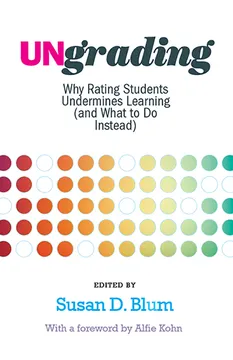


Key Takeaways
Treat grades as weak proxies that can displace the learning they claim to measure.
Grades are human inventions. Ungrading means reducing or removing grades on students’ work so attention can return to learning, feedback, and growth. Grades seem objective because they use numbers and letters, but their meaning varies: instructors weigh attendance, homework, tests, and improvement differently. In early studies, teachers assessing the same geometry work gave scores in the 38-42 range or the 83-87 range. The precision of a score does not guarantee consistency.
Measurement changes behavior. Grades can combine mastery with punctuality, compliance, prior knowledge, and other factors, leaving students unsure what a mark actually reports. The book argues that when students focus on how they are performing, they can become less invested in what they are learning. The problem is not merely unfair grading rules. A score can make the score itself the goal.
What's striking is that grading works like many organizational metrics: once a measure becomes a target, people adapt their behavior to improve the measure, sometimes at the expense of the underlying work. That does not make measurement useless. Grades still help institutions allocate opportunities, and students need legible credentials in systems built around them. The stronger claim is narrower: a course grade is a poor instrument for guiding learning while it is happening. Separating coaching from ranking can preserve information about progress without pretending that one compact symbol captures a student's understanding.
Give students usable feedback before assigning a final verdict.
Comments can keep learning open. The book repeatedly draws on Ruth Butler’s study comparing three approaches: grades alone, grades with comments, and comments alone. Students who received comments without grades showed the strongest improvement; adding a grade to comments did not produce the same benefit. The proposed explanation is that a grade pulls attention toward judgment, while descriptive comments direct attention to the work and possible changes.
Make response actionable. Instead of marking an essay as simply weak, identify a specific move the writer can reconsider, then let the student try again. Teachers in the collection use written comments, conferences, and revisions to make feedback part of an ongoing process. Because detailed comments take time, prioritize the most important next steps rather than covering every flaw at once.
Feedback is most useful when it gives a learner information they can act on, a principle familiar from coaching, design critique, and clinical supervision. The practical distinction is between describing an observable feature and issuing a global judgment: the former invites a testable next move. Still, comments are not automatically helpful. Vague praise, overwhelming corrections, or advice that arrives too late can be ignored just as easily as a score. A strong feedback system therefore needs time for revision and a clear purpose for each response, not simply a ban on numbers.
Make students assemble evidence of growth before discussing the final grade.
Build a record of learning. A portfolio is a collection of a student’s work across a course, reviewed to show development rather than isolate one performance. Teachers in the book ask students to revisit early and later work, explain what changed, and identify what remains difficult. This reflection also develops metacognition, the ability to notice and assess one’s own thinking and learning.
Use conversation, not surprise. In end-of-term conferences, students present evidence and propose a course grade when institutions still require one. Susan Blum’s students reviewed assignments and reflections before brief meetings; middle-school teacher Joy Kirr likewise used conferences to consider current evidence and set future goals. Some students initially struggled to judge their work, while others underestimated themselves. The conversation gave teachers a chance to clarify and respond.
A portfolio shifts the question from “What label did this performance earn?” to “What can this learner now do, and what supports that conclusion?” That resembles evidence-based professional review, where a body of work matters more than a single snapshot. Self-assessment is not naturally accurate, however. Students may lack confidence, misread expectations, or face unequal access to the cultural cues that make self-advocacy easier. The method works best when criteria are understandable, evidence is varied, and a conference helps students calibrate their judgment rather than leaving them to grade themselves alone.
Offer choice inside clear scaffolding, not an unbounded assignment buffet.
Autonomy needs support. Contract grading is an approach in which students agree in advance to a defined amount of work associated with a course grade. It can make expectations more predictable and let students plan around other obligations. Some contracts also let classmates assess whether work meets shared standards, while the instructor provides guidance.
Freedom can overwhelm. In a small philosophy course, Marcus Schultz-Bergin let students choose from a buffet of assignments. Some produced substantial work, while others submitted little. After midterm, he offered a suggested schedule and sample exam questions to lower the effort required to get started. These changes helped some students, though not all. The lesson is to offer meaningful choice without assuming every learner can independently design a plan, manage deadlines, and recognize what evidence of learning is needed.
This is a useful distinction between autonomy and abandonment. Motivation research often finds that choice supports engagement, but choice is most productive when learners understand the task and can see a path through it. A menu of options can otherwise impose hidden planning work, especially on students balancing jobs, care responsibilities, or unfamiliar academic expectations. Stable milestones, check-ins, and a few well-designed options can preserve agency while reducing that burden. Structure is not necessarily control; it can be the support that makes meaningful choice possible.
Let peers help define quality, then teach them to evaluate it.
Assessment can be communal. In some contract-grading models, students help establish what counts as satisfactory work and review one another’s projects. One method, badging, lets reviewers recognize strengths in chosen categories, such as clear argument or strong research, while offering feedback on areas to develop. The purpose is not to rank classmates but to make standards visible and invite revision.
Practice can exceed the plan. In a course on twenty-first-century literacies, students took charge of a class session and proposed turning their work into a collectively edited book. Their instructor accepted the ambitious project, which became a public resource. Peer review can therefore become more than a grading substitute: students learn to give and receive critique, coordinate work, and take responsibility for a shared outcome.
Peer review makes the standards of a discipline discussable instead of leaving them hidden inside an instructor’s judgment. It also gives students practice in explaining why a piece of work succeeds, a form of learning that can deepen their own craft. Yet peer evaluation is not inherently fair: friendship, status, bias, and uneven expertise can shape whose work is praised or criticized. Shared criteria, examples, instructor oversight, and opportunities to revise help keep the process constructive. Community participation should broaden feedback, not become a cheaper way to transfer all assessment labor to students.
Turn technical assessment into repeated practice, critique, and resubmission.
Treat work as improvable. Critique-driven learning and assessment replaces one-shot scoring with repeated cycles of creating work, receiving specific feedback, and revising it. In computer science professor Christopher Riesbeck’s programming course, students selected exercises and resubmitted solutions until major problems were resolved. The course guidance suggested about thirty new exercises, plus revisions, over a ten-week quarter. Final grades, when required, drew on progress, quality, and effort rather than isolated marks.
Track patterns, not just totals. A digital system stored submissions and critiques, helping the instructor see which skills students practiced and where difficulties persisted. The approach also exposed limits: some students delayed work without due dates, and shared programming solutions created plagiarism concerns. It is most useful when tasks develop skills students see a reason to master.
Repeated attempts resemble deliberate practice: performance improves through focused effort, informative correction, and another chance to apply what was learned. The model also makes technical feedback concrete, since an instructor can point to a specific flaw in a program rather than assign a mysterious fraction of a point. But submission counts are only proxies for competence. A student may improve with extensive support yet struggle to transfer a skill to a new problem. Good designs therefore pair repeated revision with varied tasks that reveal whether learning travels beyond the original exercise.
Without meaningful work, removing grades only removes the lever.
The work itself matters. Several contributors argue that grades can hide a deeper teaching problem: students may be completing tasks whose purpose is unclear. High-school English teacher Aaron Blackwelder changed his course after noticing that point-chasing had replaced lively reading and discussion. Instead of assigning a standard essay on The Odyssey, he turned the story into a courtroom exercise, asking students to debate the characters’ actions. In another project, students researched problems in their school and presented possible solutions to people able to act on them.
Design for purpose and choice. These projects gave students an audience and a reason to read, write, and argue. Ungrading does not automatically create engagement; teachers must explain why the material matters, invite student interests, and build work that calls for real effort.
Removing an extrinsic incentive is not the same as creating intrinsic motivation. In self-determination theory, autonomy works alongside competence and a sense of purpose; students need both room to choose and a plausible reason to care. The courtroom and school-improvement projects make academic skills consequential without reducing them to points. Not every necessary topic will feel immediately compelling, though. Teachers still need to make foundational material accessible and explain its use, rather than treating entertainment as a substitute for intellectual substance.
Audit whose work grading rewards, and whose learning it obscures.
Rules have unequal effects. Grades can reward factors beyond understanding. Participation scores may favor students comfortable speaking aloud and penalize those who are ill or managing difficult responsibilities. Advanced courses with weighted grades can advantage students whose schools offer more of them. The book also describes how attempts to limit high grades have disproportionately harmed Black students in at least one reported case.
Ungrading is not bias-proof. Removing scores does not erase unequal expectations or implicit judgment. Some students may also find open-ended assessment less transparent than familiar marks. Teachers need to make goals explicit, offer multiple ways to demonstrate learning, invite student input, and examine whose work receives encouragement, attention, and opportunity. Equity requires attention to the conditions around assessment, not just the format of the final grade.
The equity argument is strongest when it treats both numerical and narrative evaluation as human systems that can reproduce bias. A number may conceal whose prior preparation shaped the result; an open-ended conference may reward fluency and confidence. At the same time, well-designed measurements can reveal disparities that informal impressions miss. The goal should not be to replace data with intuition, but to combine multiple forms of evidence and ask who benefits from each rule. Transparent expectations and disaggregated outcomes make that scrutiny more concrete.
Make ungrading a supported experiment, not a lonely act of defiance.
Start within real constraints. Institutions often require a final grade, and transcripts influence scholarships, admissions, and jobs. Contributors therefore describe many routes: remove grades from selected assignments, use pass-fail where allowed, or delay the final grade while students receive feedback. Some experiments take more time than conventional grading, especially conferences and detailed responses. John Warner found that his feedback work could still fill weekends, but it felt more connected to teaching than scoring did.
Explain and iterate. Tell students why the course is changing, check institutional rules, and begin with a manageable experiment such as a low-stakes assignment or an ungraded portion of the term. Compare what students learn and how they respond, then adjust. The book calls for support from colleagues and administrators, particularly because contingent instructors may have less protection when trying unfamiliar practices.
The collection’s most realistic contribution is its refusal to present one formula for every classroom. Ungrading is better understood as design work: test a practice, observe its effects, and revise it in context. That approach aligns with improvement science, where small, documented experiments can inform broader change. But experimentation has a labor cost. Institutions should not celebrate richer feedback while leaving instructors without time or security to provide it. Evidence should include student learning, access, workload, and trust, not simply enthusiasm for a new label.
Analysis
This book is an anthology of teacher experiments rather than a single prescribed system. Its common argument is that conventional grades often confuse measurement with learning: a letter compresses complex evidence, influences what students choose to do, and can shift classroom relationships toward judgment. The contributors replace that familiar mechanism with varied practices, including descriptive feedback, revision, portfolios, student conferences, contracts, peer assessment, and iterative critique. Their shared destination is not a classroom without standards, but one where standards and progress are discussed rather than hidden inside a score.
The book is strongest when it shows how these ideas work in different settings. An organic chemistry instructor has students assess exam work and discuss discrepancies; a programming instructor builds a system for repeated critique; a middle-school teacher confers with students about portfolios. These accounts make ungrading practical, while their failures show why structure, explanation, and iteration matter. The central caution is also important: student choice alone can leave some learners adrift, and removing numerical grades does not remove bias or institutional pressure.
The evidence is suggestive but not uniform. The contributors draw on motivation research and grading studies, then offer reflective accounts of their own classrooms. Those accounts reveal mechanisms and generate useful hypotheses, but they are not controlled comparisons that establish one approach as universally superior. Results may depend on class size, subject, student experience, and the resources available to instructors. The book acknowledges those limits and treats variation as a reason for experimentation rather than a reason to preserve the default.
Its deeper challenge is institutional. Grades serve as credentials and sorting devices, even when they are weak descriptions of learning. Individual instructors can reduce their influence, but lasting change requires schools to reconsider transcripts, admissions expectations, workload, and who gets the authority to define success. For teachers, the practical test is not whether a course is technically gradeless. It is whether its assessment helps students understand their work, improve it, and see what they are learning.
Glossary
Ungrading
Assessment without routine scoresUngrading is a broad approach that reduces or removes grades on individual student work and shifts attention toward feedback, reflection, revision, and learning. It does not prescribe one method, and it does not always eliminate the final grade required by an institution. Teachers in the book use multiple approaches adapted to their courses and constraints.
Contract grading
Agreed work for a gradeContract grading sets out in advance the work or commitments associated with a course grade. Students choose or negotiate a contract, then complete its terms rather than trying to infer a teacher’s shifting point system. Some versions separate the quantity of work from its quality, using feedback or peer review to help work meet agreed expectations.
All-feedback-no-grades
Feedback replaces assignment gradesAll-feedback-no-grades is Laura Gibbs’s name for a course practice in which the instructor places no grades on student work and instead provides ongoing feedback. Students record completed work through simple declarations in the learning system, while the instructor checks that they remain on track to pass. A required final letter grade may still be submitted.
Critique-driven learning and assessment
Repeated critique improves workCritique-driven learning and assessment is a method in which students submit work, receive specific critiques, revise, and resubmit rather than receiving a score on each attempt. The instructor considers progress, quality, and effort when a final grade is necessary. The approach is particularly suited to courses where students create artifacts or practice skills that can be improved through repeated attempts.
do-review-redo
Create, critique, reviseDo-review-redo describes the repeated cycle at the heart of critique-driven assessment: a student completes a task, reviews feedback on the work, and tries again. The cycle continues until the work meets the relevant expectations or the student moves to another task. It treats revision as part of learning rather than a penalty for earning a low mark.
grade anarchy
Shared authority over learningGrade anarchy is Marcus Schultz-Bergin’s experiment in distributing classroom authority rather than making the instructor the sole judge of student grades. Students helped shape course outcomes, chose learning activities, reflected on their work, and proposed their final grades in conferences. His small-class experience suggested possibilities as well as risks, especially when students had little guidance about pacing and assignments.
metacognition
Awareness of one’s learningMetacognition means noticing and reflecting on one’s own thinking and learning. In the book’s classrooms, students use reflection to identify what they understand, where they struggle, how feedback changed their work, and what they should try next. It is treated as a learnable skill, not an automatic ability, and is supported through prompts, portfolios, and conversation.
Download PDF
Download EPUB
.epub digital book format is ideal for reading ebooks on phones, tablets, and e-readers.








