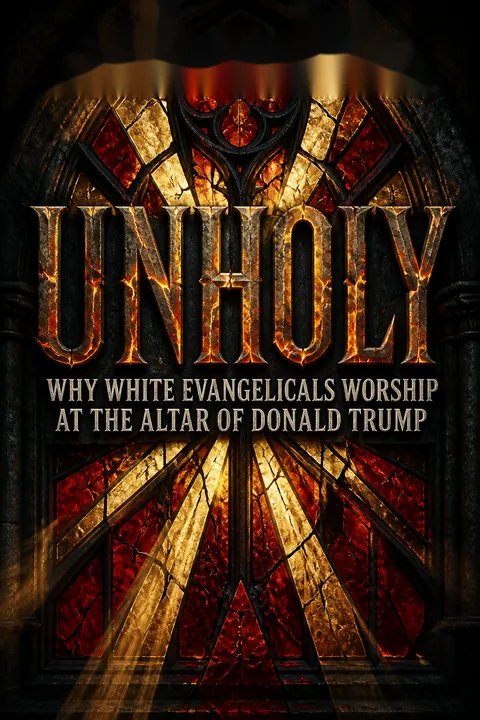


Key Takeaways
Read Trump's evangelical alliance as a five-decade project, not a sudden conversion.
A coalition with a memory. Sarah Posner argues that Trump did not create the Christian right's political project. New Right organizer Paul Weyrich spent decades building networks of activists, think tanks, lobbyists, and politicians, while religious media helped turn audiences into political constituencies. The coalition's early grievances concerned civil rights and federal action against school segregation, though its public identity later centered on abortion and family values.
A loyal, organized bloc. White evangelicals' share of U.S. adults fell from 23 percent in 2006 to 17 percent about a decade later, but their political influence remained outsized. They made up 26 percent of voters in 2016, and 81 percent voted for Trump. The numbers help explain why a candidate with little evangelical fluency could win their support: he offered not a conversion story, but a forceful champion for a long-running political agenda.
What's striking is the difference between a movement's public explanation of itself and the institutions that actually sustain it. A story about defending faith can conceal a history of coalition-building around power, status, and policy. Posner's account also cautions against treating a voting bloc as a single mind: the organizations, leaders, and voters she describes do not all have identical motives. Her strongest evidence concerns the movement's organized political infrastructure, which helps explain how a candidate can seem like an outsider while benefiting from decades of preparation.
Ask who gains power when religious freedom becomes an exemption from equal treatment.
A right with consequences. In 2017, a leaked draft executive order proposed broad permission for people and organizations to refuse services or employment on religious grounds, including in health care, housing, education, and government-funded programs. Trump signed a narrower order, but it directed Attorney General Jeff Sessions to issue guidance on religious liberty. Sessions's memo then told federal agencies to accommodate religious practice across government activity.
The conflict is practical. A religious adoption agency might refuse to place a child with a same-sex couple; a taxpayer-funded provider might turn away a client; a health worker might refuse care. The book's concern is not simply that religious liberty is invoked, but that exemptions can shift costs onto people seeking services, while being presented as protection for the objector.
Religious liberty is a genuine constitutional value, and governments should not casually force people to violate their beliefs. The difficult question is how to protect that value without making someone else bear the cost of exclusion, especially when public money or essential services are involved. Posner's examples make that trade-off concrete. They also expose how legal language can sound neutral while distributing power unevenly. A useful test is to ask not only whose conscience is protected, but who loses access, and whether a less restrictive accommodation is possible.
The Christian right's founding story obscures its early fight over desegregation.
The familiar story is incomplete. The movement often credits the 1973 Roe v. Wade decision with drawing evangelicals into politics. Posner presents a different chronology: many evangelical leaders initially accepted some legal abortion, while political organizers were already mobilizing Christians against federal action on race and education. The Southern Baptist Convention's resolutions shifted over time, moving from support for abortion in specified circumstances in the early 1970s to opposition to nearly all legal abortion by 1980.
The school dispute mattered. After courts required the IRS to deny tax benefits to racially discriminatory private schools, organizers framed enforcement as an assault on religious freedom. Although the IRS rules targeted schools that would not adopt nondiscrimination policies, activists portrayed them as government tyranny. Jerry Falwell had also opposed the Civil Rights Act and invited segregationist George Wallace to speak from his pulpit.
Origin stories do political work: they decide which actions look principled and which look compromised. Recasting the movement's beginning as a response to abortion gave it a moral narrative that could travel more easily than a defense of segregated schools. Posner's historical record makes that reframing difficult to ignore. The account should not be read as proof that every evangelical voter consciously supported racial exclusion. Its force lies in showing how movement leaders built institutions and rhetoric around conflicts whose racial stakes were then obscured.
Trump won evangelical loyalty by performing like a televangelist, not a conventional Christian candidate.
Showmanship outranked testimony. Earlier Republican candidates were expected to offer a salvation story and speak the language of Christian values. Trump struggled to do either. Yet his reality television fame, confident persona, and promises of dramatic victory fit a political culture shaped by televangelism. Paula White, a televangelist who became his spiritual adviser, helped present him to Christian audiences as a successful businessman open to biblical guidance.
Charisma can excuse contradictions. The prosperity gospel, a theology linking financial giving to divine blessing, centers charismatic leaders who promise extraordinary results and discourage challenges to their authority. Posner sees parallels in Trump's insistence on loyalty, appetite for spectacle, and claims that he could quickly solve national problems. Supporters could regard him as a flawed instrument chosen by God, rather than as a candidate whose personal conduct disqualified him.
Political communication often rewards a vivid promise more than a detailed plan. Televangelism intensifies that dynamic by making personal charisma and apparent miracles part of the message itself. Posner's comparison helps explain why Trump's lack of conventional religious credentials did not necessarily weaken him with these audiences. It also invites a distinction: a style resemblance is not proof that every evangelical supporter embraces prosperity theology. The wider point is that celebrity, confidence, and a promise of rescue can become substitutes for the forms of credibility a movement once demanded.
Treat racial grievance as a central engine of Trump's evangelical coalition.
The bond was visible early. Trump's first campaign emphasized immigration, a border wall, and restrictions on Muslims before he had secured broad evangelical endorsements. He retweeted a false statistic about Black homicide victims and declined to clearly separate himself from white supremacist support. His hard-line language resonated with white nationalists and with many white evangelical voters who saw demands for racial equality and immigration reform as attacks on their standing.
Critics were pushed aside. Russell Moore, a Southern Baptist leader who criticized Trump's anti-immigrant rhetoric and defended racial justice, became an outlier within his denomination's Trump-aligned leadership. In one poll cited by Posner, 76 percent of white evangelicals supported the proposed border wall, and 73 percent rated Trump's handling of race relations positively. The author's argument is that defenders did not merely overlook his racial politics; they often helped recast criticism of them as partisan hostility.
The distinction between explicit white supremacy and the broader politics of racial backlash matters. Posner documents direct ties and shared rhetoric, but the evidence does not establish that every Trump voter held the same beliefs or understood the coalition in the same way. That nuance strengthens rather than erases the argument: political movements can align people through common narratives about loss, threat, and unfairness without requiring identical ideologies. The key interpretive question is what those narratives make acceptable, and whose rights become negotiable when a group feels displaced.
Track how fringe ideas gain respectability through networks, not just candidates.
Local conflicts became national causes. In the 1970s, organizers turned disputes over school textbooks and court-ordered busing into stories of government intrusion on families. One campaign against textbooks in West Virginia objected to Black writers and lessons on racial difference; activists linked it to opposition to busing in Boston and presented both as a national struggle over parental authority. The method helped convert local backlash into a durable political coalition.
Ideas travel through institutions. Posner traces how figures once marginal to respectable conservatism found places in think tanks, media, campaigns, and government. Before joining Trump's campaign, Steve Bannon reportedly tested political language with Cambridge Analytica, including terms that appealed to alienated young white conservatives. The lesson is to follow the people, funding, and messages that connect extremist movements to mainstream political channels.
A movement's reach is not measured only by its formal membership or election wins. Ideas can become influential by changing the vocabulary that established institutions treat as normal. The book's historical examples show a progression from local controversy to national grievance, then from grievance to policy language. This makes episodic attention to individual extremists inadequate: removing one figure may leave the distribution network intact. At the same time, tracing networks requires careful evidence, since shared language alone does not establish identical beliefs or coordinated intent.
Staff agencies and courts to make political victories endure beyond elections.
Personnel changes policy. Trump placed Christian right lawyers and advocates in federal agencies, including the Department of Justice and the Department of Health and Human Services. Sessions's religious-liberty guidance drew on arguments advanced by Alliance Defending Freedom, a legal advocacy organization. HHS created a Conscience and Religious Freedom Division, while the administration also weakened or withdrew protections related to transgender people, racial disparities, and fair housing.
Courts extend the reach. The book describes an organized effort to appoint conservative judges and reduce the influence of civil rights law. By summer 2019, 86 percent of Trump's confirmed appellate nominees were white, and 80 percent were men. The significance is institutional: judges serve for long periods, and agency rules shape how rights are enforced in everyday settings. Political control can therefore outlast the election that produced it.
Institutions translate abstract commitments into decisions about real people: who receives services, which complaints are investigated, and what counts as discrimination. That is why staffing is not merely a technical detail. It is a means of shaping what government recognizes as a right. Posner's evidence also suggests that institutional change is cumulative, not confined to headline-grabbing laws. The argument is strongest when it distinguishes appointments from outcomes: a nominee's background signals priorities, but the practical effect still depends on decisions, legal constraints, and public scrutiny.
Notice when defending traditional values becomes permission to weaken democracy.
The alliance crossed borders. American Christian right leaders built relationships with political movements in Russia and Europe that opposed abortion, LGBTQ rights, and immigration. At events such as the World Congress of Families, activists described liberal democracy and human rights as threats to the traditional family. Viktor Orbán's Hungary appealed to some American conservatives because of its Christian-nationalist language, despite restrictions on independent media, courts, and civil society.
Elections are not enough. Posner's account shows how leaders can retain elections while weakening the institutions that make them fair and meaningful. A free press, an independent judiciary, and protections for minorities are not procedural decorations; they limit what rulers can do to opponents and unpopular groups. The attraction of foreign strongmen thus reflects more than a foreign-policy preference. It reveals a willingness to trade democratic safeguards for political control over social and cultural change.
Shared religious language can create solidarity across countries, but it can also obscure what political systems are doing to people with less power. The crucial distinction is between a government that wins elections and one that preserves the conditions for meaningful competition, scrutiny, and equal rights. Posner's examples make that distinction central to the movement's international alliances. A fair analysis should also separate cooperation on particular policies from endorsement of an entire regime. The risk arises when criticism of authoritarian practices is dismissed as an attack on faith or national identity.
Conspiracy turns scrutiny into persecution and binds followers to a leader.
Attention became a weapon. After reporting surfaced about a 2016 meeting between Trump campaign figures and a Russian lawyer, evangelical allies circulated photographs of pastors praying over Trump in the Oval Office. The images shifted attention toward the spectacle of prayer and helped supporters argue that the press was mocking their faith. Posner presents this as part of a wider pattern in which political scrutiny becomes evidence of an attack on Christians and their chosen leader.
The story protects itself. Claims about hidden enemies, Satan, George Soros, or a deep state can explain away evidence that would otherwise challenge a leader's credibility. In a 2019 poll cited in the book, 77 percent of white evangelicals said they did not believe Trump had obstructed justice, while 58 percent of American adults believed he had lied about the investigation. When every investigation is framed as persecution, loyalty can survive facts that might otherwise unsettle it.
A self-sealing explanation is powerful because it turns contradiction into confirmation: evidence against the leader becomes proof that the enemy is organized and dangerous. The prayer-photo episode also shows that media attention can be redirected without disproving the original reporting. This is not unique to religion; political communities of many kinds can protect identity by distrusting outside sources. The important question is whether followers have trusted ways to test claims, including sources that can criticize their own side without being automatically branded enemies.
Analysis
The book's central move is to replace the puzzle of Trump's personal appeal with a history of political infrastructure. Posner follows organizers, lawyers, pastors, media figures, and policy networks across decades, arguing that Trump activated an existing coalition rather than inventing one. This changes the interpretive scale: the important question is not whether his conduct fits evangelical moral teaching, but why movement leaders and voters judged a forceful champion of their grievances more useful than a candidate who performed conventional piety.
The strongest sections connect rhetoric to institutions. The account of school desegregation disputes explains how claims of religious liberty and parental rights could turn resistance to civil rights enforcement into a story of Christian victimhood. The analysis of agency appointments and judicial nominations then shows how such stories can become administrative practice and legal precedent. The international chapters extend the same pattern: leaders who invoke family, faith, and national identity can earn support despite weakening democratic checks.
The argument is most persuasive when it documents elite organizing and the consequences of policy. It is less conclusive when broad claims about white evangelical motivations risk compressing a diverse population into one political psychology. Some voters may prioritize abortion, others immigration, judges, party loyalty, or a sense of cultural threat. Those motives can coexist without being identical. Nor does the historical relationship between religious organizing and racial backlash prove that every contemporary supporter consciously endorses white nationalism.
That distinction does not undo the book's thesis. It clarifies its target: a coalition whose leaders repeatedly made racial and religious hierarchy compatible with a public language of liberty. The book's enduring insight is that authoritarian politics need not arrive through a sudden coup. It can grow through organizations, familiar grievances, selective exemptions, and the gradual erosion of trust in institutions capable of saying no.
Glossary
New Right
Conservative political coalitionThe New Right was a conservative organizing project that grew in the 1970s around political activists such as Paul Weyrich. It joined voters and organizations around cultural and social issues as well as economic conservatism, built networks linking grassroots campaigns to think tanks and politicians, and presented liberal government as a threat to traditional authority.
religious freedom
Religious liberty policy frameIn Posner's account, religious freedom is both a constitutional principle and a political frame used by Christian right advocates to seek exemptions from laws protecting other people. The disputes concern when religious practice should be accommodated, especially in employment, health care, education, and publicly funded services, and whether an exemption transfers harm or lost access to someone else.
prosperity gospel
Faith linked to material blessingThe prosperity gospel is a religious teaching that connects faith and giving money to a pastor or ministry with divine rewards, such as wealth, health, or success. Posner describes its appeal to charismatic authority figures and its susceptibility to abuse when leaders discourage questions, promise supernatural outcomes, or treat donations as proof of a believer's obedience.
New Apostolic Reformation
Modern prophets and spiritual warfareThe New Apostolic Reformation is a charismatic Christian movement whose adherents believe contemporary apostles and prophets receive direct revelations from God. In the account presented here, its leaders call followers to spiritual warfare and seek Christian influence over major areas of society, including government, education, media, business, family, religion, and the arts.
seven mountains
Seven spheres of social influenceThe seven mountains are areas of society that some New Apostolic Reformation leaders aim to influence or bring under Christian authority: religion, family, education, government, media, arts and entertainment, and business. The idea turns spiritual activism into a broad political and cultural project, not one limited to worship or individual religious practice.
illiberal democracy
Elections without full liberal safeguardsIlliberal democracy describes a system that holds elections but weakens protections and institutions that constrain government power. In Posner's examples, this includes pressure on independent media, courts, civil society, and minority rights. The term highlights that voting alone does not ensure a democracy remains accountable or protects people outside the ruling majority.
Johnson Amendment
Tax rule limiting candidate endorsementsThe Johnson Amendment is a provision of U.S. tax law that conditions tax-exempt status for nonprofit organizations, including churches, on refraining from endorsing candidates for public office. It does not bar religious leaders from discussing political issues. Posner describes Christian right efforts to weaken or repeal it as a way to expand electioneering through tax-exempt institutions.
race realism
Euphemism for racial hierarchyRace realism is a term used by some white nationalist writers to present racial hierarchy and racial separation as neutral or intellectual claims. Posner describes it as a euphemism that gives racist arguments a veneer of social science, while promoting the idea that racial groups have distinct interests and that white people should remain the majority in their homeland.
Download PDF
Download EPUB
.epub digital book format is ideal for reading ebooks on phones, tablets, and e-readers.








