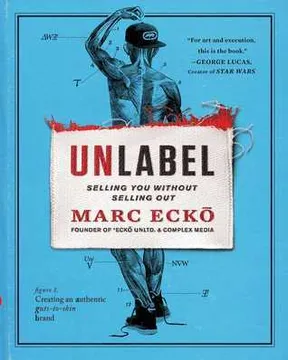


Key Takeaways
Build a reputation from your values, not from other people's labels.
A brand is more than a logo. Marc Eckō argues that everyone has a personal brand: the impression others carry away about how a person thinks, acts, and makes them feel. The challenge is to shape that impression from the inside out rather than accept categories imposed by critics, employers, or peers. His word for this refusal is Unlabel: reject a limiting identity and create work that expresses your own point of view.
Authenticity is ongoing work. Eckō offers a deliberately complicated Authenticity Formula, a way to examine voice, honesty, adaptability, emotional effect, and imagination, not a numerical test that can certify a person as genuine. His career shows how a creative identity can support a business without being reduced to a company logo or sales pitch.
The useful distinction is between being recognizable and becoming predictable. A personal brand can help others understand what someone contributes, much as a scientific model makes a complex system easier to discuss. But branding can also turn into self-surveillance, where every choice is made for its audience. The stronger interpretation is not to perform an identity more skillfully, but to make work whose pattern reflects durable values. That leaves room for contradiction and growth, qualities that a polished image often tries to conceal.
Find your voice by making things before you know where they lead.
A voice grows through practice. As a child, Eckō felt awkward and excluded. Drawing comic-book characters gave him a private craft; seeing graffiti-covered trains and the book Subway Art showed him that artists could combine influences and make public work. He practiced lettering and airbrushing long before he had a business plan or a clear career destination. A drawing of Michael Jackson even won praise from classmates who had previously laughed at him.
Start with the next step. Eckō's early ambition was not a billion-dollar company. It was figuring out what he could make with a spray can that day. His story treats a distinctive voice as a result of action, manageable risk, and a growing sense of self, rather than a hidden essence that appears fully formed.
This resembles the account of expertise built through repeated practice, but repetition alone is not magic. Skill also depends on feedback, deliberate correction, and access to materials or mentors. Eckō had a supportive family and a culturally mixed environment, advantages that helped his experiments take shape. The broader lesson is not that every beginner will follow his commercial trajectory. It is that small creative acts can produce evidence about interests and abilities before a person is ready to make a grand declaration about who they are.
Put your work in public, then let real buyers answer.
Belief needs a visible form. In seventh grade, Eckō won class president by covering school hallways with distinctive illustrated posters. Later, rather than simply claim that his airbrushed shirts might sell, he wore them, gave some away, and watched for responses. His first customer wanted a painted palm tree, a modest request that confirmed his early market hunch. He also arranged school fund-raisers and sold to local stores.
Choose the right judges. Eckō distinguishes gatekeepers, people who claim authority over taste, from goalkeepers, the people who actually choose, buy, or use the work. He mailed customized art and clothing to influential musicians, eventually earning a radio shout-out from DJ Red Alert. That attention opened a door, but it did not replace the work of developing a product people wanted.
This is a practical account of social proof and market discovery: visible work gives others something concrete to react to, while purchases reveal more than compliments do. Yet buyers are not the only legitimate audience. A market can reward familiarity and still overlook work that matters culturally or artistically. The useful test is to distinguish evidence of demand from a universal verdict on merit. Tailored outreach can create opportunity, but it works best when it offers genuine relevance rather than treating influential people as targets to be conquered.
Treat technical execution as part of the art, not its enemy.
A strong idea can print badly. Eckō's first production run used five thousand dollars of early investment, but the shirts looked muddy. He learned screen-printing from workers at a Brooklyn factory, then discovered that expert color separations could cost thousands of dollars. A fellow designer, Drew, taught him to use Photoshop to create the separations himself. The method cost about fifty dollars through a student newspaper, rather than the more than two thousand dollars a specialist would charge.
The customer sees the result. The improved shirt, Powerful Potion, sold about fifty thousand units in its first summer and eventually around 1.5 million. The breakthrough did not come from a louder advertisement. It came from acquiring a technical capability that made the original artwork look as intended. Later, Eckō also learned to build product lines around reliable core items, such as a fleece hoodie.
The episode makes innovation concrete: an artistic advantage became commercially meaningful only when production could reproduce it at a viable cost. In value-chain terms, design and operations are complements, not opposing departments. A beautiful prototype that cannot be manufactured consistently is not yet a dependable product. At the same time, the founder's personal mastery cannot scale indefinitely. The lasting advantage comes when hard-won craft knowledge becomes a repeatable process, so quality does not depend on one person's sleepless labor.
Never let brand theater outrun the business that must deliver it.
Promises create obligations. Eckō defines truthful branding through the match between what a company says and what it actually does. His company staged parties, bought conspicuous advertising, and expanded before its operations were ready. Sales orders of two million dollars one day and three million the next felt like proof of success, but orders were not the same as fulfilled shipments or profit. The company spent beyond its means, ran late on bills, and even asked employees to use personal credit cards.
Shortcuts magnified the risk. A manufacturing partnership with Wu promised scale, but delays, unexpected markups, and disputes over goods helped leave the company with six million dollars in debt. Legal and trademark troubles added cost and confusion. The lesson is not to avoid ambition. It is to count the capacity, cash, and obligations required to make each public promise real.
The account punctures a common startup mythology: visible growth is not the same as organizational health. Revenue, orders, cash flow, and profit answer different questions, and collapsing them into one success story makes risk hard to see. The deeper point is ethical as well as financial. When a company borrows credibility from employees, suppliers, and customers, it has obligations to those groups, not just to its own narrative. Ambition is valuable, but controls and truthful communication are what keep ambition from exporting its costs to others.
Change course when evidence contradicts the identity you want.
Adaptability requires humility. Eckō calls the ability to learn from failure the Capacity for Change. He links it to two things: being humble enough to absorb feedback, and knowing what one does not yet know. After joining fashion institutions and pursuing a more elevated image, he designed a futuristic collection that his buyers disliked. He initially dismissed their criticism, then revised the line before it became a larger commercial failure.
Do not confuse novelty with progress. Eckō also declined a proposed NFL partnership because it did not fit his self-image, then tried to build a separate sportswear label. That effort struggled. The contrast is instructive: sometimes a new direction is a genuine evolution, and sometimes it is a founder's projection. The response should be to investigate the mismatch, not to defend a preferred identity automatically.
This is close to the logic of scientific revision: a theory earns confidence by surviving contact with evidence, not by the force with which its author believes it. In business, however, customer feedback is noisy and can favor short-term familiarity over meaningful innovation. Humility should therefore mean disciplined inquiry, not automatic obedience to the loudest buyer. The practical question is what kind of evidence would change the decision, and whether the team can test the idea cheaply before committing heavily.
Make audiences feel something without sacrificing your own stability.
Attention can become an expensive drug. Eckō bought Barry Bonds's record-breaking home-run ball for $750,000 and let the public vote on its fate. About ten million people visited the voting site, and the ball eventually went to the Baseball Hall of Fame with an asterisk. The episode brought enormous attention to Eckō's public identity, but the company was also struggling with debt and a serious inventory mistake: it ordered one million units of a core item instead of ten thousand.
The maker is part of the equation. Eckō was chasing celebrity, working extreme hours, exercising dangerously, and neglecting ordinary business responsibilities. He describes the resulting anxiety and physical collapse as evidence that external impact has an internal cost. A campaign can succeed in making an audience feel something while damaging the person or organization responsible for it.
The story anticipates a central problem of the attention economy: attention is measurable, so organizations can mistake it for health. In the spirit of Goodhart's law, once visibility becomes the target, it can displace the less glamorous work that sustains a business. The ball campaign did create a meaningful public debate, so dismissing it as mere vanity would miss its cultural force. The more useful test is whether impact is paired with adequate capacity, and whether the people producing that impact can live with its cost.
Give up some control before debt forces you to give up everything.
Nostalgia can disguise a bad structure. By 2008, Eckō's company had expanded into more than one hundred stores, taken on heavy debt, and relied on credit secured by its assets and personal guarantees. The founders held tightly to ownership, treating equity as something to protect. But the old arrangement had become a trap, especially as sales slowed and the financial crisis tightened access to credit.
Preserve the core, not every old form. Eckō and his partner Seth restructured the company, accepting a deal in which Iconix acquired 51 percent of the trademarks in exchange for cash and a path away from immediate collapse. Eckō spun Complex into a separate venture. The moves meant relinquishing control, but they preserved the brand and its creative platform. Optionality, he argues, is responsible planning, not proof of disloyalty.
This is a lesson in resilience through redesign. Ownership can feel like freedom, but concentrated control also concentrates risk and can leave a company without the expertise or capital it needs. Distributing equity or separating businesses may protect an enterprise's ability to continue, though such choices require careful governance and clear protections for the mission. The crucial distinction is between preserving a particular ownership structure and preserving the work, relationships, and capabilities that made the organization worth saving.
Keep creating, but measure success by more than fame or sales.
Creation is the durable asset. Eckō began by tracing comic-book characters and drawing in a garage, not by planning a fashion empire. Across his career, creative work led into clothing, advertising, a magazine, and a video game. He argues that commercial success and artistic work need not cancel each other out, while also insisting that not every worthwhile creation must be sold.
The formula is a prompt, not a score. After chasing public recognition and institutional approval, Eckō concluded that fame, awards, and company size could not define his success for him. His formula organizes questions about identity, truth, adaptation, emotional effect, and imagination, but it cannot produce a fixed authenticity rating. The useful future is not a distant fantasy. It is the next decision that expresses a person's values and can be carried through honestly.
This ending shifts the focus from branding as persuasion to creativity as a source of agency. That move has affinities with intrinsic motivation research, which distinguishes the satisfaction of doing meaningful work from rewards such as status and money. Yet commercial responsibility still matters when other people depend on a venture. The strongest reading is not to reject metrics, but to keep them in their proper role: sales can test whether a product serves a market, while personal values determine whether that market is worth serving.
Analysis
Unlabel is both a creative philosophy and a business memoir, and its strongest contribution is showing that authenticity has operational consequences. Eckō does not present a smooth ascent from garage artist to celebrated founder. His narrative repeatedly moves from a vivid idea to a practical obstacle: poor printing, missing capital, weak forecasting, unreliable manufacturing, or a founder distracted by public attention. That structure makes the book more useful than a simple celebration of self-belief. The central tension is that a personal brand must be legible enough for other people to recognize, yet flexible enough not to become a costume its creator must keep wearing. Eckō's formula tries to hold both demands together. Its variables are not measurable in any rigorous mathematical sense, and the author acknowledges its satirical complexity. It works best as a diagnostic vocabulary, not a predictive model. One can ask whether a promise is being delivered, whether a new direction reflects genuine learning, and whether an audience's response is worth its cost. The memoir also complicates the familiar idea that authenticity means resisting commerce. Selling art can sustain further creation, but growth can make the enterprise less honest when promotion outruns fulfillment. Likewise, refusing dilution can feel principled until concentrated ownership turns into existential financial risk. The book's hardest lesson is therefore not simply to trust oneself. It is to distinguish conviction from attachment, and to revise the business without erasing the creative source. Its most persuasive image is not the successful logo or the viral stunt, but a founder learning that a brand is built through many small acts of making, delivering, listening, and correcting.
Review Summary
Unlabel receives generally positive reviews, averaging 4.04 out of 5. Readers praise Ecko's honesty about his business journey, his authenticity, and the blend of memoir with entrepreneurial lessons. Many appreciate his willingness to discuss failures alongside successes. Critics note the book leans more biographical than instructional, with some finding the pseudo-mathematical "Authenticity Formula" confusing or excessive. The hardcover edition receives particular praise for its quality artwork and stickers. It is most recommended for creatives, entrepreneurs, and those interested in personal branding.
Glossary
Authenticity Formula
A diagnostic for brand integrityEckō's intentionally nonliteral model for examining a personal brand through its distinctive voice, truthfulness, capacity to change, emotional effect, and imagination. The formula is not meant to calculate a definitive score. It organizes questions about whether a person's identity, public promises, actions, and creative direction are meaningfully aligned.
Unlabel
Refuse limiting identitiesEckō's term for resisting labels imposed by other people or institutions while actively creating an identity through one's work. It does not mean rejecting all categories or becoming defined by opposition. It means refusing to let a ready-made classification set the boundaries of what one can create or become.
Unique Voice
Distinctive personal expressionThe recognizable point of view that distinguishes a person or brand. In Eckō's framework, it develops through action, an ability to face fear, and a grounded sense of self. It is not merely a slogan or visual style. It becomes credible when the creator's work and experience support the expression.
Infinite Truth
Promises matched by actionsEckō's term for the ongoing relationship between what a person or company says and what it actually does. A brand makes promises through its products, marketing, and conduct; truthfulness depends on delivering them. Because people and organizations change, this alignment requires continual review rather than a one-time declaration.
Capacity for Change
Learn and adapt from failureThe ability to respond constructively to failure by learning, changing behavior, and revising plans. Eckō describes it through humility and knowledge, especially awareness of what one does not know. The concept is not about avoiding mistakes or celebrating failure for its own sake. It concerns how a person acts after evidence challenges an assumption.
Emotional Impact
How work makes people feelThe emotional response a product, service, campaign, or public action creates. Eckō argues that this response can matter as much as the object's technical features. He also applies the term inward: pursuing external impact affects the creator's own emotional and physical life, so those costs belong in the evaluation.
Range of Emotional Impact
Reach beyond one productThe breadth of settings, audiences, and experiences through which a brand can evoke a response. Eckō uses licensing, events, publishing, and video games as ways a clothing brand might extend its reach. Greater range is valuable only when new activities remain connected to the brand's underlying values and can be executed responsibly.
Brand Balance
Governance, force, and presentationEckō's model of a healthy business as a balance among governance, brute force, and swagger. Governance supplies order and oversight, brute force supplies the energy to execute, and swagger shapes how the organization presents itself. The model emphasizes that an organization becomes fragile when one of these functions is missing or dominates the others.
Delta of Now (N∇W)
Awareness of the presentEckō's notation for attentive awareness of current reality, including the business's actual condition and the creator's emotional state. He argues that nostalgia can obscure the present, while an imagined future can become escapism. Seeing the present clearly helps a person choose a next step grounded in available evidence.
Gatekeepers versus Goalkeepers
Critics versus actual decision-makersEckō's distinction between people who claim authority over access or taste and the people whose choices determine whether a product or idea succeeds with its intended audience. The contrast warns creators not to confuse critical approval with customer demand. It does not imply that critics are irrelevant or that sales alone determine cultural value.
C.H.I.L.L. G
A crisis-response checklistEckō's mnemonic for responding to crisis: calm down, identify a guiding source of direction, inspect the surroundings, listen for useful information, lay out a manageable plan, and act. It translates emergency-survival logic into business decisions, especially when panic makes it tempting to solve every problem at once.
Download PDF
Download EPUB
.epub digital book format is ideal for reading ebooks on phones, tablets, and e-readers.








