

Key Takeaways
Use the guide as a menu of possibilities, not a diagnosis
A practical index. Heshelow organizes the guide in two useful ways: by oil, such as lavender or peppermint, and by concern, such as sleep, headaches, or skin irritation. This lets beginners start with an oil they already own or look up an issue and compare options. The book ranges from everyday comfort to serious conditions, but its suggestions are not a substitute for diagnosing what is wrong or choosing medical treatment.
Start with the question. Ask what you want help with, then check the oil’s possible uses, method of application, and safety cautions. For a persistent, worsening, or serious problem, the guide itself advises seeking professional care rather than relying on an aromatherapy recipe.
The oil-first and symptom-first indexes solve different problems: one helps readers understand a product, while the other helps them find a possible use. That is a strong design for a reference book, especially when a reader is overwhelmed by dozens of bottles and claims. The important boundary is that a lookup table can suggest questions, not establish a cause or an effective treatment. This distinction matters most where symptoms overlap, such as a headache that might be related to tension, infection, or another medical issue.
Let inhalation lead, dilute skin use, and skip unsupervised ingestion
Three routes, different risks. The book describes inhalation, topical application, and ingestion as ways oils may enter the body. It favors inhalation as the quickest route, using a diffuser, personal inhaler, or a simple scent source. Topical use means mixing an oil into a carrier such as jojoba oil or cream before applying it to skin. The author advises against internal use without a licensed practitioner’s supervision, because concentrated oils can cause harm.
Match method to purpose. A diffuser can distribute aroma through a room; a diluted topical blend can be applied to a specific area. The book’s claim that inhalation is the fastest or most effective route is its general guidance, not a guarantee that it will relieve a particular condition. Avoid treating any route as a replacement for appropriate medical care.
Thinking in routes is a useful corrective to the idea that an essential oil is simply a harmless scent. The same substance can have different effects depending on concentration, exposure, and the person using it. Inhalation may also be the least complicated way to explore whether a scent feels pleasant or irritating. But the book’s broad preference for inhalation cannot settle which method works best for every purpose. The practical lesson is narrower: choose a route deliberately, and do not assume that natural origin makes ingestion or skin application safe.
Put safety before scent, especially around children, pets, and medications
Concentrated means caution. The guide advises storing oils out of children’s reach, keeping them away from eyes and flame, and patch testing before first use. It generally recommends dilution before skin application. It also flags particular concerns: citrus oils such as lemon and bergamot may make skin more sensitive to sunlight; clove may be a concern with blood-thinning medication; and pregnancy, asthma, epilepsy, and some other health conditions call for professional advice.
Pets need separate rules. The book warns that some oils can be toxic to cats and recommends not applying oils directly to them. If diffusing around a cat, it says the animal should be able to leave the room. For accidental ingestion, the book says to contact poison control immediately. These cautions take priority over any recipe or product suggestion.
The book’s strongest contribution may be its insistence that safe use begins before the bottle is opened. Its warnings make clear that exposure is not just a matter of personal preference: children may ingest oils, animals have different sensitivities, and medications or health conditions can change the risk. Still, the cautions are unevenly distributed across the guide, and a short list cannot cover every product or person. Readers should treat patch testing and dilution as minimum precautions, not proof of safety, and consult a qualified clinician or veterinarian when relevant.
A six-oil kit covers more daily needs than an oversized collection
Start with the basics. The book’s basic home kit contains lavender, peppermint, eucalyptus, clary sage, lemon, and frankincense. It presents these as versatile choices: lavender for relaxation and sleep routines, peppermint for nausea or a cooling sensation, eucalyptus for a fresh respiratory aroma, and frankincense for calm or skin-care blends. Lemon also appears in household recipes. The point is not that every oil suits everyone, but that a small set can serve as a starting reference.
Learn one bottle at a time. Keep each oil’s intended uses and cautions with it, and resist buying more simply because a guide lists more options. The author offers a larger kit as well, adding cedarwood, cinnamon, star anise, and a premixed blend. More variety is useful only if the user can store, identify, and handle it safely.
A limited kit reduces both decision fatigue and the chance that unfamiliar products will be used casually. It also makes it easier to notice whether a scent is pleasant, irritating, or simply unhelpful for a particular person. The book’s six-oil selection is a convenient organizing choice, not a universally necessary inventory. In particular, a beginner should not interpret inclusion in a starter set as a recommendation to use each oil for every listed purpose. Familiarity with handling and risk is more valuable than breadth.
Use scent as a mood cue, not a substitute for mental-health care
Scent and association. The book connects aroma with memory, emotion, and bodily responses, describing the limbic system as a brain network involved in emotion and memory. Its examples are familiar: a smell can recall a place, person, or event. Heshelow suggests lavender for calming routines, frankincense for quiet focus, rosemary for alertness, and bergamot or rose geranium for uplift. Diffusion, an inhaler, or scented jewelry are offered as ways to experience a chosen aroma.
Make it personal. A scent that one person finds soothing may be unpleasant to another. The guide’s suggestions work best as low-stakes experiments in comfort or routine, not as established treatment for depression, anxiety, or insomnia. If distress is persistent or severe, aromatherapy should not delay professional support.
Aroma can function as a cue: a repeated scent may become associated with a bedtime routine, a pause, or a familiar place. That makes the guide’s emphasis on enjoyable smells more persuasive than its more sweeping claims about changing body systems. Personal preference is central, since an unwanted scent can create discomfort rather than calm. The limit is equally important: a pleasant ritual may support well-being, but it cannot be assumed to treat a mental-health condition. The book’s emotional applications are most responsible when framed as supportive practices.
Track headache triggers before selecting a fragrance-based response
Headaches are not one problem. The book distinguishes tension, sinus, migraine, allergy-related, hormonal, and other headaches, then offers different oils to consider. For example, it suggests eucalyptus aroma for sinus-related discomfort and peppermint or lavender in a cool compress for general tension. It also recommends keeping a diary to look for patterns in food, drink, environment, or timing, and sharing useful observations with a doctor.
Use the pattern, not a guess. The guide’s many options are a reminder that the label headache covers different experiences. Its recipes should not obscure warning signs or replace assessment when pain is severe, recurring, worsening, or unusual for the person. A fragrance may offer comfort, but the book does not establish that it addresses the underlying cause.
The diary advice is more durable than any single oil recommendation. Recording when symptoms occur and what preceded them can turn a vague complaint into information that supports a useful conversation with a clinician. It also guards against trying a new scent for every episode and then mistaking coincidence for effect. The book’s symptom categories help readers think more precisely, but they are not a diagnostic tool. A familiar pattern may still have a medical explanation that an aromatherapy guide cannot evaluate.
Use oils to freshen rooms, while keeping cleaning claims modest
Aroma has household uses. The guide moves beyond personal wellness: it suggests lemon in a homemade surface-cleaning mixture, tea tree on a cloth for damp areas, lavender to freshen laundry, and cedarwood or peppermint as possible pest deterrents. It also offers a baking-soda method for refreshing a mattress. These uses make the book a practical home reference as well as an aromatherapy introduction.
Fresh scent is not proof. The book often links oils with antibacterial or antifungal activity, but a pleasant smell or a household recipe does not establish that a surface has been disinfected. Use cleaning products suited to the job, follow their instructions, and avoid treating essential oils as guaranteed pest control. Keep citrus oils away from skin exposed to sunlight, as the book warns.
The household applications are appealing because they give oils a concrete role without requiring a medical claim. Yet the distinction between deodorizing, cleaning, and disinfecting is easy to blur. A surface can smell fresh without being reliably sanitized, and a scent that people enjoy may not repel pests in a dependable way. Clear labels for each goal help preserve the useful part of the advice: an oil can contribute aroma or serve as one ingredient in a cleaning routine, while effective hygiene still depends on appropriate methods.
Treat antimicrobial studies as clues, not proof of treating infection
The book’s boldest claims. Heshelow argues that the many chemical constituents in essential oils help explain their range of effects. She recounts laboratory demonstrations in which diffused oils were associated with declines in microbial colonies, and a reported case in which tea tree and eucalyptus were used on a serious MRSA wound. Such examples convey why she sees oils as promising, particularly amid concern about antibiotic resistance.
Evidence has levels. A laboratory result does not show that inhaling or applying an oil safely treats an infection in a person. A single clinical story cannot establish reliable benefit for others. The guide’s studies and anecdotes may prompt further questions, but they do not justify replacing antibiotics, medical evaluation, or other indicated treatment with essential oils.
The argument is strongest when chemical complexity is treated as a reason to investigate, not as evidence that an oil is a proven therapy. Antimicrobial activity in a dish, a reported patient outcome, and a controlled clinical result answer different questions. Moving between them without marking the difference can make a promising laboratory observation sound like a dependable treatment. The book’s antibiotic-resistance concern is serious, but that urgency makes careful evidence standards more important, not less. Readers should preserve curiosity while keeping treatment decisions with qualified medical professionals.
Analysis
This book is best understood as an entry-level field guide, not a clinical aromatherapy manual or a systematic review. Its organizing idea is practical matching: look up a familiar oil, or begin with a concern and browse possible options. That structure, the concise descriptions of commonly used oils, and the reminders about dilution and vulnerable users give beginners an accessible way to orient themselves. The guide’s household recipes and suggestions for inhalers, diffusers, and topical products broaden its usefulness beyond symptom lists.
Its main weakness is the uneven distance between a proposed mechanism and a treatment claim. Explanations involving a plant’s chemical constituents, the limbic system, antimicrobial activity, or inflammation can sound persuasive, but they do not by themselves establish that a particular application safely improves a clinical outcome. The book refers to studies and case reports without consistently distinguishing laboratory findings, small studies, and evidence from routine patient care. The reader therefore has to supply an evidence filter that the guide itself does not systematically provide.
There is also a tension between the book’s reassuring language about natural products and its extensive warnings about toxicity, skin irritation, photosensitivity, medication interactions, pregnancy, and pets. The warnings are the more actionable message: concentrated oils are biologically active, and their risks depend on the oil, route, dose, and user. The book’s advice not to ingest oils without professional supervision is especially important. Its claims about infections, cancer, fever, urinary problems, and other serious conditions should not be used to postpone diagnosis or established care.
Finally, the author promotes products and blends from her own company, alongside general recommendations. That commercial context does not invalidate every suggestion, but it makes independent evaluation worthwhile. The lasting value here is a vocabulary for exploring aroma, a useful index of possible applications, and a set of safety prompts. The guide is most helpful when read as a source of questions and low-stakes ideas, not as proof that essential oils cure disease.
Review Summary
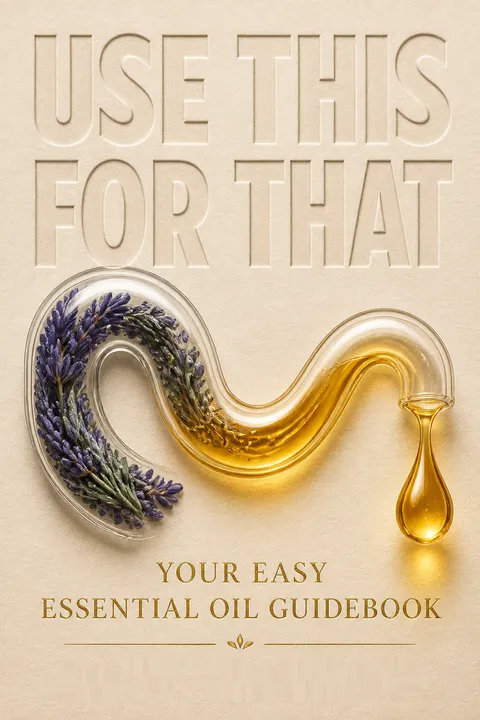
USE THIS FOR THAT is highly praised as an informative and helpful guide for essential oil beginners. Readers appreciate its concise format, detailed instructions, and wide range of oil uses. Many find it an excellent reference book for natural remedies. Some reviewers note conflicting information with other sources and editing errors. Overall, the book is well-received for its accessibility and practical advice, though a few readers desire more in-depth explanations on application methods. The majority of reviewers recommend it as a valuable resource for those new to essential oils.
Glossary
Essential oils
Concentrated plant aromasThe book defines essential oils as concentrated aromatic extracts from plant materials such as flowers, leaves, bark, roots, or peels. It says they are commonly produced by steam distillation or cold pressing and contain multiple chemical constituents. Their concentrated nature is central to the guide’s advice about dilution, exposure, and safe storage.
carrier oils
Bases for topical dilutionCarrier oils are oils, creams, or similar bases used to dilute essential oils before applying them to the skin. The guide describes them as helping make concentrated oils easier to apply and names jojoba, coconut, almond, and avocado oils among its options. The carrier itself may also affect the feel and suitability of a blend.
neat
Undiluted skin applicationIn the book, using an essential oil neat means applying it directly to the skin without first mixing it into a carrier. The guide cautions against this as a general practice because concentrated oils may irritate or burn skin. It names a few exceptions, but readers should not assume those exceptions are safe for every person or use.
patch test
Small-area reaction checkA patch test is a cautious first check before using an oil or blend on a larger area of skin. The guide recommends applying a small amount to a limited skin area and watching for a reaction, especially for people with sensitive skin or health concerns. A successful test cannot guarantee that repeated or broader use will be safe.
bioavailability
Amount used by the bodyThe guide uses bioavailability to mean the amount of an essential oil that enters the body and is used. It compares inhalation and topical application, while noting that absorption varies among people. The term is used to explain why the author favors inhalation for speed, though the book does not establish that this is best for every intended use.
limbic system
Emotion and memory networkThe book describes the limbic system as a brain network involved in emotion, memory, motivation, and other bodily functions. It uses this concept to explain why smells may be linked to memories or emotional responses. That connection helps explain aroma’s subjective impact, but it does not by itself prove that a scent treats a medical or psychological condition.
Home Pharmacy
Small household oil collectionThe Home Pharmacy is the book’s suggested collection of essential oils for common household uses. Its basic version includes lavender, peppermint, eucalyptus, clary sage, lemon, and frankincense; a larger version adds other oils and a premixed blend. It is a practical starter-kit idea, not a substitute for medicines or professional medical advice.
Download PDF
Download EPUB
.epub digital book format is ideal for reading ebooks on phones, tablets, and e-readers.








