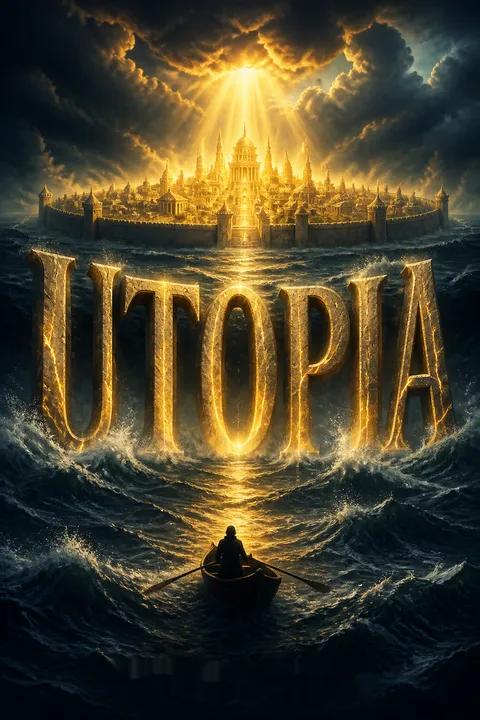


Plot Summary
Antwerp's Portuguese Witness
More1 has come to Flanders on an English diplomatic mission, accompanied by Cuthbert Tunstal. While negotiations pause, More1 spends time in Antwerp with Peter Giles,3 a learned local official who introduces him to Raphael Hythloday,2 a Portuguese traveler. Raphael2 sailed on three voyages with Amerigo Vespucci, chose to remain in the newly encountered lands, and eventually found his way back to Europe after years of wandering.
His reports concern not marvels but the laws and customs of distant peoples. Giles3 expects this knowledge to interest More,1 and Raphael's2 account soon redirects their meeting from travel stories toward a harder question: whether a thoughtful person can improve a government without being absorbed by it.
The frame makes political argument depend on a traveler whose authority comes from having lived outside European assumptions. Yet Raphael is not a neutral window: his name suggests a teller whose wisdom may be mixed with invention, and the book never supplies independent confirmation of his report. More and Giles give the account a social setting, while Raphael's personal history establishes both his curiosity and his distance from home. The reader is invited to treat the imagined polity as evidence, but also to notice that all its evidence arrives through one eloquent, self-assured witness.
Sheep Make Thieves
When Giles3 suggests that Raphael2 could advise a prince, Raphael2 recalls a dinner at Cardinal John Morton's4 English household. A lawyer there7 praises the rapid execution of thieves, so Raphael2 traces theft instead to the conditions that leave people with no lawful way to survive.
Landowners turn ploughed fields into sheep pasture, evicting families and shrinking the demand for farm labor; nobles also dismiss idle retainers when their households contract. War maims workers, while luxury and gambling drain wages.
Raphael2 argues that hanging cannot cure a poverty produced by public policy, and that making theft punishable by death may encourage robbers to kill witnesses. He proposes restitution and compulsory public labor instead. Morton4 entertains the proposal, and guests who dismissed it begin praising it once they see the Cardinal4 approve.
Raphael shifts the question of crime from individual wickedness to the institutions that manufacture desperation. The sheep enclosure argument is pointed because it makes economic change physically visible: inhabited land becomes pasture, and displaced people become punishable outsiders. His criticism also links excessive punishment to perverse incentives, anticipating a modern distinction between deterrence and incapacitation. Yet the dinner demonstrates that reason alone does not move power. The guests adopt an idea only after Morton signals its acceptability, turning the scene into a miniature study of how status can determine which arguments count as sensible.
The Philosopher's Bad Seat
Raphael's2 account of the dinner continues with a fool8 whose jokes expose a friar's anger and the company’s readiness to flatter Morton.4 More1 hears in the story proof that Raphael's2 counsel could matter if he entered a ruler's service. Raphael2 refuses that hope.
He imagines advising a French court whose ministers plan territorial conquests, manipulate treaties, and raise revenue through deceptive laws. More1 argues that a counselor should adapt his advice to the room and reduce harm where he cannot abolish it.
Raphael2 sees a harsher choice: court service demands approval of bad policy, and silence can look like complicity. He then identifies private property and money as the deeper sources of unjust distribution. More1 doubts that people can work cooperatively without ownership, but asks Raphael2 to describe Utopia in detail.
This argument supplies the book's central tension between moral purity and political intervention. More's position is practical rather than complacent: he treats partial improvement as a duty when complete reform is impossible. Raphael fears that compromise changes the reformer before it changes the court, a concern sharpened by the dinner guests' deference to Morton. Their disagreement is not resolved by the utopian account that follows. Instead, the island becomes a test case for competing judgments about human motivation: whether institutions can educate people into cooperation, or whether cooperation depends on incentives that private ownership supplies.
Utopus Cuts an Island
Raphael2 describes Utopia as a crescent-shaped island with a guarded harbor and fifty-four cities whose customs and laws closely resemble one another. It was once joined to the mainland, until the conqueror Utopus5 ordered a channel cut through the land, making its geography serve its political separation.
He also reorganized the conquered inhabitants into a more disciplined society. Each city manages surrounding farmland through rotating groups of residents, so urban citizens learn agriculture rather than leaving food production to a permanent rural class.
Amaurot, near the island's center, hosts representatives from every city, who meet yearly to settle common affairs. The design joins unity with local administration: the towns remain distinct, but shared institutions prevent any one from treating the island's resources as its private possession.
Utopia's founding story complicates the apparent harmony of its later institutions. Its geography is deliberately engineered, and its social order begins with conquest, not voluntary agreement among equals. The channel protects the community from invasion, but it also separates it from outside influence. Agricultural rotation similarly turns a practical necessity into civic education, ensuring that citizens understand the work that sustains them. The arrangement imagines solidarity as something built through common labor and repeated participation. At the same time, its origin raises an unresolved question: whether an egalitarian society can be founded without coercion.
Six Hours for Everyone
In Amaurot, public life is governed through elected magistrates, a lifelong prince who can be removed for threatening liberty, and councils that delay major decisions so members can reconsider them.
Raphael2 emphasizes that Utopians6 do not spend their days in exhausting toil: citizens work six hours, learn a trade, and use remaining time for study or other worthwhile pursuits. Agriculture is taught to everyone, and residents move between town and country so that farming knowledge remains widespread. Magistrates are expected to work rather than claim idleness as a privilege.
The system also directs unusually gifted citizens toward scholarship and public service. Since unnecessary occupations and ornamental consumption are minimized, Raphael2 argues, a short working day can still produce abundance without assigning one class to labor for another.
The six-hour day is not presented as a miracle of individual efficiency. It follows from a decision about what counts as useful work and who is permitted to avoid it. By making magistrates labor and giving citizens broad education, Utopia tries to prevent political authority from becoming a separate, self-serving profession. Rotation between countryside and town also resists the social invisibility of food production. Still, the system's confidence rests on extensive coordination: the state decides which work is necessary and how people should spend their free time. Its freedom from overwork therefore depends on a strong collective power to organize life.
Gold Becomes a Disgrace
Utopians6 collect goods in public markets and take what their households need without payment; regular shared meals and public hospitals make the distribution visible in daily life. Because people trust that necessities will remain available, Raphael2 says, they have little reason to hoard.
The island still accumulates gold and silver through overseas trade, but reserves them for emergencies and war rather than private display. To weaken their prestige, Utopians6 make chamber pots and slave chains from the metals.
When wealthy Anemolian ambassadors arrive dressed in gold and jewels, local children mistake their finery for childish ornaments, and the visitors lose their confidence once they understand the custom. Raphael2 uses their embarrassment to show how status symbols depend on collective agreement.
The scene with the ambassadors turns an abstract economic claim into social comedy. Gold has not lost its material properties; its power to command admiration has been deliberately dismantled through shared custom. That inversion exposes how wealth often works as a public signal rather than a direct source of well-being. The communal markets and hospitals give the principle a practical base: security is organized through access, not accumulated individual reserves. Yet the image of gold on slaves also reveals a contradiction. Utopians can ridicule luxury among the powerful while using the same metal to mark people whom their society has placed under coercive control.
Marriage Under Inspection
Utopian law reaches into family life as firmly as it governs public labor. Before marriage, each prospective spouse is shown to the other without clothing, a custom meant to prevent physical deception in a lifelong commitment.
Adultery brings enslavement, while divorce is restricted to serious misconduct or carefully examined mutual consent. Slavery also serves as the usual punishment for major crimes; some condemned people from abroad are bought out of execution, while Utopian6 offenders are treated especially harshly.
Raphael2 reports that incurably ill people may be encouraged by priests and magistrates to choose a voluntary death, but no one is forced to do so. The society uses few written laws and has no professional lawyers, expecting citizens to present their own cases plainly before judges.
Utopia's egalitarian promise does not mean an expansive realm of personal autonomy. Marriage, sexuality, punishment, and even the choice to die are governed by institutions that claim to know what sustains the common good. The pre-marital inspection is framed as practical fairness, but it makes bodily privacy subordinate to collective norms. Slavery is the sharpest fracture in Raphael's portrait: a society that rejects private ownership can still own people through law. The contrast invites readers to distinguish equal access to goods from equal freedom, and to question whose suffering the system considers acceptable in order to preserve order.
War Without Glory
Raphael2 says Utopians6 regard war as shameful, yet they train men and women to fight and intervene when they or their allies face serious injury. Their preferred victories come through negotiation, strategic bribery, or division within an enemy's leadership, including rewards for capturing or killing rulers.
They hire foreign mercenaries, especially the fierce Zapolets, and spend treasure more readily than they risk Utopian6 lives. When their own citizens must fight, they use disciplined formations and try to capture rather than kill defeated opponents.
They avoid plundering surrendered towns and seek compensation from the defeated state. Their distrust of treaties follows from neighboring rulers' habit of exploiting ambiguous wording. The result is a polity that condemns martial glory while practicing calculated, sometimes ruthless, forms of war.
The military account refuses an easy opposition between peaceful ideals and violent reality. Utopians do not celebrate battle, but they treat force as an instrument that can be managed through money, intelligence, and psychological pressure. Their willingness to spend foreign lives to protect their own citizens gives this prudence a disturbing edge. The policy may reduce casualties at home, yet it exports danger to people already described as poor and violent. Raphael's report therefore tests the moral limits of utilitarian reasoning: minimizing one's own losses is not the same as minimizing suffering overall.
More Leaves Doubting
Utopians6 practice several religions, though many worship one supreme creator, and their law protects people from punishment for belief. Raphael2 recounts that some inhabitants embraced Christianity after hearing about Christ and his followers.
One new convert was banished, not for changing faith, but for publicly denouncing other worshippers and provoking disorder. Utopus5 had made religious liberty a founding rule after seeing how religious divisions weakened the island before his conquest. Raphael2 ends by praising Utopia as a society where common ownership removes poverty and much of the conflict produced by money.
More,1 however, recalls features that trouble him, especially the island's warfare, religious doctrines, and abolition of private property. He admires some institutions but cannot promise that their arrangement could be adopted elsewhere.
Religious toleration appears as both an ethical commitment and a technology of political stability. Utopus permits persuasion but punishes agitation that threatens civic peace, so freedom has a boundary defined by public order. The Christian episode links spiritual appeal to communal property, without making the island simply Christian or resolving the difference between its beliefs and Europe's. More's closing reserve preserves the work's double vision: Raphael's account is persuasive enough to unsettle familiar institutions, but strange or troubling enough to resist straightforward endorsement. The ending leaves reform as a question rather than a program, asking readers to judge both their society and the imagined alternative.
Analysis
Utopia turns political criticism into a problem of comparison. Raphael's2 description makes familiar European practices look newly chosen rather than inevitable: hanging thieves, enclosing farmland, rewarding idle privilege, and treating money as a measure of worth all become decisions with identifiable beneficiaries and victims. The island's counter-institutions are deliberately concrete. Shared stores answer fear of scarcity, short working hours depend on eliminating useless labor, and political rotation tries to keep office from hardening into a private possession.
The book does not let those arrangements stand as a clean solution. Utopus5 establishes the order through conquest and forced labor. Slavery persists as punishment and as a tool of ordinary life. The society regulates marriage, travel, work, and acceptable religious conduct, while its military strategy shifts danger onto paid outsiders. These tensions matter because they reveal that equality in material provision does not automatically produce freedom from coercion. Utopia reduces some forms of domination by organizing resources collectively, yet preserves others through state authority.
The frame makes that contradiction part of the reading experience. Raphael2 treats his eyewitness account as evidence that human beings can live differently; More1 responds with both admiration and skepticism. Their dispute over serving rulers distinguishes reform from complicity without resolving whether withdrawal is morally cleaner than imperfect influence. The book's irony also keeps certainty at a distance: a narrator named for speaking of trifles describes a place called nowhere, but its critique of poverty and political self-interest is sharply directed at the real world.
The lasting question is not simply whether Utopia could be copied. It is what current institutions teach people to desire, and which kinds of inequality they disguise as natural. More's1 closing uncertainty prevents the imagined commonwealth from becoming a blueprint. Instead, the island acts as a measuring instrument, exposing the costs of existing arrangements while making the costs of reform visible too.
Review Summary
Utopia presents Thomas More's vision of an ideal society, sparking debate on its practicality and intended message. Readers appreciate its historical significance and thought-provoking ideas, while acknowledging its flaws from a modern perspective. The book's influence on political philosophy and literature is widely recognized. Some find it a challenging read, others see it as satirical. More's imagining of a communal society without private property is seen as both revolutionary and problematic, reflecting the complexities of human nature and societal organization.
People Also Read




Characters
Thomas More
The skeptical listenerMore is an English diplomat, narrator, and participant in the conversations that frame Raphael's2 account. He is intellectually curious but wary of advice that cannot survive contact with political realities. His argument for adapting counsel to circumstance suggests a temperament drawn toward practical compromise, while his questions keep Raphael's2 ideal society from becoming an unquestioned authority. More listens closely, asks for a full account of Utopia, and gives the reader a way to examine the distance between political ideals and institutions people might actually accept. His role is less to settle the debate than to make its competing claims audible.
Raphael Hythloday
The traveling criticRaphael is a Portuguese traveler who has seen distant societies and spent five years in Utopia. He prizes independence over wealth or a court appointment, believing that rulers and their advisers are often too invested in conquest and self-interest to welcome honest counsel. His travels make him an observant critic of European punishment, poverty, and political vanity. He speaks with the confidence of someone who has witnessed an alternative, but that confidence also invites scrutiny: his account is filtered through his own judgments, and his proposed society contains troubling compromises. Raphael's tension lies in wanting public life to become just while refusing the roles through which he might try to change it.
Peter Giles
The welcoming mediatorGiles is a courteous Antwerp official and scholar who befriends More1 during the diplomatic mission. He introduces More1 to Raphael2 because he recognizes that Raphael's2 knowledge of unfamiliar peoples will interest him. Giles also presses Raphael2 to consider serving a ruler, giving the debate over political usefulness its first practical shape. His role is that of a bridge: he brings the travelers and the argument together, while his sociability contrasts with Raphael's2 guarded independence.
Cardinal John Morton
The discerning statesmanMorton is an influential English churchman and statesman remembered by More1 and described by Raphael2 as a shrewd judge of character. At a dinner in his household, he allows discussion to range beyond conventional praise of harsh punishment and gives Raphael's2 alternative a hearing. His approval changes how the other guests respond, showing that he understands both policy and the social machinery through which policy gains acceptance. Morton represents a rare possibility in Raphael's2 critique: a powerful listener capable of considering an unfamiliar proposal.
Utopus
The island's founderUtopus is the conqueror who gives the island its name and remakes its institutions. He orders a channel cut to separate it from the mainland and establishes rules intended to prevent religious conflict. His legacy combines civic design with forceful political authority, making him central to the question of whether a just society can emerge from conquest.
The Utopians
A designed commonwealthThe Utopians are the inhabitants whose shared customs Raphael2 presents as an alternative to European inequality. They work, learn, worship, and distribute necessities through institutions designed to limit private accumulation. Their habits suggest that people can be shaped by the rules around them, rather than driven only by competition. Yet their society also imposes strict controls and relies on slavery, so they are not a simple portrait of universal freedom. They function as both a people in Raphael's2 account and a test of the assumptions More's1 audience brings to politics.
The English lawyer
The punitive traditionalistAn unnamed lawyer at Morton's4 dinner praises the execution of thieves as evidence of effective justice. His confidence gives Raphael2 the opening to argue that poverty and dispossession create the crimes the law then punishes.
The Cardinal's fool
The court's sharp observerThe unnamed fool at Morton's4 dinner provokes a friar with jokes about idleness and religious privilege. His exchange exposes how quickly moral authority gives way to anger when satire touches a favored institution.
Plot Devices
The Antwerp frame
Sets argument in motionThe diplomatic mission, More's1 friendship with Giles3, and their encounter with Raphael2 give the book a social frame for its political debate. Rather than present Utopia as an impersonal treatise, the frame makes its institutions the subject of a conversation among people with different assumptions. More's1 questions and reservations remain present around Raphael's2 long report, reminding readers that the account is being received and judged as it is told.
Raphael's travel testimony
Makes comparison possibleRaphael's2 journeys allow him to compare European customs with laws he claims to have witnessed elsewhere. His experiences support the discussions of theft, kingship, and Utopian6 institutions, giving abstract political arguments concrete examples. The device also creates uncertainty: the reader encounters these societies through a single narrator whose judgments are forceful but not independently verified.
The island's engineered boundary
Makes separation physicalUtopus's5 channel transforms a peninsula into an island and gives the commonwealth a defensible edge. The act makes political independence visible in the landscape, while the island's guarded harbor reinforces its separation from neighboring powers. Because this geography is deliberately created after conquest, it also links the security of the ideal society to its founder's5 authority and capacity to command labor.
Gold as a shameful object
Reverses social prestigeUtopians6 deliberately assign gold and silver to objects associated with waste and slavery, while reserving the metals for external trade and emergencies. The arrival of richly dressed Anemolian ambassadors dramatizes the reversal: what the visitors intend as a display of superiority appears childish or degrading to their hosts. The custom demonstrates how social value can be taught and changed, rather than treated as an inherent property of wealth.
The competing speakers
Keeps judgment unsettledMore1 and Raphael2 disagree about whether a counselor should adapt to imperfect rulers or refuse participation in compromised courts. Their debate frames the Utopian description as a challenge rather than a settled prescription. More's1 final hesitation preserves the gap between recognizing injustice and knowing how to replace it, leaving readers to assess both the island's achievements and its costs.
FAQ
Synopsis & Basic Details
What is Utopia about?
- Ideal society exploration: Utopia presents a fictional island society with a radically different social, political, and economic structure than 16th-century Europe, prompting readers to consider alternative ways of organizing society.
- Critique of European norms: Through the eyes of Raphael Hythloday, the book critiques European practices, such as private property, excessive wealth, and unjust laws, by contrasting them with the seemingly perfect society of Utopia.
- Philosophical debate: The narrative is framed as a dialogue between Thomas More, Peter Giles, and Raphael Hythloday, exploring themes of justice, equality, and the nature of a good society, without necessarily endorsing all aspects of Utopia.
Why should I read Utopia?
- Thought-provoking social commentary: Utopia offers a timeless critique of societal norms, prompting readers to question the status quo and consider alternative ways of organizing society, making it relevant even today.
- Exploration of philosophical ideals: The book delves into complex philosophical concepts, such as the nature of justice, equality, and happiness, encouraging readers to engage in deep reflection on these fundamental questions.
- Unique literary experience: Thomas More's blend of fiction, satire, and philosophical discourse creates a unique and engaging reading experience, offering both intellectual stimulation and entertainment.
What is the background of Utopia?
- 16th-century European context: Utopia was written during a time of significant social and political upheaval in Europe, marked by the rise of nation-states, religious conflicts, and economic inequality, which More critiques through the lens of Utopia.
- Exploration and discovery: The book is influenced by the Age of Exploration, with Raphael Hythloday's travels to the New World mirroring the real-life voyages of explorers like Amerigo Vespucci, providing a backdrop for the discovery of Utopia.
- Humanist ideals: More's work reflects the humanist ideals of the Renaissance, emphasizing reason, human potential, and the importance of civic virtue, which are central to the design of the Utopian society.
What are the most memorable quotes in Utopia?
- "For as long as private property exists, there is no hope of a cure.": This quote encapsulates the core of Utopia's social structure, highlighting the belief that private property is the root of societal ills and inequality.
- "They detest war as a very brutal thing.": This quote reveals the Utopians' pacifist stance and their belief that war is a sign of human failure, contrasting with the militaristic tendencies of European nations.
- "They think it is an evidence of true wisdom for a man to pursue his own advantage as far as the laws allow it.": This quote underscores the Utopian philosophy of balancing individual needs with the common good, emphasizing the importance of reason and law in achieving a harmonious society.
What writing style, narrative choices, and literary techniques does Thomas More use?
- Dialogue-driven narrative: More employs a dialogue-driven narrative, using conversations between characters to explore complex ideas and present different perspectives on Utopia, engaging the reader in a philosophical debate.
- Satirical and ironic tone: The book uses satire and irony to critique European society, highlighting its flaws and absurdities through the contrast with the seemingly perfect Utopian society, prompting critical reflection.
- Detailed descriptions and world-building: More provides extensive descriptions of Utopian society, including its cities, customs, and laws, creating a vivid and immersive world that allows readers to fully engage with his social and political vision.
Hidden Details & Subtle Connections
What are some minor details that add significant meaning?
- Gold as chamber pots: The Utopians' use of gold for chamber pots and chains for slaves is a powerful symbol of their disdain for wealth and material possessions, highlighting their focus on intrinsic value over monetary worth.
- Uniform clothing: The Utopians' uniform clothing, with minimal distinction between individuals, emphasizes their commitment to equality and the rejection of social hierarchies based on appearance or status.
- Shifting houses by lot: The practice of shifting houses every ten years by lot underscores the Utopian rejection of private property and their emphasis on communal living, preventing the development of personal attachment to material possessions.
What are some subtle foreshadowing and callbacks?
- Hythloday's reluctance to serve: Raphael Hythloday's initial refusal to serve a king foreshadows the inherent conflict between his Utopian ideals and the realities of European politics, highlighting the impracticality of implementing such ideas in existing power structures.
- Cardinal Morton's anecdote: The story of Cardinal Morton's dinner conversation about thieves and the proposed solutions foreshadows the Utopian approach to crime and punishment, emphasizing rehabilitation over retribution.
- The Anemolian ambassadors: The Anemolian ambassadors' ostentatious display of wealth and their subsequent embarrassment when confronted with the Utopians' disdain for it serves as a callback to the book's critique of European values and the pursuit of material possessions.
What are some unexpected character connections?
- Utopus and More's ideals: While Utopus is a legendary figure, his actions in creating Utopia mirror More's own desire for a just and equitable society, suggesting a connection between the fictional founder and the author's own aspirations.
- Hythloday and the reader: Hythloday's role as a narrator and critic of European society connects him to the reader, inviting them to question their own values and consider the possibility of a better world.
- The Fool and social commentary: The Fool's seemingly random jests and observations often contain sharp social commentary, revealing a connection between the seemingly frivolous character and the book's deeper themes of justice and equality.
Who are the most significant supporting characters?
- Peter Giles: Peter Giles serves as a bridge between More and Hythloday, facilitating the dialogue and representing the open-minded intellectual who is eager to learn about new ideas, making him a crucial figure in the narrative.
- Cardinal Morton: Cardinal Morton, though not a major character, represents the voice of reason and reform within the European context, providing a counterpoint to the more extreme views of Hythloday and foreshadowing some of the Utopian ideals.
- The Utopian priests: The Utopian priests, with their emphasis on moral guidance and social responsibility, represent the ideal religious leaders, highlighting the importance of ethical conduct and community service in a just society.
Psychological, Emotional, & Relational Analysis
What are some unspoken motivations of the characters?
- More's internal conflict: Thomas More's skepticism towards Utopia, despite his admiration for its ideals, reveals an internal conflict between his desire for social reform and his awareness of the practical challenges of implementing such radical changes.
- Hythloday's disillusionment: Raphael Hythloday's refusal to serve a king stems from a deep disillusionment with European politics and a desire to remain true to his Utopian ideals, suggesting a personal struggle with the compromises of power.
- Giles' intellectual curiosity: Peter Giles' eagerness to engage with Hythloday's ideas reveals a deep intellectual curiosity and a desire to explore alternative perspectives, suggesting a personal quest for knowledge and understanding.
What psychological complexities do the characters exhibit?
- More's skepticism and idealism: Thomas More exhibits a complex mix of skepticism and idealism, admiring the Utopian society while also recognizing its impracticalities, reflecting a nuanced understanding of human nature and the challenges of social reform.
- Hythloday's idealism and frustration: Raphael Hythloday's unwavering belief in Utopian ideals is coupled with a deep frustration with the corruption and injustice of European society, revealing a complex psychological state driven by both hope and despair.
- The Utopians' collective mindset: The Utopians' collective mindset, with their emphasis on communal living and social harmony, reveals a psychological state that prioritizes the well-being of the group over individual desires, highlighting the power of social conditioning.
What are the major emotional turning points?
- Hythloday's description of Utopia: Raphael Hythloday's detailed description of Utopia evokes a sense of wonder and possibility, prompting a shift in the reader's perspective and challenging their assumptions about the nature of a good society.
- The Anemolian ambassadors' shame: The Anemolian ambassadors' embarrassment at their ostentatious display of wealth marks a turning point in the narrative, highlighting the Utopians' rejection of material values and prompting a reevaluation of European priorities.
- More's final reservations: Thomas More's final reservations about Utopia, despite his admiration for its ideals, create a sense of ambiguity and complexity, leaving the reader to grapple with the challenges of implementing such a radical vision.
How do relationship dynamics evolve?
- More and Hythloday's intellectual sparring: The relationship between More and Hythloday evolves from initial curiosity to a more complex intellectual sparring, with More challenging Hythloday's ideas while also acknowledging their value, highlighting the tension between idealism and pragmatism.
- More and Giles' shared curiosity: The relationship between More and Giles is characterized by a shared intellectual curiosity and a desire to explore new ideas, with Giles acting as a facilitator for the dialogue between More and Hythloday.
- The Utopians' communal bonds: The Utopians' relationships are defined by their communal bonds and their commitment to the common good, with family and social ties reinforcing their shared values and promoting social harmony.
Interpretation & Debate
Which parts of the story remain ambiguous or open-ended?
- The practicality of Utopia: The practicality of implementing the Utopian system in the real world remains ambiguous, with More's final reservations highlighting the challenges of translating such radical ideals into concrete action.
- The nature of Utopian happiness: The nature of Utopian happiness is left open to interpretation, with the book raising questions about whether a society that prioritizes communal living and social harmony can truly fulfill individual needs and desires.
- The role of religion in Utopia: The role of religion in Utopia is presented as both a source of social cohesion and a potential source of conflict, leaving the reader to consider the complexities of religious tolerance and the limits of human understanding.
What are some debatable, controversial scenes or moments in Utopia?
- The presentation of slavery: The Utopians' use of slavery, despite their commitment to equality, is a controversial aspect of their society, raising questions about the limits of their ideals and the potential for exploitation even in a seemingly perfect world.
- The Utopian approach to euthanasia: The Utopians' acceptance of euthanasia for those suffering from incurable diseases is a controversial topic, prompting debate about the value of life and the limits of human intervention in matters of death.
- The Utopian view of war: The Utopians' strategic and often ruthless approach to warfare, despite their pacifist ideals, is a debatable aspect of their society, raising questions about the morality of using violence to achieve peace.
Utopia Ending Explained: How It Ends & What It Means
- More's qualified endorsement: The ending of Utopia is marked by Thomas More's qualified endorsement of the Utopian society, acknowledging its merits while also expressing reservations about its practicality and certain aspects of its design, leaving the reader to grapple with the complexities of the ideal.
- The enduring power of the ideal: Despite More's reservations, the ending underscores the enduring power of the Utopian ideal as a source of inspiration and a challenge to the status quo, prompting readers to continue questioning the nature of a good society.
- A call for reflection and action: The ending serves as a call for reflection and action, inviting readers to consider how they might apply the lessons of Utopia to their own lives and communities, encouraging a continued pursuit of justice and equality.
Download PDF
Download EPUB
.epub digital book format is ideal for reading ebooks on phones, tablets, and e-readers.








