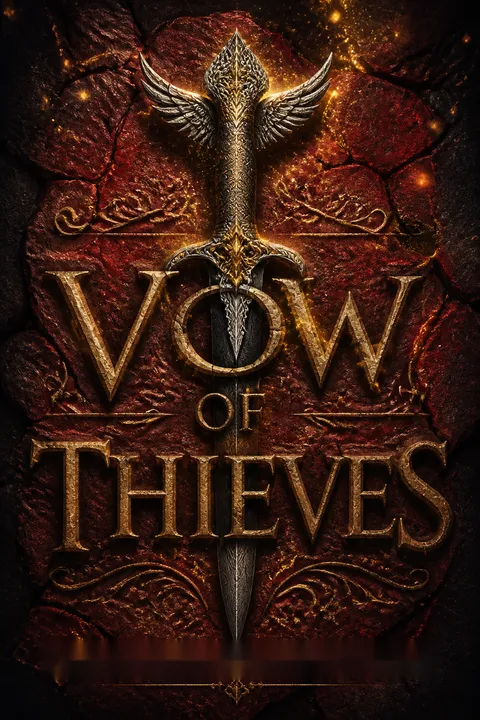


Plot Summary
A Road Back to Hell's Mouth
The story opens with Kazi1 chained in a dark cell, feverish and certain that worse than death is coming, then rewinds two weeks. She and Jase2 are riding home after the Queen of Venda21 has recognized Hell’s Mouth as a future kingdom of the Alliance. Kazi1 carries a second order: recover or destroy papers left by the scholars, whose knowledge may threaten the continent.
Their journey has brought a new ease between them, and they have privately married with a ribbon and feastcake, though Jase2 expects his family to need time to accept her. Kazi1 also fears returning to people who remember her as the soldier who betrayed them. Their fragile plans end when a dead Valsprey falls from the sky.
The opening frame makes captivity the destination before the reader knows its cause, while the rewind lets intimacy acquire suspense: every promise on the road home is shadowed by the cell already waiting. Kazi and Jase are not simply returning to power. They are attempting to convert private trust into a public family and political order. Her commission concerning the scholars’ papers also establishes that their future depends on controlling knowledge as much as territory. The contrast between their shared plans and the novel’s first image turns ordinary hope into something both precious and vulnerable.
A Message From the Dead
The bird is a trained Valsprey, but its body has been dead for weeks. Kazi1 finds a hurried note attached to it, warning that Samuel15 is dead and attackers are at the door. Jase2 rejects the message as a hoax, then recognizes that its handwriting may belong to Jalaine,14 his sister.
He and Kazi1 abandon their measured travel plans and ride through the night, stopping only to water their horses. Jase2’s fear turns inward: he wonders whether he failed Samuel15 by leaving him at the arena office with an injured hand. Kazi1 tries to steady him, but the message has made their return urgent for a reason neither can yet understand.
The impossible messenger brings two kinds of uncertainty into the story. Its decayed body makes the warning feel supernatural, while the familiar handwriting ties that mystery to the ordinary people Jase loves. His first response is denial, not because he lacks courage, but because accepting the note would mean imagining a catastrophe he cannot yet prevent. Kazi’s reassurance cannot remove that helplessness. The bird’s arrival therefore changes the couple’s pace and emotional posture at once: the homecoming they had pictured as a beginning becomes a race toward a possible loss.
The Broken Skyline
At Greyson Tunnel, Jase2 and Kazi1 see that Tor’s Watch has lost a tower and part of its fortress wall. Before they can assess the damage, arrows strike Jase2 in the thigh, shoulder, chest, and side. Kazi1 fights off the attackers and orders both horses to carry him away, but a knife wounds her abdomen and the raiders bind her.
She recognizes Paxton4’s voice among them. Jase2 loses consciousness and falls from his horse; Paxton4 secretly takes him to Caemus19’s settlement, where Caemus19 and Jurga begin treating his wounds. Kazi1 wakes chained in a cell, unaware that Jase2 survived. Her rescuers feed her barely enough to live, while an unseen ally slips her medicine and extra food.
The ambush destroys the couple’s shared future in a single instant, but it also exposes the difference between their immediate powers. Kazi can fight, improvise, and save Jase’s chance of escape, yet she cannot control where he goes or whether he lives. Jase, meanwhile, is reduced from Patrei to an unconscious body dependent on strangers. The split narrative turns love into uncertainty rather than comfort. Paxton’s hidden rescue and the anonymous medicine complicate the apparent division between enemies and allies, showing that survival here depends on actions performed out of sight.
A King’s False Story
Kazi1’s captors are foreign-looking soldiers serving King Montegue,3 who has taken over the Ballenger Inn and Hell’s Mouth. General Banques5 presents a mutilated hand bearing Jase2’s signet ring as proof that Jase2 is dead. Montegue3 admits that the Ballengers have fled into their mountain vault and asks Kazi1 to announce that Jase2 was tried and executed in Venda, not murdered in an ambush.
He argues that a criminal’s death will end resistance. Banques5 threatens Lydia12 and Nash13 if Kazi1 breaks his rules, so she reads the lie to a town crowded with soldiers and hanging bodies. The crowd calls her a murderer. Montegue3 then claims her service, using the children’s captivity to keep her compliant.
Montegue’s power depends on controlling the account of events before anyone can test it. The ring converts a family emblem into manufactured evidence, and Kazi’s position as a Vendan soldier gives the lie official weight. Her coerced announcement is not passive surrender: she calculates that keeping Lydia and Nash alive matters more than protecting her own reputation. Still, the public cost is severe. The town sees her perform the betrayal, while the children must hear her erase their brother. Montegue’s strategy turns truth into a weapon that can be aimed at the living and the grieving alike.
The Patrei in the Cellar
Jase2 wakes in Caemus19’s root cellar with five arrow wounds and learns that an unknown man brought him there. Caemus19 and Jurga keep him alive, and seven-year-old Kerry20 drives his slow recovery with blunt exercises and no patience for self-pity. The settlement has stayed away from town as an army occupies Hell’s Mouth and Tor’s Watch.
Jase2 learns that the attackers possess shoulder-fired launchers like the weapon Beaufort had designed for the Ballengers. He suspects Paxton4 and Truko17 have joined the coup, but cannot reach his family or Kazi.1 Wren7 and Synové8 eventually arrive, carrying Synové8’s disturbing dream of Kazi1 chained and bloodied. Jase2 abandons hiding and prepares to find her.
Jase’s survival is a reversal without relief. He is alive, but his role as protector has become impossible while his body cannot carry him beyond the cellar. Kerry’s practical care gives him a small community rather than a heroic recovery montage; every gained step is earned through dependence. The settlement also changes Jase’s understanding of his own authority. People he once treated as beneficiaries of a vow are now the people keeping him alive. Synové’s dream does not provide certainty, but it converts private fear into a reason to act.
The Farmer King Unmasked
Montegue3 tells Kazi1 that the Ballengers armed leagues and blackmailed the town, but she knows his account does not match what happened. Paxton4 reveals that he secretly rescued Jase2 and supplied Kazi1’s medicine; he is pretending to serve the new regime so he can protect the children and undermine it.
At Tor’s Watch, Montegue3 admits his alliance with the scholar Phineas24 and exposes a glittering substance made from fallen stars. It intensifies whatever it touches, from crops to human strength, and powers the weapons. Kazi1 also realizes Banques5 is Devereux Illarion,5 Beaufort’s brother and the former magistrate who financed the unrest. Montegue3 wants the missing papers because he intends to expand his power beyond Eislandia.
The apparent restoration of order is revealed as a manufactured crisis. Montegue has not merely exploited events; he has arranged them, then offered himself as the solution. His star substance makes that political logic literal: desire becomes an accelerant, enlarging existing drives rather than giving people new ones. Paxton’s double role provides a counterpoint. He accepts the danger and moral ambiguity of appearing disloyal because open resistance would leave the children exposed. Kazi’s understanding of the coup changes the stakes from local succession to a contest over the continent’s capacity for domination.
A Kingdom Under Watch
Jase,2 Wren,7 and Synové8 enter the mountains disguised as Kbaaki traders, hoping to learn who controls the town before they risk an attack. They kill a patrol that recognizes their bread as a suspicious detail, then reach the arena, where Jase2 captures Sheridan, a former employee now serving the occupiers. Sheridan confirms that Montegue3 commands the army and that Zane6 has become a lieutenant.
In town, Jase2 meets Aleski, who confirms the hanging of Ballenger loyalists and reveals that Lydia12 and Nash13 are being kept with the king.3 Jase2 urges the frightened citizens to decorate for Winter Festival so the soldiers will mistake public compliance for surrender. The festival becomes cover for organizing resistance.
Disguise is more than a tactical trick here. Jase must conceal the identity that once made him a natural center of loyalty, because openly claiming it would expose everyone around him. The town’s festival performs the same double function: its decorations can be read as obedience by the occupiers and as quiet coordination by the people. Jase’s instructions to Aleski show leadership shifting from command to interpretation. He cannot yet defeat the soldiers, so he helps citizens manage what the enemy thinks it sees.
Zane’s Old Bargain
Zane6 arrives as Kazi1’s escort, corners her in her room, and uses the king’s rules to keep her from fighting back. He threatens to expose Kazi1’s old betrayal of Banques,5 then claims her mother is alive and within reach. Kazi1 believes the claim is likely a lie, but agrees to keep quiet until she can free Lydia12 and Nash.13
Meanwhile, Paxton4 helps her build a plan around the children’s guarded trip to the graveyard, and Oleez18 agrees to help them. Kazi1 begins performing loyalty for Montegue,3 who is eager to be admired and to eclipse Jase2 in every measure. Her private hatred of Zane6 remains a vulnerability he can still exploit.
Zane’s offer works because it reaches a wound that training has never closed. Kazi can assess the threat as a likely deception and still feel its pull; rational knowledge cannot simply cancel the child’s unanswered longing. Her bargain is therefore strategic but emotionally costly. She postpones confronting him, not because she forgives him, but because other lives depend on her restraint. Montegue’s desire for admiration creates a different opening. Kazi recognizes that his ego can be manipulated, though she knows the rules are his and he can change them.
The Crypt’s Hidden Door
At the graveyard, Kazi1 lures the guard away from Lydia12 and Nash,13 kills him, and hides the children inside Sylvey’s supposedly occupied crypt. They reveal a second entrance to the Ballenger vault, hidden behind a waterfall. Kazi1 then wounds Montegue3 with the guard’s push knife, escapes into a canyon, and discovers that she has taken his vial of star substance.
She hides it in a crevice before fleeing through the mountains. Seeking the Ballengers, she finds Gunner,9 Priya,10 and Mason,16 who still believe she caused Jase2’s death. They catch her in a snare and summon a patrol. Kazi1 is captured again before she can convince them that Jase2 is alive.
The crypt gives Kazi a way to protect the children by using the family’s own reverence for its history. Its emptiness, created by Jase’s earlier act of love for Sylvey, becomes a shelter nobody else would think to search. Kazi’s escape also turns Montegue’s ambition into a portable object: the vial can be stolen, hidden, and denied to its owner. Yet the attempt to reach family fails because Kazi’s public lie has hardened into the only story Gunner and Priya can believe. Her tactical victories cannot erase the emotional damage of misinformation.
Jase Returns to His Family
Jase2 and his Rahtan companions reach the mountains, where Paxton4 confirms that Lydia12 and Nash13 escaped to the settlement and Kazi1 was taken by the king’s soldiers. Jase2 reunites with Gunner9 and the others, then enters the vault to find his mother,11 siblings, and injured household workers sheltering there. Samuel15 is alive, but Jalaine14 has died after sending the Valsprey message.
Jase2 learns that his family mistook Kazi1’s forced announcement for betrayal and helped deliver her to the patrol. When he demands their help, he reveals that Kazi1 is his wife. Gunner9 later admits his mistake and joins the rescue effort, while Jase2 begins planning against an army too strong for a direct assault.
The reunion restores Jase’s public identity but not his security. The vault contains a living family, yet its crowded, injured survivors make the cost of the invasion unmistakable. Jalaine’s death turns the message that drove him home into a delayed grief he cannot correct. His declaration of marriage is both intimate truth and political insistence: Kazi belongs to the family even when the family has failed her. Gunner’s apology begins repair, but it does not erase the consequences. Jase has to transform anger into a plan before it consumes the people he wants to save.
The Gallows Turned Upside Down
Montegue3 has Kazi1 bitten by ashti dogs after she refuses to reveal the children’s location or the vault entrance. As the poison brings fever and hallucinations, Jase2’s family prepares a rescue for her public hanging. They use ropes and pulley work among the enormous tembris trees, while Mason16 and Synové8 ignite the munitions stored in an icehouse as a diversion.
When the explosion draws guards away, Jase2 drops from the canopy and catches Kazi1 before the noose can take her. She is barely conscious and shaking from the bites, so the rescuers race toward the hidden vault entrance for the antidote. The army pursues them, forcing Jase2’s allies to split off and draw soldiers away.
The rescue depends on the same spectacle Montegue uses to rule. He expects a public execution to make fear visible; Jase’s group uses the gathered crowd and the trees above it to hide an equally visible reversal. Kazi’s refusal has protected the children and the family, but the poison strips away her control and makes survival depend on people she cannot direct. Jase’s return to her is therefore not a simple romantic rescue. It is a collective operation, built from labor, timing, and the willingness of others to risk themselves for someone they once mistrusted.
The Vault Holds
Rhea gives Kazi1 the ashti antidote in the vault, where Jase2 stays beside her until she wakes. Kazi1 reunites with him, Wren,7 and Synové,8 then faces the Ballengers, who thank her for saving Jase2 and the children. Priya10 and Mason16 apologize for helping trap her; Kazi1 acknowledges their remorse without pretending the hurt has vanished.
She also confronts Gunner9 about using Zane6 to reopen the trauma of her mother’s abduction. The family’s remaining questions turn to the scholars’ missing papers and Montegue3’s weapons. Kazi1 remembers overhearing that the munitions have been moved from the arena to somewhere beneath Tor’s Watch. Before they can decide how to search, Montegue3 begins blasting toward the vault.
Kazi’s return to consciousness brings a reunion, but not instant emotional repair. The Ballengers have to encounter her as a person rather than as the villain of the story Montegue gave them. Her willingness to hear apologies is not a declaration that everything is healed; it is a decision to keep working within a relationship still marked by injury. The sudden bombardment makes that work urgent. The vault’s physical safety has become the family’s last advantage, while Kazi’s memory supplies the clue that may turn their defensive refuge into a route back toward the enemy.
Fire Beneath Tor’s Watch
Jase2 leads Kazi1 and a small team through the concealed waterfall entrance into Tor’s Watch, while the rest remain ready to defend the vault. Kazi1 identifies a hidden room beneath Darkcottage as the place where Montegue3’s ammunition is stored. She and Jase2 distract the guards, then find casks stacked to the ceiling.
When soldiers and ashti dogs block their retreat, Jase2 uses his commands to turn the dogs against their handlers. The team lights an improvised fuse and runs for the vault. The explosion destroys Darkcottage and kills much of the occupying force, but the ancient vault door and surrounding granite hold. Jase2 then brings the survivors out, gathers weapons, and prepares to take the fight into town.
The Ballengers’ home has been turned into a weapon store, so reclaiming it requires the family to destroy part of its own inheritance. Jase’s choice accepts that preservation cannot mean keeping every stone intact when the people those stones shelter are at risk. Kazi’s identification of the hidden chamber and her skill at misdirection make the operation possible, while Jase’s bond with the ashti changes the enemy’s animals into a defense. The vault’s survival offers a material answer to the novel’s central fear: old structures can endure, but only if the living are willing to act.
The King Faces the Patrei
Montegue3’s mercenaries flee after the arsenal explodes, and Jase2’s force grows as Hell’s Mouth citizens return with improvised weapons. At the inn, Montegue3 appears holding Jalaine,14 alive but gravely injured, and offers to exchange her for Jase.2 Jase2 accepts so she will not die in Montegue3’s hands.
Kazi1 notices Truko17’s signal that he is ready to switch sides, and Truko17 throws Jase2 a sword before the king3 can shackle him. The resulting fight spreads through the street: Kazi1 and her Rahtan allies fight Banques5’s soldiers, while Jase2 duels Montegue.3 Jase2 kills Banques,5 then defeats Montegue3 when his rage overwhelms his swordsmanship. Montegue3 dies still convinced that power should have made him loved.
The trade forces Jase to choose between strategic caution and the face of his sister in danger. His willingness to surrender himself is not a failure of leadership; it is fidelity to the family he claims to serve. Kazi’s attention to Truko’s unspoken signal shows how much the outcome depends on reading loyalties that public declarations conceal. Montegue’s defeat also exposes the limits of force amplified by desire. He can seize a city and command an army, but he cannot make affection obey him. His final conviction keeps his defeat psychologically consistent rather than granting him sudden insight.
The Papers and the Grave
After the battle, Kazi1 searches the stable and finds Zane6 preparing to flee with the scholars’ papers. He wants to sell copies of the star formula to rulers and ambitious lords. Kazi1 wounds him, kills him, and takes the documents. Before dying, Zane6 tells her that her mother was taken to a farm in the highlands.
Kazi1 and Jase2 find the grave there and learn that the old king had acquired her through a Previzi driver as a prospective wife; isolated and unable to speak the local language, she died years earlier. Kazi1 marks the grave with her mother’s name and makes a final wish for her rest. She burns the dangerous papers, while Jalaine14 is later buried beside Sylvey.
Zane’s death closes the physical confrontation that began when Kazi was a child, but the information he gives her does not restore what was taken. The truth replaces an eleven-year uncertainty with grief that can finally be named and mourned. Kazi’s choice to mark the grave matters because her mother had been erased through displacement, language, and secrecy. Destroying the papers rejects the same logic that animated Montegue: knowledge is not automatically a gift when it magnifies domination. The burials also place the dead within chosen kinship rather than leaving them as instruments in someone else’s story.
Vows in the Ruins
The Ballengers hold a public ceremony to affirm Kazi1 and Jase2’s marriage, adding a priest and witnesses to the ribbon vows they made on the road. Kazi1 is welcomed not as an intruder but as Jase2’s daughter and partner. The family buries its dead, rebuilds Hell’s Mouth, and starts a settlement later named New Fogswallow.
A year and a half after the invasion, the Queen of Venda21 and King Jaxon22 arrive with the new settlers and formally admit Tor’s Watch to the Alliance as a kingdom. Wren7 and Synové8 remain as liaisons, and Kazi1 records the gathering in her journal beside Jase.2 Their shared life is no longer only a promise; it has become a home others can enter.
The renewed wedding does not invalidate the private vows. It translates them into a form the Ballengers and the wider community can witness, making Kazi’s place public rather than merely asserted by Jase. The kingdom’s recognition similarly formalizes work already done by the people who rebuilt the town and settlement. New Fogswallow joins remembered loss to a future that can be inhabited. Kazi’s journal and Jase’s histories turn memory into a shared civic practice, not just a family archive. The ending answers the opening journey home by showing home as something they build with others.
Epilogue
A year and a half after the new kingdom is recognized, a crow finds a glittering vial caught in an abandoned jay’s nest. It carries the prize away without noticing that the stopper has loosened.
Star substance drifts from the vial, some falling to earth and some rising into the clouds, scattering beyond Tor’s Watch. The people have destroyed Montegue3’s arsenal and Kazi1 has burned the papers, but the substance has escaped the place where they thought it was lost. Its next destination is unknown.
The crow’s theft quietly reopens a danger that the human characters believe they have contained. Unlike Montegue, the bird has no political ambition; it is drawn by shine and instinct, which makes the escape feel less like a deliberate villain’s plan than a material consequence of carelessness. The substance disperses without an owner or destination, suggesting that dangerous knowledge cannot be controlled simply by defeating one ambitious person. The main story ends in a founded kingdom, but the epilogue refuses to let restoration become certainty. The future remains vulnerable to what has already been released.
Analysis
Vow of Thieves treats power as a struggle over both bodies and interpretation. Montegue3 does not simply occupy Hell’s Mouth; he manufactures a story in which his invasion appears to be rescue, then forces Kazi1 to repeat it before the people who know the Ballengers. The false report of Jase2’s execution demonstrates how propaganda becomes effective when it recruits someone with credibility, especially someone already feared or distrusted. Kazi1’s public lie is morally compromised but strategically intelligible: she chooses the children’s safety over her reputation, then must live with the consequences of that choice.
The novel also distinguishes inherited loyalty from chosen responsibility. Jase2 begins as a young leader who believes he can protect everyone through planning and authority. His injuries make him dependent on the settlers, and the invasion reveals that the family’s history cannot substitute for present cooperation. Kazi,1 meanwhile, has learned to survive by expecting abandonment. Her gradual willingness to claim Jase2’s family as her own is not a sentimental cure for trauma. It is a repeated decision to risk attachment while remaining alert to the possibility of betrayal.
The star substance gives ambition a physical metaphor, but its danger is not simply magical power. It amplifies whatever desire already exists, making Montegue3’s long-nursed resentment materially destructive. The book’s answer is not a purer ruler or a better weapon. It is the difficult work of shared accountability: Paxton4 acts against the role he performs, the Ballengers admit the harm they have caused, and citizens help reclaim the town. The ending’s rebuilt kingdom therefore matters less as a triumph of sovereignty than as a community assembled from people who have had to revise their beliefs about one another. The escaping vial preserves a final caution: removing a tyrant does not remove the conditions that made his power attractive.
Review Summary
Vow of Thieves receives overwhelmingly positive reviews, with readers praising its intense plot, character development, and satisfying conclusion to the duology. Many highlight the political intrigue, action, and romantic elements. Fans appreciate the growth of protagonists Kazi and Jase, as well as the found family aspect. Some readers note that the book improves upon its predecessor, with tighter pacing and more complex storytelling. A few criticisms mention the length of separation between the main characters and the lack of LGBTQ+ representation.
People Also Read



Characters
Kazimyrah Brightmist
The shadow-solving soldierKnown as Kazi, she is a Vendan Rahtan soldier whose childhood as a starving street thief taught her to read people, improvise under pressure, and conceal fear behind performance. Her loyalty to the Queen of Venda21 and her complicated bond with Jase2 pull her between duty and intimacy. Kazi is alert to power because she has lived beneath it, and she distrusts easy promises, especially those involving family. Her training gives her formidable physical skill, but it cannot erase the trauma surrounding her missing mother. She is driven by justice and survival, yet increasingly willing to risk herself for people who were once strangers. Her riddles and tricks are not decoration; they are tools for taking back control.
Jase Ballenger
The burdened PatreiJase is the young Patrei, or leader, of Hell’s Mouth and the head of a large, fiercely loyal family. He inherits authority earlier than expected and treats leadership as a vow to protect the town, his relatives, and the settlement his family helped establish. He is a planner and negotiator, but his confidence can become recklessness when loved ones are threatened. His relationship with Kazi1 forces him to understand that devotion is not the same as control: he cannot command her into belonging or remove the damage she has endured. He draws strength from family history and records it carefully, while learning that the present is made through decisions rather than inherited stories alone.
Montegue
The hungry farmer kingThe young King of Eislandia presents himself as a practical, sometimes bumbling ruler, but beneath that image lies a disciplined and deeply resentful political mind. He grew up feeling that his father and subjects deferred to the Ballengers, and he interprets their influence as proof that his own family has been diminished. Montegue wants authority, but also the recognition and affection he believes authority should guarantee. His ability to read other people makes him more dangerous than a simple braggart, while his need to be seen as worthy distorts every compromise into an insult. He seeks to turn personal grievance into a new political order.
Paxton
The polished family rivalPaxton is a Ballenger cousin from a branch of the family long excluded from the main household. His ambition and polished manner have made him a persistent rival to Jase2, and he is accustomed to treating business as a contest in which charm and opportunism are necessary tools. Beneath his self-interest is a claim to the family history that others have denied him. Paxton is difficult to trust because he has made a career of appearing to serve whichever side offers advantage. That same adaptability gives him room to work inside dangerous systems when open loyalty would be useless.
Devereux Banques
The king’s military architectKnown publicly as General Banques, Devereux is Montegue3’s military adviser and a disciplined commander with ambitions of his own. He was once a rising officer in Morrighan, but his family name became a liability after his older brother’s treason. Banques responds to lost status by pursuing a larger stage where he can command rather than be judged. He values hierarchy, force, and strategic control, and he treats cruelty as a legitimate instrument of order. His polished military authority hides a personal grievance that makes him more than a hired sword.
Zane
Kazi’s childhood tormentorZane is a former Previzi driver whose past links him to Kazi1’s childhood and to the networks that move people and goods across kingdoms. He understands how to exploit another person’s vulnerability, especially when fear or hope can make them hesitate. His confidence depends on reading others as helpless, and he treats their suffering as a source of leverage. Zane’s connection to Kazi1 is rooted in a wound she has never been able to close, making him a threat beyond his physical strength or political position.
Wren
The Rahtan bladeWren is one of Kazi1’s closest Rahtan companions, a skilled fighter whose sharp judgment often checks the impulsiveness of the people she loves. She is guarded, practical, and slow to trust, but her loyalty is expressed through action rather than sentiment. Wren’s humor can be cutting, particularly when she thinks someone is being foolish. She understands that survival often requires a plan beyond courage, and she is willing to challenge Jase2 when she thinks his emotions are obscuring risk.
Synové
The dream-reading RahtanSynové is Kazi1’s friend and fellow Rahtan, warm, talkative, and more emotionally open than Wren7. Her dreams sometimes offer warnings, though she is not always certain how to interpret them. She balances her companions’ hard edges with humor and an instinctive readiness to care for others. Synové can be impulsive, especially when someone she loves is in danger, and relies on Wren7 to help keep that urgency from becoming reckless. Her gift gives the group information but never the certainty they crave.
Gunner
The fierce eldest brotherGunner is Jase2’s older brother and one of the most forceful members of the Ballenger family. He is protective, quick-tempered, and inclined to act before he has heard every side of a dispute. His anger often grows from loyalty, but it can make him mistake revenge for justice. As a family leader during crisis, he carries a heavy share of practical responsibility and grief. His pride makes apology difficult, even when he understands that he has caused harm.
Priya
The sharp-tongued strategistPriya is Jase2’s sister and the family member most associated with its businesses and careful accounting. She is clever, exacting, and capable of turning sharp words into a form of defense. Her instinct is to protect the people closest to her, but grief and anger can narrow her judgment. Priya values competence and loyalty, and she does not offer trust casually. Her relationship with Kazi1 is complicated by the clash between the family’s memory of betrayal and the evidence of what Kazi1 has done for them.
Vairlyn
The family’s steady centerVairlyn is Jase2’s mother, a practical and emotionally perceptive matriarch who has helped hold the Ballenger household together through illness, grief, and sudden change. She sees family as something built through care rather than merely blood, but she also understands the weight of its traditions. Vairlyn tends to look toward the next task when others are immobilized by loss. Her steadiness does not make her untouched by sorrow; it gives her a way to keep moving while carrying it.
Lydia
The observant young sisterLydia is one of Jase2’s younger siblings. She is perceptive and capable of following complex instructions, even when adults assume her age makes her unaware. She has grown up inside the Ballenger household’s close traditions and learns to read the danger around her. Lydia’s loyalty to her family is strong, but she is also a child who needs safety, reassurance, and room to remain a child.
Nash
The youngest Ballenger boyNash is Jase2’s young brother, affectionate and observant beneath his easy manner. He is close to Lydia12 and responds strongly to the family stories that give him a place in the Ballenger line. Though still a child, he can understand when adults are hiding fear from him. His trust in familiar people is both a source of comfort and a vulnerability in a world where adults use children to pressure one another.
Jalaine
The quick-witted sisterJalaine is one of Jase2’s sisters, known for her practical skill at the arena and her lively place in the family. She can manage work under pressure and understands the importance of the household’s communication network. Her concern for her brothers and the family does not depend on authority; she acts when a crisis reaches her. Jalaine’s note and presence in the family’s memories reflect the way ordinary acts of courage can carry enormous consequences.
Samuel
Jase’s steadfast brotherSamuel is Jase2’s younger brother, thoughtful and dependable, with a quieter temperament than Gunner9. He is accustomed to helping with the family’s work and is valued for his ability to follow through without demanding attention. Samuel’s injured hand makes him physically vulnerable at a dangerous moment, but it does not define his judgment or loyalty. He shares the family’s habit of preserving its history and its people.
Mason
The guarded Ballenger fighterMason is a Ballenger and one of the family’s capable fighters. He is guarded around outsiders, particularly when he believes the family has been used or betrayed. His seriousness can look like coldness, but it is bound to a history of loss and a strong instinct to protect those under his care. Mason has difficulty forgiving quickly and carries old conflicts into new encounters.
Truko
The calculating league chiefTruko is a powerful league leader whose interest in profit makes him an unpredictable figure in Hell’s Mouth politics. He is difficult to read and rarely gives others the satisfaction of knowing what he intends. Truko dislikes being ordered around and prefers to choose his own alliances. His self-interest does not make him simple: he can recognize when a larger power is trying to make every choice for him.
Oleez
The observant household allyOleez is a longtime Ballenger servant who helps care for Lydia12 and Nash13. She is observant, cautious, and skilled at protecting children without drawing attention to herself. Her loyalty is practical rather than ceremonial, grounded in the daily work of keeping a household functioning. Oleez understands that survival under occupation may require a composed face and carefully chosen silences.
Caemus
The settlement’s quiet hostCaemus is a leader among the settlers who have rebuilt their homes near Hell’s Mouth. He is pragmatic and reserved, with a deep sense of responsibility toward the people who depend on him. He does not romanticize hardship, but he knows how to make shelter, food, and patience serve as forms of protection. His relationship with Jase2 grows through shared work and the vulnerability of receiving help.
Kerry
The young, unsparing helperKerry is a young settler who helps nurse Jase2 back to strength. He is blunt, determined, and unusually unawed by the Patrei’s status. His practical attention keeps Jase2 exercising when despair would be easier.
The Queen of Venda
Kazi’s sovereign and mentorThe Queen of Venda is Kazi1’s ruler and the political authority who trusts her with sensitive work. She combines strategic judgment with a capacity to recognize value in people whom others dismiss. Her influence helps Kazi1 imagine a life beyond survival, though the queen expects her to meet difficult responsibilities rather than merely admire her.
King Jaxon
The Dalbreck allyKing Jaxon rules Dalbreck and supports the political recognition of Tor’s Watch. He brings the authority of an allied kingdom without eclipsing the people who have built the new community. His presence signals cooperation between rulers who understand that stability depends on more than borders.
Maggielle
The guarded seerMaggielle is a seer whose warnings are meaningful but incomplete. She speaks cautiously because visions do not provide the certainty people want from them. Her presence reinforces the story’s distinction between receiving a warning and knowing how to act on it.
Phineas
The brilliant scholarPhineas is the youngest of the scholars and the most inventive. He is curious about the ancient world and impatient with the limits imposed by his rank. His intellectual ambition can uncover extraordinary possibilities, but his work carries consequences beyond the laboratory.
Plot Devices
The dead Valsprey message
A warning from homeA trained Valsprey arrives already dead, carrying a hurried message that appears to report Samuel15’s death and an attack at the arena. Its impossible arrival makes the warning feel like a summons from beyond ordinary time, but the handwriting may belong to Jalaine14. The note forces Jase2 and Kazi1 to abandon their careful route and hurry toward Tor’s Watch. It also gives the early captivity plot its emotional charge: Jase2 believes his family may be dying while Kazi1 is separated from him, and the truth of the bird’s journey remains strange even after the attack is explained.
The star substance
Desire made dangerousA glittering material derived from fallen stars intensifies what it touches, whether the drive of a person, the force of a weapon, or the growth of living things. Phineas24 studies its potential and Montegue3 turns it toward military expansion. Its effects explain the strange strength and weapons that help the king’s forces seize Hell’s Mouth. Kazi1 steals Montegue3’s vial, while the missing papers contain knowledge that could allow the formula to be reproduced. The device links scientific discovery to political appetite: the substance does not create ambition, but makes existing ambition more powerful.
The Ballenger vault
A refuge with a second wayThe ancient vault beneath Tor’s Watch is a fortified shelter whose steel door and surrounding granite protect the family and household workers during the invasion. Its ventilation and hidden routes make it more than a sealed tomb. Jase2’s family knows its main entrance, while Lydia12 and Nash13 remember a concealed approach through a waterfall. The vault also stores the Ballengers’ written history, making it both a physical refuge and a record of collective survival. Its survival during the arsenal explosion allows the family to return to the conflict rather than be buried by it.
The ribbon and feastcake
Private vows made publicA red ribbon and a Vendan feastcake provide the simple elements of Kazi1 and Jase2’s first wedding on the road home. Their private ceremony expresses a commitment formed beyond the traditions of either kingdom. Later, the Ballengers hold a public ceremony with a priest and witnesses, affirming the marriage in the family’s own community. The repeated ritual turns the ribbon from a tender travel keepsake into a bridge between Kazi1’s culture and Jase2’s inheritance. It gives the novel a concrete way to show that belonging can be chosen and then recognized by others.
Greyson’s journals
History as survival practiceEntries attributed to the young Greyson Ballenger appear between sections, recording a patchwork family trying to endure after the devastation. The children learn practical skills, defend themselves from scavengers, and preserve stories because they fear losing one another and their past. These fragments illuminate the Ballenger tradition without making the family’s history a simple legend of heroic ancestors. Jase2’s habit of recording that history and Kazi1’s later journal echo the journals’ function: written memory helps people understand what they have survived, but each generation must still make its own choices.
Dance of Thieves Series

About the Author
Other books by Mary E. Pearson



Download PDF
Download EPUB
.epub digital book format is ideal for reading ebooks on phones, tablets, and e-readers.








