

Key Takeaways
Spend more effort choosing the question than polishing the answer.
Questions set the destination. Ryan argues that answers can only be useful when the question points toward the real problem. At a law school dance, he meant to introduce himself to Katie, but nervously asked her dance partner whether he was a classmate named Norman. Norman gave a perfectly reasonable answer, but it could not deliver what Ryan wanted. Katie understood the intention anyway, and they later married. The story makes the gap between a question's literal wording and its purpose easy to see.
Inquiry is a practical skill. Ryan learned to value questions through law teaching, where a series of follow-ups tests whether an argument still holds when facts shift. Leaders also need questions to discover what colleagues consider important, rather than announcing a vision no one helped shape.
The dance story is funny because it exposes a general design problem: people often optimize their response before checking whether they are solving the right problem. In science, product design, and clinical practice, problem definition shapes which evidence is gathered and which solutions seem possible. A useful question can therefore save more effort than a clever answer. Still, questions are not a substitute for expertise or decision-making. In urgent situations, inquiry must be brief enough to support action, not become an elegant form of delay.
Clarify what someone means before deciding what they deserve.
Pause before judgment. Ryan treats “Wait, what?” as a request to slow down, clarify an unexpected claim, and check whether important facts are missing. In a Harvard teaching exercise, participants criticized a character named Lee for failing to defend a junior colleague against sexist remarks. They had assumed Lee was a man. When the instructor revealed that the case never identified Lee’s gender, the class saw how quickly an unstated assumption had shaped its verdict.
Good questions expose weak points. Ryan recalls Supreme Court Justice John Paul Stevens asking lawyers to explain pivotal claims before making his own arguments. That courteous request often revealed whether a case depended on a shaky fact or legal premise. The practical sequence is simple: understand the claim, test its foundations, then decide whether to agree.
This habit resembles epistemic humility, the recognition that a person’s current picture of a situation may be incomplete. It also counters confirmation bias, the tendency to notice evidence that supports an existing view. The Lee example is especially useful because the mistaken inference was shared by an entire room, not just one careless person. Clarification is not automatically innocent, however. Questions can be used to intimidate or exhaust someone. The key distinction is whether inquiry genuinely seeks missing information or disguises an accusation.
Ask why ordinary things exist, and the familiar world becomes legible.
Curiosity reveals hidden histories. Ryan’s daughter once asked why New England fields were crossed by stone walls. Investigating the question revealed a chain of events: glaciers left rocks near the surface, farmers cleared them from fields and built boundary walls, and many walls were later swallowed by woodland as agriculture declined. A seemingly plain landscape became evidence of both natural history and human labor.
People are part of the landscape. Ryan argues that the same curiosity can uncover the stories behind a neighbor’s habits, a colleague’s beliefs, or a community’s customs. He cites social science research linking curiosity with learning, memory, social connection, and lower anxiety in unfamiliar situations. The point is not to turn every walk into homework. It is to resist treating what is visible as the whole story.
Curiosity changes attention from passive reception to active investigation. That shift matters because context is often hidden in plain sight, whether in a landscape or another person’s choices. Research on learning generally supports the idea that interest can help people engage with and retain information, though curiosity alone does not guarantee accurate conclusions. A compelling explanation can still be wrong. The strongest version of this habit pairs wonder with checking: notice a puzzle, gather evidence, and remain willing to revise the story.
Treat the story you assume about yourself as a hypothesis.
Old assumptions can hide real possibilities. Ryan knew he was adopted but had never seriously investigated why. He assumed his birth parents were young and had simply chosen adoption. At forty-six, he requested the non-identifying records held by the New Jersey agency. They revealed that his birth mother, Geraldine, had emigrated from Ireland, had stayed with him for nine days, and had struggled with the decision to place him for adoption.
One question opened a relationship. The agency eventually located Geraldine, who had built a family nearby and had prayed that she and her son would meet. Ryan discovered that the story he thought he knew was incomplete, and he formed a warm relationship with her and his half-siblings. Asking why, then whether a search was possible, changed his actual life, not merely his understanding of it.
The story illustrates how a plausible personal narrative can become a quiet barrier to discovery. In psychology, autobiographical memory is understood as a reconstruction, not a perfect recording, so confidence in a life story does not make it complete. Ryan’s experience also shows that curiosity can carry emotional risk: answers may complicate identity or reopen grief. The value is not that every person must investigate their origins. It is that an inherited assumption deserves scrutiny when the person living with it wants to know more.
Find one honest point of agreement before widening a disagreement.
Common ground lowers the temperature. Ryan’s friend Doug Kendall challenged both conservative and liberal approaches to constitutional interpretation. Rather than accept either side’s caricature of the other, he asked whether they could agree that constitutional words matter and that broad principles may apply differently as circumstances change. Doug used that shared ground to build a stronger argument and a public interest organization that influenced debate.
Agreement need not erase conflict. Ryan connects this method to group polarization, the tendency for like-minded people to reinforce one another and move toward more extreme views. In education debates, accusing opponents of bad motives can end discussion before anyone examines shared aims, such as children’s welfare. Finding a starting agreement does not settle policy. It can make the remaining disagreement more precise and less personal.
This approach resembles principled negotiation: separate the relationship from the issue, identify interests that overlap, and make the real dispute visible. Shared ground can reduce the impulse to treat disagreement as evidence of bad character. But consensus is not always the right first move. When one party faces a clear injustice, an insistence on finding commonality can protect the status quo or burden the harmed person with making others comfortable. Common ground is most constructive when it opens debate rather than suppressing necessary conflict.
Start with the smallest step that keeps a worthwhile plan alive.
Progress can begin before certainty. Ryan and Katie wanted to live abroad with their children for a year, but time and family demands made the full plan seem impossible. They asked whether a semester might work instead, chose New Zealand, and made the arrangements once they committed. Their five-month stay became a treasured family experience. Ryan uses the same logic in describing Katie’s request to discuss having a fourth child: a conversation did not force an immediate decision, but it moved them out of a stalemate.
Small beginnings invite learning. A loosely organized campus conversation about diversity at Harvard’s education school revealed strong interest, but also showed that participants wanted more structure. The next year, organizers added common readings, courses, speakers, and student-led work. Beginning did not guarantee success; it gave them information and a basis for improvement.
The small-step principle connects with behavioral science on implementation intentions: a concrete next action can make a vague goal easier to start. It also resembles prototyping in design, where an early version reveals needs that planning alone cannot expose. The important distinction is between a reversible first step and an irreversible commitment. A conversation, visit, or pilot can safely test an idea. Some choices require more preparation. Starting small is not an argument for recklessness; it is a way to replace imagined obstacles with information.
Offer help by asking what the other person actually needs.
Help should preserve agency. Ryan warns against the savior complex, the belief that a helper arrives with the answers while the person in need waits to be rescued. Asking how to help recognizes that the other person knows important things about their own situation and keeps them involved in deciding what support looks like.
Listening can change the outcome. During a cycling trip in Africa, Ryan’s wife, Katie, noticed that a fellow traveler was acting unusually confused. She asked what was wrong, helped him reach a hospital, and learned he had cerebral malaria, which required urgent treatment. In another case, Ryan’s legal client Patrick was suffering in immigration detention. Once Ryan asked what would help, Patrick said he needed to get out. Ryan found a release option and later helped him prepare his asylum case around his own story.
This is closely related to autonomy-supportive practice, in which professionals offer help while respecting a person’s capacity to choose. In medicine, education, and social services, advice can miss the mark when it is built around the provider’s assumptions rather than the recipient’s goals. The question also makes room for listening, practical help, or simply companionship. There is one important boundary: emergencies sometimes require immediate action before full consultation is possible. Even then, explaining what is happening and restoring the person’s voice as soon as possible preserves dignity.
Use what matters most to separate urgent work from distracting detail.
Priorities become clearest under pressure. When Ryan’s wife was in rapid labor, he worried about parking costs and hospital procedure while she needed to reach the delivery room. A resident fretted about equipment as the baby was about to arrive. Experienced staff cut through the distractions and focused on the healthy delivery. The episode shows how routine habits and small concerns can crowd out the central task.
Values need specific answers. Ryan’s father built his life around family, including hours spent playing baseball with his son. Ryan later told him that those afternoons had taught him how to be a good father. Ryan also recalls realizing that his mother’s request to drink champagne at his wedding was really a request to know whether he forgave her for her past alcoholism. The important issue was not the drink; it was forgiveness.
A priority question acts like a filter on attention, a scarce resource that is easily captured by whatever is loud, familiar, or measurable. In organizations, this can expose performative work that creates activity without advancing the mission. In personal life, it can reveal that a small conversation carries more weight than a large event. Yet priorities are not always singular. Caregiving, work, health, and loyalty can collide. The question helps name the trade-off, but it cannot remove the need to make one.
Act on a concern when the cost of silence may be lasting regret.
Inaction leaves unanswered counterfactuals. After Ryan’s mother broke her hip, complications accumulated during five weeks in hospital. Ryan worried that her care was inadequate but did not push for a second opinion or another team. His mother later died after a series of strokes. He does not claim that different action would have changed the outcome. The torment came from not knowing, and from feeling he had failed to pursue an available way to help.
Trying is not the same as controlling. Ryan connects this regret to a nurse’s account of dying patients, whose most common regret was not pursuing their own dreams. The lesson is not that every missed opportunity can be recovered or every intervention succeeds. It is that speaking up, making a call, or beginning a difficult project can reduce the specific regret of never having tried.
The distinction between outcome and process is central in decision science. People can make a careful choice and still face a bad result, while a reckless choice can succeed by luck. Judging only by outcomes encourages hindsight bias, the illusion that the past was more predictable than it was. Ryan’s regret is therefore not proof that a second opinion would have saved his mother. It is evidence that acting on a concern can matter for agency and peace of mind, even when no one can guarantee the result.
Measure a life by whether its relationships leave people feeling cherished.
The final question looks beyond achievement. Ryan’s friend Doug gathered old roommates year after year, believed in them, offered help, and asked about the decisions they were making. At Doug’s memorial, a poem prompted a question about whether a person had received what they wanted from life despite its pain. Ryan uses that question as a test of fulfillment, not as a promise that five habits can prevent sorrow.
Connection is both gift and measure. Ryan observes that memorials commonly emphasize family, friends, work, and kindness. He suggests that being loved, respected, and genuinely valued may matter more at life’s end than material success. The book’s five recurring questions help build this kind of life by encouraging understanding, curiosity, movement, service, and attention to personal values.
The closing idea shifts success from accumulation toward belonging. That resonates with research traditions that treat social connection as a major component of well-being, while leaving room for achievement, autonomy, and solitude to matter too. The useful question is not whether a person has met a universal checklist, but whether daily choices match the relationships and commitments they claim to value. There is a risk in turning affection into a scorecard. The stronger reading is relational: make care observable, and help others feel that their lives are seen.
Analysis
The book’s central method is not a grand theory of personality. It is a compact discipline of attention: pause to understand, remain curious, locate a feasible next step, ask what help means to the recipient, and identify the value that should govern the choice. Its strength is that the questions work across scales. The same posture can clarify a legal argument, prevent a premature judgment, help a child name a fear, or redirect a meeting from ritual to purpose.
The personal stories carry much of the argument’s force. Ryan’s adoption, his regret about his mother’s hospital care, and the moment of recognizing what his mother was really asking give the questions emotional stakes without claiming that they solve every problem. This distinction matters. The method improves how people notice and respond; it cannot guarantee the result of a medical crisis, reconcile every disagreement, or make all aspirations attainable.
The framework also has a civic dimension. In a polarized environment, asking for clarification and identifying limited common ground can interrupt reflexive condemnation. Yet openness must not become false equivalence. A genuine question invites understanding; a hostile question can be a verdict in disguise. Likewise, consensus is valuable only when it does not silence people with less power.
The most useful interpretation is therefore neither a script nor a set of magic words. These questions are prompts for better judgment, and their value depends on timing, listening, and willingness to revise assumptions. Their cumulative effect is a life with fewer avoidable misunderstandings and fewer unexamined omissions. The closing measure is not perfect happiness, but whether a person’s choices have helped build relationships and commitments they can honestly call their own.
Review Summary
Wait, What? received mixed reviews, averaging 3.93 out of 5 stars. Many readers found the book insightful and inspiring, praising its brevity and practical life lessons. They appreciated Ryan's personal anecdotes and the five essential questions he presents. However, some critics felt the content was obvious or redundant, and the book didn't offer much beyond the original speech. Overall, readers found it a quick, thought-provoking read that could be particularly suitable as a gift for graduates or those seeking inspiration.
People Also Read






Glossary
The five essential questions
Everyday prompts for livingRyan’s practical set of questions guides five recurring tasks: clarify what is being said, stay curious about the world, find common ground or a first step, offer help respectfully, and identify what matters most. They are meant for ordinary conversations as well as major decisions, and are useful because they turn broad values into repeatable habits of attention.
The bonus question
A life-fulfillment testA question to ask oneself about whether life has provided what one truly wanted, despite its pain and disappointments. Ryan presents it as a final measure rather than a promise of happiness. The answer depends less on material gain than on a person’s relationships, commitments, and sense of having lived in a way that feels genuinely their own.
Savior complex
Helping without shared agencyA stance in which a helper sees themselves as the expert who can rescue another person, assumes they know what is needed, and treats the recipient as passive. Ryan uses the term to warn that benevolent intentions can still undermine dignity. Asking what help is wanted allows the person receiving support to retain a role in decisions about their own life.
Group polarization
Like-minded views grow strongerA social tendency for people who already share similar opinions to reinforce one another’s positions when they interact. The group may become more confident in its original view and sometimes adopt a more extreme version of it. Ryan uses the idea to explain why segregated media and social circles can harden disagreement and make sincere engagement across differences more difficult.
De facto segregation
Segregation occurring in practiceSegregation that exists as a matter of fact rather than because a law explicitly requires people to attend separate schools. Ryan distinguishes it from legally mandated segregation, which was ruled unconstitutional in the United States. Residential patterns, school policies, and other forces can still produce racially or economically separated schools without a formal segregation law.
Sin of omission
Wrongdoing through inactionA failure to do something one has a responsibility or moral reason to do. Ryan recalls learning the idea in religious confession and comes to see omissions as a source of deep regret, especially when silence or hesitation prevents someone from trying to help. The concept does not mean every failure to act is blameworthy; context and responsibility matter.
FAQ
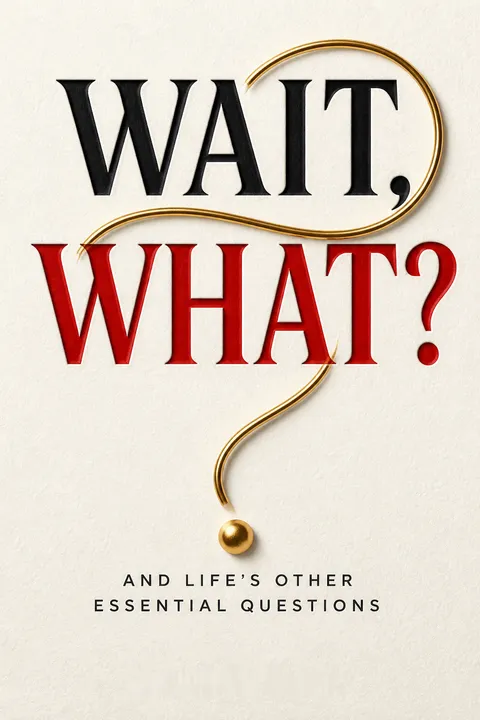
What's "Wait, What?: And Life's Other Essential Questions" about?
- Five Essential Questions: The book explores five essential questions that can lead to a happier and more successful life: "Wait, What?", "I Wonder...?", "Couldn't We at Least...?", "How Can I Help?", and "What Truly Matters?".
- Origin of the Book: It originated from a graduation speech given by James E. Ryan, which went viral and was later expanded into this book.
- Purpose: The book aims to encourage readers to ask these questions regularly to gain deeper understanding, foster curiosity, promote progress, build relationships, and focus on what truly matters.
- Personal and Professional Growth: Through anecdotes and personal stories, Ryan illustrates how these questions can be applied in both personal and professional contexts to improve decision-making and relationships.
Why should I read "Wait, What?: And Life's Other Essential Questions"?
- Practical Guidance: The book offers practical advice on how to incorporate essential questions into daily life to enhance understanding and relationships.
- Engaging Stories: Ryan uses engaging personal stories and anecdotes to illustrate the power of asking the right questions.
- Self-Reflection: It encourages self-reflection and introspection, helping readers to focus on what truly matters in their lives.
- Universal Relevance: The questions are applicable to a wide range of situations, making the book relevant for anyone seeking personal or professional growth.
What are the key takeaways of "Wait, What?: And Life's Other Essential Questions"?
- Understanding Through Questions: Asking "Wait, What?" helps clarify and deepen understanding before making judgments.
- Curiosity and Engagement: "I Wonder...?" fosters curiosity and engagement with the world, encouraging exploration and innovation.
- Finding Common Ground: "Couldn't We at Least...?" is a tool for finding consensus and making progress in disagreements.
- Empathy and Support: "How Can I Help?" emphasizes the importance of offering help with humility and respect for others' autonomy.
- Focus on Priorities: "What Truly Matters?" helps prioritize what is important in life, guiding decisions and actions.
What is the significance of the question "Wait, What?" in the book?
- Clarification: "Wait, What?" is used to ask for clarification, ensuring a true understanding of ideas, opinions, or proposals.
- Avoiding Snap Judgments: It helps avoid jumping to conclusions and making snap judgments without full comprehension.
- Encouraging Inquiry: The question encourages inquiry before advocacy, promoting a culture of understanding and dialogue.
- Versatility: It can be used in various contexts, from personal conversations to professional settings, to ensure clarity and understanding.
How does "I Wonder...?" contribute to curiosity and engagement according to James E. Ryan?
- Curiosity Catalyst: "I Wonder...?" is a catalyst for curiosity, prompting individuals to explore and question the world around them.
- Two Variations: The question can be paired with "why" to understand the present and "if" to explore future possibilities.
- Encouraging Exploration: It encourages trying new things and considering how the world or one's life could be different.
- Personal Growth: By remaining curious, individuals can discover new interests and opportunities for personal growth and fulfillment.
What role does "Couldn't We at Least...?" play in making progress?
- Finding Consensus: This question helps find common ground in disagreements, facilitating consensus and collaboration.
- Overcoming Stagnation: It is a tool for getting unstuck and making progress, even when a full plan is not in place.
- Encouraging Action: By suggesting small steps, it encourages action and movement toward larger goals.
- Reducing Polarization: In polarized environments, it helps reduce extremism by focusing on shared values and goals.
How does "How Can I Help?" foster empathy and support?
- Respect and Humility: Asking "How Can I Help?" shows respect for others' expertise in their own lives and offers help with humility.
- Effective Assistance: It ensures that the help offered is aligned with the actual needs and desires of the person being helped.
- Empowering Others: By asking this question, helpers empower others to take ownership of their problems and solutions.
- Building Relationships: It fosters genuine relationships based on reciprocity and mutual support.
What does "What Truly Matters?" help individuals focus on?
- Prioritization: This question helps individuals prioritize what is truly important in their lives, both personally and professionally.
- Cutting Through Distractions: It aids in cutting through distractions and focusing on core values and goals.
- Guiding Decisions: By identifying what truly matters, individuals can make more informed and meaningful decisions.
- Balancing Life Aspects: It helps balance different aspects of life, such as work, family, and personal growth, by focusing on what is most important.
What are the best quotes from "Wait, What?: And Life's Other Essential Questions" and what do they mean?
- "Wait, what?" - This quote emphasizes the importance of seeking clarification and understanding before making judgments.
- "I wonder...?" - It highlights the value of curiosity and the willingness to explore new possibilities and ideas.
- "Couldn't we at least...?" - This quote suggests finding common ground and taking small steps toward progress, even in disagreement.
- "How can I help?" - It underscores the importance of offering help with humility and respect, fostering genuine relationships.
- "What truly matters?" - This quote encourages focusing on core values and priorities, guiding decisions and actions in life.
How does James E. Ryan use personal stories to illustrate the book's concepts?
- Engaging Narratives: Ryan uses personal anecdotes and stories to make the concepts relatable and engaging for readers.
- Real-Life Applications: The stories demonstrate how the essential questions can be applied in real-life situations, both personal and professional.
- Emotional Connection: By sharing personal experiences, Ryan creates an emotional connection with readers, enhancing the impact of the lessons.
- Illustrating Outcomes: The stories illustrate the positive outcomes of asking the right questions, reinforcing the book's message.
What is the "Bonus Question" mentioned in the conclusion of the book?
- Reflective Question: The bonus question is "And did you get what you wanted from this life, even so?" which encourages reflection on life's fulfillment.
- Acknowledging Challenges: The phrase "even so" acknowledges that life includes challenges and disappointments but still offers joy and contentment.
- Life's Measure: It serves as a measure of whether one has lived a fulfilling life, focusing on relationships and personal growth.
- Guiding Principle: The bonus question acts as a guiding principle for living a life that is meaningful and rewarding.
How can the five essential questions guide someone in living a fulfilling life?
- Understanding and Curiosity: By asking "Wait, What?" and "I Wonder...?", individuals can deepen their understanding and remain curious about the world.
- Progress and Support: "Couldn't We at Least...?" and "How Can I Help?" encourage progress and build supportive relationships.
- Focus on Priorities: "What Truly Matters?" helps individuals focus on their core values and priorities, guiding their decisions and actions.
- Holistic Approach: Together, these questions provide a holistic approach to living a life that is fulfilling, meaningful, and connected to others.
Download PDF
Download EPUB
.epub digital book format is ideal for reading ebooks on phones, tablets, and e-readers.








