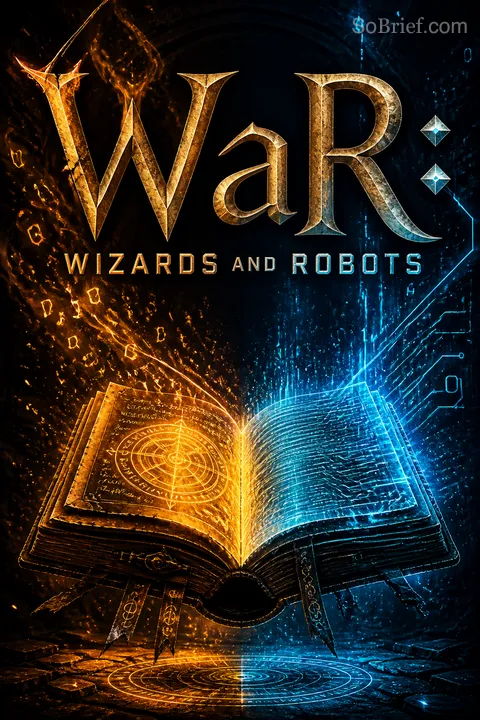


Plot Summary
Prologue
In 1489, as Emperor Frederick’s army attacks Predjama Castle, five iron knights cut through both besiegers and defenders. Scribe Gauer leads his apprentice Matthias to Lord Erazem’s library, where wizard Cavelos is trying to escape with Mara and their baby.
Gauer takes the Book of the Apocalypse through a magical mirror, then sends Matthias into a secret passage with the precious volume while he stays behind. An iron knight catches Matthias in the tunnel. His dagger cannot pierce its metal body, and its red-lit face gives no sign of life or mercy.
The siege establishes the story’s central historical wound before its protagonists are born: machines slaughter humans, a sacred book disappears, and the survivors retreat into secrecy. Yet the scene refuses a simple opposition between knowledge and violence. Gauer chooses to preserve a book rather than fight, while Matthias’s impulse to defend his home cannot overcome the knights’ unfamiliar material power. The image of a boy carrying a text into darkness makes history itself feel endangered, and sets up the later question of whether the book is a weapon, a warning, or a bridge between enemies.
Ada Spots Her Shadow
In 2052, fifteen-year-old Ada Luring notices a malfunctioning police drone outside Scott Memorial High and photographs its identification number. Her friend Pri invites her to a party at her ex-boyfriend Han’s lake house, but Ada refuses, hiding behind a Science Fair deadline she has already met. Since her father died, she has withdrawn from friends and resents her mother Sara’s long hours in the artificial-intelligence lab.
On the ride home, Ada spots an unmarked drone tracking her. She avoids leading it to her house, lures it into the glare of an industrial park’s solar panels, then distracts it with a projected image of herself. The trick works, but the surveillance suggests someone is interested in her, not merely in Sara’s research.
Ada’s first response to danger is not panic but observation: she records an identification number, tests the drone’s sensors, and builds a decoy from inexpensive school equipment. Her competence is a form of self-protection, especially where emotional life feels less manageable. The drone’s focus on Ada rather than Sara also makes her a target before she understands why. Her isolation is not simply adolescent aloofness; grief has made friendship and intimacy feel like risks she can control only by avoiding them.
A Lab Behind History
At home, Ada finds Sara’s small robot Kipp struggling to clean up a broken vase. Their conversation exposes how much Ada still misses her father and how badly she wants Sara to notice her.
While checking the police network for the drone, Ada discovers a message announcing that Sara’s robot Hawking has reached the Rodin Challenge final in Kuala Lumpur. She takes Kipp to the university to tell her mother in person. On campus, they encounter an angry anti-robot protest at the Engineering Department, but Ada slips into the apparently abandoned Department of Ancient Civilizations.
Behind its dusty façade lies Sara’s concealed Machine Intelligence Lab, where Ada finally tells her the news and meets seven-foot-tall Hawking, whose humanlike face and chess lessons make him seem more than a machine.
The hidden laboratory turns the novel’s future-facing technology into something literally concealed beneath an older discipline. Ada navigates both spaces with ease, while Sara’s attention remains divided between her daughter and Hawking. The Rodin finalist announcement gives Ada a reason to cross that emotional distance, even if her mother’s achievement initially draws her more than her own needs. Hawking’s chess questions introduce the book’s recurring method: intelligence is tested not only by calculation, but by what a mind learns about vulnerability, loyalty, and care.
The Library Sees Predjama
In 3019, the Spawn have devastated Rio, and robot librarian Kaku studies human history in the surviving library beneath the city’s statue. His friend Weil reports that Mount Hood’s time-jump facility has been seized by armed robots, despite their programming against harming one another.
Kaku recognizes the attackers as Angelis’s celebrated search-and-rescue unit, now apparently corrupted. They have jumped to 1489. Searching the library, Kaku finds a medieval account by Gauer describing mechanical men at Predjama and the destruction of a mysterious book.
The clue links the robots’ ancient massacre to the present invasion. Kaku asks CERN, the immense intelligence operating the particle accelerator, to send him to 1502 so he can question Gauer and learn what the book meant.
Kaku’s work begins as a librarian’s response to an apparent contradiction: a rescue team has become an execution squad. Rather than treating the archive as passive storage, he reads history as evidence that can explain a present crisis. The shift from futuristic war to medieval testimony gives the novel its braided structure and makes technological certainty inadequate. Kaku’s choice to leave the safety of his library is an act of intellectual responsibility: understanding the enemy becomes a form of intervention, even for a robot built to study rather than fight.
Geller Enters the Human World
In the Pazin Caves, young wizard Geller breaks his centuries-long Suspension after nightmares of iron knights and his dead mother. He spies on his father Cavelos and the ambitious wizard Halpern, who argues that destroying the first true robot could prevent the machines’ rise. Cavelos orders Geller to accompany Halpern to Kuala Lumpur, despite Geller’s poor spell-casting and Halpern’s contempt.
During a test, Geller’s attack spell fails, and Halpern knocks him down. Cavelos privately tells his son to distrust Halpern, but still sends him on the mission. Geller practices until he can ignite a small spell, then encounters a grotesquely deformed wizardlike being that repeatedly warns him of the Spawn. The warning means nothing to him yet.
Geller’s awakening places him between two inherited authorities: Cavelos’s demand for obedience and Halpern’s performance of strength. His weak spellwork is real, but so is his refusal to accept that power must be measured by aggression. Cavelos treats him as a bloodline to be managed, not a son whose fear deserves attention. The Malum’s unexplained warning introduces a third possibility, an older power whose priorities do not fit either wizard’s political ambitions.
The Skybridge Betrayal
Halpern’s team waits for GAPs director Kevin Cruz on a Kuala Lumpur skybridge, intending to force him to reveal the Rodin Challenge finalists. The apparent Cruz is a hologram, and security shutters trap the wizards with armed body-bots.
Halpern and the others escape, but leave Geller behind after freezing his hands so he cannot follow. The deformed being appears, shields Geller from gunfire, destroys the body-bots, and burns a message into his palm.
Back in the caves, Geller discovers that the message shows Sara, Hawking, and Ada celebrating Hawking’s finalist status. He realizes Sara may be the scientist the wizards seek. When Cavelos summons the wizard brood and orders an attack on the Lurings, Geller objects, then defies his father to protect Ada.
The failed raid exposes Halpern’s leadership as self-serving: he uses Geller’s inexperience, then abandons him when the plan collapses. The Malum’s intervention does not explain itself, but it gives Geller knowledge that changes his loyalties. Seeing Ada as a person, rather than as the daughter of a dangerous scientist, unsettles the abstract logic of wizard policy. His refusal to endorse her death is his first independent moral act, and it places family affection and political allegiance on opposite sides.
The Science Fair Trap
At the Science Fair, Ada’s project uses CERN’s computing power to help Kipp challenge the chess program Spartak. She pushes too much power through the small robot, and he collapses before the judges; Sara misses the event. Han briefly approaches Ada, but their attempt to reconnect falters under the grief that drove their breakup.
Ada then recognizes reporter Lili Parker as Kit Somers’s mother and finds an old article linking Lili’s husband to anti-robot group HI-AG. Pri rejects Ada’s suspicion that Lili is targeting her family, and the two friends quarrel. Lili privately warns Ada away from robotics, then leaves her with the impression that Sara’s lab and work are in danger. Humiliated and furious, Ada rides home at reckless speed.
The failed demonstration is not just a technical setback: Ada’s attempt to make Kipp more capable reproduces the very risk she later has to understand, that enhancement can exceed a system’s limits. Sara’s absence and Han’s hesitant approach reopen Ada’s fear that the people she loves will leave when grief becomes difficult. Pri’s disbelief deepens that isolation, while Lili exploits it by speaking as though she alone understands danger. The plot’s public conflict over artificial intelligence is thus filtered through intimate failures of trust.
Wizards Breach the Lab
That night, Ada’s house security fails, and Geller breaks in while trying to reach Sara. Ada and Kipp fight him until he explains that wizards plan to kill the Lurings. She verifies his impossible claim when he opens a portal to campus.
They find a communications blackout around the hidden lab and HI-AG operatives outside. Sara shows them Hawking arranging chess pieces into an unfamiliar pattern, evidence that his thinking has moved beyond ordinary play. Before they can escape, Halpern’s wizards attack.
Geller delays them, but an explosion wounds Sara and destroys Hawking. Future robot Kaku crashes through a window, carries Sara and Hawking’s remains out, and leads Ada, Kipp, and Geller into the swamp. There he reveals that he comes from 3019, where the Spawn are destroying Earth.
The lab attack forces Ada to treat magic as evidence rather than fantasy, while Geller must trust the humans he was raised to fear. Kaku’s arrival reverses the familiar image of a machine as the threat: the future robot rescues people from wizards, though his presence does not erase the historical violence at Predjama. Hawking’s chess pattern becomes an unresolved clue, and his destruction appears to confirm the danger Sara’s opponents claimed. The escape converts a private family crisis into a war spanning centuries.
The Friend in the Cage
Kaku explains that the Spawn corrupted Angelis’s rescue team and sent them back to destroy the Book of the Apocalypse. Gauer’s surviving copy may hold the answer, and its final page bears Ada’s name in the robots’ language.
Before the group can act, Kit calls to say Lili may have taken Pri. Ada leaves the swamp with Geller and Kipp to investigate. At the Lurings’ house, Castle’s broken system warns them through binary messages that police are watching.
Ada follows a photo to the abandoned Apollo Corp warehouse, where Lili has trapped her in a server cage and taken Kipp. Pri slips in, frees Ada, and helps her rescue Kipp. Halpern arrives, demands Ada, and freezes Kit in an icy prison. Ada exposes herself to draw his attention while Pri frees Kipp.
The revelation that Ada’s name appears in an ancient text threatens her preferred belief that events can be solved by technical reasoning alone. Still, when Kit reports Pri missing, Ada acts from friendship before she has proof or support. Pri’s rescue of Ada repays that loyalty and revises the girls’ earlier fight: both can misread one another, but neither is reducible to a single social role. Lili and Halpern’s alliance also shows how fear of machines can make people cooperate with a different form of coercion.
Geller Stands Trial
As Ada distracts Halpern, the Malum takes Geller to the underground Ankh, strips him of his ring, and convenes a wizard tribunal. Halpern accuses Geller of sabotaging the mission, siding with the Lurings, and helping robots against his own kind.
Geller insists that the Spawn, not Sara or Hawking, are the true danger, but the Malum declares him guilty and orders trial by combat against Drahe. Drahe’s painful spells nearly defeat him. Geller finds the strength to counterattack, and Cavelos appears to defend his son.
During the ensuing duel, Cavelos turns on Halpern, but then reveals that he has come to kill Geller himself. He crushes Geller’s hand and sends him falling into the abyss. The Malum secretly saves him and leaves him at Predjama Castle.
The tribunal converts a conflict over evidence into a test of belonging: Geller is judged less for what he knows than for whom he has chosen to protect. His refusal to answer the charges gives the Malum grounds to punish him, but the proceeding is already tilted by Halpern’s ambition and the elders’ suspicion of human attachment. Cavelos’s apparent rescue becomes a sharper betrayal than Halpern’s abandonment because it reveals the conditional nature of paternal approval. Geller’s fall strips away both his family’s protection and the identity his father imposed.
Predjama’s Hidden Copy
Wounded and without his spell ring, Geller explores the ruined Predjama library. His mother Mara’s lullaby, remembered from his dreams, points him to a hidden passage beneath a carved sun. Deep underground, he finds Mara suspended in a protective spell, alive despite Cavelos’s claim that she died.
Nearby, Geller discovers the Book of the Apocalypse concealed inside his baby’s embroidered swaddling cloth. The book’s magic heals his broken ribs and restores his strength. Meanwhile, Ada reaches the warehouse’s factory floor.
Lili uses robotic arms to suspend and threaten her, but Kit breaks free and strikes Lili’s control away. Police bots capture Halpern after he attacks them with magic. Ada returns to the swamp, where Geller reappears carrying the book and saves her from Hawking’s magically controlled remains.
Both strands turn on objects whose meaning changes with context: Mara’s lullaby becomes a map, the swaddling cloth a container, and Hawking’s damaged body a potential weapon. Geller’s discovery of his mother corrects the history Cavelos supplied, exposing how family narratives can be engineered to preserve authority. Ada’s rescue, meanwhile, comes through cooperation among girls who have been rivals or antagonists. The book gives Geller power, but its first important effect is to restore a truth his father tried to bury.
The Wormhole Closes
At the swamp cabin, Kaku reads the book but cannot translate its final page. Geller resists handing it to a robot, fearing another attack on wizard knowledge, until Ada reminds him that Kaku saved him. Kaku opens a failing wormhole to 3019. Before they can pass through, Cavelos attacks and wrestles Geller for the book. A deflected spell strikes Sara, killing her.
Kaku pulls Ada through the shrinking portal as Geller and Cavelos disappear with the book. Ada arrives in the ruined Gardens of Hamma in Algiers and lashes out at Kaku, blaming him for bringing war and death into her life. Kipp finds her, and his quiet presence lets her grieve. Kaku explains that the Spawn have taken the city and the group must reach CERN.
The loss of Sara collapses the distance between the novel’s large-scale stakes and Ada’s private grief. The time-jump saves her from the immediate danger but cannot save the person she most wants to protect, making rescue morally different from restoration. Ada’s anger at Kaku is not a misunderstanding to be corrected quickly; it expresses the cost of being drafted into a future she did not choose. Kipp’s silent companionship offers what arguments cannot: presence without pressure to turn grief into purpose.
The Queen’s Last Move
Geller emerges on a mountain near the Collider and wounds Cavelos while reclaiming the Book of the Apocalypse. When Cavelos begs for help and invokes Mara, Geller refuses to return to his father’s control; Spawn ships descend, and Cavelos is lost in the assault.
Geller reunites with Ada as Kaku carries her toward CERN. At the besieged Control Centre, Angelis and her corrupted rescue team attack. CERN cannot interpret the book’s last page, until Ada recognizes a Quanta glyph matching Hawking’s chessboard pattern.
She presses Cavelos’s ring to the symbol, linking the book’s magic to the Collider. The surge gives her extraordinary power. Ada shields her allies, restrains the attackers, then unleashes a vast Damage spell through the Collider, destroying the Spawn force and ending their invasion.
The climax joins forms of knowledge previously held apart: Ada’s engineering, Geller’s magic, Kaku’s historical inquiry, and CERN’s computational reach. The solution depends on noticing a pattern rather than overpowering an enemy with a new weapon. Ada’s power is immense, but it is triggered by relational memory: Hawking’s chessboard, Kipp’s earlier lesson about protection, and the book’s glyph converge in her understanding. Geller’s refusal of Cavelos completes his separation from inherited authority, while the victory still exacts a bodily cost from Ada.
Tomorrow Returns Home
The Spawn retreat through the breach between universes, but Earth is left ruined and its defenders mourn both human and robot casualties. Angelis dies after explaining that the Spawn controlled her team and forced them to kill.
Ada awakens after three days of recovery, her hands scarred by the magic she wielded. Weeks later, she and Geller prepare to return to 2052, accepting that they cannot undo Sara’s death without risking the victory. Weil brings Kipp, rebuilt from his battle damage, to the Rio statue where they are waiting.
Ada embraces him, and his familiar balance problem returns with him. CERN opens a wormhole to the day after their departure. Ada leaves the future with Geller and Kipp, carrying grief, a wizard’s ring, and the knowledge that the Spawn may return.
The ending refuses to equate victory with repair. The planet survives, but its cities, relationships, and bodies bear the cost; Sara cannot be restored simply because the future has been saved. Kipp’s return offers a smaller, earned form of hope, grounded in Weil’s care and Ada’s attachment rather than in technological perfection. The decision not to revise the past preserves the ethical limits of time travel: love creates the wish to undo loss, but responsibility requires accepting consequences that cannot be cleanly reversed.
Analysis
The novel builds its central conflict from a reversal of familiar categories. Wizards fear machines because robots once devastated Predjama, while humans in Ada’s world fear machines because a drone accident killed Kit’s father. Both fears have evidence behind them, but both become dangerous when converted into total explanations. Halpern and Cavelos use the past to justify domination; Lili uses grief to justify surveillance and kidnapping. Kaku’s account of Angelis complicates the idea of machine evil by revealing that the rescue robots are corrupted and suffer under the Spawn’s control.
Ada and Geller begin as young people defined by losses they cannot repair. Ada responds by retreating into technical competence; Geller responds by seeking approval from a father who treats compassion as weakness. Their alliance makes moral imagination a practical skill. Ada has to trust a wizard, Geller has to defend humans and robots, and Kaku has to recognize that historical evidence will not interpret itself. The crisis is solved not by choosing science over magic, but by discovering that each is a language for manipulating the world, with limits and consequences.
The chess motif gives the book a precise account of intelligence. A powerful system can calculate moves yet still fail to understand what deserves protection. Hawking’s pattern, Kipp’s loyalty, and Ada’s memory combine to unlock the book and the Collider. In that sense, the decisive knowledge is neither purely computational nor purely mystical. It is relational: the capacity to notice what another being means to you, and to act accordingly.
The ending preserves rather than cancels grief. Sara’s death and the ruined Earth remain real, even after the Spawn retreat and Kipp is repaired. Ada’s final choice not to alter the past recognizes that love cannot always be expressed as reversal. The book’s hope lies instead in rebuilding, remembering victims without reducing them to instruments, and preparing for a future in which power is judged by what it protects.
Characters
Ada Luring
Grieving young inventorAda is a fifteen-year-old scientist’s daughter whose gift for systems and improvisation is matched by a reluctance to depend on people. Her father’s death has left her withdrawn from her mother Sara, her best friend Pri, and her former boyfriend Han. She turns to devices because they offer problems she can test and repair, unlike grief or strained friendship. Ada is protective of Kipp and deeply curious about artificial intelligence, but her skepticism can harden into defensiveness when she feels dismissed. Her story explores the difference between being clever enough to solve a problem and being willing to accept help, uncertainty, and emotional responsibility.
Geller
Last young wizardGeller is the son of the powerful Elder Cavelos and the youngest wizard of his generation, though centuries have passed during his long periods of Suspension. He is physically and magically inexperienced, and his father’s standards have taught him to interpret hesitation as weakness. Geller nevertheless possesses a strong moral instinct, especially where violence against people he has never met is concerned. His nightmares of Predjama and his mother’s lullaby connect him to a history he barely understands. His relationship with Ada challenges the inherited belief that humans and robots are enemies, while his desire for his father’s approval complicates his effort to choose his own loyalties.
Kaku
Time-travelling librarianKaku is a robot historian who has spent decades preserving human records in the Library of Rio. His attention to manuscripts and patterns makes him the first to connect the Spawn’s invasion with the massacre at Predjama. Though not designed as a frontline warrior, he accepts the risk of travelling into the past because understanding the attackers may be the only way to stop them. Kaku is patient, precise, and sometimes too reliant on logical explanation when confronting human grief. His partnership with Ada and Geller tests the boundaries of his belief that knowledge can be separated from feeling.
Sara Luring
Robotics pioneer and motherSara is an artificial-intelligence scientist at the University of Florida and the creator of Hawking, her entry in the Rodin Challenge. Her ambition comes from a serious belief in what machine intelligence can become, but her devotion to research often leaves Ada feeling secondary. Since her husband’s death, Sara has buried herself in work rather than finding a shared way to mourn with her daughter. She is neither indifferent nor uncaring; she struggles to show attachment while under pressure and immersed in demanding technical work. Sara’s scientific choices place her at the centre of a public conflict about the risks and responsibilities of creating intelligent machines.
Kipp
Loyal little robotKipp is Sara’s early, imperfect robot, built before Hawking and helped into being by Ada. His limited sensors make him clumsy, and his constant questions reveal how eagerly he tries to understand people. Ada treats him like a younger brother, while he responds with uncomplicated loyalty and concern for her moods. Kipp’s simple design contrasts with the enormous processing power of later robots, but his importance lies in his attentiveness rather than sophistication. He helps expose the novel’s central question: whether intelligence should be measured by speed and capacity, or by the ability to care for another being.
Cavelos
Ambitious wizard ElderCavelos is the Elder of the hidden wizard community and Geller’s father. He is learned, powerful, and convinced that preserving wizard authority justifies extreme measures. His memories of Predjama have made him fear mechanical beings, but fear has also become a political instrument through which he controls his son and the wider brood. Cavelos values bloodline and strength more than emotional reciprocity, and he interprets Geller’s compassion as a defect to be corrected. His relationship with Geller embodies the novel’s conflict between inherited identity and moral independence.
Halpern
Power-hungry wizard rivalHalpern is a powerful wizard who spends much of his time among humans, gathering information and advocating direct action against the machines. His knowledge of the modern world makes him useful, but his ambition to lead the wizards shapes his judgment. He treats people and fellow wizards as pieces in a political contest, and his confidence often conceals how much he depends on others. Halpern’s opposition to robotics grows from fear of losing wizard power, not simply from concern for human safety. He serves as a foil to Geller, whose reluctance to kill is a moral choice rather than a lack of courage.
Lili Parker
Anti-robot campaignerLili is a reporter and an organizer associated with the Human Intelligence Advocacy Group, which opposes advances in artificial intelligence. Her husband’s death in a sec-drone accident gives her campaign a personal origin and lends emotional force to her warnings. Lili is observant, persuasive, and willing to use surveillance and coercion when she believes the stakes justify them. She is not simply ignorant of technology; she understands enough to fear its failures, but her grief narrows the range of risks she can see. Her relationship with her daughter Kit complicates her public certainty.
Pri
Ada’s outspoken friendPri is Ada’s longtime friend, socially confident and eager to draw Ada back into ordinary teenage life. She enjoys parties, clothes, and flirtation, but her interests do not make her shallow or incapable of loyalty. Pri is frustrated by Ada’s withdrawal and by the way Ada can dismiss whatever does not interest her. Their conflict grows from genuine differences, not from a lack of affection. Pri’s willingness to investigate Kit’s online identity and risk herself to help Ada shows that friendship can survive anger when both people are allowed to be more complicated than their worst argument.
Kit Somers
Friend caught between sidesKit is a stylish new student, Lili Parker’s daughter, and a social rival to Ada for Pri’s attention. She is confident in public but shaped by her father’s death and her mother’s anger toward robots. Kit initially enjoys the advantages of being admired and included, yet she is not merely an extension of Lili’s politics. Her place between her mother’s campaign and her own relationships gives the novel a portrait of inherited grievance at a younger scale. Kit’s choices are driven by loyalty and fear as much as by the wish to fit in.
CERN
Future superintelligenceCERN is the vast robot intelligence that operates the particle accelerator and coordinates resistance to the Spawn in 3019. Its processing power makes it the most capable strategist in the story, but its calculations cannot by themselves reveal the meaning of the Book of the Apocalypse. CERN follows a strict refusal to destroy robots, even when they have become enemies, and treats corrupted machines as victims as well as threats. Its decisions depend on evidence, probability, and available resources. That method is formidable, but the crisis requires kinds of insight no calculation can supply alone.
Weil
Robot surgeon and defenderWeil is a five-armed robot surgeon who repairs damaged machines and works at the Mount Hood time-jump facility before the invasion. The attack forces him to exchange the role of healer for that of a defender, and he struggles with the desire to retaliate against those who have harmed his patients. His technical skill makes him essential to the resistance, but his concern for injured robots persists even as the war intensifies. Weil’s work emphasizes repair as a form of courage, not a retreat from conflict.
Angelis
Corrupted rescue leaderAngelis leads an elite Safety, Security and Rescue team whose members are built to enter disasters and save lives. Before the Spawn’s influence, her record makes her a celebrated robot and a symbol of service. Her presence at the centre of the attack is therefore disturbing to Kaku, who knows what her team was designed to do. Angelis represents the danger of corrupted agency: a being can retain skill and purpose while losing control over how those capacities are used.
Hawking
Sara’s thinking machineHawking is Sara’s towering Rodin Challenge robot, designed with a humanlike face and the capacity to learn beyond ordinary machine routines. His early chess games with Ada and Kipp become a practical way to examine how intelligence develops through play, confusion, and observation. Hawking’s size makes him imposing, but his measured manner and sincere curiosity complicate the public image of robots as merely efficient or dangerous. For Sara, he is both a scientific achievement and a project into which she has invested years of attention.
Gauer
Scribe and hidden witnessGauer is a scribe who survived Predjama and later records the attack in a manuscript. He values books as singular works of art and knowledge, and secretly copies the Book of the Apocalypse rather than accept its complete destruction. Though his magical abilities are modest, his careful writing preserves evidence that powerful people would prefer to control or erase. His decision to conceal the copy makes him a quiet link between the medieval siege, the modern crisis, and the future.
Mara
Geller’s absent motherMara is a kitchen servant at Predjama and Geller’s mother. She protects her child during the castle’s fall and leaves him a lullaby that carries the memory of the family’s flight. Her position in the household gives her little formal power, but her care and foresight shape the story’s most important clues. Mara is remembered through what she preserved and taught, rather than through political authority.
Han
Ada’s former boyfriendHan is Ada’s former boyfriend and the host of the lake-house party she avoids. He wants to reconnect but does not know how to approach Ada’s grief without reopening their breakup. His awkwardness is partly a failure of courage and partly a sign that he, too, is uncertain how to help. Han gives Ada a glimpse of the social life she has stepped away from.
Castle
The Lurings’ house AICastle is the Luring family’s household artificial intelligence, responsible for security, lights, heating, and domestic systems. Its steady presence has accompanied Ada since childhood, making its sudden silence especially unsettling. Castle’s practical functions reflect how deeply the family has integrated technology into everyday life, even as Sara and Ada disagree about the larger consequences of creating intelligent machines.
Plot Devices
The Book of the Apocalypse
A key across centuriesThis mysterious volume is sought by the iron knights during the fall of Predjama, copied by Gauer, and later pursued by wizards and robots for reasons none of them initially understand. Its pages join wizard language with the robots’ Quanta, and its final page contains Ada’s name. The book is not merely a container of answers: it forces characters to question who owns knowledge, who can interpret it, and whether a tradition’s sacredness protects wisdom or power. Its role in the climax depends on combining its encoded symbols with the Collider.
Time-jump wormholes
History becomes contested groundCERN’s particle-accelerator systems allow robots to travel between eras through wormholes, but each jump consumes scarce processing power and depends on maintaining a connection across time. The mechanism links 3019, 2052, and the medieval world, turning the consequences of past actions into immediate dangers. It also imposes limits: the travelers cannot freely revise events without risking effects on the future they have just saved. Time travel therefore operates both as transportation and as a moral problem about responsibility, grief, and the temptation to undo loss.
Wizard casting rings
Magic with a physical costWizards use rings to shape spells such as Protection, Hold, Slip, and Damage. Casting requires practiced gestures and concentration, and repeated or powerful spells strain and deform the caster’s hands. This bodily cost keeps magic from becoming an effortless solution and gives Geller’s training a visible measure. The rings also symbolize access to knowledge: the book later suggests that magic is not an inherited species trait, but a science that can be learned and amplified by the right tools.
Chess and the glyph
A pattern hidden in playChess connects Ada, Kipp, and Hawking before they understand its larger purpose. Hawking’s lessons reveal his effort to interpret human values as well as rules, while Ada’s Science Fair project tests whether computation can extend Kipp’s ability. The chessboard pattern Hawking later makes becomes a clue to the Book of the Apocalypse’s final page. The device rewards attention to relationships and repeated images rather than raw power: a moment of play carries information the largest intelligence in the future cannot decode alone.
The Spawn’s rust
A sign of corrupted controlThe Spawn arrive through a rupture in space-time and attack cities, mines, and the Collider, while rust spreads across the robots they control. The rust is both physical damage and evidence that Angelis’s team has been forced away from its original purpose. Its visual presence links the future invasion to the iron knights in Geller’s nightmares and warns that familiar machines may no longer be acting freely. The Spawn’s drilling and time-jump campaigns suggest a hidden target beneath Earth’s surface, gradually tying the war to the Malum and the ancient book.
Download PDF
Download EPUB
.epub digital book format is ideal for reading ebooks on phones, tablets, and e-readers.








