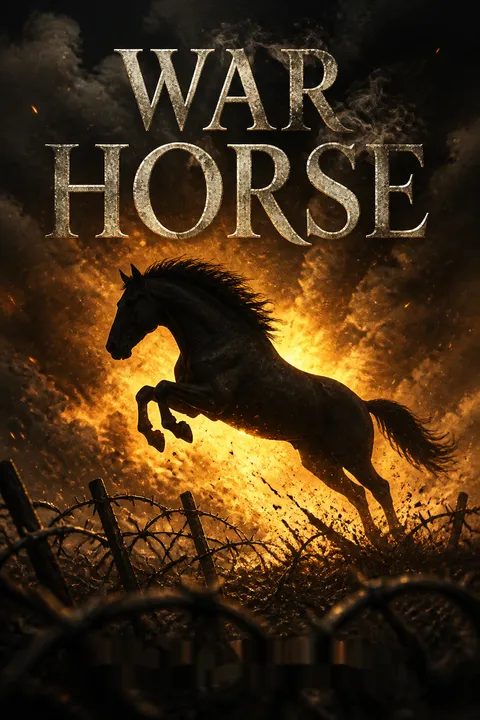


Plot Summary
Prologue
A faded painting in a village hall shows Joey, a red bay horse with a white cross on his forehead. Its frame identifies the painter as Captain Nicholls and dates the portrait to the autumn of 1914.
The image is more than a keepsake: it preserves the memory of a horse and the people whose lives crossed his during the war. The story begins with the colt himself, but the painting frames his journey as something the village must remember after the people and animals who lived it are gone.
The painting establishes memory as an act of care. Joey cannot tell his story in human language, so the portrait and the account around it become ways for others to preserve what war would otherwise erase. Its modest place in the village hall also matters: this is not a grand monument but a local object among ordinary gatherings, suggesting that remembrance belongs in shared daily life. By naming Captain Nicholls and dating the image, the frame ties one horse to a network of human witnesses. The book’s narrative then gives that silent image a history, making remembrance a form of responsibility rather than nostalgia.
A Colt Finds Albert
At six months old, Joey is separated from his mother at a horse sale and bought cheaply by Albert Narracott's father, who wanted to spite a rival farmer. The frightened colt is dragged to the farm, where the drunken farmer roughs him up and leaves him without food or water. Albert, a gentle boy of thirteen, ignores his father's order and enters the stable.
He dries Joey, treats the raw marks on his face, gives him water and hay, and names him. The two grow close as Albert trains him across the fields, calling him with an owl-like whistle. Even the farmer's old mare, Zoey, becomes Joey's first companion, though the colt remains wary of his unpredictable owner.
Joey's first bond is built through acts that answer bodily fear: Albert brings warmth, water, food, and patient touch. The sequence makes trust practical before it becomes sentimental. Albert's affection also offers a contrast to his father's unstable authority, but the father is not reduced to a simple villain. His spiteful purchase creates the relationship by accident, and the farm's economic pressures already shape the family's choices. Joey's instinctive caution and Albert's attentiveness establish a pattern that will recur throughout the story: care is demonstrated through what someone does for a vulnerable creature, especially when power would make neglect easier.
The Plow Saves Joey
When Albert's father comes to the stable drunk and threatens to break Joey into farm work with a whip, Joey kicks him hard enough to make him limp. The farmer threatens to sell or shoot the horse unless Albert can make him pull a plow within a week. Albert understands that tenderness alone cannot keep Joey safe, so he works him beside Zoey across the fields, sometimes using a harsher voice and a whip to keep the colt moving.
Joey learns the work, and the farmer lets him stay. In the following months, Albert rides him across the farm and begins teaching him the landscape by touch and habit. Then news arrives that Britain has entered the war, unsettling the family's fragile routine.
This episode complicates the idea of kindness by showing that protection can require discipline. Albert temporarily gives up the gentleness that defines their bond because the farmer's threat leaves no safer option. Joey's willingness to pull is tied not to submission but to loyalty toward Albert and Zoey. The plow also makes his survival depend on being useful, a logic that will govern his life in uniform. Meanwhile, war reaches the farm first as distant news, but the household's debts and tensions have already prepared the ground for its consequences. The coming conflict will intensify pressures that were present before any soldier arrives.
Sold to the Army
As the war begins, Albert's father worries that the farm's mortgage and falling prices will overwhelm them. He secretly takes Joey to the village, where Captain Nicholls buys the horse for the cavalry. The sale is not an act of simple cruelty: the farmer needs money to keep the land. Still, Joey calls after Zoey as she is led away, and Albert arrives too late to stop the transfer.
Too young to enlist, Albert cannot follow him. Captain Nicholls promises to care for Joey and tells Albert to return when he is old enough. Albert accepts the separation only after making clear that he will come for his horse. Joey leaves the village with the officer, carrying that promise into an unfamiliar military life.
The sale turns economic necessity into a personal rupture. Albert's father has treated Joey as a costly asset, yet his tears reveal that the decision wounds him too; the farm's survival leaves affection with little authority. Albert's inability to enlist gives the separation a second edge: he cannot even choose the same danger as Joey. Nicholls's promise briefly makes military ownership seem compatible with humane care, but the larger institution is already taking the horse beyond the boy's reach. The scene plants a promise that will organize the story, while refusing to pretend that love can simply cancel debt or war.
Joey Meets Topthorn
At the cavalry camp, Joey resists the tight indoor drills, the severe bit, and Corporal Perkins's hard riding. Captain Nicholls visits each evening, sketches him, and argues that the horse needs understanding as well as control. During a final maneuver, Joey outruns the formation beside Topthorn, Captain Stewart's powerful black stallion.
The two horses meet as rivals, then travel side by side to France with their officers. On the crossing, the storm frightens the horses, but Topthorn remains steady enough for Joey to lean against him. Once ashore, the soldiers see wounded men returning from the front and understand that the war ahead is not the adventure they had imagined.
The camp introduces two forms of authority: Perkins's technical control and Nicholls's respect for the animal's character. Joey is not portrayed as incapable of learning, but as a creature whose cooperation depends on how he is handled. His bond with Topthorn extends the story's network of trust beyond Albert, giving him a companion able to steady him when no human can. The wounded at the port puncture the soldiers' optimism and foreshadow the breakdown of cavalry warfare. The horses' apparent fitness and speed, qualities celebrated in training, are about to meet a battlefield designed to make those virtues tragically irrelevant.
The First Charge
When the cavalry squadron finally meets German infantry, the charge scatters the enemy line, but the victory costs many lives. Joey gallops ahead after Captain Nicholls is shot from his saddle, then Topthorn and Captain Stewart recover him. Nicholls is dead, leaving Joey without the officer who had promised to protect him.
The next morning Stewart assigns him to Charlie Warren, a young former blacksmith whose first horse was killed in the same battle. Charlie is an awkward rider, but he tends Joey's sores and treats him gently. As the cavalry is used less often and the winter rain turns roads to mud, Charlie's care keeps Joey going and gradually restores the young trooper's confidence.
The first battle replaces the polished fantasy of cavalry with sudden, impersonal violence. Joey survives the charge without understanding its military purpose, while the person who gave his new life its most humane shape disappears. Charlie's inexperience makes their relationship reciprocal: Joey needs careful treatment, and Charlie needs to recover his nerve after losing a horse. Their bond does not erase the war's hierarchy, but it creates a small pocket of responsibility within it. The winter march also signals the failure of the cavalry ideal. The animals once trained to charge are increasingly reduced to enduring weather, exhaustion, and the decisions of distant commanders.
The Wire Stops the Charge
After a winter of waiting, the squadron is sent across no-man's-land in a new attempt to break the lines. The promised bombardment has not destroyed the barbed wire. Shells and machine guns tear through the horses and riders as Joey follows Topthorn toward the enemy trenches.
A few horses reach the far side, but the attack collapses; Captain Stewart orders the survivors to surrender rather than continue the slaughter. Charlie and Stewart are taken prisoner, while German soldiers lead Joey and Topthorn away separately.
At a field hospital, a tall, wounded German officer insists that the two horses be fed and treated with respect. When the doctors need transport for wounded men, the officer agrees to harness the former cavalry horses to an ambulance cart.
The failed charge is the novel's clearest collision between inherited military doctrine and modern weapons. The horses do exactly what training has prepared them to do, but the wire and guns make courage useless as a tactic. Stewart's surrender is a refusal to let loyalty to the cavalry become another excuse for killing. The German officer's care then crosses the boundary that the battle has enforced: he recognizes the horses' suffering even while they belong to the opposing army. Their change from mounts to ambulance animals is both a practical adaptation and an ethical correction, since they now carry the wounded that the charge produced.
Emilie Gives Them Home
Joey and Topthorn haul wounded German and British soldiers to a field hospital, where the exhausted doctor depends on them for transport. Emilie, a frail girl living with her grandfather near the hospital, persuades him to let her care for the horses. She grooms them, tends their injuries, and leads them to graze, turning the farm stable into a place of safety amid the fighting.
When Emilie develops pneumonia, her grandfather fears losing the last close family he has. The horses return from a hard Christmas day's work to find her recovering, and her grandfather credits their familiar presence and her determination to see them again with helping her hold on. The daily journeys become bearable because Emilie is waiting at home.
Emilie's care gives the horses a temporary home without pretending that the war has stopped. Her attachment grows from sustained attention, not from an idealized claim of ownership: she notices their sores, prepares their feed, and welcomes them back each day. Her illness exposes the cost of that attachment, since the girl has already lost much of her family and now fears losing the animals who have become kin. The old man's gratitude connects human recovery to routine and relationship. The horses cannot cure Emilie, but their return gives her something concrete to anticipate, making care a shared practice rather than a one-way rescue.
Taken Back to the Guns
When the field hospital moves away, Emilie believes Joey and Topthorn can remain with her and her grandfather. They return to farm work, and the old man insists that continuing the harvest is necessary if they are to live. Their peace lasts only weeks. A German artillery unit arrives short of horses, and its bespectacled major claims Joey and Topthorn for a gun team.
Emilie's grandfather cannot prevent the seizure, so she leads the horses out herself, hides her grief, and makes the soldiers responsible for feeding and protecting them. The pair are dragged away behind an ammunition cart. For Joey, the loss recalls his first forced departure, but this time Topthorn is beside him as they enter another phase of the war.
The return to farm labor briefly lets the horses' strength serve life rather than battle, but the army's claim demonstrates how little security private affection can provide in an occupied landscape. Emilie's grandfather understands that refusal would be futile, while Emilie turns helplessness into a final act of agency by handing over the reins herself. Her demand that the soldiers care for them carries moral force precisely because she cannot enforce it. Joey's memory of earlier separations links his story's recurring pattern: each apparent home can be taken away, yet bonds persist through the care people manage before the next displacement.
Topthorn Falls
The artillery team works through freezing mud on scant food, while sores split the horses' lower legs. Joey moves into the leading pair beside Topthorn after the stronger horses weaken; the small Haflingers endure, while Heinie and Coco are eventually lost. The gentle old gunner Friedrich takes special care of Topthorn and speaks of his longing to return to his family and butcher shop.
In a spring offensive, Topthorn collapses from heart failure as the men rest beside a river. Joey refuses to leave him, even when shells strike the woods and Friedrich tries to pull him to safety. Friedrich is killed nearby. At dawn, the first tanks roll down the hill, and their grinding approach finally drives Joey into flight, alone and injured.
Topthorn's death is not a sudden accident detached from the war's machinery. It follows a season of overwork, poor food, and exposure that the veterinary officer had warned could destroy him. Friedrich's tenderness makes the loss more intimate, since he and the horse recognize something of their own exhausted lives in one another. Joey's refusal to leave the body is a form of attachment that cannot alter the outcome, but it makes the cost visible before the tanks erase the moment. The new machines represent a battlefield changing faster than animal bodies can endure, pushing Joey away from the last companion who had shared his journey.
A Coin Divides the Trenches
Joey wanders through shell craters and abandoned ground with a deep wound in his foreleg. Mist carries him into no-man's-land between British and German trenches, where neither side can reach him through the barbed wire. A German soldier and a Welsh soldier each climb out under a white flag, hoping to bring the horse to safety.
Rather than fight over him, they inspect his injury and agree to decide ownership by tossing a coin. The Welshman wins, and the German hands Joey over before returning to his own line. The two soldiers part as allies for a brief moment, though they know the battle will resume. British men guide Joey toward a veterinary hospital, where a familiar voice waits among the orderlies.
The coin toss turns a military boundary into a temporary space for negotiation. Neither soldier denies the other side's claim, but both recognize Joey first as an injured creature needing help. Their agreement is deliberately ordinary, a simple procedure that lets each preserve dignity without using force. That modest fairness contrasts with the systems that have repeatedly taken Joey from one owner to another. The brief truce does not end the war or reconcile the armies, yet it proves that cooperation can exist inside its machinery. The Welshman's rescue also brings Joey close to Albert, whose search has been sustained by a promise rather than certainty.
Albert Knows the Whistle
The familiar voice belongs to Albert, now serving in the veterinary corps and still searching among the army's horses. He cleans Joey but does not recognize him until his friend David points out the white cross and four white socks. Albert then uses the owl-like whistle from their Devon walks, and Joey crosses the yard to him.
The reunion is short-lived: Joey's wound develops into tetanus, stiffening his body and making noise and touch painful. Major Martin recommends ending his suffering, but Albert, David, and Sergeant Thunder persuade him to try treating the horse. Albert and David keep watch, feed Joey milk and gruel, and protect him from disturbance. After weeks in a sling, Joey moves his head and begins the long recovery.
Recognition depends on a combination of visible detail and learned habit. Joey's markings identify him to David, but Albert's whistle confirms the bond through a shared history of response. The reunion therefore restores more than companionship; it returns Joey to a person who knows how to read his fear. Tetanus then tests whether that affection can survive helplessness. The veterinary team's decision to keep treating him turns Albert's personal hope into collective labor, supported by Major Martin's expertise and the others' willingness to stay. Recovery is not miraculous in the sense of effortless. It is made possible by patient care repeated through weeks of uncertainty.
The War Ends, David Doesn't Return
Once Joey can work again, Albert stays beside him as they carry supplies and wounded horses between the veterinary hospital and the front. David is killed by a shell while bringing back horse casualties, and Albert loses the friend who had shared the search for Joey. When the armistice arrives, the relief in the yard is subdued.
The soldiers expect to go home, but the army announces that the sick and war-worn horses will be sold in France rather than transported back to Britain. Albert asks whether Joey will be included, and Major Martin cannot offer an exemption. The men decide to pool their money and bid for him, while the major quietly contributes his savings. Their plan is fragile: a local butcher is also buying horses for slaughter.
The ending of combat does not automatically restore what the war has used. David's death shows that peace arrives after irreversible losses, while the planned sale reveals how institutional accounting continues to govern the animals even when they are no longer militarily useful. Albert's grief gives his determination a sharper edge, but he cannot rely on rank or sentiment to save Joey. The soldiers' pooled money converts gratitude into practical action, and the major's hidden contribution shows that humane resistance can occur inside military obedience. Yet their resources are limited, so the auction makes the final question brutally concrete: what can care accomplish when another buyer can pay more?
One Penny Brings Joey Home
At the auction, Sergeant Thunder's bidding reaches its limit just as a butcher appears ready to buy Joey. Emilie's grandfather arrives and raises the price, refusing to let the butcher take him. Albert recognizes the old man from the farm where Joey and Topthorn had lived. The grandfather explains that Emilie died after the horses were taken from her, and that he promised to find them and care for them.
Rather than keep Joey himself, he sells him to Albert for one penny, asking him to remember Emilie and love the horse as she did. Joey returns to Devon with Albert that Christmas. Albert marries Maisie, resumes farm life and bell-ringing, and Joey works beside Zoey, while the village remembers those who did not return.
The penny makes the final transfer an exchange of responsibility rather than a contest over market value. Emilie's grandfather could claim Joey as his own, but he understands that Albert and the horse share a life he cannot replace. His request that Albert remember Emilie gives the reunion a debt of memory: Joey carries the care she gave him into a new home, and Albert must carry her story with him. The ending brings the opening's separation full circle without pretending that homecoming repairs every loss. The village celebrates Joey and Albert, but the absent Nicholls, Topthorn, Friedrich, David, and Emilie remain part of what their return means.
Analysis
War Horse makes the horse's body its history book. Joey's changing labor records military decisions in immediate terms: a bit that hurts, a harness pulling a gun, a wound left exposed, or a stable made safe by someone who knows how to feed him. Because Joey cannot understand national allegiance, the human world appears through its practical effects. British and German soldiers can be kind or cruel, and the dividing line between them is less decisive than the choices they make toward a dependent animal.
The story repeatedly separates possession from care. Albert's father owns Joey but cannot offer the stable affection Albert does; the army purchases him but transfers him among tasks; Emilie and her grandfather give him a home without controlling how long he can stay. The novel does not suggest that love makes these transfers painless. Rather, each loss tests whether care can survive a change in ownership, language, and circumstance. Joey's attachments accumulate instead of canceling one another.
That accumulation also challenges the fantasy of heroic warfare. Cavalry training turns speed and obedience into virtues, but wire and machine guns render them disastrous. Later, the same animals carry wounded men and haul artillery, their usefulness measured by how long their bodies hold up. The war's machinery is shown not as abstract strategy but as repeated extraction from living creatures. Topthorn's decline makes that cost impossible to mistake.
The ending offers neither a clean victory nor a return to innocence. Albert brings Joey home, but the reunion has been bought through the deaths of friends and the loss of Emilie. Her grandfather's penny makes the final transfer an act of memory: Albert accepts not merely the horse but an obligation to remember the girl who cared for him. The village painting that frames the narrative performs the same work. To tell Joey's story is to preserve the people who made care possible, especially those who never came home.
Review Summary
War Horse is a beloved children's novel about a horse named Joey who serves in World War I. Told from Joey's perspective, it explores themes of friendship, loyalty, and the horrors of war. Readers praise the emotional storytelling, vivid descriptions, and anti-war message. Many found it moving and cried while reading. The book is compared to Black Beauty and is appreciated by both children and adults. Some criticize the anthropomorphized horse narrator, but most find it effective. The story was adapted into a successful play and film.
People Also Read
Characters
Joey
The remembering war horseJoey is a red bay horse marked by a white cross and four white socks. He narrates the story through a keen awareness of touch, voice, hunger, fear, and companionship. He does not interpret human politics, but he feels their consequences whenever a sale, battle, or military order changes who feeds him and where he sleeps. His early bond with Albert teaches him to trust care, while his encounters with other soldiers and civilians show that gentleness can arise across enemy lines. Joey's resilience is physical and relational: he keeps working and surviving, but he is never untouched by separation. His attention to individual people gives the sprawling war a close, embodied scale.
Albert Narracott
Joey's steadfast boyAlbert is a farm boy whose connection to Joey begins in practical kindness. He notices the colt's fear, tends his injuries, and patiently teaches him to work. His loyalty is fierce, but it is not blind: he understands the farm's needs and later accepts the discipline of military service in order to search for his friend. Albert's tenderness is expressed through attention and persistence, from the owl-like whistle that calls Joey to the care he gives sick horses in the veterinary corps. His bond with Joey anchors him through war, while his friendships and losses make clear that courage does not protect anyone from grief. He is driven by a promise he intends to keep.
Topthorn
Joey's brave companionTopthorn is Captain Stewart's tall black stallion, powerful and composed beside the more fiery Joey. He becomes Joey's closest companion in the army, offering steadiness during the stormy crossing to France and the frightening approach of battle. His strength makes him valuable to cavalry and artillery alike, but it also exposes him to relentless work. Topthorn's quiet presence shapes Joey's sense of safety: he is a partner who shares labor without rivalry and offers comfort without needing words. His connection with Friedrich adds another example of the bond that can grow between a horse and the person responsible for him.
Captain Nicholls
Joey's first army protectorCaptain Nicholls buys Joey for the cavalry and takes the promise made to Albert seriously. He visits the horse during training, sketches him, and urges Corporal Perkins to handle him with care. Nicholls combines military confidence with a sober awareness that modern weapons may make cavalry charges disastrous. His kindness gives Joey a humane first experience of army life, and his care establishes the standard against which Joey later judges other handlers.
Captain Stewart
Topthorn's cavalry officerCaptain Stewart is Topthorn's rider and Captain Nicholls's close friend. He shares Nicholls's doubts about the cavalry's place in modern warfare, even while leading his men into battle. Stewart values both horses and soldiers, and his willingness to surrender rather than prolong a doomed charge shows a practical moral courage. He also recognizes the bond between Joey and Topthorn and tries to keep them together when circumstances allow.
Charlie Warren
The careful young riderCharlie Warren is a young former blacksmith assigned to Joey after the first battle. He is an uncertain rider, still shaken by losing his own horse, but careful and devoted when tending Joey's sores and injuries. His work with Joey helps restore his confidence in riding, while Joey benefits from Charlie's patient grooming and protection through a brutal winter. Charlie's affection for home and the girl he hopes to marry keeps his life outside the war present in the story.
Emilie
The horses' young caretakerEmilie is a frail girl living with her grandfather near a German field hospital. She insists on caring for Joey and Topthorn, tending their injuries, preparing their stable, and making their return from dangerous journeys something to look forward to. Her kindness is both playful and determined; she treats the horses as companions and imagines a peaceful future in which she can ride them. Having suffered family losses, she invests deeply in the fragile home she can still create.
Emilie's grandfather
A farmer's promise keeperEmilie's grandfather is a French farmer who shares his home with his granddaughter and accepts the horses into their daily life. He understands the necessity of work and the limits of what a civilian can resist during occupation, but he remains protective of Emilie and the animals. His care is quieter than hers, grounded in feeding, shelter, and keeping the farm running. He sees the horses as part of the family Emilie has left, and he values the stories that keep the dead present.
Friedrich
The gentle German gunnerFriedrich is an older German soldier, nicknamed Crazy Old Friedrich because he talks and chuckles to himself. In truth, he is a homesick butcher who dislikes the war and longs for his family. He gives Joey and Topthorn extra food and rest whenever he can, particularly watching over Topthorn after illness. His quiet humor and opposition to pointless killing reveal how a person can remain humane even while serving within a violent institution.
David
Albert's loyal army friendDavid is Albert's friend in the veterinary corps and a former fruit seller from London. He helps Albert care for Joey and supports his belief that the horse can be found. David is practical and warm, sometimes teasing Albert but never dismissing the depth of his attachment. His experience with horses and his loyalty to Albert make him a steady presence in the veterinary unit.
Major Martin
The veterinary decision makerMajor Martin leads the veterinary hospital where Albert serves. He is a skilled horse doctor who treats each animal's condition seriously and expects his staff to work with discipline. Martin balances military orders against the needs of sick horses, and his authority can make room for compassion when others argue that an animal deserves a chance. He is neither sentimental nor indifferent; his decisions depend on expertise and the willingness of his unit to carry out difficult care.
Sergeant Thunder
The unit's blunt caretakerSergeant Thunder is the booming, exacting sergeant at Major Martin's veterinary hospital. He enforces routines and keeps the men working, yet his gruff manner conceals a strong concern for the horses and the people caring for them. He backs Albert's effort to save Joey and helps the unit find a way to bid for him after the war. Thunder's practical kindness appears as logistics, protection, and money rather than softness.
Albert's father
The pressured farm ownerAlbert's father is a farmer burdened by a mortgage, declining prospects, and the demands of running the land. He can be harsh when drunk and resentful of the expense of keeping Joey, yet his behavior is not simply cruelty: he worries about the family losing its farm and later shows remorse for how he has treated them. His strained relationship with Albert reflects the way fear and hardship can distort care without erasing it.
Albert's mother
The family mediatorAlbert's mother tries to hold the family together as her husband drinks and Albert resents his demands. She explains the pressures behind the father's behavior and often mediates between them, while also recognizing that Albert's complaints are justified. Her tenderness does not make her powerless, but she has few tools beyond persuasion and patience. She offers a view of the farm's troubles that neither excuses harm nor ignores the burdens driving it.
Maisie Brown
Albert's village sweetheartMaisie Brown is a young woman from Albert's village who works on a neighboring farm and bakes bread and pastries. Albert speaks of her affectionately while away at war and hopes to return to her. She represents the ordinary future he imagines beyond military service: a home, familiar work, and the person who supported his search for Joey.
Plot Devices
The white cross and whistle
Recognition across distanceJoey's white cross and four white socks make him visually distinctive, while Albert's owl-like whistle carries the memory of their life on the farm. The two details work together when Albert encounters the mud-covered horse at the veterinary hospital: David recognizes the markings, but the whistle confirms that this is the Joey Albert has been seeking. The markers also connect the opening relationship to the later reunion without relying on coincidence alone. They turn physical description and a repeated sound into evidence of shared history.
Changing work for horses
War's shifting demandsJoey's changing roles trace the war's effect on both animals and soldiers. He moves from farm labor to cavalry training, then to ambulance work, artillery hauling, veterinary service, and finally farm life again. Each new task follows military necessity rather than the horse's preference, and each shift changes who is responsible for him. This recurring pattern gives the story a physical way to register the obsolete cavalry charge, the scale of casualties, and the persistence of agricultural life beneath wartime disruption. The horses' bodies record what the official accounts of military movement cannot.
The coin toss
A truce made practicalWhen Joey is trapped between opposing trenches, a German soldier and a Welsh soldier both try to reach him. They use a coin toss to decide which side will take him for treatment, allowing either man to help without forcing the other to retreat in humiliation. The device is small and improvised, but it briefly replaces military rank and national identity with a shared concern for an injured animal. Its outcome sends Joey toward the British veterinary hospital and makes the reunion with Albert possible.
The auction and penny
Care replaces ownershipThe army's sale of its remaining horses threatens to turn Joey's life into a final question of price. Albert and his fellow soldiers pool what little money they have, while Emilie's grandfather arrives with enough determination to keep Joey away from the butcher. He then transfers the horse to Albert for a penny, asking him to care for Joey and preserve Emilie's memory. The auction reveals how vulnerable the horses remain even after the fighting stops; the penny turns the last transfer into a promise between people who have loved the same animal.
FAQ
Synopsis & Basic Details
What is War Horse about?
- Synopsis focuses horse's journey: War Horse tells the story of Joey, a farm horse in England, and his extraordinary journey through World War I. Sold to the army, Joey experiences the horrors of war from various perspectives, serving both the British and German forces.
- Highlights bond amidst conflict: The novel emphasizes the powerful bond between Joey and a young man named Albert, who enlists in the army to find and protect his beloved horse. Their relationship is tested by the war's brutality.
- Themes of war and friendship: War Horse explores themes of war, loss, friendship, and the resilience of the human and animal spirit, showcasing the impact of conflict on individuals and their relationships.
Why should I read War Horse?
- Emotional and moving narrative: War Horse offers a deeply emotional and moving narrative that explores the bond between humans and animals, particularly in the context of war. It evokes empathy and understanding for all involved.
- Historical perspective on WWI: The book provides a unique historical perspective on World War I, depicting the war's impact on ordinary people and animals, and challenging traditional notions of heroism and patriotism.
- Exploration of universal themes: War Horse delves into universal themes of friendship, loyalty, loss, and the search for meaning in the face of adversity, making it a relevant and thought-provoking read for all ages.
What is the background of War Horse?
- Set during World War I: The novel is set against the backdrop of World War I (1914-1918), a global conflict characterized by trench warfare, technological advancements in weaponry, and immense human suffering.
- Rural England to Western Front: The story begins in rural Devon, England, and follows Joey's journey to the Western Front in France and Belgium, where much of the war's fighting took place.
- Historical context of cavalry: The book reflects the historical context of cavalry warfare during WWI, highlighting the transition from traditional horse-mounted combat to mechanized warfare and the devastating impact of new technologies like machine guns.
What are the most memorable quotes in War Horse?
- "I will find you, Joey": This quote encapsulates Albert's unwavering determination and love for Joey, driving him to enlist and search for his horse amidst the chaos of war. It highlights the theme of enduring friendship.
- "The world has gone quite mad": This quote, spoken by the German officer, reflects the senselessness and absurdity of war, where noble creatures are reduced to beasts of burden. It underscores the novel's anti-war message.
- "We have shown them that any problem can be solved between people if only they can trust each other": This quote, spoken by the German soldier in no-man's land, emphasizes the potential for understanding and reconciliation even amidst conflict, highlighting the theme of humanity.
What writing style, narrative choices, and literary techniques does Michael Morpurgo use?
- First-person animal narration: Morpurgo employs first-person narration from Joey's perspective, allowing readers to experience the war through the eyes of an animal, creating a unique and emotionally resonant narrative.
- Simple and accessible language: The writing style is simple and accessible, making the story engaging for a wide range of readers, particularly young adults. It focuses on clear descriptions and emotional impact.
- Use of vivid imagery: Morpurgo uses vivid imagery to depict the beauty of the natural world and the horrors of war, creating a strong contrast that emphasizes the destructive impact of conflict on the environment and its inhabitants.
Hidden Details & Subtle Connections
What are some minor details that add significant meaning?
- The white cross symbolism: Joey's distinctive white cross on his forehead is mentioned repeatedly. It symbolizes innocence and purity amidst the brutality of war, making him a beacon of hope and goodness.
- Zoey's initial kindness: The old mare Zoey's initial act of kindness towards Joey in the stables foreshadows the importance of companionship and empathy throughout the story, highlighting the theme of connection.
- Albert's owl whistle: Albert's unique owl whistle, used to call Joey, becomes a symbol of their unbreakable bond and a reminder of their peaceful life on the farm, contrasting with the chaos of war.
What are some subtle foreshadowing and callbacks?
- Father's drunken purchase: Albert's father buying Joey while drunk foreshadows the impulsive decisions and regret that will plague the family, ultimately leading to Joey's sale and the start of his war journey.
- Captain Nicholls' painting: Captain Nicholls' painting of Joey, sent to Albert, foreshadows the enduring memory and impact Joey has on those who encounter him, even after Captain Nicholls' death.
- Emilie's Christmas gift: Emilie's promise of extra rations for Joey during Christmas foreshadows the fleeting moments of kindness and humanity amidst the war's brutality, highlighting the theme of hope.
What are some unexpected character connections?
- Albert and Trooper Warren: Trooper Warren's initial fear of horses, stemming from a battle where his horse was shot from under him, creates an unexpected parallel with Albert's fear of losing Joey to the war.
- Captain Nicholls and Friedrich: Both Captain Nicholls and Friedrich represent opposing sides of the war, yet they share a deep respect for horses and a sense of disillusionment with the conflict, highlighting the shared humanity.
- Emilie and Albert: Though they never meet, Emilie and Albert are connected through their shared love for Joey, representing the enduring power of kindness and compassion that transcends national boundaries.
Who are the most significant supporting characters?
- Zoey provides early comfort: Zoey, the older farm horse, offers Joey initial comfort and guidance, representing the importance of mentorship and connection in navigating new and challenging environments.
- Friedrich embodies compassion: Friedrich, the German soldier, embodies compassion and empathy, demonstrating that kindness can exist even in the midst of war and challenging the notion of the enemy.
- Emilie represents innocence: Emilie, the young French girl, represents innocence and the devastating impact of war on civilians, particularly children, highlighting the theme of loss and the search for hope.
Psychological, Emotional, & Relational Analysis
What are some unspoken motivations of the characters?
- Albert's need for control: Albert's initial protectiveness of Joey stems from a need for control and stability in a home environment marked by his father's alcoholism and the farm's financial struggles.
- Father's guilt and redemption: Albert's father's initial harshness towards Joey masks a deep-seated guilt over his financial struggles and inability to provide for his family, leading to a later attempt at redemption.
- Captain Nicholls' artistic expression: Captain Nicholls' artistic endeavors, particularly his painting of Joey, reflect a desire to find beauty and meaning amidst the chaos of war, serving as a form of emotional expression.
What psychological complexities do the characters exhibit?
- Albert's internal conflict: Albert experiences internal conflict between his love for Joey and his sense of duty to his family and country, leading to difficult decisions and emotional turmoil.
- Friedrich's moral dilemma: Friedrich faces a moral dilemma as a German soldier, torn between his duty to his country and his compassion for the suffering he witnesses, leading to disillusionment and a desire for peace.
- Joey's learned helplessness: Joey's experiences of being sold and captured lead to a sense of learned helplessness, where he adapts to his circumstances but longs for connection and stability.
What are the major emotional turning points?
- Joey's separation from mother: Joey's initial separation from his mother at the auction is a traumatic event that shapes his early life and underscores the theme of loss and the search for connection.
- Captain Nicholls' death: Captain Nicholls' death in battle is a significant emotional turning point for Joey, highlighting the senselessness of war and the loss of innocence.
- Albert and Joey's reunion: Albert and Joey's reunion at the veterinary hospital is a moment of profound joy and relief, reinforcing the theme of enduring friendship and the power of hope amidst adversity.
How do relationship dynamics evolve?
- Albert and his father: The relationship between Albert and his father evolves from strained and distant to one of understanding and reconciliation, particularly after Joey's sale and the father's subsequent remorse.
- Joey and Topthorn's bond: Joey and Topthorn's bond deepens from initial wariness to a strong friendship based on mutual support and understanding, highlighting the importance of companionship in times of hardship.
- Albert and David's brotherhood: Albert and David's relationship evolves into a close brotherhood forged through shared experiences and mutual support, demonstrating the power of friendship to overcome the challenges of war.
Interpretation & Debate
Which parts of the story remain ambiguous or open-ended?
- Maisie's true feelings: Maisie's true feelings towards Joey remain somewhat ambiguous, leaving the reader to interpret the dynamics of her relationship with Albert and her acceptance of Joey into their lives.
- The long-term impact of war: The long-term psychological impact of the war on Albert and Joey is left open-ended, suggesting that the scars of conflict may linger even after their return home.
- The fate of other horses: The fate of other horses encountered by Joey, such as the black stallion Topthorn, is left unresolved, prompting reflection on the countless animals affected by war and their often-unacknowledged suffering.
What are some debatable, controversial scenes or moments in War Horse?
- Albert's father selling Joey: Albert's father's decision to sell Joey to the army is a controversial moment, raising questions about economic necessity versus emotional attachment and the ethics of profiting from war.
- The cavalry charge scene: The cavalry charge scene, depicting the senseless loss of life and the futility of traditional warfare in the face of modern technology, can be interpreted as a critique of military strategy and leadership.
- The ending's sentimentality: The ending, with Joey's miraculous recovery and reunion with Albert, can be debated for its sentimentality, with some arguing that it offers a too-neat resolution to the complexities of war and loss.
War Horse Ending Explained: How It Ends & What It Means
- Emilie's grandfather's intervention: Emilie's grandfather's intervention at the auction, saving Joey from the butcher, symbolizes the enduring power of love and remembrance, offering a glimmer of hope amidst the war's devastation.
- Albert's promise fulfilled: Albert's return home with Joey fulfills his promise and represents the triumph of friendship and loyalty over adversity, providing a sense of closure and emotional resolution.
- Legacy of remembrance: The ending emphasizes the importance of remembering those lost in war, particularly Emilie, ensuring that their stories and sacrifices are not forgotten, highlighting the theme of remembrance and the enduring impact of conflict.
War Horse Series
Download PDF
Download EPUB
.epub digital book format is ideal for reading ebooks on phones, tablets, and e-readers.








