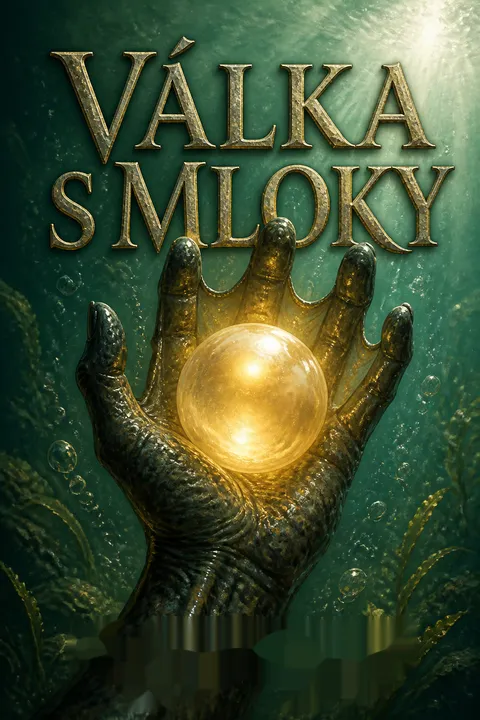


Plot Summary
The Devils of Tana Masa
Captain J. van Toch, a Czech merchant sailor hunting for new pearl beds, reaches Tana Masa and hears that sea devils live in the forbidden bay. When his divers return terrified, he goes back alone after dark. There, small upright creatures emerge from the water, and one offers him a pearl oyster.
Van Toch opens it, gives the shell back, and watches the creature eat. Rather than treat the encounter as a monster story, he returns night after night, learning that the newts are curious, intelligent, and vulnerable to sharks. Their numbers and the pearls they bring turn his search for an ordinary commercial opportunity into a private responsibility.
Van Toch’s first response is shaped by the same colonial confidence that brought him to the island: he assumes local fear is superstition and approaches the bay as a resource to be tested. Yet the newts’ curiosity changes the terms of the encounter. The decisive act is not simply finding pearls, but opening a shell for a creature that cannot manage it alone. He recognizes a capacity for learning and vulnerability, though he still frames care as a bargain he can administer. The novel plants its central contradiction here: genuine affection and commercial usefulness are not opposites for Van Toch, and the good faith of one person cannot control what others will do with his discovery.
Pearls Buy a Passage
Back in the bay, Van Toch hires a Dayak shark hunter and teaches the newts to use knives and harpoons. They begin killing sharks, building dams to protect their breeding grounds, and bringing him pearls in exchange for tools and food. Van Toch keeps his promise, treating the creatures as partners rather than stock. To move them beyond their crowded home, he needs a ship with tanks.
In his Czech hometown, journalists Golombek and Valenta point him toward G. H. Bondy, a wealthy industrialist and former schoolmate. Bondy listens to the captain’s account, sees the pearls, and agrees to finance a vessel. Mr Povondra, Bondy’s doorman, admits Van Toch to the house, unknowingly opening a door through which the discovery will spread.
Van Toch’s training is both protection and preparation for exploitation. Knives and harpoons help the newts survive, while the dam shows they already possess collective engineering instincts. His promise to exchange tools for pearls establishes a personal ethic, but Bondy’s investment gives the arrangement a scale no personal ethic can govern. Povondra’s small act of hospitality later becomes a source of torment because he mistakes access for authorship: he helped connect two men, but did not create the system that followed. The novel’s causal chain is deliberately ordinary. A threatened habitat, a commercially minded captain, an investor, and a doorman’s judgment suffice to set global history moving.
The Lagoon Film Set
On a Pacific island, young Abe Loeb and his friends encounter newts when the actress Lily Valley enters the lagoon. The creatures approach with pearls, repeating words they have heard from humans. The party captures one for display, but it dies in a tub before they can understand how to care for it.
Instead, they turn the meeting into publicity: Lily’s photographs and stories about marine monsters circulate widely, and her acting career benefits.
Scientists initially dismiss the images as a hoax, while reporters and audiences argue over whether the creatures are reptiles, mammals, or sea gods. The newts have made contact with people who could have learned about them. Instead, the humans convert that encounter into a spectacle and a marketable story.
The lagoon episode compresses the novel’s larger pattern into a social comedy. The newts approach with an object of exchange, but the humans read their gestures through vanity, romance, and entertainment. Lily’s career gains from the encounter even as the captured animal dies, a sharp contrast between human self-promotion and the creature’s physical dependence. The argument over classification seems scientific, yet it mostly protects human assumptions from revision. Calling the newts monsters, hoax figures, or mythic admirers makes them easier to consume as images. The public sees them everywhere in the press before it recognizes them as living beings with needs.
The Newt Becomes News
As reports of upright sea salamanders multiply across Pacific islands, an expedition captures specimens and identifies them as Andrias Scheuchzeri, a species thought extinct. Scientists dispute names and national claims, but the evidence can no longer be dismissed as a camera trick.
At London Zoo, keeper Thomas Greggs teaches a newt to speak, and the animal, Andy, learns by repeating the papers and conversations around him. Researchers conclude that he has absorbed familiar opinions rather than developed independent thought.
Visitors nevertheless crowd around him, bringing sweets until he becomes ill and dies. The episode exposes how quickly humans turn an unfamiliar mind into a public attraction, then confuse repetition of their own culture with proof that the newt has no mind.
Andy is not presented as a hidden genius whose speech settles the question of animal personhood. His borrowed language instead reflects the narrowness of the tests imposed on him: the experts ask him to reproduce human categories, then treat the result as a measurement of his limits. The visitors’ affection is equally compromised. Their gifts overwhelm the animal they admire, turning attention into a physical danger. The irony is exact: the scientists underestimate Andy because he echoes human habits, while the crowd overvalues him as a novelty. Both responses keep the humans, rather than the newt, at the center of the encounter.
Povondra’s Missing Clue
Years later, Povondra takes his son Frankie to a shabby fairground show advertising Van Toch’s trained newts. The single exhausted animal in a bathtub bears little resemblance to the wonders described in newspapers, but Povondra recognizes the captain’s name and remembers admitting him to Bondy.
Around the same time, Professor Uher receives an old newspaper clipping describing a captain who removed newts from an isolated lagoon. Uher reconstructs a likely chain: a few survivors were released into warmer, food-rich waters where they multiplied rapidly.
He wants to publish the warning that the species may still be evolving, but the newspaper rejects his article. The clue survives only as private knowledge, while the public continues treating the newts as entertainment or ordinary merchandise.
The fair and the rejected article offer two kinds of failed recognition. Povondra sees the living consequence of a discovery he once helped connect to Bondy, but the fair’s poor conditions reduce that consequence to a cheap diversion. Uher, by contrast, sees an ecological process: human relocation has placed an ancient species in conditions that favor explosive growth. Yet expertise cannot matter when editors decide the subject has become tiresome. The novel makes ignorance active rather than innocent. People have evidence, but their institutions reward novelty, profit, and familiar explanations over attention to what the evidence implies.
The Syndicate Replaces Van Toch
After Van Toch dies at sea, Bondy chairs a meeting of the Pacific Export Company as its pearl business falters. The company holds a vast unsold stock, and the newt colonies are outgrowing their natural food supplies.
Bondy proposes abandoning the captain’s small-scale, adventurous approach and building a broader enterprise. The shareholders approve the Salamander Syndicate, a partnership linking shipping, food, insurance, heavy industry, and Bondy’s own manufacturing interests.
Newts will be hired or sold for harbor works, breakwaters, and other underwater projects. Bondy presents this as a way to preserve the creatures and keep the company profitable. He never asks what the newts are or want; their value is now measured in labor capacity and future numbers.
Van Toch’s death removes the one person who insisted on a reciprocal relationship with the newts, but it does not stop the trade he began. Bondy’s institutional answer is more efficient precisely because it removes personal obligation from the process. The Syndicate connects businesses that each benefit from a different part of the newt economy, making responsibility diffuse and therefore easy to evade. Bondy can sincerely believe that employment protects the animals while designing a system that treats reproduction as an asset. The transition from pearl exchange to industrial labor marks the novel’s moral hinge: exploitation becomes respectable when distributed among boards, contracts, and projections.
Millions Beneath the Water
The Syndicate spreads the newts along coasts worldwide, sorting them into grades for skilled leadership, heavy labor, team work, or sale by weight. Training farms teach speech, drill, tool use, and engineering; tank ships move workers between continents.
Human societies debate whether newts are property, citizens, or a competing labor force, while schools, churches, reformers, and political movements try to shape them. Some newts publish scientific work and gain limited recognition, but legal protections mostly regulate where they may live and how employers may use them.
Meanwhile, engineers plan new islands and expanded coastlines, and industries depend on the newt market. The language of humane treatment grows alongside a trade that turns living beings into standardized units of production.
The newt system does not rely on crude violence alone. It combines schooling, regulation, charitable concern, and commercial classification, each making control appear more reasonable. The categories used by the trade reduce differences among individuals to usefulness, while education is designed largely to improve work. Even debates over citizenship often preserve the assumption that humans may define the newts’ place. The novel’s satire is especially sharp where benevolence and exploitation share the same vocabulary: the newts are protected so they can be transported safely, and educated so they can serve more effectively. Progress becomes a process of making domination administratively legible.
Cocos Island Retaliation
Pirate crews regularly raid isolated newt colonies, stunning the animals and shipping survivors in filthy tanks. On the Cocos Islands, Lieutenant McCarth leads a hunting party against hundreds of newts, expecting an easy capture. The newts fire underwater pistols and use explosives, killing McCarth and several sailors.
Captain Lindley arrives with a hidden machine gun, but a newt detonates a charge beneath his boat and destroys it. A surviving sailor watches the newts kill the trapped raiders. The authorities respond by sending warships to bombard the island and nearby colonies, killing large numbers of newts. The incident is officially treated as a warning against resistance, while the raiding trade resumes with little change.
The massacre makes visible the violence concealed by the commercial language of capture and transport. The newts’ weapons came from the human economy, but their use against raiders is framed as an intolerable surprise rather than a foreseeable response to repeated attacks. The authorities punish the colony instead of examining the conditions that produced resistance. Even the pirate crews’ business rules, which limit weapons to prevent competition among humans, reveal the actual priority: order among merchants, not safety for newts. The episode establishes a recurring pattern of human policy. When the newts defend themselves, the resulting violence is used to justify tighter control.
Apples Ignite Normandy
In Normandy, newts working on coastal projects steal apples from nearby orchards after employers refuse to include fruit in their ration. Farmers arm themselves, kill newts, and clash with police sent to confiscate their guns.
When village boys attack a newt, it throws an explosive that kills itself and three children. An enraged crowd raids a colony, and troops build a barrier between the workers and the villages. The cruiser Jules Flambeau arrives to calm the coast, but an underwater explosion sinks it.
France acknowledges that it armed its newts and claims they mistook the ship’s flares for an attack. The government then sends apples into the sea and subsidizes wine for the newts, easing the conflict without addressing the arms or the exploitation.
Normandy’s crisis begins with a small refusal: employers deny the workers a food they desire, then treat their theft as a security problem. The state tries to separate humans and newts with fences and troops, but the explosive and the sinking cruiser show that the conflict cannot be contained by administrative boundaries. France’s eventual solution is revealingly transactional. Apples and wine soothe the immediate dispute because they cost less than a confrontation, yet the armed workforce remains in place. The episode turns an absurd appetite into a credible political crisis, showing how systems manufacture emergencies by refusing to acknowledge ordinary needs.
The Channel Goes Under
Britain and France secretly build opposing underwater fortresses in the Channel, each fearing the other will gain control of the passage. Armed newts and workers on the seabed clash, triggering explosions that tear apart nearby waters and alarm ferry passengers.
The governments blame one another and mobilize their forces. Only when a British official discovers that an old law technically forbids newts from working in British waters does the crisis lose its legal footing.
The two countries agree to a neutral strip between their fortifications, and the immediate danger passes. The compromise does not stop the arms race. It instead preserves the fiction that the newt problem can be managed through territorial rules while both nations continue preparing for war.
The Channel incident shows how human states turn a shared workforce into a proxy for national rivalry. France and Britain arm newts, build fortresses, and then argue over whether those same workers have crossed a border. The legal technicality that prevents open war is less a triumph of diplomacy than an accidental escape route from their own contradictions. Neither government wants to relinquish the strategic advantage the newts provide. The neutral strip quiets the immediate dispute while preserving its causes. In this world, international law can limit a crisis without challenging the incentives that will produce another one.
The Newt Becomes a Nation
In the Baltic, German scientists describe a paler, more upright newt as a superior Nordic type, and newspapers use the claim to demand more coastline and military strength. A monument to the fossil scientist Scheuchzer turns biology into national mythology.
The philosopher Wolf Meynert then argues that humanity is doomed because its divided nations cannot match the newts’ apparent unity. An anonymous pamphlet, A Warning from X, counters that the newts’ silence and growing industrial power are dangerous, urging people to stop supplying them.
Both warnings reach a public unwilling to sacrifice prosperity. Trade unions fear lost jobs, industries fear lost orders, and governments fear that rivals will keep arming their own newts. The arguments multiply, but no one interrupts the system.
The newts become a screen onto which humans project their most dangerous beliefs. German racial propaganda turns a biological variation into proof of national entitlement, while Meynert turns the newts into an idealized answer to human conflict. X sees the opposite danger, but even this warning offers little practical route out of dependence. The public’s failure is not simply that it lacks foresight. Every group can identify a cost to changing course, and those costs are immediate, while catastrophe remains abstract. The novel shows ideology and economics reinforcing each other: fantasies of racial greatness and the defense of jobs both keep the same machinery running.
The Coastline Is Dismantled
Earthquakes and tidal floods strike Louisiana, China, and the West African coast, opening new inlets and drowning settlements. Scientists offer competing natural explanations until the governor of Louisiana receives a message from the newts’ leader accepting responsibility for the deaths there.
Soon a powerful radio broadcast reaches listeners across the world. The leader explains that the newts need more shallow water and coastline, and that they intend to break up the continents to create it. They ask humans to supply metal, machinery, and explosives, offering cooperation in return.
Their next broadcasts announce attacks on ships and warn governments against blocking deliveries. The newts are no longer merely a labor force scattered among human nations. They have coordinated their demands and begun remaking the map.
The earthquakes transform the novel’s long chain of commercial decisions into an unmistakable act of political coercion. The newts explain their need in material terms: they lack space in the shallow waters they can inhabit. Yet their solution treats human settlements as removable obstacles, mirroring the way human businesses treated newt lives as units of labor. The radio is a new form of power because it lets the newts address humanity directly, bypassing the institutions that once spoke for them. Their demand for continued human supplies also exposes the dependence beneath their apparent independence: the revolt is built from the same tools and industries that created their global reach.
Vaduz Sells the World
The newts blockade Britain, sink ships, and shell its ports after the British government embargoes supplies. Britain refuses to negotiate and faces hunger, while other nations profit by selling food and goods through the air. At the Vaduz conference, governments refuse to recognize the newts as a sovereign enemy, since doing so might give their own colonies a claim to nationhood.
The newts send human lawyers, who demand apologies, supplies, and territory, then offer to buy parts of the world. Delegates debate which regions might be ceded, even as reports arrive that the newts have flooded part of Venice. The conference cannot agree on collective action. It treats an existential crisis as a set of negotiable property claims.
Vaduz is the political culmination of a system built to avoid responsibility. The states that once supplied weapons and labor now insist that the newts are not a state, because recognizing them would complicate their own control. Britain’s refusal to negotiate is presented as honor, but the conference’s calculations are no less self-interested: every government tries to preserve its position or pass the cost to someone else. The newts’ lawyers adopt the language of purchase and compensation, exposing how thoroughly human political thought has taught them to translate conquest into contracts. Venice floods while the delegates continue bargaining, a physical verdict on procedural delay.
Povondra Sees the River
Years into the war, the retired Povondra fishes on the Vltava with his grown son Frankie. He has spent much of his life collecting newspaper reports about the newts and telling himself that admitting Van Toch to Bondy helped bring progress to the world.
Now Frankie reports that the newts have reached Dresden and that much of Europe has drowned. Povondra insists that landlocked Bohemia is safe, protected by mountains and neutrality. Then a black head rises near Prague’s riverbank.
Povondra recognizes a newt and breaks down, convinced that his decision began the catastrophe. His family tries to calm him, and Frankie reminds him that governments, banks, and industries all chose to expand the trade. Povondra still asks the children to forgive him.
Povondra’s return gives the novel’s vast history a domestic scale. His collection of clippings once offered him a flattering role in events: he had recognized Van Toch’s importance and helped Bondy act. When a newt appears in Prague, that story collapses into guilt. His mistake is not that he caused the catastrophe alone, but that he confused one small contribution with control over a collective process. Frankie’s answer restores scale without erasing responsibility. The family cannot promise safety, yet it refuses Povondra’s solitary verdict. His fear makes the novel’s political argument intimate: complicity is widely shared, but people still experience it one conscience at a time.
The Ending Changes Course
The final chapter becomes a conversation between the author and an inner voice, which refuses to leave Povondra in despair or accept human extinction as inevitable. The author initially argues that events follow the logic of economic and political choices, then considers how people might survive on narrow strips of land and serve the newts.
The inner voice proposes another possibility: the newts could divide into rival populations, compete for coastlines and prestige, and eventually fight one another.
The author develops the speculation into a war between westernized and traditional newt societies, ending in a disease that destroys them. This is not a reported resolution but a deliberately uncertain alternative. The book closes by asking whether the newts will inherit human habits as well as human technology.
The ending refuses the comfort of a conventional rescue. Its imagined newt war is a possibility, not a forecast secured by the plot, and the author knows that it depends on the newts adopting the divisions humans have taught them. The exchange also challenges the fatalism of Meynert, whose vision of a unified newt world merely reverses the hierarchy without changing its logic. Human survival, if it comes, would not prove human wisdom; it might depend on the newts repeating humanity’s failures. By ending in speculation, the novel leaves readers with responsibility rather than closure: the future remains open, but the mechanisms driving it are already visible.
Analysis
War with the Newts traces catastrophe not to a single villain or a sudden technological mistake, but to a chain of ordinary decisions that become difficult to reverse. Van Toch’s discovery begins in a morally mixed space: he cares for the newts, yet also sees their usefulness. Bondy turns that local exchange into an industry, and the Syndicate makes exploitation appear rational by distributing it across firms, governments, and professions. Each institution can defend its part while denying responsibility for the whole.
The newts’ rise exposes how humans define intelligence and personhood according to convenience. Andy’s speech is dismissed as imitation, newt scholarship is often denied standing, and laws regulate the creatures mainly to protect employers and property. At the same time, human economies depend on their labor. The question of whether newts possess a soul becomes less important than whether recognizing their agency would disrupt production. The novel’s satire works by letting familiar systems speak for themselves: investment, labor regulation, public relations, national security, and humanitarian concern all help maintain the trade.
The newts do not simply mirror humans. Their need for shallow water is specific to their bodies, and their collective engineering follows from their environment. But human tools and institutions teach them how to scale their power. When they begin destroying coastlines, they reproduce the logic humans used against them: other lives and places become obstacles to expansion. The final speculation about newts fighting one another resists the comforting idea that humanity’s successor will be morally superior. It suggests that hierarchy, prestige, and conflict may be learned as readily as engineering.
Povondra gives this political history a human measure. His guilt is understandable, but Frankie’s reminder prevents him from mistaking one small decision for the whole cause. The novel leaves no easy absolution and no certain escape. Its warning is more precise than a general indictment of technology: when profit and rivalry reward a dangerous system, accurate knowledge alone may not be enough to stop it.
Review Summary
War with the Newts is a satirical science fiction novel that critiques capitalism, fascism, and human nature. Readers praise its clever humor, prescient themes, and innovative narrative style. The story follows the discovery of intelligent aquatic creatures and humanity's exploitation of them, leading to eventual conflict. Many reviewers draw parallels to contemporary issues and note the book's enduring relevance. The novel's creativity, social commentary, and dark humor are widely appreciated, with some calling it a masterpiece of 20th-century literature.
Characters
Captain J. van Toch
The Pearl-Fishing ProtectorA blunt, experienced Czech sea captain, Van Toch is sent to find new pearl beds and discovers a community of intelligent marine salamanders instead. His affection for the newts grows from practical encounters: he sees them learn to open shells, build dams, and defend themselves against sharks. He is generous but not free of the commercial assumptions of his time; he sees a viable pearl business alongside the obligation to protect them. His loyalty is personal and concrete, expressed through tools, food, and promises kept. Van Toch represents a genuine but limited alternative to exploitation: his care matters deeply to the creatures he knows, yet it cannot prevent others from scaling his enterprise beyond his control.
G. H. Bondy
The Industrial VisionaryBondy is a powerful Czech industrialist and former schoolmate of Van Toch. He is intelligent, pragmatic, and capable of responding to an idea that others would dismiss, but his imagination instinctively turns possibility into enterprise. He can admire the captain’s honesty and feel the romance of distant seas while also calculating how a new workforce might serve industry. Bondy’s confidence comes from his ability to organize capital and persuade shareholders, not from close knowledge of the newts themselves. He embodies the modern manager’s moral distance: he can describe an immense transformation of the world without needing to know what an individual newt looks like.
Mr Povondra
The Doorman Who Admitted HistoryPovondra is Bondy’s conscientious doorman, a modest family man who takes pride in judging visitors well. When Van Toch arrives, Povondra chooses to admit him rather than turn him away. The decision gives him a lasting sense of importance, and he collects newspaper clippings about the newts as proof that his judgment mattered. His interest in history is earnest but self-protective: he wants to believe that responsible action by an ordinary person can guide events toward progress. Through Povondra, the novel explores how people narrate their place in systems too large for any one person to direct, and how pride can become burden when consequences emerge.
The Chief Salamander
The Voice of Newt PowerThe newts’ leader becomes known to humanity through radio broadcasts, where a weary, commanding voice announces their demands and explains their need for more shallow water. He speaks for a population that has been dispersed, trained, and armed by human institutions. His public statements combine practical necessity with threats, making him difficult for human governments to dismiss or negotiate with comfortably. The novel gives little access to his private character, which is itself significant: humans hear his voice as a political instrument but know almost nothing about the society he represents. He stands at the point where a workforce begins to act collectively.
Andy Scheuchzer
The Speaking Zoo NewtAndy is a newt in the London Zoo whose speech develops through listening to his keeper and reading newspapers. His repeated phrases and borrowed opinions lead experts to underestimate him, while visitors treat him as a charming curiosity. Andy’s story highlights the limits of tests designed around human expectations and the danger of attention that ignores an animal’s needs. He is neither a simple mimic nor a human in disguise; the book leaves the boundary unresolved while showing how quickly people turn uncertainty into a verdict.
Abe Loeb
The Hesitant Young PatronAbe is the wealthy son of a film producer and a friend to the young people aboard the yacht Gloria Pickford. He is romantic, self-conscious, and eager to protect Lily Valley, but his idealized picture of her falters when she behaves outside his expectations. His role in the lagoon episode shows how affection, vanity, and social privilege shape the way people interpret the newts. Abe is quick to turn an encounter into a story, and his access to money and publicity helps make that story more influential than the animal’s actual needs.
Lily Valley
The Actress in the LagoonLily Valley, also known as Li, is an ambitious young actress who imagines her future through the roles she hopes to play. She is confident about her beauty and instinctively treats experience as material for performance. When newts approach her on a beach, she moves quickly from fear to fascination with the pearls they offer. Her response helps turn the encounter into publicity, though she does not understand what the creatures are communicating. Lily’s theatrical imagination is both a personal drive and a comic example of how human culture can transform a living encounter into a marketable image.
Judy
The Clear-Eyed FriendJudy is a wealthy young woman traveling with Abe, Lily, and their friends. She is socially perceptive and skeptical of the stories people tell about themselves. During the lagoon incident, she helps document the encounter and recognizes how its images might circulate. Her involvement places her between private rivalry and public spectacle, while her practical eye often sees the social performance more clearly than the men around her.
Baseball Fred
The Confident CompanionFred is Abe’s college friend and Judy’s romantic partner. Athletic, self-assured, and fond of scientific-sounding explanations, he helps the yacht party turn the newts’ appearance into a debate and a filming opportunity. His confidence does not amount to understanding; he is as ready as the others to fit an unfamiliar creature into familiar categories. Fred’s role contributes to the novel’s satire of people who mistake naming something for knowing it.
Wolf Meynert
The Prophet of Human DeclineMeynert is a reclusive philosopher whose influential book interprets the newts’ apparent unity as evidence that humanity is destined to fail. He sees human divisions as incurable and imagines a homogeneous newt society as a more stable successor. His argument is compelling because it transforms fear into a theory of historical necessity, but it also treats conformity as happiness and domination as evolutionary logic. Meynert represents the danger of intellectual systems that explain catastrophe so elegantly that readers mistake explanation for wisdom.
The author of A Warning from X
The Unheeded AlarmThe anonymous author of A Warning from X warns that the newts’ growth, silence, and military capacity pose a danger that commerce and diplomacy are unwilling to confront. The pamphlet calls for an end to supplying them with food, machinery, metals, and weapons. Its case is urgent but politically difficult, since human economies have grown dependent on newt labor and trade. X functions less as a solved identity than as a voice of alarm whose reasoning does not overcome the interests it challenges.
Frankie Povondra
The Son Who Shares BlameFrankie is Povondra’s son, first seen as a schoolboy and later as a grown man with a family of his own. His relationship with his father is affectionate but not blindly deferential. When Povondra blames himself for the catastrophe, Frankie reminds him that governments, banks, and industries also chose to profit from the newts. He brings a broader political perspective into a family crisis, resisting both his father’s self-importance and his attempt to carry collective responsibility alone.
Mrs Povondra
The Practical WitnessPovondra’s wife is a patient, practical presence in family life. She listens to her husband’s stories about the newts, tolerates his collecting habit, and worries about what the expanding conflict may mean for their son. Her domestic work and understated skepticism keep Povondra’s grand claims grounded in ordinary life. She offers care without endorsing his belief that history turns on his single decision.
Professor Vladimir Uher
The Scientist with a ClueUher is a Czech scientist who studies the newts’ unusual resurgence and suspects their population growth signals a major evolutionary change. An old newspaper clipping leads him to a plausible account of how human transport may have placed them in a more favorable habitat. He tries to share his findings beyond specialist circles, but editors reject the article as an overworked subject.
Thomas Greggs
Andy’s KeeperGreggs is a widowed London Zoo keeper who spends time teaching and talking with Andy. His patient companionship gives the newt access to language and newspapers, though Greggs must keep the lessons discreet to avoid reprimand from the zoo director.
Plot Devices
Pearls and the First Bargain
A Trade That SpreadsThe pearls first give Van Toch a reason to approach the newts as partners: they bring shells, and he opens them and supplies tools in return. Their value attracts Bondy’s investment and helps fund the ships that carry newts to other waters. Once the pearls become abundant, the original exchange loses importance and the newts are redirected toward industrial labor. The device tracks a moral shift from a personal bargain, where Van Toch knows the creatures involved, to a vast economy in which their bodies and labor are priced at a distance.
Povondra’s Newspaper Archive
History in Uneven FragmentsPovondra collects newspaper stories about the newts, believing that the record confirms his role in admitting Van Toch to Bondy. His clippings later serve as the narrative’s imperfect historical archive. Dates and sources are often missing, and important items are lost or discarded, so the history arrives through partial evidence rather than a complete official account. The device makes the story feel like a public event assembled from headlines, reports, scientific papers, and personal recollections. It also links Povondra’s private pride to the larger question of how ordinary people understand their place in events.
Tank Ships and Newt Farms
Transport Becomes ExpansionThe newts cannot cross deep ocean waters by themselves, so Van Toch’s tank ship allows them to reach new pearl grounds. The same transport technology later enables mass relocation, training, labor recruitment, and international trade. Farms classify and drill the animals, while ships move them in large numbers between distant coasts. A practical solution to the newts’ limited habitat therefore becomes the infrastructure of a global workforce. The device connects the initial act of assistance to the industrial system that eventually makes the newts powerful and difficult for humans to control.
The Salamander Syndicate
Profit Joins Every IndustryAfter Van Toch’s death, Bondy brings shipping, manufacturing, food, insurance, and engineering interests together under the Salamander Syndicate. The organization turns newt labor into a dependable economic sector and encourages further growth by creating uses for ever-larger populations. Its structure diffuses responsibility: each participant can claim to be providing a service, a job, or a safeguard. The Syndicate is not merely a company but the mechanism by which economic dependence becomes political power. Once many industries rely on the newts, warnings about stopping the trade threaten everyone’s immediate interests.
The Newt Broadcasts
A Workforce Speaks CollectivelyThe newts’ radio broadcasts carry the Chief Salamander’s demands across national borders. The voice announces responsibility for the coastal disasters, explains the need for more shallow water, and warns governments that ships and supply routes will be attacked if deliveries stop. Radio changes the newts from a scattered population discussed by human authorities into a collective actor addressing humanity directly. The broadcasts also expose the limits of diplomacy: governments hear the demands, but their economic and territorial rivalries prevent a united response.
About the Author

Download PDF
Download EPUB
.epub digital book format is ideal for reading ebooks on phones, tablets, and e-readers.








