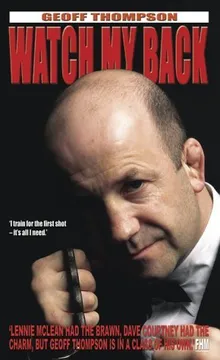


Key Takeaways
Stop trying to eliminate fear; learn what it is asking you to do.
Fear is not failure. Thompson begins as a boy who dreads confrontation, partly because he has been abused by a trusted martial arts instructor. Karate gives him a measure of confidence, but a black belt does not make him fearless. A later encounter with a much larger aggressor exposes the difference between feeling afraid and being unable to act. He eventually treats fear as a normal signal to understand and manage, not a flaw to erase.
Courage is a choice. His years as a nightclub doorman put that idea under relentless pressure. He learns that action can coexist with shaking legs, a dry mouth, or a racing heart. The book’s central claim is not that fear disappears, but that a person can learn to move while feeling it.
What's striking is the distinction between emotional state and chosen behavior. Fear does not automatically make someone cowardly, just as confidence does not guarantee sound judgment. That distinction can reduce shame and make reflection more useful: what is the fear detecting, and what response fits the actual danger? The book's vivid setting makes the lesson memorable, but a violent workplace is an extreme and hazardous way to learn it. Fear may signal danger that should be escaped, not mastered through exposure.
Climb a personal fear ladder one manageable confrontation at a time.
Map the steps. Thompson calls his method the fear pyramid. He lists the things he fears, orders them from less difficult to most difficult, and faces them progressively. The idea is to build evidence of capability through smaller challenges instead of demanding instant fearlessness. He also stresses admitting a fear honestly, rather than disguising it as mere reluctance.
Choose exposure carefully. His own hardest step is taking a doorman job in a city known for violence. He recognizes that this is a risky, personal route, not a universal prescription. The larger lesson is to make growth deliberate: name the fear, choose a tolerable first step, and seek trustworthy support when the challenge feels too heavy to carry alone.
The pyramid turns a vague ambition into a sequence, which is useful because people often mistake readiness for a feeling that must arrive before action. A small, repeatable challenge can instead provide evidence that discomfort is survivable. Still, the quality of exposure matters. A manageable public-speaking task and repeated contact with violent offenders are not equivalent exercises. The method works best when the challenge is chosen for learning, with safety and consent, rather than when danger itself is treated as proof of courage.
Train for cramped, chaotic reality, not only for a clean dojo.
Match practice to conditions. Thompson finds that the karate he learned did not transfer neatly to crowded pubs and clubs. He adds boxing and judo, and changes practice to include pressure, close range, and uncertainty. His point is not that one art is universally superior. It is that a skill practiced in one setting may fail when the space, rules, and emotional intensity change.
Test the weak links. He argues that fighters need to understand more than one range and that technical ability is useless if panic prevents its use. He also credits his mentor John, who had little formal martial arts training but extensive practical experience. The episode forces Thompson to set aside rank and ego, observe, and learn from what actually works in context.
This is a useful case of transfer learning: competence in a controlled environment does not automatically travel to a messy one. Practice needs enough resemblance to the demands of performance to reveal gaps, while remaining safe enough to learn from mistakes. Thompson's critique of formal martial arts is strongest when aimed at untested assumptions, not at tradition itself. The same caution applies in reverse: one person's street experience is not a complete training standard, and dangerous realism can create injuries rather than reliable skill.
Offer an exit before force makes everyone lose.
Keep choices open. Thompson describes winning many confrontations without striking anyone. He uses avoidance, conversation, and what he calls loop-holing, a way to let someone back down without public humiliation. If those options fail, he sometimes uses a show of confidence to discourage an attack. These approaches reflect a practical aim: resolve the immediate problem while preserving a path away from violence.
Know the limits. At a nightclub, he might refuse entry, remove someone who is harassing staff, or separate customers before an argument grows. He also admits that some people are determined to fight and that talking does not always work. The book presents de-escalation as a judgment call, not a magic script, and repeatedly shows how quickly a situation can become dangerous.
Face-saving is a subtle but important social tool. When a person can change course without being publicly defeated, the conflict has less reason to continue. This insight applies far beyond nightlife, from tense workplace conversations to family disputes. Yet the author's use of intimidation as a fallback carries a real risk: displays intended to deter can also provoke or misread someone in crisis. The most transferable principle is to preserve options and look for safe exits, not to imitate a bouncer's authority.
Name your body's fear signals before mistaking them for cowardice.
Recognize the patterns. Thompson's Adrenal Map sorts the bodily responses he associates with confrontation. Anticipation can wear someone down before an event; a sudden threat can produce a rapid surge; and fear can return after an apparent resolution. He describes signs such as shaking, nausea, tunnel vision, a trembling voice, and urgent bathroom trips. Naming them helps him avoid treating every sensation as proof that he cannot cope.
Prepare for the whole event. He also warns that stress can linger after a shift and spill into home life. In his own case, unexplained anger and destructive outbursts become easier to understand once he connects them with pressure he has not processed. His practical emphasis is to notice, prepare, and find a constructive way to settle after intense situations.
The map is powerful as a vocabulary for sensations that people may otherwise interpret as personal weakness. A name can create a pause between a body's alarm and the story attached to it. That pause makes better choices possible. The model is less convincing when it treats adrenaline as a single explanation for varied emotional and physical states. Fear, trauma, fatigue, and chronic stress can overlap but are not identical. The useful move is awareness, followed by care, rather than assuming every symptom has the same cause.
A reputation for control can protect people, but violence can trap you.
Success has a shadow. At first, Thompson enjoys the respect, camaraderie, and excitement of the door. His reputation helps deter some trouble, and he sees himself as protecting customers and staff. But admiration after a fight becomes its own reward. He describes feeling proud of blood on his shirt, then recognizing that repeated violence is making him resemble the people he condemns.
Question the story. In several incidents he continues attacking after an opponent is down, explaining that fear of retaliation drove him. The memoir does not hide the cost: injuries, police attention, possible prison, and shame. Thompson's own account makes clear that survival and justification can become tangled. A useful lesson is to examine not only whether force seemed necessary, but also what repeated reliance on it is doing to character.
The memoir is most revealing when its narrator cannot fully celebrate his victories. The praise of spectators and colleagues can reinforce behavior even when the person acting feels uneasy about it. That is a recognizable feedback loop: identity forms around what earns recognition, and then demands more performances of the same kind. The book's survival context deserves respect, but its justifications should not be generalized into permission to retaliate. The strongest reading holds two truths together: some force may be protective, and excess can still cause profound harm.
Count the aftermath as part of every risky decision.
The fight continues afterward. Thompson's stories include police interviews, threats of retaliation, fear that an opponent may die, and long nights replaying what happened. He describes the strain spreading into marriage and family life. In one incident, the possibility that an opponent has been fatally injured keeps him awake, imagining prison and the damage his absence would do to his loved ones.
Price the consequences honestly. The danger is not limited to the moment of confrontation. A decision can affect an injured stranger's family, a worker's livelihood, a partner's sense of safety, and the future of the person who acted. Thompson writes that anticipation itself can be draining and that unaddressed pressure may emerge at home. His account asks readers to include these delayed costs when judging a risky choice.
This wider accounting corrects a common bias: attention gravitates toward the dramatic moment, while the slower costs remain invisible. Yet relationships and legal consequences are not side effects; they are part of the event's real footprint. The book also shows how stress can travel through a household, making people close to the worker bear costs they did not choose. Its account is personal rather than clinical, so it cannot prescribe treatment. It does make a strong case for taking recovery and support seriously.
Leave a role when its rewards no longer justify its risks.
Know when the bargain changes. Thompson starts door work to confront his deepest fear. Over time, the job becomes an identity, a source of status, and a community he is reluctant to leave. After a frightening fight with a martial arts student, he realizes how close he came to devastating consequences. Later, a violent encounter with an old adversary becomes his final night on the door.
Leaving is an act of judgment. By then, he has spent years facing threats and has survived hundreds of confrontations, but he no longer believes the rewards justify the danger. He admits that he had been afraid to quit because he worried his hard-won confidence would disappear with the job. The decision to leave marks growth: he can carry what he learned without continuing to prove it in the same arena.
The distinction between courage and persistence is essential here. A person can bravely enter a difficult role and later wisely decide that staying has become needless exposure. Group identity and public reputation make departure especially hard, since leaving can feel like surrender even when the original purpose has been fulfilled. The book's personal arc helps separate capability from performance: confidence does not need constant demonstrations to remain real. A limit of the story is that it offers a dramatic exit, not a general formula for deciding when to leave.
Start writing with the scraps of time already available.
Begin before life is ideal. Thompson works in a factory by day and on pub and club doors at night. He begins writing his experiences in notebooks during breaks, sometimes on the toilet at work. A colleague's suggestion and his partner Sharon's encouragement help him take the ambition seriously. Early publishers reject his manuscript, and he nearly gives up, but he keeps submitting it and eventually finds a publisher willing to see its potential.
Make the next step concrete. His story is not that talent guarantees success. He needs advice, revision, persistence, and help preparing the manuscript. Publication changes the direction of his life and grows from material he had first treated as ordinary workday stories. The practical lesson is to use the time and tools at hand, then improve the work and keep seeking a route to readers.
The creative arc complements the book's account of fear: action generates information that waiting cannot. A rough first draft, an editor's response, or a rejection can show what the next step requires. The story also reveals how recognition from one supportive person can counter years of discouragement. Still, persistence alone does not guarantee publication, and Thompson benefits from both editorial help and a publisher who sees value in the project. His example is less a promise of success than a portrait of how ambition becomes actionable.
Forgiveness can loosen the past without pretending the harm was small.
Face what happened. At eleven, Thompson is sexually abused by a martial arts instructor and keeps the experience secret for decades. Near the end of the memoir, he unexpectedly encounters the man again. He tells him plainly what happened and how deeply it affected him, then says he forgives him. The moment is not presented as a denial of the abuse or as evidence that the harm was minor.
Choose what to carry. Thompson describes leaving the encounter with a sense of freedom, no longer emotionally fixed at the age when he was harmed. The scene gives the book's journey a different kind of resolution from its fights: the decisive act is speaking the truth and choosing how to relate to the past. Forgiveness is his personal choice, not a requirement imposed on other survivors.
The scene's force comes from the survivor reclaiming speech and agency, not from a clear confession or repair by the person who caused harm. That distinction matters. Forgiveness can be meaningful for one person without serving as absolution, reconciliation, or a model everyone should follow. The book locates release in the narrator's own decision, while leaving the original injury intact. Its ending also reframes strength: control is not only the ability to confront an opponent, but the ability to decide what response belongs to oneself.
Analysis
Watch My Back is a memoir of fear, occupational violence, and self-reinvention, not a neutral manual for street survival. Its narrative engine is a striking reversal: a child who hides from confrontation becomes a doorman who is feared, then must confront the way that role is changing him. The stories give the argument unusual force because the narrator records both the intoxication of victory and the dread, shame, and family strain that follow. The book's most valuable distinction is between fear as a bodily experience and cowardice as a moral judgment. Its weakest generalization is the suggestion that knowledge and exposure can tame fear in a broadly predictable way. Contemporary psychology distinguishes ordinary anxiety from trauma responses, and exposure-based approaches work best when they are gradual, collaborative, and conducted with appropriate safety. Repeated exposure to actual violence is not a universal cure and may deepen harm. The memoir itself supports that caution: the door improves Thompson's confidence, but also feeds aggression, strains relationships, and nearly entangles him in lethal consequences. Its practical wisdom is therefore more conditional than some of its bravado suggests. Learn to recognize fear, prepare for real constraints, look for nonviolent exits, and count the aftermath. Do not confuse survival in a particular arena with a prescription for everyone. The final movement, from fighting to writing and then to confronting childhood abuse through speech and forgiveness, complicates the book's early equation of courage with physical action. Its fullest account of agency is not victory over another person, but the freedom to leave a destructive identity and choose what to do with one's experience. That makes the memoir both an engaging portrait of a subculture and a caution about the price of becoming what an environment rewards.
Glossary
Fear pyramid
Ordered steps for facing fearsA personal exercise in which someone lists their fears, ranks them from less difficult to most difficult, and works through them in sequence. Thompson uses the structure to replace vague resolutions with progressively harder challenges. In his own story, taking a doorman job becomes the most demanding step, but he does not present that particular choice as suitable for everyone.
Adrenal Map
Patterns of fear responsesThompson's way of categorizing bodily and emotional reactions around confrontation. It distinguishes prolonged anticipation, a sudden surge when danger arrives unexpectedly, renewed alarm when a situation restarts, and stress after an encounter. He uses the map to help people recognize reactions such as shaking, nausea, or tunnel vision without automatically interpreting them as proof of cowardice.
duck syndrome
Calm appearance, inner alarmThompson's image for appearing composed while experiencing intense fear or physical arousal internally. The outward calm is deliberate, particularly in confrontational settings where visible panic might affect the other person's behavior. The term describes a performance of control, not the absence of fear, and it should not be mistaken for evidence that someone is psychologically unaffected.
loop-holing
A face-saving exitA de-escalation approach in which a person offers an opponent a socially acceptable way to withdraw from a dispute. The aim is to let someone change course without feeling publicly humiliated, reducing pressure to continue the confrontation. Thompson presents it as one possible verbal strategy, while acknowledging that some people will reject opportunities to disengage.
Animal Day
High-pressure sparring sessionsThompson's name for intense training sessions in which partners practiced at varied ranges and used a broad range of techniques, including submissions and knockouts. He developed them to make practice feel less predictable and more demanding than rehearsed drills. The term describes his training method, not a general recommendation to use unsafe or unsupervised sparring.
fence
A boundary controlling distanceThompson's term for a boundary used to manage the space between a person and a potential aggressor. It may involve a visible hand position, verbal limits, or a psychological signal that communicates awareness and discourages unwanted closeness. In the memoir, it functions as an early warning and distance-management idea, rather than a guarantee of safety.
Download PDF
Download EPUB
.epub digital book format is ideal for reading ebooks on phones, tablets, and e-readers.








