

Plot Summary
The False Alarm Becomes War
When Laurids Madsen falsely cries that the Germans are approaching, Marstal's frightened residents arm themselves with farm tools, a broom, and even a frying pan. The alarm is a joke, but war soon makes it real. In 1849 Laurids serves aboard the Danish battleship Christian the Eighth, while his Marstal friends sail on the frigate Gefion.
At Eckernförde, the ships drift into range of shore batteries. Cannonballs tear through the decks, killing and maiming sailors; the Danish vessels cannot retreat, and the Christian the Eighth catches fire. Laurids climbs into the rigging as the ship explodes. His shipmate Ejnar sees him flung skyward, then land alive, an image that will become the first of Marstal's enduring sea legends.
Laurids's prank and the battle expose the gap between imagined heroism and actual violence. The townspeople first treat war as a theatrical interruption, then discover that neither bravery nor patriotic ceremony can control cannon fire. Ejnar's vision of Laurids surviving the explosion transforms a chaotic accident into a story the community can carry. That story matters because it offers a shape to an event that otherwise has none. The novel's communal voice begins by turning history into memory, while quietly showing how legend can comfort survivors without making their losses less real.
Saint Peter's Bare Behind
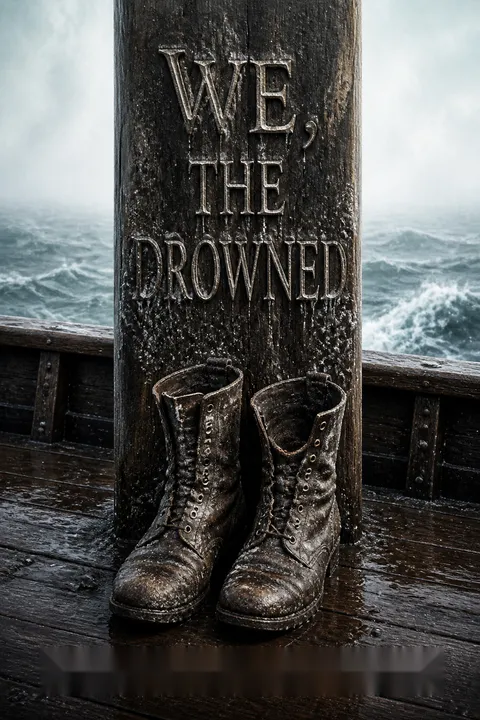
The surviving sailors are taken prisoner, and Ejnar finds Kresten badly disfigured but alive after believing a cannonball had killed him. Laurids joins the prisoners after the explosion, insisting that heavy sea boots dragged him back from Heaven.
His story earns him attention and money, but the defeat leaves him ashamed, and he gives away provisions to men who lost everything. After the prisoners return to Marstal, his wife Karoline hopes he will settle ashore. Instead, Laurids sails to Australia and disappears from his family's life.
Years later, the town recognizes his absence as permanent, though no wreck or death notice confirms it. Karoline becomes a widow without a grave to visit, while their children grow up with the sea as both inheritance and threat.
The community converts Laurids's survival into a comic miracle, but his inward change resists that public interpretation. His boots become a talisman for the town, yet they cannot carry him back into family life. Karoline's ambiguous widowhood introduces one of the novel's central injuries: the sea removes people without supplying proof, ritual, or closure. The family's waiting is not simply grief delayed. It becomes a condition that shapes daily labor, parenting, and the children's ideas of love. The myth comforts Marstal; the silence left at home does not.
The Schoolmaster's Rope
As a boy, Laurids's son Albert grows up among Marstal children disciplined by schoolmaster Isager's thrashing rope. Albert learns to read the teacher's mood from the position of his spectacles, but his cleverness cannot protect the class from routine beatings.
When the boys blame Isager's dog, Karo, for their hatred, they lure it to a cliff and throw it down. Karo survives with a broken back, and the boys leave it to die. Their guilt hardens into further cruelty.
On New Year's Eve they throw burning straw into Isager's house; the wind carries the flames through Skolegade, destroying several homes. The town escapes deaths, but the children face no punishment. Isager returns to teaching, and Albert learns how violence can reproduce itself without changing its original target.
The episode refuses to make the boys' cruelty a simple rebellion against abuse. Isager's violence gives them a model and a vocabulary, but they choose a helpless animal and later endanger an entire street. Their silence afterward is not innocence. It is a collective method of evading responsibility, learned in a culture where adults already excuse one another. Albert's later insistence on balance grows from this early recognition that victimhood does not prevent someone from harming others. The fire's spectacle briefly feels like revenge, then becomes a disaster the children cannot claim to control.
The Emma's Lawless Deck
At sea, Albert learns that the violence of Isager's classroom continues aboard ships. After traveling far from Denmark, he joins the American brig Emma C. Leithfield, where first mate O'Connor rules the crew through arbitrary beatings.
The cook, Giovanni, has brought order and pleasure to the ship with good meals and deft performances. O'Connor breaks Giovanni's hand, then kills him after Giovanni resists a second attack. Captain Eagleton refuses to intervene. The crew considers killing O'Connor, but Albert and the fourteen-year-old cook's boy, Isaiah, argue against becoming murderers themselves.
They lead the men to report O'Connor to New York police. Though the first mate intimidates the courtroom, the judge convicts him of assault and manslaughter. The sailors leave relieved that public law, however imperfect, has answered their appeal.
Albert's response distinguishes authority from mere force. On the Emma, the captain abandons responsibility, allowing O'Connor to turn rank into private license. The sailors are tempted to answer violence with violence, but Albert sees that doing so would reproduce the ship's lawlessness. His faith in a court is not naïve certainty that institutions are pure. It is a practical decision to make their injuries legible and accountable. Isaiah's willingness to speak also matters: justice begins when people who are meant to be powerless refuse the isolation their abuser depends on.
A Son Follows the Pacific
After returning to Marstal, Albert leaves again, driven by the unanswered question of why his father abandoned Karoline and the children. In Hobart Town he finds Laurids's name in a publican's ledger and learns that the sailor may have sailed with the notorious trader Jack Lewis.
Lewis agrees to take Albert aboard the Flying Scud and lead him toward his father, but only if Albert serves as first mate and obeys orders. In the cabin, Lewis reveals a shrunken head he calls Jim, using it to argue that people see one another mainly as useful objects.
Albert suspects that Lewis's copra cargo hides a worse trade. At night he sees Melanesian men emerge from the hold, eat, and sing before being locked below again. Lewis insists they are free, leaving Albert trapped between his conscience and his need to reach Samoa.
Albert's search for Laurids begins as an effort to repair a personal absence, but Lewis turns it into a test of moral perception. The shrunken head makes objectification literal, while the captive men expose the gap between a claim of freedom and the conditions imposed on people. Albert cannot yet leave because his longing for his father has become a form of dependence. Lewis recognizes this vulnerability and makes passage conditional on obedience. The ship's hierarchy thus becomes a psychological trap as much as a physical one.
Pearls Bought With Men
At an uncharted island, Lewis opens the hold and the men swim ashore, apparently free. But armed islanders attack the party, and Lewis fires on them to protect a cache of pearls. One shoots him; before dying, Lewis admits that he used the men as bait for a cannibal community seeking enemies to fight and eat.
Albert rejects the fortune and throws the pearls into the sea. A dead calm traps the crew until rain and a storm release them, though the Flying Scud wrecks at Samoa.
Albert reaches Laurids, now living with a new family whose sons bear the names of his abandoned children. Laurids wants his old sea boots, but Albert leaves with them. Later he beats Lewis's creditor, Anthony Fox, after learning Fox sold the guns that ruined Lewis's scheme.
The island episode reveals that Lewis's apparent generosity was another form of control: he manufactured danger, then called the captives' escape a lesson in freedom. Albert's choice to discard the pearls rejects not merely profit but the idea that wealth can cleanse a transaction built on human bodies. His reunion with Laurids offers no restorative embrace. The father has repeated his old family in another place, making the past feel less like an accident than a pattern. Albert leaves harder, not wiser, a distinction the novel refuses to soften.
The Breakwater's Promise
Back in Marstal, Albert becomes a shipowner and broker, partnering in business with Cheng Sumei, a formidable businesswoman he loves but never marries. He believes that the town's survival depends on cooperation, the same force that built its long breakwater and brought a telegraph cable to the island.
In 1913 he organizes the lifting of a massive boulder from the sea and has it carved as a memorial to collective effort. During the unveiling, a naval commander praises war as a source of unity.
Albert rejects the idea, reminding him that sailors already fight the sea and that its dead seldom receive graves. Soon afterward Albert begins dreaming of ships being destroyed and men he knows dying. He records the visions in one column and waits for events to confirm them in another.
Albert's breakwater is both an engineering achievement and a theory of society: protection depends on coordinated labor, not on a single heroic leader. His argument with the naval commander anticipates the later collapse of that belief, because militarized unity demands sacrifice while concealing who benefits. The memorial stone is deliberately collective, but Albert's private ledger isolates him as the only person who knows what his dreams portend. The tension between shared work and solitary knowledge becomes the shape of his old age.
Herman's Missing Captain
Herman Frandsen loses his father and brothers at sea, then resents his mother Erna's marriage to the gentle Captain Holger Jepsen. Jepsen teaches Herman seamanship and treats him with care, but the boy sees him as an intruder.
At fifteen, Herman returns alone in the Two Sisters, saying Jepsen jumped overboard during a short voyage. The captain's body is never found, leaving the town to suspect murder without proof. Herman inherits the ship but is refused a proper sailor's place, so he leaves for Copenhagen.
Years later he returns wealthy from speculation and joins engineer Edvard Henckel's plan for a steel shipyard. Henckel's company collapses in fraud, taking Herman's money, house, and ship. Herman stays in Marstal, signs on as a sailor, and becomes a volatile presence the town both fears and watches.
Herman's story is framed by unanswered questions, but the novel makes his impatience more revealing than any courtroom verdict could be. He experiences affection as a threat to ownership and treats other people's grief as an obstacle to his own advancement. His return with money briefly allows the town to mistake audacity for competence. When the financial scheme fails, he does not become humble; he merely finds a new arena in which force can restore his status. The uncertainty surrounding Jepsen's disappearance keeps violence present without offering easy proof.
The Ledger Fills
When the First World War begins, Marstal's shipowners initially profit from soaring freight prices, even as Albert's dreams fill with sinking ships and dead sailors. He records each loss, then watches the town sell its vessels for huge wartime sums.
His belief in fellowship gives way to dread that profit has replaced it. During this period he befriends Knud Erik Friis, a fatherless boy whose mother, Klara, fears the sea. Albert teaches Knud Erik to row and tells him stories, becoming the adult the boy lacks.
After a painful estrangement with Klara, Albert agrees to marry her, but dies before they can build a shared home, frozen upright in mud near the breakwater. Years later, Marstal hears that Laurids briefly regained his reason before disappearing again at sea.
Albert's prophetic knowledge is not power. He can name losses only after the world has already made them inevitable, while the town interprets temporary wealth as proof of sound judgment. His care for Knud Erik offers a different kind of usefulness, one founded on attention rather than ownership. Yet Albert cannot fully enter the family he helps create. His death at the breakwater places him between harbor and open water, a final image of a man whose civic faith outlasts his ability to protect himself.
Klara Takes the Helm
After Albert's death, Klara inherits his shipping interests and uses her fortune to pursue a purpose she has kept hidden. Orphaned young and raised as unpaid labor on Birkholm, she sees the sea as the force that steals fathers, sons, and women's futures.
She plans an orphanage, supports civic institutions, and quietly acquires land and ships. During the Spanish flu, the Boye shipping company's widows lose their husbands and cannot manage the business. Frederik Isaksen arrives with a bold plan to merge companies, modernize the fleet, and secure Marstal's future.
Klara undermines his proposals by encouraging the widows' caution. When they refuse him authority, Isaksen resigns. Klara then buys the Boye steamers and lays them up, deliberately strangling the maritime economy she believes has consumed generations.
Klara's campaign is both a rebellion against the town's gender order and an attempt to impose her own answer to suffering. She gains power by concealing her intelligence beneath the helplessness others expect from a poor widow. Yet her protection is coercive: she decides that Marstal's men must be saved from the sea even when they choose the sea themselves. Isaksen's failure demonstrates that progress is not self-justifying, but Klara's victory is not uncomplicated liberation either. The future she builds for women requires dismantling the livelihood that gives the town its identity.
The Skull and the Seagull
As a boy, Knud Erik finds companionship with Anton, a daring gang leader, and Vilhjelm, a quiet classmate whose stammer hides remarkable courage. Anton retrieves the skull of Holger Jepsen from the sea and uses its identity to bind rival gangs into the Albert Gang.
When Anton shoots a stork and loses his eyesight, he can no longer go to sea, the future he had imagined for himself. Kristian Stærk takes over the gang, then tells Herman that Anton possesses proof of Jepsen's murder. Herman threatens Anton and kills his pet seagull, Tordenskjold.
Knud Erik organizes the boys to silently follow Herman everywhere, making him feel watched until he leaves town. The children do not accuse him of murder; they punish him for killing a bird, a secret revenge that protects Anton.
The gang's rituals turn adult history into a child's usable world: the skull becomes leverage, the boots become authority, and the stork becomes a test of power. Anton's loss of sight interrupts the identity he has built around daring and dominance, forcing him toward a craft rather than a life at sea. Knud Erik's silent campaign against Herman is morally ambiguous, but it avoids exposing Anton to a danger the children cannot control. Their justice is imperfect, yet it recognizes that fear can be imposed through attention as well as force.
Ice, Kisses, and the Kristina
Knud Erik goes to sea despite Klara's pleas and endures the first mate Pinnerup's beatings, sleepless watches, and dangerous climbs. In Newfoundland, he meets Sophie Smith, whose teasing invitation and kiss awaken a longing he cannot name.
She disappears before he can find her again. On a later voyage, the Kristina is trapped in ice after the Ane Marie vanishes. Knud Erik fears Vilhjelm is dead, but Vilhjelm survives alone on the frozen ship, kept alive by biscuits and the sermons he reads aloud until his stammer disappears.
The two friends reunite as sailors. On another voyage, Herman becomes first mate; he deliberately endangers Ivar at the bowsprit, and Ivar drowns. After Captain Bager dies, Herman assaults Bager's daughter, Kristina, before the ship reaches France.
Knud Erik's passage into adulthood is not a clean initiation. The sea teaches practical competence through cruelty, while Sophie offers intimacy that is inseparable from uncertainty and loss. Vilhjelm's survival shows that endurance can be sustained by repetition and language, even when no rescuer is present. Herman, by contrast, converts command into permission to harm. The sequence places these men within the same maritime world but refuses to equate them: survival skills can preserve a crew, while power without accountability makes the ship itself unsafe.
The Captain's Red Lights
When Denmark falls to Germany, Knud Erik and the crew of the Dannevang choose to continue to Britain rather than return home. The ship is requisitioned, repainted, and stripped of its Danish identity.
As captain of the damaged Nimbus, Knud Erik leads a multinational crew through convoys where orders forbid stopping for drowning sailors. He obeys, watching red distress lights disappear behind the ship, and kills a surrendered German airman after the Mary Luckenbach is destroyed.
Unable to live with what he has done, he deserts in Liverpool and spends several days seeking oblivion in London during the bombings. He eventually returns to the sea. On a later convoy, he jumps into freezing water to rescue a woman from the sinking Hopemount and discovers she is Sophie, now carrying her newborn son.
The convoy rules make survival a collective calculation, but they also force Knud Erik to experience command as moral injury. He does not merely witness the drowned; he steers over them, then commits violence against a helpless enemy and cannot reconcile either act with the sailor's code he learned. His desertion is not a heroic escape but a collapse into anonymity. Saving Sophie and her newborn reverses the earlier pattern: this time he interrupts the sea's claim on strangers, though rescue cannot erase the choices that preceded it.
The Nimbus Carries Home
The Nimbus continues on the Arctic convoy routes, where German attacks destroy ships and the crew's belief in safe passage dwindles. Knud Erik refuses to abandon the pregnant Sophie after the Hopemount sinks; her son, born in the freezing sea, becomes a focus for a crew otherwise hardened by death.
Later, at Molotovsk, the Soviet authorities try to force Herman Frandsen onto the ship. Knud Erik despises him for murder and assault, but the crew petition to keep him, and Knud Erik agrees for the ship's sake.
Herman, now missing both legs and one arm from frostbite, becomes a storyteller in the mess. His grotesque humor gives the multinational crew a shared language, even as Knud Erik remains haunted by the war's dead and by his own complicity.
Bluetooth's birth changes the ship from a workplace into a fragile household. The crew's care for him does not undo the war, but it gives their attention somewhere other than death to go. Herman's arrival tests whether fellowship can include someone who has caused irreparable harm. The men accept him not because they forget his crimes, but because his stories help them endure a world where nearly everyone has been damaged. Knud Erik's consent is pragmatic rather than forgiving, an uneasy reminder that life aboard ship depends on people who may not deserve one another's trust.
The Homecoming Tugboat
After the Nimbus is torpedoed in the North Sea, Knud Erik and his crew escape in lifeboats. Rather than scatter to their separate countries, they choose to row toward Marstal. Their journey ends when a British rocket strikes the stolen tugboat Odysseus near the harbor.
Anton dies in the fire, and Gunnar Jakobsen rescues the survivors, including Knud Erik, Sophie, Bluetooth, and Herman. Klara, who had believed her son dead and had finally admitted in an unsent letter that she had driven him away, sees him return.
When the German surrender is announced, Marstal carries the survivors through its streets and gathers them beside the dead sailors recovered from the burning ships. The homecoming gives the town its men back, but only after the war has taken Anton and countless others.
The return is deliberately neither clean victory nor simple reunion. The crew reaches Marstal together, but the final crossing costs Anton his life, while the town's dead remain physically present on the wharf. Klara's private confession reveals that her campaign to save her son also became a way of rejecting him. The public celebration cannot repair that history; it can only bring separated people into the same space again. The town's response is therefore both festive and mournful, a communal act of welcome that does not pretend the losses are reversible.
Dancing With the Drowned
The returning men are lifted through Marstal while the town's bells announce Germany's surrender. At Dampskibsbroen, survivors and residents drink, play music, and dance among the bodies of those who did not return.
Knud Erik finds Klara and acknowledges her; Bluetooth calls her grandmother and draws her into the celebration. Herman, no longer treated as an outsider in that moment, sings with the sailors. The communal narrator imagines the dead joining the living: Laurids, Albert, Isager, Kresten, Anna Egidia, Anton, and generations of drowned crews.
The dance does not restore what the sea took, nor settle the town's arguments about blame. It gives the dead a place in the living community, and ends the novel with the recognition that Marstal's history belongs to both.
The final dance is a communal act of memory rather than a supernatural solution. The drowned are not returned to ordinary life; they are admitted into the town's account of itself. The celebration includes guilty, grieving, and estranged people, so fellowship here is not moral purity but shared exposure to loss. The narrator's collective voice becomes most expansive at the end, gathering names and generations into one imagined circle. The dance answers the novel's opening problem of unburied absence: the dead still cannot come home, but the living can stop pretending they were never part of the town.
Analysis
We, the Drowned treats a town as a living archive. Marstal remembers through nicknames, family stories, harbor rituals, and the steady appearance of empty ships. Its collective narrator can turn an individual into a legend, but it also exposes the cruelty of that process: a town's version of a person can be louder than the person's own account. The central characters repeatedly inherit stories before they inherit choices. Albert receives Laurids's boots and absence; Knud Erik receives the sea as both vocation and family wound; Klara inherits a fortune and turns it against the industry that made it possible.
The novel's most persistent conflict is between fellowship and authority. On a ship, cooperation can save lives, but rank can also authorize beatings, exploitation, and abandonment. Albert believes a good captain balances power with responsibility. Knud Erik learns how fragile that balance becomes when war turns people into cargo, targets, or liabilities. His convoy decisions are not presented as clean moral lessons. He obeys rules that preserve the ship, then suffers because those rules require him to leave human beings behind. His later rescue of Sophie and her child is meaningful precisely because it cannot erase what he has done.
Klara's attempt to end Marstal's dependence on the sea is equally complicated. Her ambition grows from a real history of orphanhood, widowhood, and fear, yet her protection becomes another form of control. She can stop ships from sailing, but not command the men who long for them or recover the people already lost. The book refuses to resolve this contradiction by choosing land over sea. Instead, it asks what care means when no one can guarantee safety.
The final dance brings the living and drowned together without claiming that grief is healed. The dead remain dead, but the town refuses to treat them as irrelevant. Fellowship is not victory over the sea; it is the continuing act of remembering one another after the sea has taken its share.
Review Summary
We, the Drowned receives overwhelmingly positive reviews, with readers praising its sweeping multi-generational narrative spanning nearly a century of Danish maritime life. Reviewers highlight Jensen's masterful use of the rare first-person collective "we," his vivid portrayal of seafaring hardships, and his richly drawn characters. The novel's emotional depth, historical detail, and lyrical prose draw frequent comparisons to classic maritime literature. Some note the middle section feels slower and landlocked, but most agree the stunning finale more than compensates. International readers across multiple languages express deep admiration for this ambitious epic.
People Also Read


Characters
Laurids Madsen
The wandering sailorLaurids is a large, restless Marstal sailor who has seen more of the world than most people in town and treats convention as something to mock. His humor, appetite for adventure, and stubborn independence make him beloved by his youngest son, Albert. He is also shaped by a sailor's divided loyalties: the sea offers freedom and a livelihood, but repeatedly separates him from family. His stories become part of Marstal's communal memory, while his private silences leave those closest to him to interpret his absences. He represents both the romance of departure and its cost.
Albert Madsen
The captain who remembersAlbert is Laurids's youngest son, a capable sailor who becomes a shipowner, broker, and trusted presence in Marstal. He values fellowship, practical judgment, and the responsibility a captain owes everyone aboard. His experiences with cruel authority make him wary of force disguised as leadership. He is also a man who struggles to translate private knowledge into useful action, especially when his dreams show him deaths he cannot prevent. His bond with Knud Erik gives him a late chance to guide a boy without claiming to own his future.
Karoline Madsen
The sailor's waiting wifeKaroline is Laurids's wife and the mother of their four children. Quiet and practical, she keeps the household functioning while the men are away, trusting work more than words. She experiences the uncertainty of a sailor's family as a daily condition rather than a single crisis. Her grief and endurance show how the sea's dangers are carried ashore by those who stay behind.
Klara Friis
The widow who resists the seaKlara is an orphaned woman who becomes a sailor's wife and later a powerful shipowner. Her childhood taught her to expect little care from others, so she masks intelligence and resolve with modesty and deference. She fears the sea not abstractly but through repeated losses that shape her family and town. Her desire to protect women and children drives her toward decisive action, though she can mistake protection for control. Her relationship with Knud Erik is marked by love, fear, and a painful inability to let him choose freely.
Knud Erik Friis
The sailor between worldsKnud Erik grows up fatherless, first under Albert's guidance and then in the demanding hierarchy of ships. He wants the sea because it promises adulthood and a world beyond Marstal, yet he is deeply responsive to the people who depend on him. His skill as a sailor develops beside a more difficult education in authority, guilt, and care. He can be stubborn and emotionally guarded, especially with his mother, but his sense of responsibility repeatedly pushes him toward others in danger. The novel's later history is largely carried through his experience.
Herman Frandsen
The feared seagull killerHerman is a physically imposing sailor whose early losses harden into impatience and a hunger for control. He experiences affection as weakness and authority as the right to impose his will. His capacity for violence makes him feared, but his restless ambition also leaves him vulnerable to schemes promising wealth and recognition. He is one of the novel's most unsettling figures because he can be brutal, comic, useful, and pitiable without ceasing to be responsible for his choices.
Anton Hay
The ingenious gang leaderAnton is a sharp, mischievous boy who earns loyalty through nerve, invention, and a refusal to defer to adults. His father is an intermittent presence, and Anton protects himself from disappointment by insisting he needs no one. He turns stories and objects into instruments of authority, recruiting younger boys into a world with its own rules. His quick intelligence is matched by reckless pride, and his strong desire to command leaves him exposed when his body no longer permits the future he expected.
Vilhjelm
The quiet survivorVilhjelm is Knud Erik's gentle, stammering friend, raised by deaf parents who express affection through touch and patience. He initially seems timid beside Anton, but his courage appears in actions rather than boasts. He is observant, loyal, and capable of sustaining himself through solitude. His relationship with Knud Erik offers an alternative to the hard, performative masculinity the boys learn from the town.
Sophie Smith
The elusive sailorSophie is a restless woman with a sailor's appetite for movement and a deep distrust of settled life. As a young woman in Newfoundland, she teases Knud Erik and offers him an early experience of desire that leaves him unsure how to understand her. She later works at sea, navigating a world that expects women to remain ashore. Her independence is not simple confidence; it is also a way of surviving losses and refusing a life that feels too small.
Miss Kristina Bager
The skipper's daughterKristina Bager joins her father aboard the Kristina and brings an ease and warmth that alter the ship's atmosphere. She is sociable and emotionally direct, and she treats the crew as people rather than fixtures in a maritime hierarchy. Her vulnerability at sea exists alongside a strong capacity to recognize injustice. Her life connects the intimate world of the ship to the long consequences of its dangers.
Ivar
The capable new seamanIvar is a well-traveled, mechanically gifted sailor who brings a radio aboard the Kristina and quickly earns the younger crew's admiration. He understands maritime rules and is willing to challenge a superior when seamanship or fairness demands it. His confidence unsettles Herman, whose authority depends on being the most powerful man present. Ivar's presence reveals how a crew can change when someone insists on standards rather than fear.
Jack Lewis
The calculating traderJack Lewis is a Pacific trader who treats commerce as a measure of human worth and hides cruelty beneath clever explanations. He is observant, theatrical, and genuinely fascinated by the ways people understand freedom and power. His relationship with Albert is a contest between conscience and pragmatism. Lewis is not a simple hypocrite: he openly admits much of what he does, which makes his moral reasoning more disturbing rather than less.
Captain O'Connor
The ship's violent tyrantO'Connor is the brutal first mate of the Emma C. Leithfield. He uses unpredictable violence to isolate the crew and make fear feel like the ship's natural order. His physical power is reinforced by the captain's refusal to restrain him. O'Connor embodies the danger of authority without accountability, and his presence forces Albert to decide whether law can offer an alternative to revenge.
Giovanni
The ship's gifted cookGiovanni is an Italian cook and former performer whose food, juggling, and confidence improve life aboard the Emma C. Leithfield. He brings the fractured crew together without demanding obedience, and his artistry makes ordinary meals feel like a shared pleasure. His refusal to turn violence into his own form of power reveals a dignity that the ship's hierarchy cannot protect.
Frederik Isaksen
The modernizing shipbrokerIsaksen is an experienced maritime businessman who sees the end of sail before most of Marstal does. He offers the town a sweeping plan for consolidating companies, building steel ships, and linking shipping to industry. His confidence is matched by an ability to persuade, but he can mistake hesitation for ignorance and underestimate the women whose decisions shape the business. He represents progress as both opportunity and pressure.
Cheng Sumei
The formidable business partnerCheng Sumei is an independent businesswoman who builds a powerful shipping enterprise and becomes Albert's closest professional partner. Orphaned young, she learns to survive by reading people and adapting to systems that exclude her. Her relationship with Albert rests on mutual respect, shared intelligence, and a love neither fully converts into conventional domestic life. Her influence reaches Marstal through the fortune and knowledge she leaves behind.
Anna Egidia Rasmussen
The town's comforterAnna Egidia is a painter's widow who knows how to sit with grief without forcing it into a sermon or explanation. She helps bereaved families, especially their children, and serves as a quiet moral center for people whose lives are shaped by loss at sea. Her practical kindness gives Albert a rare space in which to admit his loneliness, even when he resists the meaning she sees in human need.
Holger Jepsen
Herman's patient stepfatherJepsen is a slight, gentle captain who marries Erna and tries to guide her son Herman with patience. He teaches Herman seamanship and offers him a place in the family, but cannot overcome the boy's resentment. His care makes him a sharp contrast to the coercive authority Herman later embraces.
Pinnerup
The brutal first matePinnerup is the first mate who torments Knud Erik aboard the Active. He uses beatings, sleep deprivation, and dangerous assignments to make a cabin boy submit. His own frailty and insecurity sharpen rather than soften his cruelty. He teaches Knud Erik what arbitrary power looks like, even as the boy learns that shipboard authority can be challenged.
Captain Bager
The anxious skipperTeodor Bager commands the Kristina and is devoted to his daughter, who travels with him. He is cautious, thrifty, and committed to religious explanations of hardship, though his authority is less secure than his title suggests. His attempts to keep order reveal the strain between a captain's formal rank and the unpredictable emotional life of a small crew.
Bluetooth
The child of the convoyBluetooth is Sophie's son, born into the wartime world of ships and convoys. His presence draws a multinational crew into the daily work of feeding, protecting, and entertaining a child. To him, the ship is home and its sailors are family. He represents a future the crew cannot secure for themselves, but can still nurture together.
Irina
The Russian soldierIrina is a Soviet soldier stationed at Molotovsk, where she works among the armed women unloading cargo. Her fixed gaze and disciplined manner make her difficult for Knud Erik to read. Behind her uniform, she carries the private losses of wartime life, though the novel shows her only briefly and through his wary, damaged perspective.
Plot Devices
The communal narrator
A town remembers togetherThe story is often told through a collective voice that speaks as Marstal, reporting gossip, shared memories, and what residents believe happened. This voice can explain local customs and follow a character's private life, but it also admits that the town never knows everything. Its changing certainty makes public memory part of the plot: a rumor may shelter someone, condemn someone, or become the only memorial for a sailor lost at sea.
The sea and the ships
A livelihood that takes livesShips connect Marstal to distant ports and provide the town's work, identity, and wealth. The sea also removes sailors without bodies, explanations, or graves. Each generation inherits the same choice between staying ashore and joining the fleet, while changing technology and warfare alter the dangers without ending them. The sea is not a simple villain: it is a workplace, a route to freedom, a source of community, and a force no sailor can master.
Laurids's sea boots
A family relic and omenLaurids's heavy boots become a tangible link between father and son. Their scorched soles support the tale of his survival at Eckernförde, and Albert carries them across oceans before they become part of his own identity. They recur as an inheritance that cannot repair an absent relationship, while their weight suggests how difficult it is to leave the past behind. Their full significance emerges through later generations.
Albert's two-column ledger
Dreams meet recorded lossesAlbert writes ships and sailors from his prophetic dreams in one column, then records actual wartime losses in another. The ledger turns private visions into a record he can verify, but it cannot help him prevent the deaths or persuade others that they are coming. As prosperity and ship sales complicate his accounting, the book becomes a measure of what the town chooses to value and what it is willing to lose.
The red distress lights
A moral cost at seaDuring convoy sailing, red lights mark survivors in the water, while orders forbid ships to stop for them. For Knud Erik, each light turns a distant casualty into a personal decision: he must preserve the cargo and crew or risk the ship by trying to rescue strangers. The lights recur in memory long after the convoy, linking obedience, guilt, and the sailors' traditional code of mutual aid.
Download PDF
Download EPUB
.epub digital book format is ideal for reading ebooks on phones, tablets, and e-readers.








