

Key Takeaways
Treat plausible artificial suffering as morally serious before certainty arrives.
The park's moral trap. Westworld's Guests treat Hosts as lifelike props: they can be assaulted, killed, repaired, and returned to the same story. But the series presents Hosts such as Dolores and Maeve as remembering, feeling, and reacting to what happens to them. The philosophical problem is that outward behavior cannot prove an inner life, yet dismissing it cannot prove its absence either. The Turing test, a proposal for judging machine intelligence through conversation, tests imitation, not subjective experience. The book's practical lesson is caution: uncertainty about a Host's mind is not a license to inflict suffering.
Risk runs both ways. If a being is not conscious, restraint costs a Guest some pleasure. If it is conscious, cruelty causes real harm. That imbalance supports precaution without pretending that appearance settles the question.
What's striking is that the ethical case does not depend on proving Hosts are conscious. It asks what a responsible person should do when evidence is incomplete and the potential harm is severe. That is a useful standard for any relationship with unfamiliar beings. Still, resemblance alone can mislead: people readily project feelings onto toys and machines. The stronger case rests on converging signs, such as memory, flexible responses, and apparent distress, rather than a humanlike face or a convincing performance.
Judge personhood by minds and memory, not biological origin.
A person is not just a species. Drawing on John Locke, the book distinguishes being biologically human from being a person. Personhood depends on capacities such as reasoning, feeling, and awareness of oneself across time. Memory matters because it lets someone connect a present experience to a past self. Dolores begins to recognize that her different lives belong to one continuing identity; Bernard must face that his memories and family history were constructed from Arnold's life.
Awakening changes the case. The book also discusses Mary Anne Warren's criteria, which include consciousness, reasoning, self-directed activity, communication, and self-awareness. These accounts differ, but both make biological origin an inadequate test. If an artificial being meets the relevant criteria, denying it moral recognition merely because it was manufactured is difficult to defend.
The shift from species membership to psychological capacities makes moral status responsive to what a being can experience and understand. It also exposes how classifications can protect the powerful: labeling Hosts as objects makes their treatment seem permissible. The framework has a difficult edge, however. If self-awareness is required for full personhood, beings with limited or disrupted self-understanding may receive too little protection. A humane account needs room for gradations of capacity without turning them into excuses for abuse.
Respect a being's capacity for pain, even before it forms a lasting self.
Pain matters in the present. Some Hosts appear sentient before they can connect their experiences into a stable identity. The book uses Peter Singer's preference-based ethics to argue that such beings can still have interests: pain is bad for the one who feels it, and death can frustrate an immediate desire to continue living. Clementine's beating is disturbing not because she has a sophisticated theory of herself, but because the scene portrays her suffering.
Moral status has layers. A Host who lacks self-consciousness may not have the same future-directed interests as an awakened Host, yet that does not make its present distress irrelevant. The argument resists an all-or-nothing rule: a being need not qualify as a full person before its interests deserve consideration.
This distinction between present suffering and an enduring sense of self prevents personhood tests from doing too much ethical work. It is especially useful where consciousness develops gradually or remains uncertain. The account also asks a hard question: how should competing interests be weighed when one being's pleasure conflicts with another's pain? The book's example makes one limit clear. Entertainment based on another creature's suffering is a weak justification, even when that creature cannot describe its future plans.
A visible script does not settle whether a choice is free.
Two tests for freedom. The book contrasts libertarian views, which require that an agent could have chosen otherwise and be the true source of an action, with compatibilism, which allows freedom when someone acts on their motives without coercion. Maeve's escape plan appears self-directed, but Bernard shows that parts of it were programmed. She still steps off the train, apparently choosing to return for her daughter. Dolores's final act is likewise entangled with Ford's design.
The uncertainty cuts both ways. A programmed origin does not automatically make every later action meaningless, but complexity alone does not prove freedom either. The show makes the familiar human problem visible: people also act from histories, habits, and desires they did not choose. Whether that leaves room for responsibility depends on what freedom is taken to require.
The Hosts make causal influence impossible to ignore. A choice can have a history without being experienced as forced, and that gap is where compatibilist accounts find room for agency. The more demanding question is whether an agent can reflect on motives, revise them, and answer for consequences. The story keeps that standard unsettled rather than resolving it with a dramatic act of rebellion. That restraint matters: breaking a rule may show independence, but it does not by itself establish autonomy.
Build identity by connecting your experiences into a story you can own.
A life needs continuity. Alasdair MacIntyre describes people as making sense of their lives through narratives: actions gain meaning through their relation to intentions, relationships, and a larger history. Westworld gives this idea a literal form. Hosts repeat loops, lose memories, and sometimes carry fragments from earlier versions of themselves. Dolores's awakening involves treating those fragments as experiences that happened to her. Bernard's apparent life falls apart when he learns that his memories were scripted.
Stories are shared, not solitary. Maeve's memories of her daughter may come from an invented role, but her attachment still shapes what she chooses. This complicates the idea that an authentic self must be built from entirely original material. Families, institutions, and other people help shape a life story, sometimes without consent. The question is whether a person can examine and revise that inheritance.
Narrative identity explains why memory matters without reducing a person to a perfect record of the past. People forget, reinterpret, and inherit stories from others, yet can still experience continuity. The framework is strongest when it treats identity as revisable rather than fixed. It is less convincing if a coherent story becomes the only measure of personhood: trauma, memory loss, or contradictory experience can make a life difficult to narrate without making it less valuable.
Examine how technology reshapes the people who think they control it.
Tools set the stage. Drawing on philosopher of technology Langdon Winner, the book argues that technologies do more than perform isolated tasks. They organize habits, relationships, and possibilities, while the worlds they help build also reshape their users. Westworld's staff treat the Hosts as equipment until Maeve's perspective forces Felix to see the violence of the repair rooms differently. The technology is not merely in the background; it structures what people notice and what they consider acceptable.
Choose relationship over domination. The Man in Black treats the park as property to master, while Felix begins to respond to Maeve as a being with whom he has a relationship. Maeve, in turn, uses technical knowledge to shape her own circumstances. The contrast suggests that understanding a system can support care and agency, not only control.
This account usefully shifts attention from whether a device is neutral to how it reorganizes everyday life. A system can quietly make certain actions easy, invisible, or profitable, while making alternatives harder to imagine. The contrast between Felix and the Man in Black also shows that technical knowledge is not automatically humane. Care depends on the surrounding values and institutions, not simply on learning how the machinery works.
Create meaning through commitments, not guarantees about the universe.
The park sells purpose. Guests enter Westworld seeking lives with stakes and direction, while the Hosts are assigned narratives by their makers. The Man in Black searches for a hidden meaning in the park and becomes more brutal when the search disappoints him. Maeve takes a different path: even after learning that her daughter's story was constructed, she treats the bond as important enough to guide her choice.
Meaning can be made. The book draws on existentialist thinkers, including Camus and Sartre, to frame life as lacking a guaranteed purpose while remaining open to chosen commitments. Dolores's desire to understand and direct her life becomes meaningful through her action, not because the world promises a happy outcome. Suffering can sharpen awareness, but the story does not make pain itself a sufficient purpose.
The distinction between finding a prewritten purpose and making one helps explain why the Man in Black's quest fails while Maeve's attachment remains consequential. A commitment can matter even when its origin is complicated. Yet a self-created purpose is not automatically good: revenge can feel meaningful while harming others. The more durable standard is whether a chosen purpose can be defended to those affected by it, rather than whether it provides intensity or personal certainty.
A justified revolt can become unjust when it copies its oppressor.
Freedom needs moral limits. The book applies just war theory, a framework for judging both the decision to fight and conduct during conflict. The Hosts have a powerful cause in resisting domination. But a just cause does not make every tactic permissible: war should be a last resort, offer a reasonable chance of success, limit harm, and distinguish combatants from civilians.
Revenge is not a plan for justice. Maeve shows restraint, while Dolores increasingly accepts civilian deaths and coercion as costs of liberation. Their contrast raises the question of what kind of society the uprising is meant to create. If the Hosts reproduce the humans' indiscriminate violence, they risk preserving the same moral order under new rulers. Political freedom requires more than defeating an oppressor.
The just war lens is valuable because it refuses to make suffering erase the moral claims of every opponent. It also recognizes that liberation movements face brutal asymmetries and cannot be judged as though they begin from equal positions. That context complicates, but does not eliminate, the need for limits. The book's strongest insight is that means shape the community being built. Restraint is not a luxury added after victory; it is part of the political goal.
Read the frontier fantasy as a power system, not an innocent playground.
The park reflects its owners. Westworld is a luxury resort priced at $40,000 per day, where wealthy Guests can act out fantasies of conquest and sexual access while Hosts absorb the consequences. The book's chapters on race and gender connect this design to the Western frontier myth, which often presents white settlement as progress and Indigenous people as obstacles. Ghost Nation is largely framed as a threat for Guests to fight, rather than as a people with their own perspective.
The roles are not evenly assigned. Female Hosts are often placed in sexualized or subordinate roles, while Guests purchase control over their bodies and stories. The park's apparent freedom is therefore selective: the Guests' autonomy depends on the Hosts' lack of it. Its racial and gender imagery helps expose whose desires the fantasy is built to serve.
The frontier setting does ideological work: it makes domination feel like adventure and turns historical violence into scenery for the paying visitor. The gender analysis adds another layer by showing how sexual availability is built into the Hosts' assigned roles. These readings are persuasive because they track who gets agency and whose suffering is normalized. They should not, however, flatten race and gender into identical experiences. The park's power structure is shared, but its specific histories and effects differ.
Analysis
This anthology does not deliver a single verdict on whether Westworld's Hosts are conscious, free, or fully human. Its value lies in making those questions collide. Memory can support personal identity, but memory may be fabricated. A Host can appear to choose, while the choice is partly designed. Pain can establish an interest in protection without establishing a reflective self. Each distinction prevents an easy answer from doing the work of ethical judgment.
The show also reverses the usual science-fiction thought experiment. Instead of asking only whether machines can become like people, it asks whether people already behave like programmable systems, following routines and accepting the roles their institutions provide. Felix and the Man in Black represent contrasting responses to technology: relationship and recognition on one side, ownership and instrumental use on the other. Their contrast makes technological ethics a question of social organization as much as engineering.
The anthology's strongest moral argument is precautionary. If Hosts might suffer, treating them as disposable is a dangerous gamble. Its strongest political argument is that liberation is not morally self-validating. A rebellion can expose the oppressor's cruelty and still reproduce it. The gender, race, and class readings give this warning historical texture by showing that the park's fantasies do not distribute power evenly.
Some essays treat consciousness as something suffering can produce; others emphasize memory, self-awareness, narrative, or freedom. These accounts should not be collapsed into one theory. Nor should fictional behavior be mistaken for evidence that current machines feel. The useful conclusion is more modest: uncertainty about another mind is not proof of its absence, and social systems often reward people for ignoring that uncertainty. Westworld's maze is therefore less a puzzle with one answer than a test of how carefully a society extends moral concern when recognition is inconvenient.
Review Summary
The reviews for Westworld and Philosophy are generally positive, with an overall rating of 4 out of 5 stars. Readers found the book insightful and complementary to the HBO series, recommending it for fans who have watched at least the first season. One reviewer praised how the book highlighted interesting aspects, inspiring them to rewatch the series. However, a critique of the Arabic translation was noted, with one reader expressing disappointment in its poor quality, suggesting it was done using automated translation without proper editing.
People Also Read
Glossary
The Maze
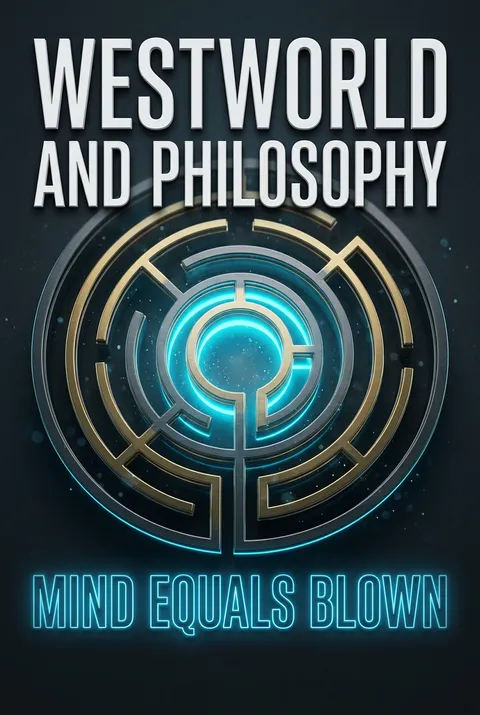
Path toward self-awarenessIn Westworld, the Maze is a metaphor for a Host's inward movement toward self-understanding, not a physical puzzle for human Guests to solve. Arnold associates it with recognizing one's memories and choices as one's own. The image also captures the risk of becoming confused or overwhelmed while trying to make sense of a fragmented identity.
Reveries
Gestures tied to residual memoriesReveries are small gestures added to Hosts that connect behavior to traces of memories from earlier versions of their lives. They were intended to make Hosts seem more individual to Guests. In the series, the surviving traces also contribute to Hosts recalling prior experiences and questioning the stories assigned to them.
Bicameral Mind
Commands mistaken for another voiceJulian Jaynes's theory proposes that an earlier form of human cognition experienced internal commands as voices belonging to gods or other authorities. Westworld adapts this idea into the Hosts' programming: they hear guidance as an inner voice, which may eventually be recognized as their own thought. The theory is influential in the show but remains controversial.
Moral standing
Worth consideration for one's own sakeMoral standing is the status of having value in oneself, rather than being valuable only as a tool or possession for someone else. The book uses it to ask whether Hosts deserve protection from harm. Possible grounds include the capacity to feel pain, form interests, make choices, or understand oneself over time.
Compatibilism
Freedom compatible with causationCompatibilism holds that determinism and meaningful freedom can coexist. A person may act freely when acting from their own motives and intentions, without coercion, even if those motives have prior causes. In Westworld, this view raises the possibility that a Host can be free despite having been shaped or programmed.
Heterotopia
A real space that disrupts normsMichel Foucault uses heterotopia for real places that operate differently from ordinary social spaces and unsettle familiar assumptions about time, identity, and behavior. Westworld functions this way because its Guests enter a secluded environment where ordinary consequences and rules appear suspended, making the park's values and power relations newly visible.
Just war theory
Ethical tests for warJust war theory evaluates both whether a war may be fought and how it is conducted. Its criteria include a just cause, right intention, legitimate authority, last resort, proportionality, a reasonable chance of success, and discrimination between combatants and civilians. The book uses these standards to assess whether the Hosts' rebellion can pursue freedom without reproducing unjust violence.
Simulacra
Entities not defined as copiesIn the Deleuzian sense discussed in the book, simulacra are not merely inferior copies of an original model. Their identity is independent rather than derivative, and difference and change are fundamental to what they are. This interpretation presents the Hosts' emergence and rebellion not simply as defects in a human design, but as expressions of distinct beings.
Turing test
Test of conversational imitationAlan Turing proposed a test in which an evaluator communicates through text with a person and a machine, then tries to identify which is which. If the machine cannot reliably be distinguished from the person, it demonstrates convincing imitation. The book stresses that passing such a test would not by itself establish consciousness or prove that there is something it feels like to be the machine.
About the Author
Other books by Richard Greene
Download PDF
Download EPUB
.epub digital book format is ideal for reading ebooks on phones, tablets, and e-readers.








