

Key Takeaways
Replace donor dependence with organized people, not just better fundraising.
Money shaped the bargain. In March 2010, Democrats celebrated the Affordable Care Act at a Washington bar. Progressive congressman Raúl Grijalva mourned the defeat of a Medicare-like public option. The law expanded coverage and Medicaid, but compromises with the insurance industry helped leave many people facing high premiums and deductibles. The scene captures the book’s argument: passing a bill is not the same as meeting people’s needs.
A different route emerged. In 2018, Alexandria Ocasio-Cortez challenged Joe Crowley, a powerful party fundraiser, with a campaign built on volunteers, small donations, and local frustrations. She won the primary by 15 points. Her victory did not prove that grassroots campaigns always beat money. It showed that organized voters can create a viable alternative to a party machine.
The important distinction is not money versus moneylessness. Campaigns need resources. The question is who supplies them, what priorities those resources reward, and whether supporters gain any lasting role beyond donating. This resembles a principal-agent problem: voters authorize representatives, but donors and party institutions can exert more continuous pressure. Small donations do not automatically solve that imbalance, since a campaign can still treat supporters as a revenue stream. The book’s stronger proposal is organizational: give people meaningful work and influence, so financial support is one expression of participation rather than its substitute.
Expand the electorate before chasing voters party strategists assume are persuadable.
Jackson organized the overlooked. Jesse Jackson’s presidential campaigns drew on the idea that many potential Democratic voters were not registered or engaged. His 1984 campaign registered about two million new voters; his 1988 campaign registered another million. In Michigan in 1988, his team combined practical caucus logistics with door-knocking in Black and student neighborhoods. Jackson surged into a near tie with frontrunner Michael Dukakis, helping demonstrate the electoral potential of a multiracial, working-class coalition.
The gains outlasted the campaign. Jackson’s efforts helped create opportunities for Black political organizers and candidates, including Donna Brazile and Barbara Lee. His campaign also helped win a shift toward proportional delegate allocation in Democratic primaries, a rule change that the book says enabled Barack Obama’s 2008 nomination. The lasting asset was not only votes, but people and rules that could support future campaigns.
This strategy challenges the assumption that elections are mainly contests over persuading a fixed pool of voters. It treats participation itself as politically constructed: registration, convenient access, credible messengers, and a reason to care can change who counts as the electorate. That is a useful corrective to narrow targeting models. Still, coalition-building is not automatic. Groups that share economic interests may disagree over priorities, and expanding turnout does not guarantee policy influence. Jackson’s example is strongest when read as both mobilization and institution-building, not as a promise that diversity alone produces unity.
Treat campaign cash as a policy-making force, not merely a funding source.
Fundraising occupies governing time. After Democratic losses in 1980, party officials such as Tony Coelho encouraged a stronger reliance on corporate political action committees. The change was presented as a way to compete with Republicans, but it altered incentives. New members were placed on fundraising-rich committees, including Financial Services, even when their votes weakened the party’s stated agenda. In 2009, for example, committee members backed an exemption that kept auto dealers outside the reach of a new consumer-protection agency.
No explicit bargain is required. Freshman congressman Beto O’Rourke later recalled being told to spend four hours a day raising money, another hour on outreach, and only three or four hours on legislative work. He described how a large donor can influence a vote simply because a member does not want to jeopardize a future contribution. The book’s claim is structural: dependence can narrow choices before anyone demands a specific favor.
This is a resource-dependence argument, not a simple accusation that every recipient is corrupt. An institution becomes responsive to the actors on whom it relies for survival, even without an explicit exchange. That makes the time spent fundraising politically consequential in its own right. Yet money can also help candidates excluded from established networks, as early EMILY’s List support did for women candidates. The relevant test is therefore not whether money exists, but whether its source and distribution create accountability to a narrow set of patrons or broaden who can compete.
Keep the campaign alive after victory, or insiders will reclaim the agenda.
A winning movement can be switched off. Barack Obama entered office in 2009 with a vast network of supporters, high approval, and a Democratic majority in Congress. His campaign organization was converted into Organizing for America, but the White House did not use it to sustain pressure for its priorities. Instead, advisers negotiated largely inside Washington. The stimulus began at a proposed $1.8 trillion, then was reduced to less than $800 billion, despite mass job losses and warnings that the economy needed more support.
Compromise brought a political cost. The administration also pursued deficit restraint while foreclosures continued and Wall Street executives largely escaped prosecution. In health care negotiations, industry deals and the failure to secure a public option left progressives dissatisfied. The book connects these disappointments to weakened enthusiasm and Democratic losses. Its point is not that one large rally would have solved every problem, but that an energized base was treated as a campaign asset rather than a governing constituency.
The transition from campaigning to governing creates a classic collective-action problem: millions of supporters have potential influence, but need coordination, clear demands, and repeated opportunities to act. Without those structures, organized industries and experienced insiders retain an advantage simply because they are always present. The book is persuasive about this imbalance, though it can make mobilization sound more potent than it is. A mass network cannot erase Senate rules, internal party divisions, or economic constraints. It can, however, change which compromises are politically costly and which options leaders consider realistic.
Make civil disobedience raise the political cost of indefinite delay.
Patience was not producing action. LGBTQ activists had watched Democrats court their votes while postponing policy promises. After California voters revoked marriage rights through Proposition 8 in 2008, activists built protests across the country and organized groups such as GetEQUAL. They interrupted public events and targeted the White House, insisting that ending the military’s ban on openly gay service members could not be left to an endless study process.
Pressure met a changing climate. A Pentagon survey found that 67 percent of surveyed service members expected repeal to have a positive or neutral effect on their units, while 12 percent expected a negative one. Activists were only one factor among public opinion, legal challenges, lawmakers, and a president who supported repeal. But they helped make delay more visible and costly. Congress repealed the ban in 2010. The broader lesson draws on ACT UP’s earlier fights against government indifference during the AIDS crisis.
Direct action works partly by changing the audience for a political decision. A private promise can be postponed; a public contradiction between stated values and visible conduct is harder to manage. That logic resembles agenda-setting: protest makes an ignored issue salient enough to compete with institutional routines. The account also makes clear that disruption alone is insufficient. Repeal had support within government, legal pressure, and a favorable shift in public opinion. Activists can accelerate a decision when conditions are ripe, but they cannot reliably manufacture those conditions by spectacle alone.
Convert online enthusiasm into local teams with a specific next task.
The internet can gather people, not organize them by itself. Howard Dean’s 2004 campaign used online supporters to raise money and build a community around an anti-war candidacy. MoveOn had earlier raised $1.25 million in three days from more than 30,000 individual donors. But the book stresses that email fundraising is not the same as field organizing.
The Sanders campaign tested a bridge. Its barnstorms brought supporters together, recruited volunteer hosts, and matched other attendees to events they agreed to attend. The campaign held roughly 1,000 barnstorms, about 650 led by volunteers. A simple sign-up process turned vague enthusiasm into a concrete commitment. The method built on an older organizing practice, using digital coordination to help people meet and act in person, rather than treating an online list as an ATM.
The design insight is behavioral as much as technological. A broad invitation creates interest, but a specific role, a nearby event, and a commitment to other people make follow-through more likely. The face-to-face element supplies trust and accountability that an email cannot. At the same time, volunteer systems can reproduce inequalities: people with more flexible schedules and resources may participate more easily. A strong organizing model therefore needs both low-friction entry points and deliberate ways to include people whose time is scarce.
Use credible primary threats to move incumbents, even when challengers lose.
A challenge can change behavior before it wins. Sarah Smith, backed by Justice Democrats, challenged Democratic congressman Adam Smith in Washington state and repeatedly criticized his position on U.S. support for Saudi Arabia’s war in Yemen. The book reports that Adam Smith became more forceful in opposing the war as her campaign gained attention. He denied that her challenge caused his shift, so the relationship remains contested, but the race made the issue harder for him to ignore.
Crowley’s loss made the threat tangible. Alexandria Ocasio-Cortez defeated Joe Crowley, a senior Democrat widely expected to rise into House leadership. Her victory showed incumbents that a primary challenge could be more than a symbolic protest. The value of a challenge, then, is not measured only by whether the challenger takes office. A credible campaign can expose a neglected issue, force a public response, and make other officials reconsider their own vulnerability.
Primaries can function as accountability mechanisms inside a party, where general elections may offer voters little leverage over a safe-seat incumbent. Their broader effect depends on credibility: an incumbent must believe that organizers, donors, and voters can sustain a real contest. The book’s examples support that mechanism, but causal attribution needs care. Politicians can shift because public opinion changes, new evidence emerges, or their own views evolve. The most defensible claim is that a visible challenge changes the incentives and attention surrounding an issue, not that it single-handedly dictates an incumbent’s position.
Build politics from civic groups already trusted in people's daily lives.
The resistance did not start from scratch. After Donald Trump’s 2016 victory, many people who had organized school events, church activities, and community projects began attending protests and political meetings. In Lancaster County, Pennsylvania, Annie Weaver moved from church and school volunteering into Lancaster Stands Up, a local group that organized against the Muslim ban and mobilized for elections.
Local networks could win concrete fights. The group helped elect school-board candidates, challenged a plan to outsource support for formerly incarcerated people to a private prison company, and organized public scrutiny after police used a Taser on a Black resident. The book’s example is not that every civic group is inherently progressive. It is that practical skills, relationships, and local knowledge can be redirected into political participation, then used between elections to address problems people can see firsthand.
This is a theory of civic capacity: organizing competence often exists before people adopt a political identity. Schools, congregations, and neighborhood groups provide relationships and routines that can lower the cost of collective action. That makes local organizing more durable than a burst of national attention. But trusted networks are not necessarily inclusive or representative. A group must ask whose concerns are centered, who is missing, and whether new participants share power rather than simply supplying labor. The Lancaster story matters because coalition-building and local accountability develop together.
Connect progressive policy to lived experience so identity and class reinforce each other.
A message travels farther when it has a human address. Ocasio-Cortez grew up between the Bronx and a more affluent suburb, then saw her family struggle after her father died. Her mother worked multiple jobs, while a probate dispute added legal costs and uncertainty. Those experiences gave her campaign a way to connect economic policy to recognizable pressures such as rent, health care, and wages.
Her coalition exceeded one identity group. Ocasio-Cortez won Crowley’s district by mobilizing many voters who turned out for the 2016 presidential election but often skipped midterms. The precinct analysis described in the book challenges the claim that Hispanic voters alone carried her to victory: Crowley actually did better in the Bronx than in Queens. Her story and platform helped connect class concerns, identity, and a new electorate without pretending those experiences were interchangeable.
Lived experience can make policy legible without reducing a candidate to autobiography. It supplies examples of how institutions operate in ordinary life, and can build credibility with people who distrust abstract promises. The book is especially useful in showing identity and economic interests as potentially reinforcing rather than competing frames. Still, one candidate’s biography cannot be turned into a universal template. Personal authenticity is not a substitute for policy competence, and a compelling story does not guarantee that a coalition will agree on what to do.
Analysis
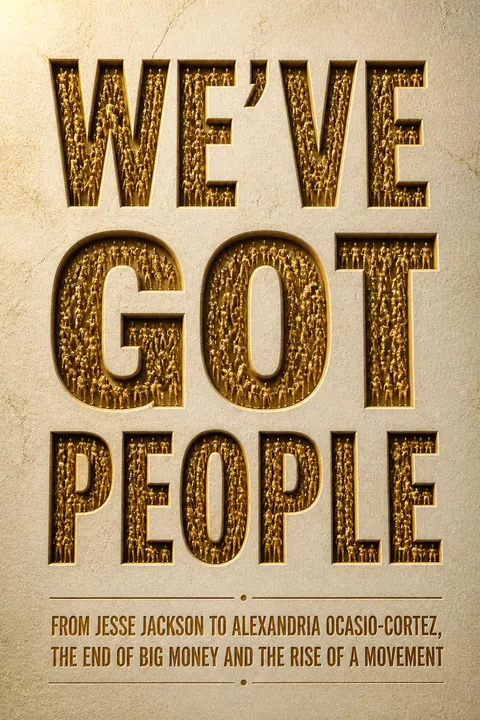
Grim’s central argument is not simply that wealthy donors corrupt individual politicians. It is that funding systems, committee assignments, party rules, and leadership habits shape which ideas can advance before any explicit bargain occurs. That makes the book an institutional history of attention and leverage. Who gets invited into the room, who is expected to raise money, and who can credibly threaten a primary all help determine what counts as politically possible.
Its narrative arc moves from Jesse Jackson’s coalition-building through the Democratic Party’s turn toward corporate fundraising, the underuse of Obama’s campaign network, and the rise of digitally connected activists. Ocasio-Cortez’s victory becomes a visible crest, but the deeper story is the accumulated infrastructure beneath it: local groups, small-donor lists, volunteer methods, independent media, and organizers who carry lessons from one campaign to another. The title’s contrast between money and people is therefore most convincing when understood as a contrast between passive financial dependence and active, organized participation.
The book is strongest when it shows mechanisms in detail, such as fundraising schedules that crowd out legislative work or a primary threat that forces an issue into public debate. It is less conclusive when it assigns causation to private motives or close election outcomes. Interviews are retrospective, some actors dispute the author’s interpretation, and examples of insurgent success can reflect unusual candidates, favorable timing, or district conditions. The broader argument should not be mistaken for a guarantee that grassroots energy can overcome every institutional barrier.
A useful synthesis is that durable political power requires both mobilization and governing capacity. Protest can change the agenda; elections can change who holds office; policy expertise and organization are needed to convert both into lasting results. The book invites readers to evaluate politics not only by who wins, but by whether supporters gain an ongoing way to influence decisions. Its most transferable lesson is organizational: build structures that let people participate before, during, and after an election.
Glossary
Rainbow Coalition
Multiracial political allianceThe coalition associated with Jesse Jackson’s presidential campaigns, joining Black, Latino, Native American, Asian American, and white working-class and progressive constituencies. Its purpose was to build shared political power around economic justice and peace while resisting the idea that race and class required separate political strategies.
Netroots
Online progressive organizingA network of progressive activists, bloggers, and supporters who used the early internet to share political information, raise small donations, coordinate campaigns, and pressure elected officials. The book distinguishes this activity from treating the internet merely as a fundraising channel: its political significance came from building relationships and organizing action offline.
Barnstorm
Volunteer organizing meetingIn the Sanders campaign’s use of the term, a barnstorm was a large local gathering that energized supporters and helped them launch smaller volunteer events. Attendees could host or join phone banks and other campaign activities. The method aimed to turn a crowd into a network of locally organized teams rather than leaving people as spectators.
Distributed organizing
Volunteer-led campaign activityA campaign model in which supporters are trusted and equipped to organize activities across many locations, with digital tools helping coordinate and track the work. It contrasts with relying mainly on paid staff to direct each action. The Sanders and O’Rourke campaigns used versions of this approach to expand volunteer-run events, offices, and voter contact.
Blue Dogs
Conservative Democratic blocA group or tendency of business-friendly and often socially conservative Democrats, including lawmakers from districts where they considered progressive positions electorally risky. In the book, Blue Dogs repeatedly use their pivotal votes to press for smaller spending, weaker legislation, or more centrist party choices.
Public option
Government insurance planA publicly administered health insurance plan proposed to compete with private plans in the marketplaces created by the Affordable Care Act. It was not the same as single-payer health care. Supporters argued that a public plan could expand coverage and create competition, but it was excluded from the final law after political negotiations.
PAYGO
Spending offset ruleShort for pay-as-you-go, a legislative rule requiring new government spending to be offset by spending cuts or new revenue. The book traces its rise in Democratic politics from a tactic for challenging unpaid-for Republican tax cuts and military spending to a constraint used to resist domestic investment, including aid during high unemployment.
Veal pen
Managed activist accessA label for a White House practice of bringing outside progressive organizations into regular meetings with administration officials. The meetings offered access and recognition, but could also encourage groups to follow the administration’s preferred strategy and restrain public pressure on Democratic lawmakers.
Dean Bat
Visual fundraising trackerA red bat graphic used by Howard Dean’s 2004 presidential campaign to show progress toward a fundraising goal. The campaign publicly explained how much it had raised and what it still needed, turning a financial target into a visible shared challenge for supporters. Its spread helped demonstrate the potential of internet-enabled small-donor fundraising.
Download PDF
Download EPUB
.epub digital book format is ideal for reading ebooks on phones, tablets, and e-readers.








