

Key Takeaways
Treat a friendship breakup as real grief, even when nobody names it.
A loss without a ritual. Pryor opens with Maggie, a close friend who gradually stopped responding and finally offered only a vague explanation. There was no agreed breakup, no clear reason, and no social script for grieving. Pryor spent months wondering what she had done wrong, then recognized a longer history of friendships that had ended without acknowledgment. The pain was easy to hide, but not easy to erase.
Friendship has real stakes. The book cites a 2005 Harvard Medical School study reporting that women with more friends were less likely to develop physical impairments as they aged. Its researchers reportedly compared lacking close friends with risks such as smoking or obesity. Pryor’s point is not that friendship is always permanent, but that its loss deserves to be taken seriously.
Friendship breakups often lack the public markers that help people process other losses: a name for the event, permission to grieve, and support from others. That absence can make sorrow feel embarrassing, even when the relationship shaped daily life. Naming the loss is therefore more than a comforting gesture; it gives people a shared way to recognize what happened. The comparison with bereavement is emotionally illuminating, though it should not imply that all losses are identical. The useful claim is narrower: a friendship can be important enough to mourn, whether or not other people understand why.
Trust the pattern of withdrawal, not the soothing claim that nothing is wrong.
An unacknowledged ending. Pryor calls an unexplained or avoided friendship ending an “unending.” It can take the form of unanswered calls, canceled plans, or a sudden retreat, without either person clearly saying the relationship is over. Because the change is real but its meaning is denied, the person being left may distrust her own perception and search for a personal mistake that may not exist.
The pattern matters. Pryor’s own experience with Maggie began with an unanswered invitation and continued through vague reassurances. Robin, a sculptor whose neighbor and close friend stopped responding to their shared walkie-talkie, eventually chose to mark a day as the end and stop waiting. That did not reveal the other woman’s reason, but it helped Robin accept what the behavior already showed.
A person’s words and repeated actions can conflict, and the conflict itself becomes information. In interpersonal psychology, ambiguous loss describes situations in which someone is physically present or absent without a clear social or emotional resolution. Pryor’s term captures a familiar version of that uncertainty. Still, withdrawal does not disclose its cause: stress, illness, conflict, and changed priorities can look similar from the outside. The practical lesson is not to claim certainty about another person’s motives. It is to respect a sustained pattern, ask clearly once or twice, and avoid letting denial erase what is observable.
Stop making the abandoned friend solve a mystery the initiator refuses to explain.
Silence transfers the burden. Mia had been close to Terry for years, speaking with her often and seeing her regularly. When Terry began canceling plans, Mia asked whether something was wrong. Terry said no, while continuing to retreat. Mia was left trying to identify an offense without evidence. Pryor argues that this denial compounds rejection: the receiver not only loses a friend, but is encouraged to doubt her own judgment.
The harm can spread. Jessica’s case was unusually severe. After a false rumor about her family circulated among neighbors, several families cut contact, their children were excluded, and the household became so distressed that Jessica eventually moved. The story is not typical friendship drift, but it shows how silence and group avoidance can amplify damage beyond the two adults involved.
When one person withholds an explanation, the other often supplies one, and self-blame is an especially available explanation. That is one reason a direct acknowledgment can be kinder than a supposedly protective silence. Jessica’s story also shows that exclusion is not always a private emotional matter: children, spouses, and neighbors can become part of its consequences. At the same time, an explanation is not always safe or constructive, especially where coercion, harassment, or volatile behavior is involved. Accountability should mean recognizing the effects of a choice, not insisting that every ending requires a face-to-face encounter.
Write a clean ending letter only after deciding you are truly done.
Purpose shapes the letter. Pryor contrasts two letters. Grace wrote to Shay after deciding to leave a shallow, stressful connection, but included judgments about Shay’s personality and life. Shay replied defensively and attacked Grace in turn. Blake, alarmed after her young daughter nearly swallowed a pill that belonged to her friend Annette, wrote a different kind of letter. She stated that she did not want the friendship to continue, acknowledged qualities she had valued, and avoided accusations that might provoke an argument.
Choose clarity over prosecution. Pryor’s advice is to keep a departure letter focused on its purpose: ending contact, not proving who was right. The relationship and the circumstances matter, however. Blake feared an unpredictable response, so a written boundary was more appropriate to her situation than an in-person discussion.
A letter can create distance between an intense feeling and the words used to communicate it. That pause is useful when the goal is a boundary rather than emotional vindication. It also makes the sender’s intention legible, reducing the chance that the recipient mistakes a final decision for an invitation to negotiate. The contrast between Grace and Blake illustrates a general communication principle: feedback that attacks character tends to invite counterattack, while a clear statement of one’s decision leaves less to litigate. Directness is not the same as maximum disclosure, especially when safety or escalation is a concern.
If the other person will not close the door, choose your own stopping point.
Closure may be self-made. Robin kept calling, emailing, knocking, and trying to reach Sophia, a close friend who lived one floor away. Sophia would not explain the withdrawal, and Robin’s anxiety grew whenever she stepped out of her apartment. After reflecting on her own past, Robin remembered that she had also left friends without a clear ending. She then selected a day to accept that the friendship was over for her.
Stop waiting for permission. Robin’s choice did not produce a conversation or restore the relationship. It gave her a way to end the daily cycle of anticipation and rejection. She could still value what the friendship had meant without treating its past importance as a promise that it would return. Pryor presents this as one route through an ending when the other person refuses to participate.
A self-chosen endpoint is a practical response to uncertainty, not a claim that the other person’s silence was fair or understandable. Rituals can help organize emotion when no shared ritual exists: a date, a letter never sent, or a deliberate decision to stop initiating contact. Such acts do not erase grief, but they can reduce the exhausting search for a definitive answer. There is a useful distinction between accepting that a relationship is unavailable now and declaring that its meaning was false. Robin’s story preserves the value of the past while ending the demand that it determine the future.
Before ending a close friendship, test whether a boundary could change it.
Distance is not always a breakup. Reese initially planned to fade out of her eight-year friendship with Colette. She later realized that she felt smothered because she had stopped making time for other friends, not because she wanted Colette gone. Once Reese identified the problem, she saw a possible adjustment: keep the friendship, but reclaim room for a broader social life.
Make the problem specific. Rachel’s friendship with Ann had become painful because Rachel felt she gave far more than she received. Rather than quietly disappearing, Rachel described what she could no longer accept and asked for distance. Their relationship did not return to its old form, but the conversation made a changed relationship possible. Pryor’s examples challenge the false choice between staying exactly as before and ending everything.
A friendship is not a single fixed arrangement. Frequency of contact, emotional availability, shared activities, and expectations can all change independently. Treating those dimensions as adjustable can prevent resentment from turning into a total verdict on the person. This resembles boundary-setting in other relationships: a boundary describes what someone can participate in, rather than trying to control another person’s character. The approach has limits. Some relationships are harmful, and a boundary may not be respected. But when the underlying need is space, reciprocity, or reduced intensity, naming that need can reveal options that an all-or-nothing decision hides.
Confrontation works best when you know what outcome you are asking for.
Questions need a destination. Pryor confronted Hilda, a former acquaintance who had treated her coldly for years. Hilda avoided explaining herself, but agreed to behave civilly, which was what Pryor most needed in their shared school community. The conversation did not uncover the past; it changed the practical terms of their future contact.
Tone can shape the result. Ella confronted childhood friend Jill after Jill insulted another close friend at a baby shower. The argument ended their relationship, though Ella later wished she had asked more about Jill’s hurt and controlled her anger. By contrast, Page wrote to Deandra with gratitude for their shared history and a clear explanation that she wanted to leave. Deandra responded with sadness and appreciation for the honesty. A conversation can clarify, repair, or end, but it cannot guarantee agreement.
The word confrontation often carries an expectation of truth emerging in a dramatic exchange. Pryor’s examples are more useful when treated as different tools for different aims. A person may want a behavior to stop, a friendship to change, a final explanation, or simply a clean goodbye. Those are not interchangeable objectives. Naming the desired outcome beforehand helps prevent an emotional encounter from becoming an unplanned trial. It also leaves room for an important limit: the other person may refuse to explain, apologize, or repair. A successful conversation is sometimes one that establishes a workable boundary, not one that produces complete mutual understanding.
Treat workplace friendship loss as a practical disruption, not just a private hurt.
Shared routines raise the cost. Nancy and Rachelle had worked near each other for years, commuting together, eating lunch together, and helping each other through busy days. When Rachelle stopped sharing those routines, Nancy lost a friend and a source of daily structure. She eventually left the job and found new activities, including work at a relative’s salon. Jackie, another worker whose friend began ignoring her at the office, asked her employer for a transfer to a different location.
The setting matters. Brooke overheard two close colleagues criticizing her during an accidental phone call. She maintained a working relationship with them, but the trust between them changed. Workplace endings can affect concentration, attendance, professional decisions, and other colleagues. The book’s cases show why emotional support and practical planning may both be necessary.
Workplace friendships combine intimacy with repeated, unavoidable contact. That makes their rupture different from a relationship one can simply stop seeing: coworkers may share tasks, schedules, and authority structures after personal trust disappears. The organizational cost is not only sadness; unresolved tension can impair coordination and make a team’s informal support network less reliable. Nancy and Jackie respond differently, which underscores that there is no universal remedy. A transfer can be protective but may carry professional costs, while staying requires workable boundaries. Employers often treat interpersonal strain as peripheral, even when it shapes daily functioning.
An apology can reopen a door, but cannot restore lost years.
Regret can become a repair attempt. Maria ended her close friendship with Nina by disappearing after marriage, then carried shame for years. When they spoke again while planning a mutual friend’s celebration, Maria wrote to acknowledge the harm, express regret, and thank Nina for their history. Nina responded, and they had a meaningful conversation, though Maria did not assume that trust or the old friendship would automatically return.
Some chances expire. Pryor’s grandmother, Gram, had refused to open a letter from Fiona, her closest friend, after leaving her marriage for a new life. Decades later, Gram found the letter and learned Fiona had apologized and wanted to reconcile. Fiona had died shortly before Gram discovered it. By contrast, Pryor and Lila reconnected after ten years when Pryor’s husband reached out. These stories make repair possible, but never guaranteed.
Apology matters because it restores moral recognition: the injured person is no longer left carrying the whole meaning of the rupture alone. A sincere apology does not purchase forgiveness, and it cannot return shared birthdays, ordinary phone calls, or years of trust. Gram’s story gives urgency to communication without turning every estrangement into a repair project. Some endings are necessary, and some friends will not want contact. The soundest principle is to speak honestly when there is a real opportunity, accept the other person’s response, and avoid confusing remorse with entitlement to a reunion.
Analysis
Pryor’s book is part memoir, part oral history, and part practical ethics of friendship. Its central contribution is not a universal formula for ending relationships, but a description of the damage created when one person’s decision is made illegible to the other. The initiator may experience avoidance as mercy or convenience. The receiver experiences it as rejection compounded by uncertainty. Pryor’s own disclosures give the argument force: she has been abandoned, has abandoned others, and eventually recognizes that both roles carry responsibility.
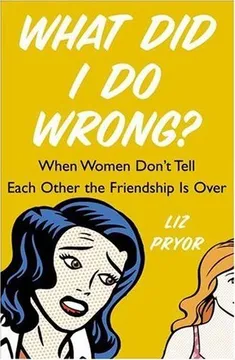
The book’s strongest method is narrative comparison. A gentle departure letter, a confrontational exchange, a boundary-setting attempt, and a dangerous friendship do not produce the same result. These cases resist simplistic advice to always confront or always preserve a relationship. Instead, they direct attention to purpose, context, and consequences. The title question, “What did I do wrong?”, becomes a description of the receiver’s burden, not proof that the receiver caused the ending.
The evidence is experiential rather than representative. Pryor collected hundreds of stories, but women who chose to share painful friendship losses may not reflect how common or typical any particular pattern is. The book also speaks broadly about women, although friendship norms vary across cultures, generations, personalities, and communities. Its health findings support friendship’s importance, but they do not establish that every close friendship must last or that ending one directly causes health decline.
The most durable ethical insight is more modest and more useful: a person may choose whom to keep close, while still taking responsibility for how that choice is communicated. Honesty does not require exhaustive criticism, and closure cannot be demanded from someone unwilling to give it. When safety, coercion, or serious harm is involved, distance may be the responsible choice. In ordinary cases, however, acknowledgment can spare another person years of inventing explanations, and spare the initiator a future shaped by avoidable regret.
Glossary
unendings
Unacknowledged friendship endingsPryor’s term for friendship losses that occur without a clear, shared acknowledgment. They may involve a gradual retreat, unanswered calls, canceled plans, or a direct refusal to discuss what changed. Because the relationship appears to be ending while the other person denies or avoids that fact, the receiver is left without a clear explanation or social marker of closure.
receiver
Friend left without clarityThe person on the receiving end of an unacknowledged friendship ending. The receiver may notice that contact has changed, ask whether something is wrong, and still receive no direct explanation. Pryor describes the resulting mix of rejection, confusion, self-blame, and difficulty deciding when to stop hoping for the friendship to resume.
initiator
Friend choosing to leaveThe person who has decided to reduce or end a friendship. Pryor observes that initiators may have considered the decision for some time and become emotionally detached before the receiver understands what is happening. Some avoid explaining themselves because they fear conflict, guilt, or hurting the other person, even though silence can deepen the harm.
moral barometer
Inner guide to conductPryor’s metaphor for the personal sense of what behavior feels honest and acceptable. It is shaped by a person’s upbringing, values, and understanding of how others should be treated. In friendship endings, the barometer can help someone assess whether avoidance, a direct conversation, or a letter best fits the person she wants to be.
downshifting
Reducing friendship intensityA gradual reduction in the frequency or closeness of a relationship, rather than an explicit declaration that the friendship is over. Pryor uses the term when distinguishing a change in level of contact from a true ending. Downshifting may suit a relationship that needs more space, but it can become an unending if the other person is left to guess what the change means.
Download PDF
Download EPUB
.epub digital book format is ideal for reading ebooks on phones, tablets, and e-readers.








