

Key Takeaways
America kept its feet because measures belong to habits, power, and trade
A system is more than arithmetic. In 1982, CBS announced the end of the U.S. Metric Board as if the meter itself had been defeated. The distinction matters: the board was gone, but metric units remained in science, industry, and commerce. The book traces why customary measures endured: people already knew them, communities built practices around them, and replacing them offered no equally obvious benefit in daily life.
History shaped the choice. A horse’s height in hands or a race’s length in furlongs can be more intuitive within the horse world than a conversion into centimeters or kilometers. Such measures carry shared habits and specialist knowledge. The metric system has clear mathematical advantages, but its logic alone could not erase the social and practical ties holding older units in place.
What's striking is how measurement behaves like infrastructure: it works best when people can rely on it without thinking about it. That helps explain why a mathematically cleaner system can lose to a familiar one. The same tension appears in software and public policy, where a technically superior standard still needs compatible tools, training, and trust. Customary units are not automatically better because they feel familiar, however. Familiarity can preserve costly confusion. The useful question is therefore not which system is universally best, but where consistency matters most and who bears the cost of switching.
Jefferson made the dollar decimal, but his decimal measures never followed
Money made the opening. After the Revolution, Americans traded in a jumble of foreign coins and kept accounts using British pounds, shillings, and pence. Thomas Jefferson proposed using the familiar Spanish dollar, divided into tenths, hundredths, and thousandths. This replaced awkward ratios with decimal arithmetic while retaining a coin people already recognized. The first U.S. coins appeared in 1792, and the dollar’s decimal divisions endured.
The larger plan stalled. Jefferson wanted the same decimal logic for weights and measures. He considered a mile based on geography, then proposed a system built from a pendulum standard, a cubic-foot bushel, and water as the basis for weight. But Congress did not adopt it. The dollar succeeded where the wider system did not, showing that a decimal idea could take hold when it solved an immediate problem without requiring people to relearn everything at once.
Jefferson’s dollar is a useful case of innovation by anchoring: retain a trusted object, change the rules around it. That pattern appears in financial technology, where new systems often gain acceptance by translating familiar balances rather than demanding entirely new mental models. The contrast also complicates the claim that decimals naturally win because they are simpler. The dollar’s success depended on a pressing need for national currency; weights and measures already had broadly shared American conventions. A reform can be elegant and still lack a compelling reason to displace what works well enough.
A mathematically elegant system can still fail at the market stall
The French problem was political. Before the Revolution, local measures varied sharply, and by some counts France had about 250,000 distinct measures. These were entangled with rents, tariffs, and privileges. Peasants often wanted a fair, consistent measure, not an abstract scientific system. Revolutionaries instead sought a uniform national order, and in 1793 the metric system became compulsory even though the new units were unfamiliar and difficult to use.
Reform reached beyond rulers. Revolutionary leaders also tried decimal time and a new calendar. The calendar replaced the seven-day week with ten-day stretches, disrupting familiar religious and work routines. These experiments reveal the ambition behind metrication: it was part of rebuilding society, not merely improving calculations. Decimal ratios simplify many calculations, but they do not always fit the everyday ways people divide, buy, and understand things.
The French example separates technical merit from political legitimacy. A shared standard can reduce opportunities for local exploitation, yet a central authority can also use standardization to extend its control. That distinction matters whenever reform is presented as an uncomplicated public good. People may welcome fairness while resisting the means chosen to deliver it. The book also surfaces a real cognitive tradeoff: base ten is excellent for multiplication, while halves, quarters, and thirds are often easier to grasp as physical portions. Rationality depends partly on the task, not just the number system.
Napoleon made metric workable by disguising it in familiar measures
A practical revision took hold. The first metric system relied on new names and decimal subdivisions, which many people found bewildering. Napoleon’s government revised it in 1800, restoring familiar names while retaining decimal relationships. In 1812, the système usuel brought back customary subdivisions, including familiar feet and pounds, while tying their sizes to the meter and kilogram. The result was a compromise between the new standard and everyday habits.
Power helped it travel. Napoleon’s administrations spread metric measures alongside legal and governmental reforms across territories under French control. Adoption was uneven, and many people continued using older measures informally. Still, the metric system gained a foothold in regions where shared administration and trade made common standards useful. Its spread was not simply a victory for scientific elegance; it was also a consequence of political expansion and practical accommodation.
This episode shows that standards can survive by changing their presentation without abandoning their underlying structure. In design terms, the system’s internal logic and its user-facing language need not be identical. That is a powerful lesson for technical reform: translation can reduce friction. Yet the compromise was not purely voluntary. Napoleon’s reach gave the system a distribution network that advocates alone could not create. A reform’s apparent usability should therefore be considered alongside the power that makes it widespread.
The meter needed international governance, not another supposedly perfect ruler
A physical standard needed caretakers. The meter was first defined from a measurement of Earth, but the survey was imperfect. Its final result differed from the provisional meter by only about a hundredth of an inch, after years of work. Later, countries discovered that copies of the meter did not always agree. A single natural origin could not guarantee that every ruler made from it stayed consistent.
Institutions made comparison possible. The 1875 Treaty of the Meter created the International Bureau of Weights and Measures to maintain standards and coordinate comparisons among nations. A new international meter and kilogram followed in 1889. The system became more than a French artifact because countries agreed to share responsibility for its precision. International standards depend on procedures, reliable copies, and institutions, not just a compelling origin story.
The meter’s history anticipates a central problem in modern measurement: traceability. A result is useful only if another laboratory can connect its instrument to the same standard through a dependable chain of comparisons. That makes governance part of scientific accuracy, not bureaucratic decoration. The account also punctures the idea that a measure taken from nature is automatically neutral or permanent. Nature supplies a reference, but people choose how to define, reproduce, and administer it. Those choices require continuing oversight and can still reflect national interests.
Railroads made shared time urgent; geography supplied the workable compromise
Local noon stopped being enough. Before fast travel, towns could keep time according to the sun without much trouble. Railroads changed that. A traveler crossing the United States might encounter many local times, and train connections became hard to coordinate. In 1879, scientist Cleveland Abbe proposed dividing the country into time zones, each sharing a common time.
Business moved faster than law. Railroad organizer William Allen adapted the plan to the companies’ schedules. In November 1883, railroads and many cities adopted the new system, with about eighty of the hundred largest U.S. cities changing their clocks. An 1884 international conference chose Greenwich as the prime meridian and established the basis for global time coordination. Standard time spread because travel and communication made its benefits immediate and visible.
Standard time offers a revealing contrast with metrication. Railroads had a direct operational problem, and each company benefited when timetables aligned. The reform therefore had a clear coalition of users and a visible payoff. Yet the choice of Greenwich also shows that coordination does not emerge from neutrality alone. A dominant observatory and its navigation tables gave Britain an advantage. Shared standards often solve real problems while quietly distributing influence, so their usefulness and their politics should be examined together.
A voluntary conversion campaign cannot survive when citizens see no reason to switch
The U.S. commitment was limited. Congress made metric measures legal in 1866, and the 1975 Metric Conversion Act later established a policy of coordinating increased use. It did not require Americans to convert. Many people nevertheless assumed a mandatory switch was underway. Metric advocates promoted highway signs as a way to make the change tangible, but the plan drew intense opposition. In 1977, the federal highway office received 5,000 letters, 98 percent of them negative.
The board could not bridge the gap. The U.S. Metric Board was meant to guide conversion, but it struggled to explain what was voluntary and why ordinary users should care. President Reagan ended its funding in 1982. The metric system itself was not abolished; the organization promoting change was. A reform can have support in industry and science yet falter when the public experiences it mainly as an imposed inconvenience.
The campaign illustrates a mismatch between policy design and public interpretation. A law can be formally voluntary while its name, school programs, and proposed road signs make it feel compulsory. That perceived loss of control can overwhelm arguments about efficiency. Public resistance is not always evidence that a reform is irrational; it can reveal that costs, benefits, or decision rights have not been made clear. Conversely, strong opposition does not prove the status quo is optimal. Deliberate pilots and transparent choices might have built more trust than confident declarations of inevitability.
Preserve local measurement habits while standardizing the systems that must interoperate
Daily life is already mixed. In American supermarkets, wine and spirits are sold in liters, while milk commonly appears in quarts or half gallons. Beer has long favored ounces and pints, and produce may be sold by count. Since a 1994 law, many products have carried both customary and metric quantities. These habits are not proof that one system has defeated the other; they show that different units remain useful in different settings.
The author rejects an all-or-nothing choice. Metric units suit science, engineering, and international trade, where consistent specifications matter. Customary measures remain familiar in many everyday contexts. The proposed distinction is between the system underneath an operation and the units presented to its users. Interoperability can be essential without requiring every person to abandon every familiar measure.
This distinction resembles the separation between a technical backend and a user interface. A system can exchange standardized data internally while presenting information in terms a particular audience understands. That approach avoids treating cultural familiarity as either a virtue to preserve everywhere or a defect to eliminate everywhere. It has a limit: dual labeling and conversion can create ambiguity when dimensions, tolerances, or safety requirements matter. The most defensible approach is contextual. Keep familiar interfaces where the stakes are low, and insist on one explicit standard wherever errors carry real costs.
Computers made conversion effortless, but unit mismatches still destroy expensive missions
Trade made measurement less visible. Containerization transformed shipping by moving goods in standardized boxes. One common capacity measure, the TEU, is based on a twenty-foot container. Meanwhile, computers and phones can convert units instantly, reducing the everyday burden that once made a single system seem essential. The United States also directed federal agencies toward metric use in the early 1990s, even as customary units remained common in daily life.
Automation does not remove every risk. In 1999, NASA’s Mars Climate Orbiter was lost after spacecraft software used SI newtons while ground operations used pound-force. The incident showed how a conversion assumption can fail when teams and systems do not share explicit units. Calculators make switching easy for individuals, but technical projects still require agreement about what each number means.
The Orbiter episode is not a simple argument that everybody should use one system in every setting. It is a warning about invisible assumptions at interfaces between teams. Software can translate units only when the quantity and conversion rule are specified correctly; automation may hide disagreement rather than resolve it. Containerization makes a related point: global commerce can build new shared measures without replacing every older one. The practical priority is explicit interoperability, especially in engineering, where an unlabeled number can be more dangerous than an unfamiliar unit.
Analysis
The book’s most valuable argument is that measurement systems are social arrangements with mathematical properties, not merely collections of units. Decimal ratios simplify calculation, but a standard also has to be taught, trusted, copied accurately, embedded in institutions, and made useful in ordinary transactions. The history therefore shifts the question from which system is logically superior to why a particular system becomes convenient enough, legitimate enough, and powerful enough to displace its competitors.
The narrative’s strongest contrast is between metrication and Standard Time. Metric reformers often relied on forecasts of inevitable adoption and national decline, while the railway time change answered a visible coordination problem. Railroads had a reason to act together, and passengers could immediately understand the benefit. This distinction clarifies why technical reform is more likely to endure when the burden of switching is matched by a concrete gain for the people expected to switch.
The book also resists the neat story of an enlightened metric system defeating irrational customary measures. Some local units encoded work routines, trade practices, or bodily intuition; others enabled unequal taxation and arbitrary privilege. Custom could preserve knowledge, but it could also preserve exploitation. Likewise, universal standards can improve fairness and exchange while strengthening centralized authority. Neither local difference nor uniformity is inherently democratic.
The conclusion is strongest when treated as a question of layers. A country can use metric units in science, industry, and international exchange while retaining customary measures in familiar daily settings. Digital conversion lowers the cost of that arrangement, but does not eliminate the danger of silent assumptions in engineering. The remaining challenge is not to make every person think in one unit system. It is to make the boundaries between systems explicit, dependable, and safe, while avoiding the false promise that one standard can solve every cultural and political problem.
Review Summary
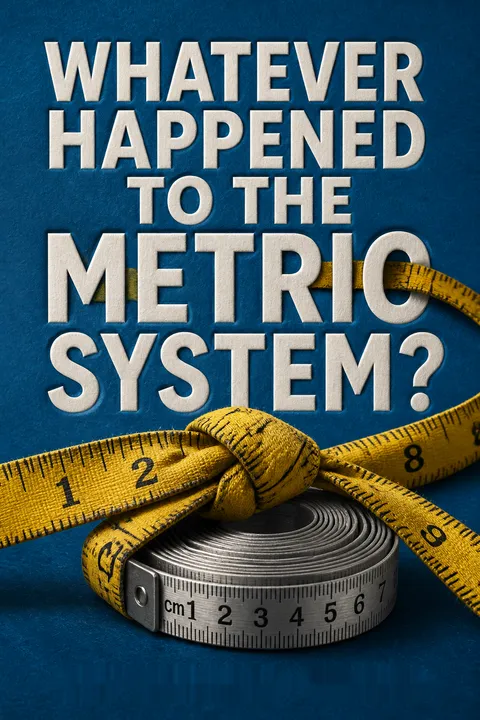
Whatever Happened to the Metric System? is a detailed history of measurement systems, focusing on America's resistance to metric adoption. Readers found it informative but sometimes dry, praising its coverage of related topics like time and currency standardization. Many appreciated learning about early American and French history's influence on measurement. Some felt misled by the title, expecting more focus on modern metric debates. Overall, reviewers found the book interesting and eye-opening, despite occasional repetition and tangents. It provided surprising insights into the cultural and political aspects of measurement systems.
Glossary
Metric system
decimal measurement systemA family of measurement systems based on decimal multiples and subdivisions, developed in revolutionary France in the late eighteenth century. Length, capacity, and weight were designed to relate through common standards. The term covers historical forms as well as everyday metric usage, and should not be treated as identical to the later SI system.
SI
international unit systemThe Système International d’Unités, established in 1960 and maintained through international agreement. It defines a coordinated set of base units and rules for scientific and technical measurement. SI grew from the metric tradition, but it is not simply another name for every historical or everyday use of metric units.
système usuel
Napoleonic customary compromiseA French system introduced under Napoleon in 1812. It retained the meter and kilogram as reference points but restored familiar names and customary subdivisions for everyday measures. The compromise aimed to make a uniform system usable without forcing people to adopt the most unfamiliar decimal forms in routine transactions.
International Bureau of Weights and Measures
international standards authorityAn organization established under the 1875 Treaty of the Meter to coordinate international measurement standards. It housed and maintained shared reference standards, supported comparisons among national standards, and helped administer the metric system beyond the control of any single country.
Standard Time
coordinated clock timeA system that replaces each town’s separate solar time with shared time standards, commonly organized into geographic zones. It arose to make railway schedules and telegraph operations workable. In the United States, railroad companies adopted a zone system in 1883, before it was formally established by federal law.
Mendenhall Order
U.S. metric reference changeA 1893 directive by Coast Survey superintendent Thomas C. Mendenhall that made the meter and kilogram the fundamental standards for U.S. weights and measures. Customary units remained in use, but their official sizes were defined in relation to metric standards, such as the foot being fixed as a precise fraction of a meter.
TEU
twenty-foot container measureA twenty-foot-equivalent unit, a measure used to describe container-shipping capacity. It is based on a container roughly eight feet wide, eight feet high, and twenty feet long. Because actual container dimensions vary, the TEU is a practical comparison unit rather than an exact physical standard.
Download PDF
Download EPUB
.epub digital book format is ideal for reading ebooks on phones, tablets, and e-readers.








