

Key Takeaways
Your worldview quietly shapes what counts as evidence, goodness, and purpose.
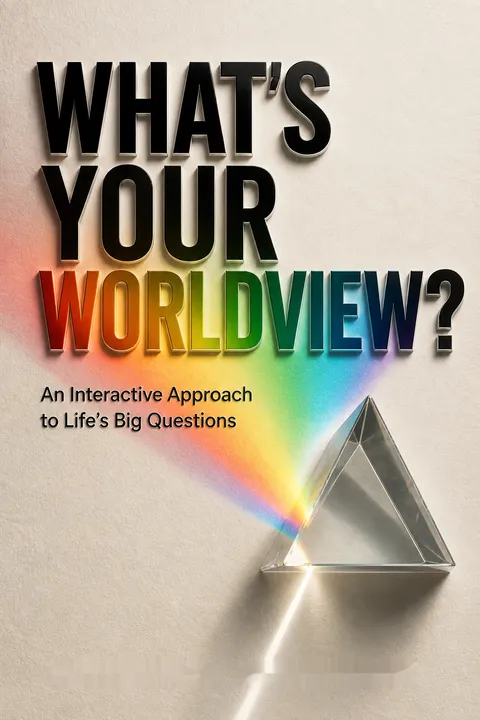
A lens you rarely notice. A worldview is an overall account of reality and the assumptions behind answers to life’s basic questions: whether God exists, what makes an action right, and whether life has a purpose. Like colored lenses, it influences how experiences are interpreted. A story about a message from a dead relative, for instance, can look like evidence of an afterlife to one person and deception to another, depending on prior beliefs.
More than abstract theory. These assumptions affect daily judgments, from moral and political choices to how people treat one another. Anderson’s point is that nobody approaches the world without a worldview. The task is not to acquire one, but to notice, clarify, and examine the one already guiding thought and action.
The lens metaphor captures a real feature of cognition: prior expectations influence what people notice and how they interpret ambiguous evidence. In philosophy of science, this is often discussed as theory-ladenness, the idea that observation is not wholly separate from the concepts used to make sense of it. The metaphor also has a limit. A lens can distort, but it can also bring details into focus, and no observer gets a completely assumption-free view. The practical aim is therefore not imagined neutrality, but making assumptions explicit and checking whether they survive evidence that does not flatter them.
Use branching questions to expose the worldview beneath your confident answers.
A guided decision trail. The book borrows the branching structure of interactive adventure stories: readers answer yes-or-no questions and follow the route their answers create. Questions about truth, knowledge, morality, God, and Jesus gradually narrow the possible worldview labels. A reader who changes an answer can return to an earlier branch and see how different commitments alter the result.
Treat the destination as a prompt. The method makes abstract beliefs concrete by asking what follows from them. It is not a scientific test or a final verdict on a person’s identity. Anderson says the map simplifies a vast subject, aims to cover prominent Western worldviews, and reflects his own Christian perspective. Its greatest use is as a structured invitation to explore, not as an impartial machine that settles disputes.
The branching format turns passive reading into a form of self-interrogation. That resembles decision trees in medicine and policy, where a sequence of distinctions helps locate the assumptions behind a recommendation. The strength is legibility: a reader can see which answer sends a belief system down a particular path. The risk is false precision. Binary questions can make contested or mixed positions look tidier than they are, and a label may describe one belief without capturing a person’s whole outlook. The map works best when readers are willing to question its categories as well as their own answers.
Keep truth, knowability, and moral value separate when testing a worldview.
Three different commitments. Anderson distinguishes the claim that objective truth exists from the claim that humans can know it, and from the claim that anything is objectively good or bad. These questions are related, but one answer does not automatically settle the others. Someone might believe that truth exists while doubting human access to it, or accept moral standards while disagreeing about their source.
Follow the implications. The book argues that theism offers a clear grounding for objective goodness: God is the ultimate standard, and good actions align with that standard. It then asks atheistic views to explain moral value and purpose without God. The questions matter because they prevent a worldview from getting by on a vague appeal to “what feels right” or “what can be known.”
Separating these claims is philosophically useful because debates often slide between them. Realism about truth does not guarantee certainty, and moral disagreement does not by itself prove that moral facts are absent. The author’s proposed link between God and objective value is a serious metaethical position, not a neutral conclusion: philosophers also defend non-theistic moral realism, while theists still must explain how divine commands relate to goodness. The section is most productive when read as a demand for an account, rather than as proof that only one account is possible.
Ask how a matter-only universe produces minds, meaning, and moral duties.
The mind problem. Materialism holds that everything ultimately consists of matter and energy and follows physical laws. Anderson argues that this makes consciousness, thought, and meaning difficult to explain: a physical object has mass and shape, but an idea can be meaningful or mistaken. He also challenges atheistic dualism, which accepts both minds and matter, by asking how mindless matter could produce minds without an antecedent intelligence.
The moral problem. If the universe is only physical processes, the book asks what makes one action objectively better or worse than another. Physical laws describe what happens, not what ought to happen. These are pressure points for naturalistic worldviews, not settled demonstrations that those views fail. Anderson’s comparison of materialist explanations to matter arranged into a meaningful message emphasizes the gap he thinks needs explaining.
The question of how subjective experience relates to brain activity remains a deep problem in philosophy of mind, while neuroscience continues to reveal extensive links between mental life and the brain. Those links constrain explanations, but they do not by themselves settle whether mental states can be reduced to physical processes. Likewise, moral philosophers distinguish the existence of moral standards from their grounding: some defend objective values without a deity. The section’s value is in exposing explanatory obligations. Its weakness is that describing a gap is not the same as showing that no naturalistic account can bridge it.
Test skepticism and relativism by applying their claims to themselves.
A claim about every claim. Relativism says truth depends on a person or culture rather than being objective. Anderson asks whether that principle is itself objectively true. If it is, it appears to make an exception for itself; if it is not, it cannot demand universal agreement. Skepticism, the view that people cannot know the truth, faces a similar test: can skeptics know that no one can know?
Nihilism raises the stakes. Nihilism denies objective value and purpose. The book argues that this threatens the distinction between rational and irrational beliefs, since calling a belief rational seems to treat it as better than its alternatives. These self-application tests do not resolve every version of the positions, but they reveal where a view may undermine the standards it uses to argue for itself.
Self-reference is a powerful diagnostic because a theory should account for its own status, not merely criticize its rivals. Yet the strongest versions of these positions can be more nuanced than the simple formulations tested here. A relativist might say the claim is true within a framework, while a skeptic might suspend judgment even about skepticism. Those replies may carry costs, but they are not identical to straightforward contradiction. The useful lesson is to ask what a position commits its advocate to, then assess whether that consequence is a genuine inconsistency or simply an unattractive implication.
Don't stop at God's existence; ask what kind of God your beliefs imply.
One word, many concepts. The book separates belief in a deity from claims about that deity’s nature. Classical theism describes God as personal, perfect, and creator of the universe. Quasi-theism treats God as impersonal; pantheism identifies God with the universe, while panentheism places the universe within a reality larger than itself. Finite theism holds that God has significant limits, and deism describes a creator who does not intervene or communicate.
Each description carries consequences. If a deity is impersonal, the book asks how that deity plans or communicates. If God is limited, it asks whether God can ultimately govern the world. If God is the universe, it asks how evil can exist without compromising divine goodness. These distinctions show why “I believe in God” is only the beginning of a worldview, not a complete account.
This taxonomy resists a common conversational shortcut: treating all theistic beliefs as interchangeable. Concepts of divine personality, power, and relation to the world shape answers to suffering, moral obligation, and religious experience. The comparisons also expose trade-offs rather than merely assigning labels. Still, traditions contain internal diversity, and some do not fit cleanly into a few yes-or-no categories. A productive use of the map is to ask whether a person’s own conception of God is coherent, rather than assuming that every adherent of a named religion holds the same philosophical package.
Religious tolerance cannot make contradictory central claims jointly true.
Respect does not erase disagreement. Religious pluralism holds that multiple religions offer valid paths or perspectives on ultimate reality. Anderson argues that major traditions make incompatible claims: Christianity affirms Jesus as divine, while Islam rejects that claim; some traditions understand God as personal, while others do not. If such claims are meant literally, they cannot all be true in the same sense.
The elephant analogy has a hidden narrator. Pluralists sometimes compare religions to blind people describing different parts of an elephant. The book’s response is that the person telling the story seems to claim a wider perspective than any of the people being described. Anderson also distinguishes Christianity, Islam, and Judaism by their claims about Jesus, Muhammad, Moses, scripture, and revelation. He asks readers to examine those claims rather than assume all religions say the same thing.
The argument usefully separates tolerance, a social virtue, from the philosophical claim that all religions are equally true. Genuine respect need not require pretending that contradictions disappear. At the same time, disagreement alone does not establish that one tradition has the best overall account: that requires historical, interpretive, and philosophical evaluation. The elephant analogy can also function modestly, as a reminder of human limitation, without asserting that every religious doctrine is literally compatible. Its force depends on whether pluralism is being offered as a claim about truth, a posture toward neighbors, or both.
Christianity's claims turn on Jesus's identity, resurrection, and grace.
A specific historical center. Anderson presents Christianity not as generic belief in God or admiration for Jesus, but as a set of connected claims: Jesus is divine, died by crucifixion, and rose bodily from the dead. He points to the disciples’ early resurrection testimony and asks non-Christian theists how they explain the movement’s origins and Jesus’s claims. The book treats the resurrection as a decisive dividing question, while recognizing that belief in it alone does not establish every Christian doctrine.
Salvation is not a moral paycheck. The Christian account described here says that people fall short of God’s goodness and are saved by divine grace through Jesus, not by earning heaven through good behavior. Pelagianism, named for the fifth-century monk Pelagius, instead treats moral effort as the basis for salvation. This distinction makes grace central to the book’s account of Christian faith.
The section makes Christianity’s defining commitments concrete, which is more helpful than reducing the religion to a general ethic of kindness. It also shows that the resurrection claim is both historical and theological: the argument concerns evidence about events and what those events would mean if true. Historical evidence can be weighed, but the book’s brief presentation cannot substitute for a full examination of sources or alternative explanations. The contrast between grace and merit likewise clarifies a doctrinal divide, though Christian traditions differ in how they describe the relation between faith, moral action, and salvation.
Compare worldviews by coherence, explanatory reach, and the life they authorize.
A worldview should answer for its consequences. Anderson urges readers to compare rival views, examine objections, and ask whether their daily conduct fits what they claim to believe. A person may profess one worldview while living as though another were true. That mismatch can indicate self-deception, weak commitment, or a worldview whose demands are difficult to live out.
No free pass, including the author’s. The book openly acknowledges that its author has a Christian perspective and that its survey is selective. It invites readers to revisit branches, challenge the criticisms, and investigate how thoughtful defenders answer objections. Its central practical question is not merely “Which label fits?” but “Which account best explains reality, and what follows if I take it seriously?”
This is the book’s strongest method for intellectual honesty: make the worldview answer both to argument and to lived practice. The approach resembles reflective equilibrium in ethics, where principles and judgments are revised together until they fit more coherently. Yet practical consistency cannot establish truth by itself; people can live consistently by mistaken principles, and social pressures often shape behavior more than explicit belief. The author’s admission of bias is therefore important. A fair comparison needs symmetrical standards, including the willingness to examine the favored worldview with the same rigor used on its competitors.
Analysis
Anderson’s book is best understood as an interactive apologetic map, not a neutral encyclopedia of religion. Its format makes a demanding philosophical topic approachable: readers answer basic questions, follow consequences, and discover that beliefs about truth, morality, mind, God, and salvation form an interconnected picture. The strongest insight is methodological. A worldview is not just a label or a list of opinions; it is a structure whose commitments constrain one another and shape conduct. The reader is asked to inspect that structure rather than merely announce an identity.
The book’s Christian destination is explicit in its argument and in its selection of pressure points. It presents objective morality as easier to ground in God, challenges materialism to explain consciousness and normativity, and treats Jesus’s resurrection as pivotal evidence. These are serious questions, but they are not uncontested conclusions. Moral realism has non-theistic defenders; physicalist philosophers offer accounts of mind that the book does not fully engage; and the problem of evil remains a substantial challenge for belief in a perfectly good and powerful God. The book acknowledges that challenge, but its comparison is brief by design.
Its binary path also sharpens distinctions at the cost of nuance. A yes-or-no choice can clarify a commitment, yet many people hold mixed, uncertain, or evolving positions. Religious traditions also contain internal disagreements that a compact taxonomy cannot capture. The author’s admission of bias and simplification helps readers calibrate the tool: it is a starting map, not an exhaustive classification or proof engine.
The most fruitful reading is therefore neither passive acceptance nor dismissal. Treat each worldview description as a set of questions: What does this position explain well? What does it leave unexplained? Does the criticism address its strongest version? Does the reader apply the same evidential standards to favored and rival beliefs? That approach preserves the book’s central invitation to self-examination while making the inquiry more even-handed and intellectually durable.
Review Summary
What's Your Worldview? is a unique, interactive book that helps readers identify their worldview through a "choose your own adventure" format. Many reviewers praise its engaging approach and ability to spark thoughtful discussions about life's big questions. Some appreciate its Christian perspective, while others criticize perceived bias. The book is generally seen as a helpful tool for understanding different worldviews, though opinions vary on its depth and objectivity. Overall, it's considered a quick, thought-provoking read that encourages readers to examine their beliefs and their implications.
Glossary
Worldview
overall view of realityA person’s broad perspective on what exists and what matters, including assumptions about truth, knowledge, morality, God, human nature, and purpose. Anderson presents a worldview as a lens that influences how people interpret experience, make judgments, and act, often without consciously noticing its influence.
Classical Theism
perfect, personal Creator GodA traditional theistic view in which God is a personal, perfect being who creates and sustains the universe. God is understood as all-good, all-wise, and all-powerful, rather than as a limited being or an impersonal principle. Anderson uses this category to distinguish traditional theism from several alternative conceptions of God.
Quasi-Theism
belief in an impersonal GodAnderson’s category for views that affirm God but deny that God is a personal being in a familiar sense. God may be understood as the universe itself, as a reality that includes the universe, or as an impersonal ordering principle. The category includes pantheism, panentheism, and related conceptions.
Finite Theism
belief in a limited GodA view in which God is a personal deity worthy of worship but is limited in at least one significant respect, such as knowledge or power. Some versions propose that God is developing toward greater perfection. Anderson distinguishes this view from Classical Theism, which treats God as perfect and unlimited.
Nihilism
denial of objective valueThe view that nothing is objectively good or bad and that human life and the universe have no objective purpose or meaning. Personal preferences may remain, but they do not make one choice genuinely better than another. Anderson argues that this position risks undermining its own distinction between rational and irrational beliefs.
Pelagianism
salvation through moral effortA Christian-associated position named for the fifth-century monk Pelagius. In Anderson’s account, it holds that humans are born morally untainted and can choose good or evil, with eternal life understood chiefly as the reward for living well. It contrasts with the Christian doctrine of salvation as a gift of divine grace rather than something earned.
Atheistic Dualism
separate mind and matterThe view that reality includes both physical matter and mental experience, which cannot be reduced to one another, while denying that God exists. It treats human minds as distinct from brains, though the two interact. Anderson challenges it to explain how minds could arise from a universe without an ultimate intelligence.
FAQ
1. What is "What's Your Worldview?" by James N. Anderson about?
- Interactive Exploration of Worldviews: The book is an interactive guide that helps readers identify, clarify, and evaluate their own worldview through a series of yes/no questions, similar to a "Choose Your Own Adventure" format.
- Focus on Life’s Big Questions: It addresses fundamental philosophical and religious questions about reality, truth, knowledge, morality, God, and the meaning of life.
- Comprehensive Overview: Anderson presents and critiques a wide range of worldviews, including Atheism, Theism, Quasi-Theism, Pantheism, and more, showing their implications and challenges.
- Encourages Critical Reflection: The book aims to provoke thoughtful self-examination and comparison of different worldviews, rather than simply presenting information.
2. Why should I read "What's Your Worldview?" by James N. Anderson?
- Self-Discovery Tool: The book helps readers uncover and articulate their own worldview, which often operates in the background of their thinking.
- Accessible and Engaging: Its interactive, non-linear format makes complex philosophical and religious ideas approachable and even enjoyable.
- Critical Thinking Development: Anderson encourages readers to think critically about their assumptions and the logical consequences of their beliefs.
- Broad Relevance: Understanding worldviews is essential for making sense of personal beliefs, ethical decisions, and cultural debates.
3. How does the interactive "Choose Your Own Adventure" method work in "What's Your Worldview?" by James N. Anderson?
- Decision-Based Progression: Readers answer a series of binary (yes/no) questions, each leading to a new question or a summary of a specific worldview.
- Non-Linear Reading: The book is not meant to be read cover-to-cover; instead, readers follow different paths based on their answers, mirroring the process of philosophical inquiry.
- Personalized Outcomes: The path taken leads to a worldview that matches the reader’s answers, with commentary on its strengths and weaknesses.
- Encourages Exploration: Readers are invited to backtrack and explore alternative paths, deepening their understanding of other worldviews.
4. What is a "worldview" according to "What's Your Worldview?" by James N. Anderson?
- Comprehensive Perspective: A worldview is an all-encompassing philosophical view of reality, shaping how we interpret everything that exists and matters to us.
- Set of Fundamental Beliefs: It consists of our most basic assumptions about God, truth, morality, the universe, and human purpose.
- Lens for Interpretation: Like a pair of colored spectacles, a worldview affects what we see, how we see it, and how we respond to life’s big questions.
- Often Unexamined: Most people have a worldview, even if they are unaware of it, and it influences their experiences, decisions, and relationships.
5. What are the main types of worldviews discussed in "What's Your Worldview?" by James N. Anderson?
- Atheist Worldviews: These deny the existence of God and include Materialism, Nihilism, Relativism, and others.
- Theist Worldviews: These affirm the existence of a personal God, covering Christianity, Islam, Judaism, Deism, and more.
- Quasi-Theist Worldviews: These posit a non-personal or impersonal divine reality, such as Pantheism, Panentheism, and Platonism.
- Other Variations: The book also explores Finite Theism, Polytheism, Mysticism, Pluralism, and Unitarianism, among others.
6. What are the key questions used to identify a worldview in "What's Your Worldview?" by James N. Anderson?
- Foundational Questions: The book starts with questions about free will, objective truth, knowledge, and morality.
- Religious and Metaphysical Questions: It then explores questions about the existence and nature of God, the validity of religions, and the relationship between God and the universe.
- Specific Doctrinal Questions: For theistic worldviews, it asks about divine communication, the nature of Jesus, salvation, and the uniqueness of religious claims.
- Binary Format: Each question is designed to be answered with a simple yes or no, guiding the reader down a logical path.
7. How does "What's Your Worldview?" by James N. Anderson address the strengths and weaknesses of different worldviews?
- Critical Commentary: At the end of each path, Anderson provides a summary of the worldview and highlights its philosophical or practical challenges.
- Fair Representation: The author aims to present each worldview accurately, noting both its appeal and its difficulties.
- Encourages Self-Examination: Readers are prompted to consider whether they can consistently live out their worldview and how it handles issues like evil, meaning, and morality.
- Comparative Approach: The book suggests comparing worldviews to assess which offers the most coherent and satisfying account of reality.
8. What are some of the most important concepts explained in "What's Your Worldview?" by James N. Anderson?
- Objective vs. Relative Truth: The distinction between truths that are universally valid and those that are subjective or culturally dependent.
- The Problem of Evil: How different worldviews explain the existence of evil and suffering in the world.
- Divine Revelation: The idea of God communicating with humanity, and the implications for religious authority and knowledge.
- Salvation and Morality: How worldviews answer questions about what it means to live a good life and what happens after death.
9. What practical advice does "What's Your Worldview?" by James N. Anderson give for evaluating your own worldview?
- Reflect on Consistency: Consider whether your beliefs and lifestyle are consistent with your professed worldview.
- Examine Objections: Think critically about the challenges and objections to your worldview, and how its advocates respond.
- Compare Alternatives: Explore other worldviews to see how they address the same fundamental questions and whether they offer better explanations.
- Be Open to Change: Recognize that changing your worldview is difficult but possible, and may be warranted if another worldview makes better sense of reality.
10. What are the key takeaways from "What's Your Worldview?" by James N. Anderson?
- Everyone Has a Worldview: Whether consciously or not, everyone operates from a set of fundamental beliefs about reality.
- Worldviews Matter: Your worldview shapes your beliefs, actions, and relationships, and has real consequences for your life.
- Critical Self-Examination is Essential: It’s important to identify, clarify, and critically assess your worldview rather than accepting it uncritically.
- Not All Worldviews Are Equal: Some worldviews are more coherent, livable, and explanatory than others, and it’s worth seeking the one closest to the truth.
11. What are some of the best quotes from "What's Your Worldview?" by James N. Anderson and what do they mean?
- "Worldviews are like belly buttons. Everyone has one, but we don’t talk about them very often." – This highlights how worldviews are universal yet often unexamined.
- "A worldview is as indispensable for thinking as an atmosphere is for breathing." – Just as we need air to live, we need a worldview to make sense of reality.
- "If the style is akin to ‘Choose Your Own Adventure’ books, the content is at least as entertaining and far more important." – D.A. Carson, in the foreword, emphasizes the book’s engaging format and its significance.
- "The real issue isn’t whether we have biases—we all do—but whether we’re aware of them and able to think critically about them." – Anderson encourages honest self-reflection and critical thinking about our own assumptions.
12. How does "What's Your Worldview?" by James N. Anderson handle objections about bias, simplicity, and comprehensiveness?
- Acknowledges Authorial Bias: Anderson openly admits he has his own worldview and bias, but argues that everyone does, and the key is to be aware and critical of it.
- Simplified, Not Simplistic: The book intentionally simplifies complex ideas for accessibility, but aims to dig below the surface and provoke deeper thought.
- Covers Major Worldviews: While not exhaustive, the book is designed to cover all prominent and influential worldviews in Western culture, using binary questions to ensure completeness.
- Encourages Further Exploration: Readers are advised to use the book as a starting point for deeper study and comparison, not as the final word on worldviews.
Download PDF
Download EPUB
.epub digital book format is ideal for reading ebooks on phones, tablets, and e-readers.








