

Key Takeaways
Customers don't want your product; they want a better version of themselves
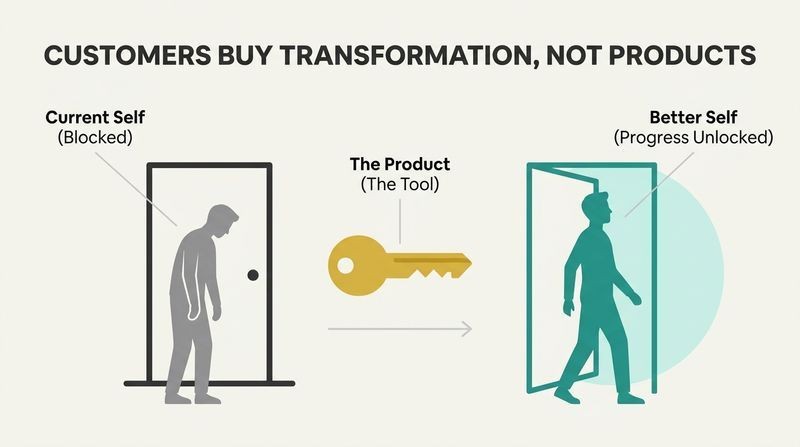
People hire products to make progress. Alan Klement's core claim: nobody wants the thing itself, they want the transformed life-situation it unlocks. Revlon's founder captured it: in the factory they make cosmetics, in the store they sell hope. Revlon's 1952 Fire and Ice ad barely showed the lipstick. One page was provocative questions inviting women to imagine a new, more desirable self.
A Job to be Done (JTBD) is the process someone goes through when trying to turn their current life-situation into a preferred one but cannot, because constraints block them. The bear wishes fishing were easier; only the human imagines a world with no fishing at all. That leap from what is to what ought to be is where every Job begins.
The framing echoes Theodore Levitt's quarter-inch-hole maxim, but Klement pushes further than marketing folklore. It resonates with self-determination theory in psychology, which holds that humans are motivated by competence, autonomy, and growth rather than static satisfaction. Where it gets slippery: not every purchase carries an aspirational arc. Buying trash bags is closer to maintenance than self-betterment. The strength of the lens is diagnostic humility. Instead of asking what features to add, it forces the question of what change a person is chasing. That reframing consistently surfaces opportunities that feature-obsessed competitors miss.
Your real competitor might be a kale smoothie, not another coffee

Competition lives in the customer's mind. Klement's title comes from a woman who swapped her morning coffee for a kale smoothie with wheatgrass. Coffee and kale look nothing alike, yet they competed for the same Job. Customers judge rivals by progress delivered, not by product category. Two things compete only if you can find a real person who switched from one to the other.
Category thinking blinds companies. PCs never actually competed with mainframes; they replaced typewriters, calculators, and Atari game systems. IBM still earns roughly half its profits from mainframes decades after the PC was supposed to kill them. Dan Martell learned his advice marketplace Clarity competed with LinkedIn, hiring advisers, and attending entire conferences, so he priced against a conference budget, not a chat app.
This is Klement channeling economist Joseph Schumpeter, who warned that lethal competition rarely comes from lookalike rivals. Clayton Christensen's disruption theory, which Klement critiques, tends to bound competition within a product class and thereby misses lateral threats. The practical test, find someone who actually switched, is a useful antidote to spreadsheet-driven market maps. It resembles the ecological concept of the niche: organisms compete over resources, not taxonomic similarity. One caution: customers combine solutions rather than choosing one, so competition is often a shifting bundle. Mapping it requires ongoing conversation, not a one-time survey.
Four forces decide whether anyone buys: push, pull, anxiety, and inertia

Demand is engineered, not spontaneous. Nobody wakes up randomly wanting a new car. Klement names four emotional forces. Two generate demand:
1. Push: a frustration or trigger making the status quo unbearable (a second child makes multi-store grocery trips impossible).
2. Pull: the magnetic idea of a better life plus attraction to a specific solution.
Two forces block demand:
3. Anxiety: worry about whether an unfamiliar product will actually deliver.
4. Inertia: habits and the tendency to keep doing nothing.
Push and pull need each other. Tesla built a premium car first to create pull before price mattered. The Tata Nano had push (people wanted cars) but too little pull (no stereo, prone to fire), so it flopped after a $400 million bet. Cheap alone never wins.
These forces map neatly onto Kurt Lewin's force-field analysis, where behavior sits in tension between driving and restraining forces, and change comes from reducing restraints rather than only pushing harder. Klement's practical insight is that most teams obsess over push and pull while ignoring the anxieties and habits quietly killing conversion. Behavioral economics reinforces this: loss aversion and status-quo bias mean the pain of switching often outweighs the promised gain. The framework's elegance is that it separates two distinct jobs for a product team, generating desire and dismantling friction, which require completely different interventions.
Attack customer anxiety and habit as fiercely as you attack rivals
Silent competitors cost you sales too. A customer who wants your product but sticks with the old way is just as lost as one who buys a competitor. Klement urges treating anxiety and inertia like enemy products. Two anxieties matter: anxiety-in-choice (fear before first use, will this even work?) and anxiety-in-use (nagging worry during ongoing use).
Small frictions block big desire. Clarity's users feared sounding stupid on calls, so Dan added prep guides. Theater patrons hesitated over mixed reviews, so Anthony offered day-of discounts as a nudge and drinks as social lubricant. YourGrocer customers kept ducking to the corner store out of habit, so Morgan sent reorder emails to build a new routine. Excel finally beat Lotus 1-2-3 only once it could import Lotus files, removing switching friction.
Klement's organ-transplant analogy is apt: the body can reject a perfectly good new organ over one incompatibility. This aligns with Nir Eyal's work on friction and with Richard Thaler's nudge theory, where tiny changes in choice architecture swing behavior more than grand feature improvements. The Excel-Lotus example is especially instructive because it shows a technically inferior product could not win until a habit barrier fell. The blind spot in many product cultures is that anxiety and inertia are invisible in analytics dashboards. They show up as non-conversion, which teams misread as lack of interest rather than unaddressed fear.
Demographics are usually misinformation; the situation drives the purchase
Who someone is rarely explains what they buy. Klement and his 65-year-old father-in-law from the Bronx, who never used a computer, own the identical smartphone and use it almost identically despite opposite ages, histories, and habits. A demographic study would never predict that. YourGrocer assumed its buyers were young urban professionals; nearly all turned out to be young families, specifically parents with two or more small children.
Circumstance, not identity, causes buying. The trigger for YourGrocer families was a second child making multi-store shopping unbearable, not their age bracket. Demographic data are corollary, not causal. Klement allows they help when casting an ad or choosing a stock photo, but warns against building products or strategy on them. Study the struggling moment instead.
This directly challenges the persona-driven playbook dominant in marketing, where teams invent detailed fictional characters with names and hobbies. Klement's position parallels Clayton Christensen's milkshake research, which found people hired a milkshake for a boring commute regardless of who they were. It also echoes situationist critiques in social psychology, which argue context predicts behavior better than stable traits. The nuance worth adding: demographics and situation are not always independent. Life stage, income, and geography shape which situations arise in the first place. The sharper formulation is that demographics may correlate with Jobs without ever causing them.
Never start with a solution; the chotuKool's $400 million lesson
Solution-first thinking sinks products. In 2006, Indian manufacturer Godrej, advised by Harvard's Clayton Christensen, decided to build a cheap, stripped-down refrigerator, the chotuKool, before talking to a single customer. It was hailed as disruptive innovation and won an Edison Award. In a market of over 100 million people it sold about 15,000 units in two years.
Customers already had good-enough free solutions. Godrej's own interviews revealed people saying plainly they felt no need for a refrigerator: they bought vegetables daily, boiled milk, and used clay pots. The company ignored this because it had prejudged the answer. The theory of nonconsumption assumed these Indians were non-users. Klement's rebuttal: if someone has a Job, they are already hiring something for it, even if it costs nothing.
The chotuKool is Klement's sharpest jab at disruption orthodoxy, and it lands because Godrej's raw data contained the warning it overrode. This is a textbook case of confirmation bias meeting sunk-cost commitment to a theory. Behavioral scientists call it theory-induced blindness, a phrase Kahneman uses for how an accepted framework makes contradicting evidence invisible. The deeper principle transcends refrigerators: cheaper is not a value proposition unless the customer was already paying for something comparable. A free habit like a clay pot is a formidable competitor precisely because switching to a paid product demands enormous push and pull that low price cannot supply.
Ask what customers actually did, not what they say they want
Stated preferences lie; revealed behavior tells truth. Dan Martell noticed Clarity customers claiming they used the product constantly, while server logs showed they had never logged in since signup. So he stopped asking what people wanted and started reconstructing what they had actually done: which solutions they tried, what they liked and disliked, what they would use if Clarity vanished.
Trace the switching journey. Klement recommends mapping the timeline of events leading to a purchase. Anthony discovered theater tickets that looked like impulse buys were nothing of the sort. Patrons had wanted a show for weeks, held back by anxiety over bad reviews, and a discount finally tipped them. To validate features, Klement's teams asked whether customers had ever tried to solve that problem before, killing ideas nobody had struggled with.
The stated-versus-revealed-preference gap is bedrock economics, formalized by Paul Samuelson in 1938, yet product teams still run surveys asking people to forecast their own behavior, which humans do terribly. Klement's move mirrors ethnographic and jobs-based interviewing: excavate the actual story rather than solicit opinions. It connects to Kahneman's WYSIATI principle, that people construct tidy narratives from whatever is easy to recall. One practical tension: past behavior is a strong guide for incremental products but weaker for genuinely novel ones, where no prior switching behavior exists to observe. There the interviewer must probe the underlying struggle rather than the tried solutions.
Stop steering by visible metrics like satisfaction scores and user counts
The most important numbers are unknowable. Spirit Airlines is consistently rated America's most hated carrier, yet it was the fastest-growing and most profitable, with a 21.3 percent margin in early 2016. If satisfaction scores drove decisions, Spirit would add legroom and free drinks, wreck its cost structure, and lose the rock-bottom prices customers actually hire it for.
Metrics are proxies, easily misread. Analysts wrote eulogies for Twitter because monthly active users stalled at 313 million, even as revenue climbed from $106 million to $2.2 billion. Nobody knows if 313 million already is the whole market. Klement invokes the mathematicians' warnings: all models are wrong but some are useful, and the belief that you cannot manage what you cannot measure is itself a costly myth. Judge figures against the system, not in isolation.
Klement leans on W. Edwards Deming, whose systems philosophy warned that chasing visible figures corrupts the very outcomes they track, a dynamic Goodhart's Law later crystallized: when a measure becomes a target, it stops being a good measure. The Spirit paradox is a clean illustration that a metric like satisfaction is meaningless divorced from the Job. Spirit's customers hire cheapness and would revolt at amenities that raise fares. The caution is that this argument can be abused to dismiss any inconvenient data. Deming's actual counsel was not to ignore numbers but to interpret them within an understanding of the system generating them.
Grow by delivering ongoing progress, not by cramming in features
Solved Jobs spawn new Jobs. Klement calls the whole picture the System of Progress: customers, producers, solutions, and Jobs are interdependent parts that evolve together. When people make progress, fresh aspirations appear, opening room for complementary products rather than a bloated single one.
Extend, don't overstuff. Justin Jackson built Product People Club to cure solo-entrepreneur loneliness, then built a separate product, Marketing for Developers, for the next struggle his customers hit: promoting a finished product. Ash Maurya's Lean Canvas satisfied users so well they churned; instead of adding features, he added complementary boards and rebranded to Lean Stack, keeping customers longer. Weber does not sell grills; it sells better grillers via recipes, hotlines, and classes. A product trying to do every Job well does none well.
The System of Progress is Klement's most Deming-flavored idea, borrowing the PDSA improvement cycle and rendering it as an upward helix of ever-renewing customer aspiration. It anticipates the platform and ecosystem logic that Apple exploited: the iPhone only took off once the App Store extended its progress. The warning against the Swiss Army knife product is well supported by research on feature fatigue, where Roland Rust and colleagues found buyers overvalue capability before purchase and regret complexity after. The strategic subtlety is knowing when a new aspiration deserves a separate product versus an extension. Klement's answer, split when it serves a distinct Job, is a durable heuristic.
Customers know only what the system taught them to want
Expectations are manufactured, not innate. In 2007 buyers wanted a $99 smartphone with a physical keyboard, and Steve Ballmer mocked the keyboardless $500 iPhone for ignoring that. He read the moment correctly. He just failed to see that customer expectations are only what producers have led them to expect, and they shift as the system shifts. Microsoft's phone share fell from 12 percent to under 1 percent.
Study the system, not the stated need. Klement compares it to a doctor: a fever and stomachache are symptoms, not the disease. Bob Moesta sold homes to empty nesters who asked for a smaller dining room, then would not move because they could not part with their family table. He enlarged the dining room instead, and sales rose 23 percent. Customers describe interactions with the system; they cannot prescribe the cure.
This is Klement's most philosophically ambitious claim, and it walks a knife-edge. Taken too far, ignore what customers say, it licenses the arrogance behind countless flops that no one wanted. Ballmer was punished for listening to expressed preferences; thousands of founders have been punished for ignoring them. The reconciliation lies in the doctor analogy: honor the symptom as real data, distrust the customer's self-diagnosis. Steve Jobs and Deming both understood that people cannot imagine what does not yet exist, a point Henry Ford's faster-horse quip made famous. The Moesta table story is the gem here, showing revealed emotional constraints override stated functional wishes.
Analysis
Klement's book is a manifesto disguised as a business handbook, and its ambition is to rescue Jobs to be Done from the confusion that popularity bred. Its central move is philosophical: relocate value from what a product is or does to the customer's desire for self-betterment, a lineage he traces through Pindar, Nietzsche, and Bandura's proactive, aspiring organism. This is both the book's power and its vulnerability. The framing is genuinely generative for consumer and lifestyle products where identity and progress are at stake, coffee, cosmetics, theater, entrepreneurial tools. It strains for commodity purchases and industrial procurement, where the aspirational arc is faint. Klement rarely concedes this scope limit, presenting the lens as universal.
The most valuable contribution is the taxonomy of demand: push, pull, anxiety, and inertia. This four-force model gives teams a diagnostic vocabulary that outperforms vague talk of needs, and it usefully splits demand generation from friction removal, two jobs most organizations conflate. The Forces map cleanly onto Lewin's force-field analysis and behavioral economics without Klement leaning on that scaffolding, which is a missed chance to strengthen his case.
His polemic against Christensen's disruption theory and Ulwick's activities-based JTBD is bracing and largely fair, especially the chotuKool autopsy, where a company's own data contradicted the theory it followed off a cliff. Yet the book occasionally substitutes confident storytelling for the rigor it demands of others, precisely the cargo-cult trap it warns against. The Spirit Airlines and IBM mainframe cases are persuasive but cherry-picked. What endures is a disciplined interviewing practice and a systems sensibility inherited from Deming: study interdependencies, distrust isolated metrics, and grow by serving the next aspiration rather than bloating the current product. For practitioners, that operational core justifies the read even where the metaphysics overreaches.
Review Summary
When Coffee and Kale Compete receives mixed reviews, with an overall rating of 4.03 out of 5. Readers appreciate the accessible explanation of the Jobs to be Done (JTBD) theory and its practical applications in product development. Many find the case studies helpful, though some criticize the lack of editorial work and repetitive content. The book is praised for its clear language and insights into customer behavior, but some readers note that it lacks depth in certain areas and could benefit from better structure. Despite criticisms, many consider it a valuable resource for understanding JTBD.
Glossary
Job to be Done (JTBD)
Customer's process of self-improvementThe process a person goes through when trying to transform an existing life-situation into a preferred one but cannot because constraints stop them. It is not a task, activity, or product feature. It describes a desired better self, answering how the customer will be improved once the right solution is in place.
Forces of Progress
Four emotions shaping demandThe four emotional forces that generate and reduce customer demand. Push (frustration with the status quo) and pull (attraction to a better life and a specific solution) generate demand. Anxiety (fear about a product) and inertia (habits and the tendency to do nothing) reduce it. All four act on the customer simultaneously.
System of Progress
Customers, producers, solutions interlinkedKlement's model in which customers, producers, solutions, and Jobs form one interdependent system that evolves markets. Value comes from how the parts work together, not any single part. As customers make progress, new aspirations arise, forming a continuous upward helix, inspired by Deming's Shewhart or PDSA improvement cycle.
Anxiety-in-choice and anxiety-in-use
Fear before versus during useTwo demand-reducing anxieties. Anxiety-in-choice is worry felt before first use about whether an unfamiliar product will deliver progress, which drives away new customers. Anxiety-in-use is worry felt during ongoing use about a known product's reliability or performance, which drives away repeat customers. Both are competitors to be reduced like rival products.
Jobs-as-Progress vs Jobs-as-Activities
Two rival JTBD interpretationsTwo incompatible readings of Jobs to be Done. Jobs-as-Progress (Klement, Christensen, Moesta) says customers seek emotional self-betterment, and innovation often eliminates activities. Jobs-as-Activities (Ulwick) treats a Job as a functional task to be executed better, resembling task analysis. Klement argues customers want the Be goal, not the activity itself.
Compensatory behaviors
Improvised or off-label product useSigns that customers are struggling and improvising their own solutions, such as using baking soda as a deodorizer or a nurse inventing paper worksheets to track patients. Klement treats these as prime innovation opportunities, revealing unmet Jobs and how people cobble together solutions when no single product satisfies their desire for progress.
FAQ
1. What is "When Coffee & Kale Compete" by Alan Klement about?
- Focus on Customer Jobs Theory: The book introduces and explains the "Jobs to be Done" (JTBD) theory, which centers on understanding why customers buy and use products—not for the product itself, but for the progress it enables in their lives.
- Innovation and Product Development: It provides a framework for innovators, entrepreneurs, and product managers to create products that people will actually buy by focusing on customer motivation and self-betterment.
- Case Studies and Practical Application: The book is filled with real-world case studies and actionable advice, showing how JTBD can be applied to various industries and product types.
- Challenging Conventional Wisdom: Klement critiques traditional approaches like demographic segmentation and feature-driven development, advocating for a shift toward understanding the deeper reasons behind customer choices.
2. Why should I read "When Coffee & Kale Compete" by Alan Klement?
- Become a Better Innovator: The book equips readers with principles to create and sell products that customers truly want, making innovation more predictable and profitable.
- Move Beyond Surface-Level Data: It helps readers distinguish between useful and misleading data, focusing on what actually drives customer decisions.
- Avoid Common Pitfalls: By understanding JTBD, readers can avoid costly mistakes like overengineering products, misidentifying competition, and relying on vanity metrics.
- Real-World Success Stories: The book’s case studies demonstrate how JTBD thinking leads to tangible business results, making the theory practical and relatable.
3. What are the key takeaways from "When Coffee & Kale Compete"?
- Customers Seek Progress: People buy products to make progress in their lives, not for the product’s features or attributes.
- Competition Is Contextual: True competition is defined by the customer’s perspective and the progress they seek, not by product categories.
- Focus on Emotional Motivation: Understanding the emotional and aspirational drivers behind customer choices is crucial for innovation.
- Systems Thinking Matters: Products, customers, and producers are all part of a larger system of progress, and innovation should optimize how these parts work together.
4. How does Alan Klement define a "Job to be Done" (JTBD) in this book?
- Transformation Process: A JTBD is the process a consumer goes through to transform their existing life-situation into a preferred one, but cannot due to constraints.
- Not a Task or Activity: JTBD is not about specific tasks or product usage; it’s about the desired change or progress in the customer’s life.
- Emotional and Aspirational: The focus is on the emotional motivation and aspiration for self-betterment, rather than functional or social goals alone.
- Unique to Each Customer: Every JTBD is a unique combination of desires and circumstances, making it essential to understand the specific context.
5. What are the main principles of Customer Jobs Theory according to "When Coffee & Kale Compete"?
- Customers Want Progress: People don’t want products; they want to become better versions of themselves.
- People Have Jobs, Not Products: Only people have JTBD; products are merely solutions to help them achieve progress.
- Competition Is in the Mind: Customers define competition based on what helps them make progress, not on product similarities.
- Value Is Contextual: The value of a product is determined by the progress it enables in a specific context, not by its inherent features.
- Systems Approach: Producers, consumers, and products should be viewed as parts of a system that evolves together.
6. How does "When Coffee & Kale Compete" suggest identifying what customers really want?
- Study Struggling Moments: Look for moments when customers are dissatisfied or struggling, as these signal opportunities for progress.
- Ask About Past Behavior: Focus on what customers have actually done to solve their problems, not just what they say they want.
- Compare and Contrast Solutions: Investigate what other solutions customers have tried and what they liked or disliked about them.
- Uncover Emotional Drivers: Dig deeper to understand the emotional motivations and aspirations behind customer choices.
7. What are the "Forces of Progress" in Customer Jobs Theory as described by Alan Klement?
- Push and Pull: Push refers to the dissatisfaction with the current situation, while pull is the attraction to a better life or solution.
- Inertia and Anxiety: Inertia represents habits and resistance to change, while anxiety is the fear or uncertainty about adopting a new solution.
- Demand Generation and Reduction: These forces work together to either generate demand for a new product or reduce it, shaping customer decisions.
- Address All Four Forces: Successful innovation requires understanding and addressing all four forces, not just the desire for change.
8. How does "When Coffee & Kale Compete" redefine competition and market analysis?
- Customer-Defined Competition: Competition is determined by what customers consider as alternatives for making progress, not by industry categories.
- Look for Evidence of Switching: True competitors are those products or behaviors that customers switch from when adopting your solution.
- Avoid Product-Centric Thinking: Don’t assume products that look or function similarly are competitors; focus on the customer’s context and JTBD.
- Continuous Feedback: Regularly update your understanding of competition by talking to customers and observing their choices.
9. What practical steps does Alan Klement recommend for applying JTBD in product development?
- Conduct JTBD Interviews: Talk to customers about their struggles, aspirations, and the solutions they’ve tried.
- Frame Design Challenges as JTBD: Present problems to your team in terms of customer progress, not just features or tasks.
- Test for Real Struggle: Ensure there is genuine energy and motivation behind a customer’s desire for change before building solutions.
- Build Complementary Products: Instead of overengineering, create a system of products that work together to deliver ongoing progress.
10. How does "When Coffee & Kale Compete" address the role of systems thinking in innovation?
- Interdependencies Matter: Innovation should focus on how products, customers, and producers interact as a system, not just on individual parts.
- Optimize for the Whole: Improvements should enhance how the system delivers progress, rather than optimizing isolated features.
- Anticipate System Changes: Be aware that changes in one part of the system can have cascading effects elsewhere, affecting customer needs and product relevance.
- Continuous Evolution: The system of progress is ongoing, and successful businesses anticipate and respond to new customer aspirations as they arise.
11. What are the most common mistakes or myths about JTBD that "When Coffee & Kale Compete" warns against?
- Confusing Tasks with Jobs: Mistaking activities or product usage for the actual JTBD leads to shallow insights and missed opportunities.
- Over-Reliance on Demographics: Demographic data often misleads; focus on situational context and motivation instead.
- Chasing Visible Metrics: Relying solely on metrics like NPS or MAU can result in poor decisions if they don’t reflect true customer progress.
- Believing in "Impulse Purchases": Every purchase has underlying motivations and struggles; there are no truly random or impulsive buys.
12. What are the best quotes from "When Coffee & Kale Compete" and what do they mean?
- “Customers don’t want your product or what it does; they want help making themselves better.” – Emphasizes the core JTBD principle that people seek progress, not products.
- “Upgrade your user, not your product.” (Kathy Sierra) – Focus on enabling customer transformation rather than just adding features.
- “People have Jobs; things don’t.” – Reminds innovators that only people have aspirations and struggles; products are just tools.
- “Progress defines value; contrast reveals value.” – The value of a product is revealed by how much progress it enables compared to alternatives.
- “A Job to be Done is the process a consumer goes through whenever she aims to transform her existing life-situation into a preferred one, but cannot because there are constraints that stop her.” – The book’s formal definition of JTBD, highlighting the focus on transformation and overcoming constraints.
Download PDF
Download EPUB
.epub digital book format is ideal for reading ebooks on phones, tablets, and e-readers.








