

Key Takeaways
A reflexive yes can turn kindness into exhaustion, resentment, and quiet dishonesty
The yes that hurts. Ehman opens with a familiar trap: a close friend asks whether her college-aged son can stay overnight twice a week during an internship. The young man is welcome, but the author is already juggling family care, house repairs, ministry work, and another guest. She says yes anyway, then cries from the strain. The problem is not generosity itself. It is agreeing to preserve approval when the answer inside is no.
The hidden bill. Repeated appeasement can create extra chores, emotional exhaustion, regret, and resentment toward people who may not even know the cost. Ehman calls the craving for acceptance approval addiction: a repeated pull to win others' approval or avoid their displeasure, even when the behavior harms the person seeking it. Kindness becomes costly when it is driven by fear rather than freely chosen care.
The book's opening strength is its refusal to treat overgiving as automatically virtuous. In behavioral science, a response that briefly reduces anxiety can become self-reinforcing: saying yes stops the immediate discomfort of disappointing someone, so the pattern becomes easier to repeat. That does not make every generous act suspect. The useful distinction is whether a person can choose freely, including the option to decline, or feels compelled to purchase security through service. A fuller account also asks who benefits from the arrangement and who carries the invisible labor. The answer can reveal a relational pattern, not merely an individual's weak will.
Replace fear of human disapproval with a steadier standard of faith
Approval is not authority. Ehman reframes people pleasing as fear of what others may think, say, or do when they are disappointed. In her Christian framework, the alternative is not indifference to people, but reverence for God and a willingness to follow what she understands Scripture to require. She uses the biblical image of a snare, moqesh, a trap that lures someone toward a tempting reward and then holds them captive. Approval can work that way: a pleasing response brings relief now, while making future refusals harder.
A costly decision. A friend and her husband felt called to foster children, but the friend's parents strongly discouraged them. After prayer and reflection, she decided their permission was not necessary to follow what she believed was God's direction. They fostered and later adopted children. The story illustrates the book's central question: whose approval is steering this choice?
This framework gives readers a clear way to distinguish love from compliance: caring about another person's reaction need not mean granting that reaction veto power. The distinction resembles values-based action in psychotherapy, where a person chooses behavior according to considered commitments rather than immediate anxiety relief. The theological language also matters because it supplies the author's deepest source of security, not just a technique for assertiveness. Discernment still requires humility. Private conviction can be mistaken, so trusted counsel and attention to consequences remain valuable. And where coercion or abuse is present, safety and outside support take priority over a direct confrontation.
Notice when your strengths become handles other people can pull
Good traits, stretched thin. Ehman describes people pleasers as helpful, driven, perfectionistic, or peace-seeking. These traits are not defects; the trouble begins when a strength is pushed past its healthy limit. A peacemaker may silence an honest disagreement to avoid tension. A generous person may serve until depleted, then feel like a martyr.
Recognize the pressure pattern. The author names several kinds of shot-callers: pushers use forceful demands, pouters invite rescue through visible sadness, guilt bombers make refusal feel selfish, and Me-First Maximizers arrange shared work so they receive the better deal. The examples range from a friend demanding a phone number lookup to a collaborator consistently taking the enjoyable tasks. The point is not to diagnose someone from one encounter. Look for repeated behavior, its effect on the relationship, and whether a clear boundary changes the pattern.
This is a useful shift from asking, 'Why am I so accommodating?' to asking what interaction is being repeated. Personality models can help people name tendencies, but they are maps, not verdicts. The same trait can be adaptive in one setting and costly in another, and labels such as 'pouter' can oversimplify grief, illness, or genuine need. Pattern recognition is strongest when it attends to observable actions: who initiates, who absorbs the inconvenience, and whether responsibilities are shared fairly. That approach preserves compassion while reducing the risk of turning a catchy category into a character judgment.
Tell the truth kindly, because approval-seeking often depends on small lies
Small distortions count. Ehman recalls a pastor's observation that people pleasers often lie, then recognizes her own habit of smoothing over the truth to avoid awkwardness. She connects the pattern to Abraham's claim that Sarah was his sister, a half-truth used to protect himself. In a more ordinary example, she tells Girl Scout cookie sellers that she buys from her nieces, implying she has already purchased cookies that year when she has not.
Honesty can be gentle. Telling the truth does not require bluntness. When a friend's daughter asks whether her mother likes a scarf, the mother says it is not her preferred style, then encourages her to choose another. A careful answer can be clear without humiliating someone. The deeper test is whether a so-called white lie protects the other person, or mainly spares the speaker the discomfort of a candid response.
The chapter connects integrity with relational trust: small social fictions may seem harmless, but they make a person's words less reliable over time. Research on trust in relationships similarly emphasizes consistency between what people say and what they mean. Still, tact is not deception's opposite in every situation. Honesty can be selective, compassionate, and appropriately timed, especially when the listener has not asked for an opinion. The book's emphasis on truth also needs its own safety boundary: people in abusive relationships may use appeasement to reduce danger. In that context, the priority is protection and support, not proving moral courage through candor.
Treat your phone as a doorway, not an open invitation
Access has changed. Digital messages make it easy for other people to place requests directly into a person's day, while social posts can make them assume the recipient is available. Ehman cites estimates of 94 texts sent and received by a typical American each day, with people often expecting a response within about 90 seconds. Those figures come from sources cited in the book, but the broader point is that instant communication can create an expectation of instant service.
Set the terms. The author's practical safeguards include silencing nonurgent messages during meals and overnight, scheduling when messages get answered, limiting private messages, and deleting or blocking repeated harassment. She also calls repeated online behavior a social media syllabus: a pattern that teaches others what kind of response to expect. Posting often or replying immediately can create expectations, even when no promise was made.
A phone is both a tool and a social environment, and design features make interruption unusually easy. Notification settings, delayed replies, and message limits restore friction, which can help people act according to priorities rather than alerts. The same boundary also clarifies that availability is not consent. The book's statistics should be treated as period-specific estimates rather than universal norms, since usage differs by age, work, and culture. Digital access is also unequal: caregivers and workers in on-call jobs may not be able to silence messages freely. The practical question is not whether to disconnect completely, but which channels deserve immediate access and why.
Pause before answering, then test a yes against Scripture, capacity, and counsel
Make the decision deliberate. Instead of answering under pressure, Ehman recommends pausing, praying, checking whether the request conflicts with Scripture, and considering its effects on existing commitments. She suggests listing the benefits and costs, leaving the list overnight, and seeking advice from people who care about the decision-maker's well-being. A yes can be appropriate, but it should not be an automatic bid for approval.
Decline without a trial. The book advises a brief, direct refusal rather than a long defense. If useful, the person can suggest another resource or help brainstorm alternatives. Not every genuine need is theirs to meet, and rescuing someone from every poorly planned crisis can reinforce dependence. A friendship can remain meaningful even when a particular request is declined. These practices make room for service that is chosen and sustainable.
This decision process turns a vague emotional dilemma into a sequence of manageable checks. In decision science, delaying a choice can reduce impulsive commitment, while writing down costs makes opportunity costs more visible. The approach also counters the planning fallacy, the common tendency to underestimate how much time and effort new tasks will require. Prayer and counsel are central to this author's faith-based method, but a reader need not interpret uncertainty as evidence of a hidden perfect answer. The useful aim is a reasoned decision based on values, obligations, and realistic capacity, not certainty that no one will be disappointed.
Make rest and white space part of your service, not its reward
Rest is a responsibility. Ehman distinguishes self-care from indulgence. She means time to stop working, regain mental clarity, and reconnect spiritually, not merely shopping or grooming. She points to Jesus inviting his disciples away from constant demands to rest, then describes her own attempt to recover from an overloaded season. A short break alone did not solve the problem when the same overcommitments were waiting afterward.
Build breathing room. The book recommends protecting some unscheduled time, even if only a small amount. Ehman describes a daily half hour for embroidery, reading, or a nap, which gave her a reset without requiring an elaborate retreat. Rest can also mean prayer, Scripture, and quiet. It is not a prize awarded after every obligation is finished. It helps preserve the capacity to care for family, work, and community without running on depletion.
The argument is strongest when rest is treated as part of a sustainable system rather than a private luxury. Recovery research distinguishes passive time away from genuine restoration, which often requires control, psychological detachment, and activities that replenish attention. A short pause cannot repair a workload that remains structurally excessive, a limitation the author's own story makes clear. Individual boundaries matter, but so do shared responsibilities and workplace expectations. The half hour example is useful precisely because it lowers the threshold for starting, though readers with intense caregiving duties may need support from others to make even brief solitude possible.
Let your calendar reflect stated priorities, not whoever asks loudest
Audit the real schedule. Ehman distinguishes a person's declared priorities from the way their time is actually spent. She once tracked her days for three weeks and found that acquaintances and lower-priority requests often displaced time for Scripture, family, and other commitments she said mattered more. A friend showed another way: she let calls go to voicemail during family time and returned them after dinner, without damaging her friendships.
Design before the rush. The book's approach is to enter nonnegotiable duties first, then reserve some white space, and create simple rules for messages and calls. Its framework of people and a punch list captures the ongoing tension between relationships and tasks. Priorities shift with life seasons, so the calendar needs regular review. The aim is not a perfectly controlled schedule, but one shaped intentionally rather than filled by every incoming request.
A calendar audit is a practical form of behavioral measurement: it replaces self-image with evidence about where attention goes. That can reveal a mismatch without requiring a dramatic reinvention. Implementation intentions, specific rules about when to check messages or return calls, make those priorities easier to enact under pressure. Yet a ranked list can imply that relationships and obligations are neatly comparable, when real life often involves competing duties of equal importance. The useful practice is periodic reallocation, not rigid adherence to one hierarchy. A schedule should protect important people while leaving enough slack for emergencies and unplanned care.
Choose commitments for faithfulness, not for the image they protect
Approval can flatter the self. Ehman describes agreeing to organize and host a baseball team's year-end party while coping with a relative's cancer recurrence, a recent move, and a book deadline. She could manage the event, but she did not want to. Part of her motivation was to appear capable and impress a new group. The applause after the party rewarded the image, while the strain fell on her family and her own energy.
Choose with the long view. The author links this motive to pride and, in her Christian interpretation, idolatry: treating one's reputation or other people's opinions as more important than God. She recommends asking which choice will matter more in retrospect, such as time with an aging parent versus another optional task. The final standard is not universal approval, but a life whose choices reflect considered faith and commitments.
This ending adds an uncomfortable but valuable layer: people pleasing can serve the pleaser's own desire for status, not only another person's needs. That insight prevents the person from casting themselves solely as a victim of demanding others. Social psychology offers a related distinction between intrinsic motivation, acting from personally endorsed values, and controlled motivation, acting for approval or to avoid shame. The book's theological language gives that distinction moral depth for Christian readers. There is a caution: accountability to God can itself become performance if framed mainly as fear of judgment. Its liberating force depends on the secure acceptance the book places at the center.
Analysis
Ehman's central insight is more precise than a simple call to become assertive. People pleasing is a system in which fear of disapproval drives a yes, the yes earns short-term relief or praise, and the long-term costs appear as exhaustion, resentment, dishonesty, and displaced priorities. By following that sequence through a marriage of anecdotes, practical guidance, and Christian theology, the book makes an invisible motive easier to recognize in ordinary life: a guest request, a phone notification, a volunteer list, or a carefully managed image of competence.
The strongest contribution is its moral distinction between loving service and approval-seeking service. The same act can be generous or self-erasing depending on whether it is freely chosen and compatible with the person's responsibilities. The book also treats boundaries as relational information. Delayed replies and clear refusals teach others what access to one's time actually means, while making room for more honest relationships.
Its advice is most persuasive when paired with concrete practices: pause before answering, assess capacity, examine the calendar, and offer a concise no. Some explanatory claims are less secure. The dopamine discussion risks making a complicated social habit sound like a simple chemical loop, and the cited message-response norms are time-sensitive estimates. More broadly, a focus on individual boundaries can understate the role of unequal caregiving, workplace pressure, or cultural expectations that make saying no costly. The book does acknowledge abuse as a distinct and serious circumstance, an important qualification to its advocacy of directness.
The Christian framework is not ornamental. Its proposed solution is to seek security in God's acceptance rather than treat human approval as a verdict on one's worth. Readers outside that faith may translate the principle into commitments or values they trust, though the book's specific spiritual argument will resonate most with Christian readers. Its lasting usefulness lies in a practical question: does this yes express love, or is it purchasing relief from disapproval?
Review Summary
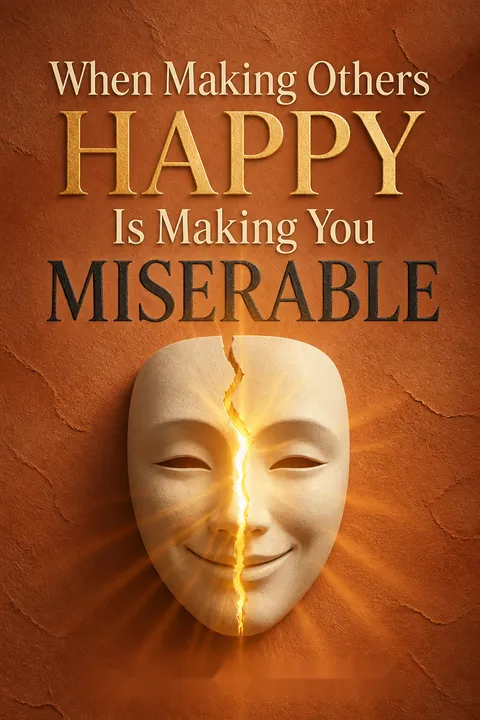
When Making Others Happy Is Making You Miserable received mixed reviews, with an average rating of 3.98/5. Many readers found it helpful for addressing people-pleasing tendencies from a Christian perspective, offering practical advice and biblical insights. Some appreciated the author's personal stories and writing style, while others found them less relatable. The book was praised for its focus on prioritizing God over others' approval. Critics noted its heavy Christian emphasis and felt some advice was repetitive or not universally applicable. Overall, readers found it thought-provoking and potentially life-changing for those struggling with people-pleasing.
Glossary
approval addiction
Compulsive approval seekingEhman's term for a repeated tendency to seek praise, acceptance, or belonging from other people, or to avoid their disapproval, even when doing so creates exhaustion or regret. It describes a behavioral pattern, not a clinical diagnosis. The book connects it to fear, learned habits, and the emotional reward of being liked.
moqesh
A tempting relational snareA Hebrew word Ehman discusses through Proverbs 29:25, translated in the book as a snare. It refers to a trap or lure that entices someone with a seeming reward, then captures or holds them. In this discussion, the lure is human approval: the relief of pleasing someone can pull a person into repeated capitulation.
Necessary and no
A season of selective commitmentsEhman's name for a three-month period in which she limited her commitments to what was necessary for her work, home, and family. She declined optional hosting, volunteering, and other requests to recover from years of over-serving and to reconsider which responsibilities belonged in her life.
social media syllabus
Online habits that set expectationsEhman's metaphor for the expectations other people infer from someone's repeated online behavior. Frequent likes, rapid replies, and public availability can teach others to expect ongoing engagement, while consistent limits can signal that replies are selective or delayed. The term emphasizes that patterns communicate even when no explicit promise has been made.
Me-First Maximizers
Subtle advantage-seekersEhman's label for people who repeatedly arrange shared situations to benefit themselves, often without open hostility. They may divide work evenly by quantity but leave another person with the unpleasant tasks, or avoid costs and inconveniences they expect others to absorb. The label concerns a repeated pattern, rather than one selfish choice.
no-regret living
Choosing by life's current seasonA decision-making idea Ehman learned from a colleague: consider what the current season of life requires and prioritize opportunities that may not remain available indefinitely. Examples include time with aging parents or children who are growing more independent. It encourages deliberate choices rather than assuming every opportunity can be postponed or repeated.
curse of capability
Skill attracting extra demandsEhman's term for the way competent, reliable people can become default helpers. Because others see that they can handle many tasks, they are asked to take on more, sometimes without regard for their existing responsibilities. Capability is an asset, but without limits it can lead to chronic overcommitment.
people and your punch list
Relationships and daily dutiesEhman's framework for the two recurring claims on a person's time: relationships with people and the tasks or responsibilities that need completing. These demands interact, and either can crowd out the other when a schedule is shaped by incoming requests rather than chosen priorities. The framework encourages deliberate attention to both.
FAQ
What's "When Making Others Happy Is Making You Miserable" about?
- Focus on People Pleasing: The book addresses the issue of people-pleasing and how it can lead to personal misery. It provides guidance on breaking free from this pattern.
- Personal Experiences and Scripture: Author Karen Ehman uses her personal experiences and biblical teachings to offer a blueprint for overcoming the need for approval from others.
- Practical Advice: It includes practical advice and strategies to help readers prioritize their own well-being and live a life that pleases God rather than people.
- Target Audience: The book is aimed at those who struggle with saying no and feel overwhelmed by the expectations of others.
Why should I read "When Making Others Happy Is Making You Miserable"?
- Identify Toxic Patterns: It helps readers identify and break free from toxic patterns of behavior that prioritize others' happiness over their own.
- Gain Confidence: The book provides tools to help readers gain confidence in making decisions that align with their values and priorities.
- Spiritual Growth: It encourages spiritual growth by focusing on pleasing God rather than people, using biblical principles as a guide.
- Practical Solutions: Readers will find practical solutions and strategies to manage their time and relationships more effectively.
What are the key takeaways of "When Making Others Happy Is Making You Miserable"?
- Prioritize God's Approval: The book emphasizes the importance of seeking God's approval over human approval.
- Set Boundaries: It teaches readers how to set healthy boundaries to protect their time and emotional well-being.
- Honesty and Integrity: The importance of honesty and integrity in relationships is highlighted, encouraging readers to speak the truth in love.
- Self-Care: The book advocates for self-care and taking time to rest and rejuvenate, as modeled by Jesus.
How does Karen Ehman suggest breaking the pattern of people-pleasing?
- Recognize the Pattern: The first step is to recognize the pattern of people-pleasing and understand its impact on your life.
- Set Boundaries: Establish clear boundaries to protect your time and energy from being consumed by others' demands.
- Practice Saying No: Learn to say no confidently and without guilt, understanding that you can't please everyone.
- Focus on God's Approval: Shift your focus from seeking approval from others to seeking approval from God.
What are some practical strategies from "When Making Others Happy Is Making You Miserable"?
- Create a "No" List: Make a list of things you will say no to, helping you prioritize your commitments.
- Use Go-To Statements: Prepare statements to use when declining requests, such as "I don't have the bandwidth right now."
- Schedule White Space: Intentionally schedule downtime in your calendar to rest and recharge.
- Seek Wise Counsel: Consult with trusted friends or mentors when making decisions to gain perspective and support.
What role does Scripture play in "When Making Others Happy Is Making You Miserable"?
- Biblical Foundation: The book uses Scripture as a foundation for its teachings, emphasizing the importance of aligning one's life with biblical principles.
- Examples from the Bible: It includes examples of biblical figures who struggled with people-pleasing and how they overcame it.
- Scriptural Encouragement: Readers are encouraged to memorize and meditate on Scripture to strengthen their resolve against people-pleasing.
- God's Approval: The book highlights the importance of seeking God's approval above all else, using Scripture as a guide.
How does Karen Ehman address the concept of self-care in the book?
- Biblical Self-Care: Ehman emphasizes that self-care is not selfish but a biblical principle, as Jesus often withdrew to rest and pray.
- Rest and Rejuvenation: The book encourages taking time to rest and rejuvenate to maintain physical, emotional, and spiritual health.
- Balance and Boundaries: It stresses the importance of balancing responsibilities with personal well-being through setting boundaries.
- Practical Tips: Practical tips for self-care include scheduling downtime, engaging in hobbies, and spending time in prayer and reflection.
What are the best quotes from "When Making Others Happy Is Making You Miserable" and what do they mean?
- "You don’t need their permission to do God’s will." This quote emphasizes the importance of prioritizing God's will over others' expectations.
- "Every need is not necessarily your call." It reminds readers that not every request or need is their responsibility to fulfill.
- "Stop making their feelings your responsibility." This encourages readers to let go of the burden of managing others' emotions.
- "You can still say yes to the friendship while saying no to a friend." It highlights the possibility of maintaining relationships without always agreeing to requests.
How does Karen Ehman suggest dealing with digital demands in the book?
- Set Digital Boundaries: Ehman advises setting boundaries for digital communication, such as not responding to messages immediately.
- Use Do Not Disturb: Utilize phone features like "Do Not Disturb" to limit interruptions during personal time.
- Social Media Syllabus: Create a consistent pattern of behavior on social media to manage others' expectations of your availability.
- Delete and Block: Don't hesitate to delete or block messages that are intrusive or inappropriate.
What is the significance of the "Summer of Necessary and No" in the book?
- Personal Experiment: Karen Ehman shares her personal experiment of saying no to unnecessary commitments for a summer.
- Focus on Essentials: During this time, she focused only on what was necessary for her work, home, and family.
- Learning Experience: It was a learning experience that helped her understand the importance of setting boundaries and prioritizing her well-being.
- Encouragement for Readers: The story serves as encouragement for readers to try their own season of saying no to regain control over their lives.
How does "When Making Others Happy Is Making You Miserable" address the issue of pride?
- Pride and People-Pleasing: The book discusses how pride can be a root cause of people-pleasing, as individuals seek approval to boost their self-image.
- Biblical Warnings: It references biblical warnings against pride and the importance of humility in relationships.
- Self-Reflection: Readers are encouraged to reflect on their motivations for people-pleasing and identify any prideful tendencies.
- Humility as a Solution: Embracing humility and seeking God's approval is presented as a solution to overcoming pride and people-pleasing.
What is the overall message of "When Making Others Happy Is Making You Miserable"?
- Freedom from People-Pleasing: The book's overall message is about finding freedom from the burden of people-pleasing.
- Align with God's Will: It encourages readers to align their lives with God's will and seek His approval above all else.
- Healthy Boundaries: Establishing healthy boundaries is essential for maintaining personal well-being and fulfilling one's purpose.
- Live Authentically: Readers are urged to live authentically, prioritizing their relationship with God and their own well-being over others' expectations.
About the Author
Other books by Karen Ehman

Download PDF
Download EPUB
.epub digital book format is ideal for reading ebooks on phones, tablets, and e-readers.








