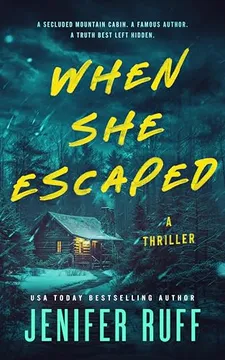


Plot Summary
A Name Borrowed at Check-In
At Raven’s Hollow, a secluded Colorado resort, Zipporah Bazile2 checks in as Hannah Williams, guarding the privacy she believes a famous thriller writer needs. She has ten days to draft a novel and opens it with Hannah, a Charlotte editor traveling with boyfriend Jackson,10 stopping at a dark highway rest area.
Jackson10 remains absorbed in an urgent work call while Hannah enters the restroom alone. A stranger seizes her at the door and drugs her; when Jackson10 finally searches the empty stalls, her purse and coat are gone, but her phone remains charging in his car.
His delayed alarm leaves the abduction without an immediate witness. Zip2 returns to her manuscript, confident she can shape fear into fiction, while the reader already knows her invented plot has begun somewhere real.
The opening makes authorship feel like control: Zip chooses a pseudonym, a private setting, and a fictional victim whose danger she can arrange from her desk. The manuscript immediately punctures that safety. Jackson’s missed warning is not deliberate betrayal, but his work call leaves Hannah unprotected at the precise moment she needs attention. By placing the abduction inside Zip’s creative process, the novel makes storytelling both refuge and exposure. The gap between what Zip thinks she is inventing and what the reader senses creates the book’s central unease.
The Sheriff’s Hunting Ground
In the pages Zip2 writes, Hannah wakes bound in a van and is taken to a remote cabin, where a bearded captor and his dog, Bolton,11 confine her below ground. Tally marks suggest women endured the room before her.
The captor repeatedly unlocks the door to bait her into escape attempts, then hunts her through freezing woods with a gun and bow. A sheriff’s5 truck, left outside as false hope, supplies the deeper shock: the captor displays the badge and admits he is the sheriff,5 so the search for Hannah is being controlled by the man holding her.
He has persuaded the community that she vanished across state lines. Hunger, injury, and isolation flatten her resistance; when another woman comes upstairs, Hannah’s pounding cannot reach her. Zip2 grows increasingly intent on ending the character rather than rescuing her.
The cabin turns ordinary signs of safety into instruments of control. A phone has no dial tone, an unlocked door is bait, and the sheriff’s vehicle signals not rescue but the captor’s command of the search. Hannah’s repeated failures are not proof of moral weakness; they show how deprivation narrows a person’s available choices. The tally marks and unheard visitor widen her imprisonment beyond one room, suggesting an entire community can be misled by the authority it trusts. Zip’s wish to kill Hannah echoes her own inability to imagine a future for a character whose agency has been systematically stripped away.
Raven Elixir and a Stranger
Outside the manuscript, Zip2 meets Robert Yates,4 a widowed cybersecurity founder staying across the hall. Their dinners, cocktails, s’mores, and shared nights soften her caution; after he finds her books, she admits her real name and learns his work is legitimate.
Yet his expertise makes every coincidence feel dangerous. A suspicious coffee, a printout of her online biography, a note about people watching her, and a publisher announcement for a book she is not writing gather into a pattern she cannot interpret.
Yoga guest Sarah6 appears to recognize Zip2 as Hannah and keeps turning up nearby. Zip2 also hears Robert4 say her name during a secretive call, then mistakes his birthday-flower surprise for proof he has been investigating her. Attraction and alarm keep trading places, and her unfinished story stalls.
Robert’s growing intimacy gives Zip a real emotional stake in the resort, but it also exposes how little she knows about him. Her suspicion is not baseless: he searches for her and has the technical skill to access private information. Yet each clue arrives without context, and Zip’s habit of converting uncertainty into a thriller plot distorts her judgments. Sarah’s presence adds another ambiguous witness. The romance therefore works as more than a subplot: it makes trust a daily decision, complicated by genuine affection and the narrator’s increasingly unreliable interpretation of evidence.
Notes Across the Hall
After spotting notes in Robert’s4 room that mirror Hannah’s abduction, Zip2 accuses him of stealing her manuscript. Robert4 instead shows her a photograph of a woman who looks exactly like her, captioned with the name Emma Wilson.1
Zip2 searches Emma’s1 name and finds a missing-person report: Emma1 was taken from a North Carolina rest area and found five months later, though the escape is unexplained. Emma’s parents7 arrive at Raven’s Hollow and reveal that Emma1 is their daughter and Zip2 is an alter created after the trauma.
Donna,9 whom Zip2 thought was her editor, confirms she is Emma’s psychiatrist9 and explains that Emma’s1 memories shaped the manuscript. Zip2 resists the diagnosis until she learns another alter may hold the missing escape memory. Under the pressure of that possibility, Zip2 loses consciousness.
The revelation changes the status of every earlier clue. The manuscript’s uncanny accuracy, the false author profile, the altered photograph, and the wrong publisher announcement are no longer separate mysteries; they expose the limits of Zip’s account of herself. Her belief is sincere, which keeps the disclosure from reading as a simple lie uncovered. At the same time, the parents’ and psychiatrist’s decision to let the writing continue raises an ethical tension: care becomes entangled with concealment. The plot asks whether a protective story can help someone survive while also making it harder for them to recognize their own life.
Katya Takes the Page
Katya Strauss,3 the resourceful heroine of Zip’s favorite thriller series, takes control of Emma’s1 body and recognizes the cabin from memories Zip2 could not reach. She knows Emma1 is still alive within the shared mind and means to preserve a path back for her.
At Raven’s Hollow, Katya3 calms Emma’s parents7 and reconnects with Robert,4 explaining Zip’s2 conduct as a writing experiment rather than exposing the full truth. Robert4 accepts her account and remains close, while Katya’s3 growing affection makes surrendering control harder.
She then resumes the manuscript in first person, asking the captor for meat and saving bones, studying the dog,11 the cabin, and the sheriff’s5 routines. The change in narration is also a change in method: Hannah’s hope has failed, so Katya3 prepares patiently to act.
Katya’s arrival converts literary knowledge into a survival strategy. The heroine’s confidence is not merely decorative fantasy; it supplies Emma with an imagined capacity for planning and action when terror has overwhelmed her. The first-person shift makes that change formal as well as psychological: the account moves from observing Hannah’s suffering to recording decisions made from inside it. Katya’s closeness to Robert creates a cost to her protective role, since the life she is building includes affection she expects to relinquish. Her purpose is not simply escape, but leaving Emma evidence that agency remained possible.
The Trap Turns Back
When the sheriff5 returns to his North Carolina cabin, Katya3 has picked the basement lock with a sliver of bone. She finds newspaper clippings proving Travis Cockeram5 abducted other women, including Kimberly Jones and Maggie Lewis, while publicly leading their searches.
Katya3 hides sedatives in his moonshine and Bolton’s11 food, takes a knife, and lures Travis5 into the woods with a whistle. He wounds her, but she maneuvers him toward one of his own concealed pits and sends him falling into it, then leaves him gravely injured.
Half-starved and freezing, she reaches a road and steps before an approaching truck. Hunters take her to hospital; she gives them the name Katya3 and her parents’7 number. Emma1 later remembers waking in intensive care but cannot recall the escape, leaving the rescue’s author and method concealed from her.
The escape reverses the sheriff’s own design without pretending the reversal is clean or painless. Katya uses the cabin’s materials, his routine, and his traps, but her success still depends on risk, physical injury, and luck at the road. The clippings reveal that his authority helped conceal repeated crimes, turning the badge from a promise of protection into a tool of predation. Katya’s decision to leave him in the pit brings justice into morally difficult territory; the story preserves that discomfort rather than converting it into a tidy arrest. Her arrival at the hospital saves Emma’s life but does not restore memory.
Emma Reclaims the Manuscript
Back in Charlotte, Katya3 finishes the account in Emma’s1 room, sends Emma1 the manuscript and a private note, and leaves the raven pendant before deliberately yielding control. Emma1 wakes after another blank stretch, healthier in appearance but frightened by three missing weeks.
Her parents7 explain the alters and she reads Katya’s3 pages, learning how she survived and why the sheriff5 never returned. Rather than share the account, Emma1 deletes it, choosing to keep the most private part of her rescue outside public reach.
Sarah6 confirms Zip’s2 weeks at the resort and helps Emma1 understand that Robert’s4 affection was real. Emma1 calls him; he welcomes her without knowing what happened inside her mind. The missing memory no longer means she has no story, but she decides that access to it belongs to her.
Emma’s recovery begins with knowledge, but the book refuses to equate healing with full disclosure. She learns how she escaped, then deletes the document rather than make her most painful history available to everyone around her. That decision is an act of authorship, not denial: she can retain the truth without surrendering control of its circulation. Katya’s note and pendant function as a bridge between identities, while Sarah’s confirmation and Robert’s welcome reconnect Emma to relationships that continued during her absence. The return of control is gradual and chosen, not a magical cure.
Back to Raven’s Hollow
With psychiatrist Dr. Payson, Emma1 develops grounding practices and begins rebuilding her own identity instead of treating every internal ripple as an approaching takeover. She returns to editing and writes a new version of the captivity, keeping it fictional and publishing under a pen name.
Robert4 becomes her partner, though he never learns Katya’s3 full account. Nine months later, publishers compete for the book; eighteen months later, Emma1 discusses it on television while allowing the public to believe Travis5 escaped.
On a winter visit to Raven’s Hollow with Robert,4 familiar drinks, the spa, and Heidi’s13 recognition stir memories she cannot fully claim. This time Emma1 grounds herself rather than fighting the sensation. She accepts Zip2 and Katya3 as parts of her survival, not rival owners of her life, and chooses to write what comes next herself.
The ending returns Emma to the resort where her identities first became visible, but the same objects now support a different response. The drink, massage room, and bodily ripple once triggered confusion; Emma can now remain present without treating internal experience as an enemy. Her choice to publish fiction protects her privacy while allowing her to transform experience into work on her own terms. The unresolved public story of Travis contrasts with Emma’s private certainty, preserving a boundary between what readers and interviewers may know and what she chooses to carry. Integration here means shared ownership, not erasure.
Analysis
When She Escaped makes authorship a question of who gets to interpret a life. Zip2 believes she is inventing Hannah, but her manuscript preserves Emma’s1 experience before Emma1 can consciously claim it. The twist does not simply reveal that the story was true; it changes the meaning of creativity. Zip’s2 confident fiction, Katya’s3 tactical first-person account, and Emma’s1 later revision are different ways of approaching the same trauma, each offering capacities the others lack. The book’s fractured narration makes perspective consequential: what a narrator can remember determines what she can imagine doing next.
The novel also tests the boundary between protection and control. Emma’s parents7 and Donna9 conceal information because they hope writing will help her, but their intervention unsettles her trust. Katya3 protects Emma1 through action, yet her attachment to Robert4 makes relinquishing control emotionally costly. Emma’s1 final decision to delete Katya’s3 account is therefore not a rejection of the truth. It asserts that understanding an event does not obligate someone to publish or share it. Her later fictionalization preserves both creative freedom and privacy.
The sheriff’s5 authority sharpens the book’s distrust of reassuring appearances. Travis5 can direct the search for a woman he has abducted because others accept the badge as evidence of safety. Against that public deception, the novel places intimate forms of care: Sarah’s6 vigilance, the parents’7 devotion, and Robert’s4 patience. Emma’s1 recovery does not mean that fear or internal difference disappears. It means she learns to meet those experiences without surrendering her present identity to them. The ending’s strongest claim is modest but hard-won: survival can include contradiction, and healing can mean choosing which truths to carry into public view.
Review Summary
When She Escaped receives mixed reviews, averaging 3.79/5. Many readers praise its atmospheric mountain lodge setting, fast-paced chapters, and a surprising mid-book twist involving dissociative identity disorder. The "book within a book" concept is frequently highlighted as unique and engaging. However, common criticisms include the twist arriving too early, leaving the second half feeling anticlimactic and lacking tension. Some found the romance underdeveloped and the ending rushed. Readers who enjoyed it often compare it favorably to Freida McFadden's work.
Characters
Emma Wilson
Editor and aspiring novelistEmma is a Charlotte-based book editor who has spent years helping other writers while doubting her own ability to write a novel. She is compassionate, observant, and inclined to put other people’s needs first. A lifelong vegetarian with a deep love of horses, she has strong convictions about care and vulnerability. Her close ties to her parents7 and friend Sarah6 offer a stable counterweight to her self-criticism, while her professional knowledge gives her a language for shaping stories even when she struggles to claim one of her own.
Zipporah Bazile
Private thriller novelistAs she appears at the beginning of the story, Zipporah is a prolific, bestselling writer who prizes privacy and disciplined work. She treats a resort retreat as a place to observe details and build a dark manuscript, drawing confidence from a career spent turning fear into plot. Her sharp imagination is also a liability: she interprets ordinary uncertainty as evidence of danger and becomes increasingly suspicious of people who care about her. Zip’s forceful self-belief contrasts with Emma’s1 hesitation and gives the narrative a second, more assertive creative voice.
Katya Strauss
Fictional survival modelKatya is the capable heroine of Zipporah Bazile’s2 Darkness novels, known for resourcefulness when threats close in. Her appeal lies in the contrast between composure and danger: she studies a problem, notices what others overlook, and acts rather than surrendering to self-doubt. For Emma1, Katya represents a form of strength that feels vivid and imaginable, even when Emma1 herself cannot access it. Her presence ties the book’s fictional world to its questions about courage, identity, and the stories people use to endure.
Robert Yates
Cybersecurity founder and widowerRobert is a successful Seattle cybersecurity entrepreneur who comes to Raven’s Hollow seeking distance from a painful professional ordeal. He is attentive, self-possessed, and comfortable with technical questions, but his reserve can make him difficult to read. The death of his wife, Danielle, remains part of how he understands intimacy: he knows time with another person is finite and tries not to take it for granted. His attraction to Zip2 develops quickly, yet he also shows patience when her fear and secrecy complicate their connection.
Travis Cockeram
North Carolina sheriffTravis holds a position that makes his community inclined to trust him. He is familiar with the mountain terrain and projects the calm competence associated with someone who knows how to manage danger. His hunting knowledge and command of the backcountry give him practical authority in the region. The distance between a public role and a private life is central to how other characters judge safety, credibility, and power.
Sarah
Friendly Charlotte guestSarah is an outgoing traveler from Charlotte whom Zip2 meets at a resort yoga class. She seeks company, asks direct questions, and readily offers to include another guest in her plans. Her warmth can seem intrusive to someone guarding her privacy, but she is perceptive and persistent. Sarah’s easy social confidence contrasts with Zip’s2 isolation and gives the resort a human connection beyond its romantic storyline.
Jack Wilson
Emma’s devoted fatherJack is a successful attorney who places his family ahead of professional ambition. He is protective, practical, and accustomed to taking responsibility when a loved one is in distress. His steadiness gives Emma1 a reliable source of support, though his desire to help can lead him to make difficult decisions on her behalf. He and Samantha8 share a deep commitment to their daughter1 and to preserving her sense of safety.
Samantha Wilson
Emma’s devoted motherSamantha, a former oncology nurse, is emotionally perceptive and deeply attentive to Emma’s1 needs. She notices small changes in her daughter’s1 appearance and behavior, and her instinct is to offer physical comfort before demanding explanations. Her compassion does not make her immune to fear; she is willing to take difficult steps when she believes Emma1 needs help. Her relationship with Jack7 is affectionate and collaborative.
Donna
Trusted professional guideDonna is calm, articulate, and influential in Zip’s2 creative life. She encourages the retreat and offers measured feedback on the developing manuscript, especially when Zip2 struggles to move the story forward. Her composed manner can feel reassuring or unsettling depending on how much Zip2 trusts her. Donna’s role connects professional guidance with the question of how much support should intervene in another person’s process.
Jackson Porter
Emma’s boyfriendJackson is Emma’s1 partner at the time of the trip that begins her ordeal. He is ambitious and accustomed to allowing work emergencies to intrude on personal plans. Emma1 understands his professional pressures and often accommodates them, a pattern that reveals her tendency to put another person’s needs first. His relationship with her is important to the story’s opening because it shows the ordinary life and expectations she leaves behind.
Bolton
The sheriff’s dogBolton is a large, trained dog who guards the isolated cabin. His barking and physical presence intensify the danger for anyone approaching the property. He is an animal following the conditions set by his owner, which distinguishes his role from the human choices that make the cabin threatening.
Detective Nadine Smith
Patient investigatorDetective Smith interviews Emma1 after she reaches the hospital. She approaches the account with patience, asks about the evidence found with Emma1, and does not press her to fill memory gaps she cannot access. Her measured manner offers a contrast to the fear and urgency surrounding the investigation.
Heidi
Resort massage therapistHeidi works at the Raven’s Hollow spa and remembers a guest who left a massage early. Her professional attentiveness gives Emma1 a concrete reminder that the resort contains events her conscious memory cannot retrieve. She treats the returning guest with courtesy rather than forcing an explanation.
Julia Jefferson
Hospital nurseJulia is a nurse who cares for the unidentified woman brought to the hospital by hunters. She notices the patient’s injuries and the distinctive birthmark described by the caller, helping connect the woman to a family7 searching for her. Her practical attention turns a medical intake into the first confirmation that the missing woman has been found.
Plot Devices
The Nested Manuscript
Fiction carries buried memoryZip’s2 novel follows Hannah’s kidnapping while the outer story follows Zip2 at Raven’s Hollow. At first, the manuscript seems to be a separate thriller, but its details increasingly match Emma’s1 real abduction. The shifts in narration also mark shifts in access: Zip2 writes from a distance, while Katya3 later recounts events she remembers from inside the cabin. The manuscript becomes evidence, treatment, and finally a private record Emma1 may accept or destroy.
Raven’s Hollow
A retreat masking disorientationThe resort is both a believable writing retreat and a setting full of recurring sensory anchors: the firepits, mountain trails, Raven’s Elixir, spa tea, and Heidi’s13 massage room. During the first visit, its isolation gives Zip2 privacy but also feeds her unease. On Emma’s1 return, familiar locations make the lost period tangible. The setting does not explain the mystery by itself; it provides a fixed landscape against which changes in memory and identity become visible.
The Missing Escape
A gap drives the mysteryEmma1 remembers the captivity but not how she reached safety. That absence shapes the novel inside the novel, motivates Zip’s2 stalled draft, and gives Katya’s3 account its purpose. The gap also protects Emma1 from memories she cannot yet bear, while frustrating her parents7 and clinicians who want to understand what happened. When the account finally supplies an answer, Emma1 still retains the right to keep it private.
The Borrowed Heroine
A fictional model becomes usableKatya Strauss3 comes from the thriller series Emma1 admires. Her competence offers an imaginative template for planning under pressure, especially when Emma’s1 own remembered self is exhausted and frightened. The story uses the heroine not as proof that Emma1 was secretly fearless all along, but as a form her mind can use to access action and strategy. Her name and methods bridge the books Emma1 reads and the survival she must understand.
Cabin Survival Materials
The captor’s tools change handsThe cabin’s bones, sedatives, moonshine, dog, newspaper clippings, and hidden pits are introduced as parts of Travis’s5 control over captives and terrain. Katya3 studies these objects before using them against him. The strategy depends on earlier details: the bones arrive with the meat she requests, the moonshine is a familiar drink, Bolton11 guards the property, and Travis5 trusts his own traps. The physical setting makes escape a chain of practical decisions rather than a sudden rescue.
Download PDF
Download EPUB
.epub digital book format is ideal for reading ebooks on phones, tablets, and e-readers.








