

Key Takeaways
Let suffering ask hard questions; faith should not silence them.
Questions belong here. Amy Orr-Ewing begins amid fresh grief: her friend Brenda has died at 36, leaving a husband and three children, including a baby. The author is not offering a neat fix or treating suffering as an abstract puzzle. She has lived with threats of violence and walked alongside people facing abuse, poverty, illness, and loss. That experience shapes the book's central invitation: ask honestly where God is, and whether Christian faith can withstand the scrutiny of real pain.
Doubt is not disloyalty. The Bible itself gives voice to people asking why God seems absent. Questions can be part of grief and part of exploring faith, rather than evidence that someone has failed spiritually. The book aims to accompany sufferers, not hurry them toward an easy explanation.
What's valuable is the refusal to confuse comfort with certainty. In acute grief, explanations can sound like attempts to close a conversation that needs to remain open. Orr-Ewing's personal and pastoral perspective helps keep the philosophical question attached to actual lives. The distinction between accompanying someone and fixing them is also ethically important: a listener's first responsibility may be attention, not interpretation. Still, a thoughtful welcome for doubt does not guarantee that every proposed answer will satisfy. The book is strongest when it makes space for the question before offering a theological response.
Use outrage as evidence of value, but not as a shortcut to God.
Worldviews carry assumptions. The book contrasts several ways of interpreting suffering. Karma can frame pain as the consequence of moral cause and effect, possibly across lifetimes. Buddhist detachment seeks freedom from suffering by loosening desire and attachment. A strict fatalism treats events as God's will, while naturalism explains them in physical terms without a divine purpose. Orr-Ewing argues that Christian belief instead grounds human dignity in people bearing God's image.
Outrage raises a question. When people grieve for strangers or condemn cruelty, she sees evidence that human life has value beyond usefulness or preference. She argues that this moral intuition points toward God. That is a case for considering Christianity, not a neutral demonstration that every nonreligious account of morality must fail.
The comparison is most useful as a map of underlying commitments: accounts of suffering also imply accounts of value, responsibility, and what counts as justice. The author's argument invites readers to ask why suffering feels morally wrong, not merely unpleasant. But moral outrage does not, by itself, establish its theological source. Secular moral philosophies can also defend human dignity and objective duties, even if they ground them differently. The Christian account offers a coherent explanation within its wider picture of creation and God; its force depends on whether that larger picture is persuasive.
Protect the freedom that makes love possible, while resisting its misuse.
Love requires choice. In Genesis, the world begins as good, and human beings are given genuine agency rather than being made to obey like machines. The story of Adam and Eve presents a boundary they can either respect or cross. Orr-Ewing argues that love must be freely given, so the same freedom that permits love also permits betrayal, selfishness, and violence.
Choices spread their effects. The biblical story describes human wrongdoing as damaging relationships among people, God, and the natural world. Its consequences reach beyond the person who made a choice, leaving others to live with harm they did not cause. This helps explain moral evil within the Christian account, though it does not identify a reason for every particular illness, loss, or disaster.
The freedom argument makes an important distinction between a world containing meaningful agency and a world in which every harmful choice is prevented. Love that cannot be refused would not be freely chosen. Yet the argument does not settle the harder question of why a loving God permits particular acts, or why intervention is rare in some moments and apparent in others. Nor should the idea that freedom enables harm soften responsibility for those who choose to abuse it. The account is strongest as an explanation of why moral risk is possible, not as a complete explanation of each victim's suffering.
Let anger name injustice instead of shaming it into silence.
Anger can be truthful. After the 2017 Grenfell Tower fire, which killed 72 people, including 18 children, residents and neighbours gathered in grief and anger. Reports that the building's exterior cladding accelerated the fire, alongside residents' earlier safety concerns, intensified public outrage. At a community service near the tower, people responded strongly to biblical words about healing the brokenhearted and judging the wicked.
Lament is part of faith. The Bible's poems and stories include people protesting God's apparent silence and demanding justice. Orr-Ewing argues that anger at suffering is not automatically a rejection of God; it can express the conviction that people matter and that cruelty is wrong. Honest speech to God is presented as more faithful than pretending to feel calm.
The Grenfell gathering shows that grief is not only private emotion. Shared anger can identify a preventable injustice and create solidarity among people who might otherwise mourn alone. The biblical permission to lament gives religious language room for protest rather than requiring cheerful submission. That permission matters especially when institutions use faith to discourage scrutiny. Anger, however, is not automatically wise or just; it can misidentify causes or target the wrong people. Its value lies in taking harm seriously and directing attention toward truth, accountability, and care.
Let grief testify to love without pretending loss is small.
Attachment makes loss profound. Orr-Ewing describes losing her father-in-law, Colin, after a final family visit. At the moment his body was taken away, she and her husband stood on the doorstep and waved, echoing the ritual of goodbye he had shared with them for years. The memory captures grief as the loss of a particular relationship, not simply the fact that a body has died.
Christian hope makes room for tears. The Bible depicts Jesus mourning at his friend Lazarus's tomb, and offers the hope of continued relationship with God beyond death. Orr-Ewing connects that hope to Jesus' resurrection, arguing that it is more than a comforting image if the resurrection is true. The promise does not make separation painless or turn grief into a failure of faith.
The story's power lies in its ordinary detail: a familiar goodbye becomes a final one. Such rituals show how bereavement disrupts habits as well as emotions, because the person remains present in memory while absent from daily life. The Christian promise of reunion can offer a framework for hope without requiring mourners to minimize the loss. Its credibility, though, depends on a contested historical and theological claim about resurrection. For a grieving person, that claim may be sustaining, but it should be offered as an invitation, not imposed as a timetable for healing.
Treat mental illness as suffering, not spiritual failure or weak character.
Pain affects the whole person. The book describes a teenager's panic attack and considers depression, self-harm, suicide, and trauma. It reports the World Health Organization's 2018 estimate that one in four people would experience a mental or neurological disorder at some point. Orr-Ewing rejects the idea that depression proves weak faith or that a person can simply reason their way out of distress. A biblical view of human dignity, she argues, does not depend on productivity or mental stability.
Care should be practical. The author urges people facing suicidal thoughts to seek professional help, and recognizes the value of medical treatment, therapy, and supportive relationships. The Christian idea of the kingdom as already present in part, but not yet fully realized, helps explain why healing may occur for some and not others. It offers hope without promising a cure.
This section's insistence on professional care is crucial: spiritual meaning should not be used to replace diagnosis, treatment, or a safe support network. Its account of a person as more than a mind or body can also resist the pressure to measure worth by clear thinking or daily output. The idea of incomplete healing helps explain why a faith community may pray for recovery while illness persists. Yet that framework can feel painful if it is used to explain away suffering. Compassion requires acknowledging what remains unresolved, not only pointing toward future restoration.
Forgiveness never cancels justice, safety, or the cost of repair.
Violence violates dignity. Orr-Ewing recounts the abuse of her childhood friend Anna, whose father was convicted after she disclosed the assaults. The book also describes Rachael Denhollander, a survivor of abuse by USA gymnastics doctor Larry Nassar. Denhollander offered him personal forgiveness while asking the court for the maximum sentence. Nassar received a 175-year sentence.
Repentance faces consequences. In the Christian account, forgiveness through Jesus does not make a crime harmless or remove the need to protect others. Genuine repentance means naming the wrongdoing, accepting its seriousness, and facing civil penalties. The author also argues that divine judgment matters because many perpetrators evade justice in this life. Forgiveness, in this framing, is not the same as excusing a crime or restoring trust without safeguards.
This distinction prevents a common moral confusion: forgiving an offender is not equivalent to granting access, withdrawing a report, or asking a victim to reconcile. Denhollander's example holds mercy and accountability together without making either one a substitute for the other. It also raises a demanding question about religious claims of repentance: what observable actions show that an offender has accepted responsibility and no longer poses a danger? The book answers partly through legal accountability and protection. Any pastoral response that ignores those requirements risks centering the offender's comfort over the victim's safety.
Read disaster through both Earth's systems and human choices.
A life-supporting planet has risks. The book notes that the tectonic movement behind earthquakes and volcanoes also helps sustain Earth's conditions for life. It similarly observes that most viruses are not harmful to their hosts, while some cause devastating disease. These examples complicate the assumption that every dangerous natural process is simply a defect in creation.
Disaster is not a verdict. Jesus rejects the idea that victims of a collapsing tower or political violence must have deserved their fate. Orr-Ewing points out that poverty, weak buildings, corruption, and poor governance can magnify the damage from natural events. The Christian response is therefore not to blame victims, but to mourn, help, and consider how human resources can reduce avoidable harm.
The distinction between a hazard and a disaster is clarifying: natural processes interact with where people live, how buildings are made, and whether institutions protect them. That directs attention toward practical prevention rather than speculation about individual guilt. It also makes the theological question harder, not easier. Showing that tectonic systems support life does not explain why particular people suffer, or why the benefits and dangers are distributed unevenly. The argument offers context for a functioning natural world, while leaving the emotional and moral force of catastrophic loss intact.
Make faith visible by confronting systems that keep people trapped.
Injustice can be built into routine. In Peckham, Orr-Ewing realized that a clinic's posters, forms, and instructions assumed that everyone could read. For a friend who could not, the systems intended to provide help could themselves become barriers. The book also describes poverty and exploitation sustained across generations, including unsafe labor and homelessness amid public wealth.
Belief demands action. The Bible gives prominent attention to enslaved people, the poor, widows, and the oppressed. Orr-Ewing traces a Christian tradition of practical aid, from early communities caring for vulnerable neighbors to modern charitable work. She also acknowledges that churches and Christians have supported injustice or failed victims. The faith's ethical claim must therefore be tested against its treatment of those with the least power.
The clinic example reveals how exclusion can persist without an openly cruel decision: ordinary procedures can quietly assume abilities, money, or security that some people lack. This makes systemic suffering harder to address than a single act of wrongdoing, because responsibility is distributed across rules and institutions. The book's appeal to Christian service is strongest when it leads to changes in access and power, not only charitable gestures. Its frank account of church failures is important; a tradition's moral credibility rests not just on its stated ideals, but on whether it confronts its own complicity.
Meet suffering through Christ's solidarity, while admitting the mystery remains.
God enters the story. Orr-Ewing sees the biblical figure of the Suffering Servant as fulfilled in Jesus, whose crucifixion is presented as God sharing human pain and bearing wrongdoing. Jesus' bodily suffering, tears, and anguish offer a picture of divine closeness rather than distant observation. The book argues that his resurrection grounds the Christian hope that death and suffering will not have the final word.
Hope is present, but incomplete. Jesus' healings and other miracles are described as signs of God's kingdom, not guarantees that every believer will recover. Christian life exists between partial experiences of healing and a promised future in which suffering ends. That hope can motivate care and endurance, but the claim that suffering may shape or redeem a person should never be used to excuse preventable harm or silence protest.
The distinctive center of this answer is not a precise explanation for every tragedy, but a claim about God's proximity: in Jesus, God is said to undergo vulnerability and death. That can make the Christian response more relational than a theory that merely classifies suffering. The resurrection claim provides the hinge between present grief and future hope, though historical evidence does not compel every reader to the same conclusion. A useful test of this theology is whether it produces solidarity, protection, and action now, rather than turning future comfort into a reason to tolerate injustice.
Analysis
Orr-Ewing's book moves between apologetics and pastoral care, and that double purpose shapes its strongest insights. Its recurring claim is that Christianity can make sense of suffering because it grounds human dignity in God's image, locates some suffering in human freedom and a damaged creation, and presents God as participating in pain through Jesus. The sequence matters: readers first encounter lived grief and violence, then theological interpretation. That order keeps the argument from becoming a detached exercise, even when the author turns to philosophical claims about morality or the natural world.
The book's most compelling contribution is not a complete causal explanation. It is a refusal to treat lament as irrational or faithless, paired with a vision of divine solidarity and practical responsibility. Its most vulnerable reasoning occurs when human outrage is treated as evidence for God's existence. The intuition that cruelty is objectively wrong is significant, but it does not uniquely establish the Christian explanation; alternative moral philosophies can defend dignity without appealing to a personal creator. Likewise, free choice helps explain how people can harm one another, but it does not resolve why particular harms go unprevented.
That gap need not invalidate the book's pastoral argument. It does, however, clarify what the Christian answer offers: not a complete account of why each sufferer receives a particular burden, but a framework for naming wrong, affirming the victim's worth, demanding justice, and hoping that death is not ultimate. The framework is credible in practice only when care accompanies doctrine. The chapters on mental illness and abuse are strongest where they direct readers toward professional help, legal accountability, and protection, rather than treating spiritual belief as a substitute. The book's central challenge is therefore both intellectual and ethical: consider whether the Christian story explains why suffering matters, then judge that story by how its followers respond to people in pain.
Review Summary
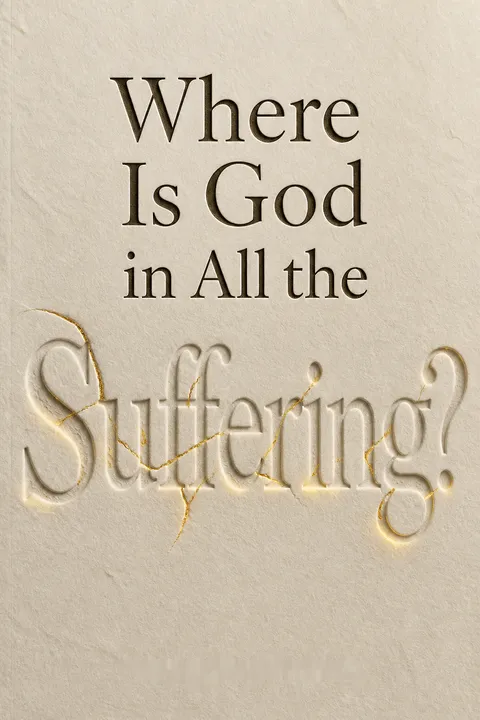
Where Is God in All the Suffering? receives mostly positive reviews for its compassionate and thoughtful approach to a difficult topic. Readers appreciate Orr-Ewing's personal stories, logical arguments, and addressing of various types of suffering. The book is praised for its accessibility to both believers and skeptics, and its timely relevance to current global issues. Some readers find it repetitive or lacking depth, but many consider it a valuable resource for understanding suffering from a Christian perspective.
Glossary
imago dei
Humanity bearing God's imageThe Christian teaching that human beings are created in the image of God. In Orr-Ewing's argument, this gives every person sacred dignity and worth that do not depend on health, ability, productivity, social status, or belief. It also explains why violence against a person is more than physical injury: it violates someone who bears God's image.
the fall
Humanity's rupture with creationThe biblical account, beginning in Genesis, of human beings rejecting God's authority and damaging their relationship with God, one another, and the natural world. Orr-Ewing uses the fall to explain why suffering, death, disease, and disorder affect people beyond the individuals whose choices contribute to harm. It does not mean that each sufferer personally deserves their particular suffering.
the now and not yet
Present, incomplete kingdomA Christian description of God's kingdom as already present through Jesus and experienced in part, but not yet fully established. Healings and other miracles are treated as signs of the future restoration God promises, not as a guarantee that every person will be healed now. The term helps explain why Christians may affirm both divine action and continuing suffering.
Suffering Servant
Messianic figure who suffersA figure in the book of Isaiah who is described as rejected, afflicted, and suffering on behalf of others. Orr-Ewing reads these passages as anticipating Jesus, whose suffering and death are understood as bearing human wrongdoing and offering restoration. The idea places a suffering, self-giving God at the center of the Christian account.
theology of the cross
God known through the crossA Christian way of understanding God's character and action through Jesus' crucifixion. In this book, the cross shows that God does not remain distant from human suffering, but enters it and bears it. The idea also shapes Christian life toward costly service, while requiring care not to romanticize harm or discourage efforts to prevent it.
vicarious suffering
Suffering on another's behalfSuffering endured by one person for the sake of others. Orr-Ewing uses the term for the Christian claim that Jesus bears human sin and its consequences through his death. This is not presented as making wrongdoing inconsequential; rather, the cross is said to take wrongdoing seriously while opening a path to forgiveness and restored relationship.
Download PDF
Download EPUB
.epub digital book format is ideal for reading ebooks on phones, tablets, and e-readers.








