

Key Takeaways
The deepest science conflict is naturalism's, not theism's
Plantinga reverses the usual story. He argues that science and theistic belief have superficial conflicts but deep points of agreement, while science and naturalism appear allied on the surface yet conflict at a deeper level. Here, naturalism means more than atheism: it is a worldview that denies God and treats human beings as wholly material. Because it offers answers about reality and humanity, Plantinga calls it a quasi-religion.
The distinction matters. A scientific discovery may challenge a particular religious interpretation without disproving theism. Conversely, accepting scientific findings does not establish naturalism. The book's central claim is that science does not belong exclusively to either worldview, and that naturalism faces its own serious intellectual problem when joined to evolution.
What's useful about this reversal is its insistence that science and metaphysics are not interchangeable. A result in biology can describe ancestry or selection without settling whether the process has purpose. That distinction improves public debate, where claims about what science shows often quietly include philosophical assumptions. The harder question is whether Plantinga applies the same scrutiny to theistic assumptions that he demands of naturalistic ones. His case is most persuasive when it exposes a hidden premise, and less decisive when it treats his own religious commitments as a secure starting point.
Separate evolutionary evidence from the claim that evolution is unguided
Evolution is not one claim. Plantinga separates an ancient Earth, descent with modification, common ancestry, and natural selection from the further claim that the whole process is unguided. In his terminology, Darwinism concerns natural selection acting on genetic variation; saying that the process has no divine direction adds a metaphysical conclusion, not a biological mechanism.
Possibility is not proof. Dawkins and Dennett argue that natural selection could produce complex life without design. Plantinga replies that showing a route is possible, or failing to show it impossible, does not establish that this route actually occurred, much less that it was unguided. Genetic variation called random in biology means it is not produced in response to an organism's adaptive needs. That does not, by itself, rule out divine direction.
The distinction resembles a standard caution in philosophy of science: a model can explain a pattern at one level without settling every question about its causes or meaning. It also helps prevent a false choice between accepting common ancestry and adopting atheism. Still, scientific explanations do not need to answer every metaphysical question to be strong explanations. Plantinga is right that evolutionary mechanisms alone do not logically exclude divine guidance, but that compatibility does not count as evidence that guidance occurred.
Physical laws describe regular systems, not necessarily a God-free universe
Closure is an added assumption. Causal closure is the idea that physical events have only physical causes. Plantinga argues that classical conservation laws apply to isolated systems, so a system affected by an outside cause would not be a counterexample to those laws. The laws describe regular behavior under specified conditions; they do not themselves prove that the universe is closed to divine action.
Quantum theory leaves room. Quantum mechanics assigns probabilities to possible outcomes rather than always predicting a single outcome. Plantinga proposes divine collapse-causation, the idea that God could determine particular quantum outcomes. He treats this as a possible account of special divine action, not as an established result of physics. His narrower point is that current physics does not straightforwardly rule out miracles or providence.
This argument usefully distinguishes a law's description of regularities from a philosophical thesis about everything that can cause events. That distinction is important in debates about science and religion, and it also clarifies why a conservation principle alone cannot settle whether a miracle occurred. But compatibility is a modest conclusion: a theory that permits divine action does not thereby support it. The proposed quantum account is also speculative, and scientific uncertainty at the quantum level should not be mistaken for positive evidence of supernatural agency.
Test claims against the evidence base they actually use
A conflict is not automatically a defeater. A defeater is information that gives someone reason to abandon or weaken a belief. An evidence base is the set of beliefs used to assess a claim. Plantinga argues that scientific inquiry often uses methodological naturalism, a rule that excludes supernatural explanations from scientific models. That rule is not the same as the metaphysical claim that no supernatural reality exists.
The starting point matters. Plantinga calls theories that conflict with Christian belief Simonian science. Some forms of historical Biblical criticism assume there are no miracles; others simply exclude religious premises because not all researchers accept them. A conclusion drawn from this restricted evidence base does not automatically defeat a Christian belief supported by a broader one. Yet scientific evidence can still defeat a religious belief if it shows that the belief rests on a mistaken reading, as when a biblical verse is taken to teach that Earth is stationary.
This is a strong lesson in epistemology: the force of evidence depends partly on what else a person reasonably knows. It resembles legal reasoning, where a verdict can be justified by the evidence available to a jury yet conflict with a defendant's direct memory. The analogy does not settle whether a religious source is trustworthy, however. A restricted method can produce useful knowledge without claiming to be a complete worldview, and its conclusions may still challenge religious beliefs when they rely on public, testable claims.
Explaining religion's origins does not settle whether its beliefs are true
Origins and truth differ. Evolutionary psychology tries to explain human traits through their history and possible adaptive effects. Some theories describe morality as a useful illusion or religion as a byproduct of cognition or a tool for social cooperation. Plantinga's point is that an account of how a belief arises does not, by itself, show that the belief is false. Explaining perception through brain activity, for example, would not alone show that what people see is unreal.
A proposed mechanism can misfire. The hypersensitive agency detection device, or HADD, is a proposed tendency to detect agents quickly, even at the risk of false alarms. Missing a predator might be costly, while mistaking a shadow for an agent may not be. But a capacity that sometimes produces false beliefs can also produce true ones, such as beliefs about other minds. A theory must show more than an origin story to discredit religious belief.
This distinction is central to the broader study of cognition: causal explanations of belief formation and assessments of truth are different tasks. A mechanism's evolutionary history may illuminate why a belief is common without deciding whether it is warranted. The reverse caution matters too. A useful belief-forming mechanism can still be systematically biased, and social benefits do not guarantee truth. The relevant question is how reliably a mechanism works in the specific domain, not whether its existence is compatible with a favored worldview.
Treat cosmic fine-tuning as evidence, not a mathematical knockout
Life depends on narrow ranges. Fine-tuning arguments point to physical constants and initial conditions that appear to fall within ranges permitting life. Plantinga reviews six examples, including gravity, the weak force, and the cosmological constant. One cited estimate places the required precision in some cases at one part in 10^53. Multiplying estimated chances across several parameters can produce odds below 10^-100, if the parameters are independent and the probability assumptions are sound.
The inference remains limited. Theism may make a life-permitting universe less surprising if God would want life. Critics raise anthropic selection, multiverse scenarios, and difficulties assigning probabilities to the alternatives. Plantinga concludes that fine-tuning offers some support for theism, but only modest support, because the relevant probabilities and background assumptions are uncertain.
The argument is strongest as a prompt to compare explanations, not as a simple calculation that delivers a verdict. Its numerical force depends on choices about which values count as possible, how parameters relate, and what probability distribution to use. Anthropic selection is not a complete explanation, but it does affect what observers should expect to observe. The broader lesson is that extreme improbability is evidence only relative to a well-specified alternative, not a standalone measure of design.
Notice when design is perceived before it is argued
Some beliefs arise directly. Plantinga distinguishes a design argument, which infers a designer from premises, from design discourse, which draws attention to features that prompt a direct perception of design. Paley's familiar watch example asks readers to notice how parts work together for a function. Plantinga applies this approach to Michael Behe's descriptions of cellular systems such as flagella and molecular machinery.
The evidence is contested. Behe defines irreducible complexity as a system whose function fails when an essential component is removed. Plantinga does not claim Behe has proved that these systems could not evolve. He notes that critics propose indirect evolutionary paths, while detailed explanations for some molecular systems remain disputed. Evolutionary accounts may weaken design impressions in some cases, but Plantinga argues that they do not automatically erase them.
Perception is not confined to color and shape. People often recognize faces, intentions, or artifacts without first constructing an explicit argument, so Plantinga's category of direct design perception is philosophically coherent. Yet immediate impressions are fallible and shaped by expectation. An object that looks engineered may have an unfamiliar natural history, just as a natural object can resemble a tool. The key issue is not whether design seems perceptible, but what independent evidence could correct or strengthen that perception.
Science flourishes when minds and nature are mutually intelligible
Science requires a fit. Plantinga argues that inquiry depends on reliable perception, memory, mathematics, induction, and a world regular enough to study. Theistic belief explains this fit through the imago dei: humans are made in God's image and can therefore know something about reality. The medieval phrase adequatio intellectus ad rem names this match between intellect and world.
The match has several parts. Nature must display stable patterns, those patterns must be discoverable, and human minds must be capable of grasping them. Mathematics reaches far beyond everyday survival, yet helps describe physical reality; induction lets people learn from repeated experience; and the contingency of creation makes observation necessary because the world could have been otherwise. Plantinga argues that theism makes these conditions intelligible, while naturalism leaves their conjunction surprising.
This is one of the book's most expansive claims: it treats science not just as a collection of theories but as a human capacity whose success needs explaining. The connection between regularity and inquiry is compelling, and the history of science shows how assumptions about an orderly nature can encourage systematic investigation. But historical origins are not exclusive proof of theological dependence. Institutions, mathematics, instruments, and collaboration also shape scientific success, while naturalists can offer evolutionary accounts of some cognitive abilities.
Naturalism must explain why survival-shaped brains reliably reach truth
The argument turns inward. Plantinga's Evolutionary Argument Against Naturalism asks whether naturalism combined with evolution gives reason to trust human cognition. He argues that natural selection favors adaptive behavior, not truth for its own sake. On materialism, neural structures cause behavior while also determining belief content. Plantinga questions why the content produced by adaptive brain processes should usually be true.
Doubt threatens the whole view. If the probability that our faculties are reliable, given naturalism and evolution, is low, then someone accepting both has a defeater for trusting those faculties. That doubt also reaches the beliefs in naturalism and evolution, since those beliefs depend on the same faculties. Plantinga calls the combination self-defeating: not a logical contradiction, but a view that cannot be rationally accepted. Critics dispute whether selection can favor accurate representations because accurate beliefs often guide successful action.
The argument's force lies in asking naturalists to account for the reliability of the reasoning they use to defend naturalism. Its most contested step is the separation between neural processes that guide adaptive behavior and the truth of their associated contents. Many ordinary tasks seem to reward reasonably accurate representations, although that does not guarantee reliability in abstract metaphysics. Plantinga establishes a serious challenge about scope: a story about survival does not automatically explain every kind of knowledge. He does not establish that naturalistic cognition is unreliable.
Analysis
Plantinga's book is best read as a philosophical audit of claims made in the name of science, not as a scientific demonstration of Christianity. Its most durable contribution is taxonomic. It distinguishes empirical theories from metaphysical extensions, explains why a research method can exclude supernatural causes without disproving them, and shows that apparent conflict depends on which beliefs and evidence a person brings to the inquiry. Those distinctions improve debates that too often slide from evolutionary biology to claims about purpose, or from physical laws to a universal ban on divine action.
The book's structure moves from removing alleged contradictions, through genuine but allegedly nondefeating conflicts, to arguments for concord, then to a proposed conflict between naturalism and evolution. This progression makes the final evolutionary argument feel like a reversal of the opening controversy. Its conclusion is more limited than a disproof: Plantinga claims that naturalism joined to evolution undermines confidence in the cognitive faculties needed to believe that conjunction. The argument is philosophically ambitious, but its key premise is disputed. Natural selection can favor behavior that tracks features of the environment, and in many cases accurate representations support adaptive action. Whether this extends to abstract reasoning, and whether materialism makes content causally irrelevant in the way Plantinga suggests, require further argument.
A related asymmetry deserves attention. Plantinga treats Christian belief as part of a legitimate evidence base that science methodologically brackets, while some scientific claims are treated as compromised by their exclusion of that belief. This is a coherent position if religious belief has independent warrant, but that warrant is precisely what many interlocutors contest. Likewise, fine-tuning and design perception can make theism more plausible to some readers without compelling those who assign different prior probabilities or trust different explanatory standards. The book is most valuable when it clarifies what a scientific result does and does not entail. Its strongest conclusions invite scrutiny rather than ending the debate: methodological limits are not metaphysical verdicts, but compatibility is not confirmation either.
Review Summary
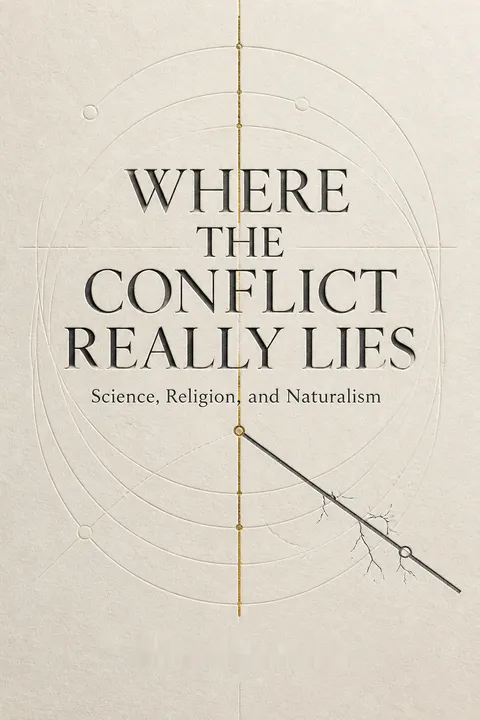
Where the Conflict Really Lies argues that there is superficial conflict but deep concord between science and theistic religion, while there is superficial concord but deep conflict between science and naturalism. Plantinga challenges the notion that science and religion are incompatible, addressing evolution, miracles, and naturalism. Many readers found his arguments compelling and well-structured, praising his clarity and humor. However, some criticized the book's density and repetitiveness. Overall, reviewers appreciated Plantinga's thorough examination of the relationship between science, religion, and naturalism, even if they didn't always agree with his conclusions.
Glossary
Methodological naturalism
Method rule excluding supernatural causesA proposed constraint on scientific inquiry that excludes appeals to God or other supernatural agents from a study's data and explanatory theories. It is distinct from metaphysical naturalism, which says there is no supernatural reality. Plantinga argues that conclusions reached under this method do not automatically settle questions that the method brackets.
Simonian science
Science conflicting with Christian beliefPlantinga's label for scientific theories or conclusions that conflict with Christian or theistic beliefs, named for Herbert Simon's evolutionary account of altruism. The label includes claims in evolutionary psychology and historical Biblical criticism. Plantinga argues that such conclusions do not automatically defeat religious belief, especially when their evidence base excludes or denies relevant religious claims.
Defeater
Reason to weaken or abandon beliefA belief or experience that gives someone reason to stop holding another belief, or to hold it less firmly. A rebutting defeater supports the opposite claim; an undercutting defeater weakens the original basis for belief without establishing its opposite. Whether something defeats a belief depends on the person's wider beliefs and evidence.
Causal closure
Physical causes suffice for physical eventsThe thesis that every physical event has a sufficient physical cause, with no causal influence from outside the physical system. Plantinga argues that classical physical laws do not themselves establish causal closure. He treats closure as a metaphysical assumption often added to physics, not as a direct consequence of its equations.
Design discourse
Attention that prompts design perceptionPlantinga's term for presenting features of nature in a way that leads people to perceive design directly, rather than infer a designer through a formal argument. His examples include Paley's watch analogy and Behe's descriptions of cellular structures. Such perception may support belief, but remains open to correction by evidence or defeaters.
Darwin's doubt
Doubt about evolved cognition's reliabilityPlantinga's name for the worry that, if naturalism and evolution are both true, human cognitive faculties may not be reliable. Natural selection favors adaptive outcomes, he argues, and does not obviously ensure true belief. If this probability is low, a naturalist may have reason to doubt the faculties used to accept naturalism and evolution.
Evolutionary Argument Against Naturalism
Argument that naturalism undermines cognitive trustPlantinga's argument that naturalism combined with evolution gives reason to doubt the reliability of human cognitive faculties. If that doubt is warranted, it undermines confidence in beliefs produced by those faculties, including naturalism and evolution themselves. The argument targets rational acceptability, not a direct logical contradiction, and depends on controversial claims about selection and belief content.
Adequatio intellectus ad rem
The intellect's fit with realityA medieval expression meaning the adequation or fit of human understanding to reality. Plantinga uses it for the match needed between cognitive faculties and the world for knowledge and science to succeed. He argues that theism explains this fit through creation in God's image, while naturalism has more difficulty accounting for it.
Divine collapse-causation
God causes quantum outcomesPlantinga's proposed account of divine action based on collapse interpretations of quantum mechanics. On this view, God could cause particular outcomes when quantum systems collapse, while the system still follows its probabilistic laws. Plantinga presents the proposal as a possible way to understand providence and miracles, not as an established scientific theory.
FAQ
What is "Where the Conflict Really Lies: Science, Religion, and Naturalism" by Alvin Plantinga about?
- Superficial vs. deep conflict: The book argues that while there appears to be a superficial conflict between science and theistic religion, there is actually deep concord; conversely, there is superficial concord but deep conflict between science and naturalism.
- Reframing the debate: Plantinga challenges the common narrative that science and religion are fundamentally at odds, suggesting the real philosophical tension is between science and naturalism.
- Philosophical and scientific analysis: The book explores philosophical arguments, scientific theories, and theological doctrines to support this thesis, analyzing topics like fine-tuning, evolutionary theory, and cognitive faculties.
- Naturalism as a worldview: Plantinga treats naturalism as a quasi-religion that offers a master narrative excluding God, which ultimately clashes with the foundations of science.
Why should I read "Where the Conflict Really Lies" by Alvin Plantinga?
- Unique perspective: The book offers a fresh and rigorous philosophical perspective on the science-religion debate, challenging widely held assumptions.
- Engages with leading thinkers: Plantinga critically engages with prominent atheists and scientists like Richard Dawkins, Daniel Dennett, and Michael Behe, providing readers with a comprehensive view of the debate.
- Clarifies key concepts: The book explains complex ideas such as methodological naturalism, fine-tuning, and the evolutionary argument against naturalism in accessible terms.
- Influential in philosophy: Plantinga is a leading philosopher of religion, and this work is considered a major contribution to contemporary discussions on science, religion, and metaphysics.
What are the key takeaways from "Where the Conflict Really Lies" by Alvin Plantinga?
- Science and theism are compatible: There is no deep conflict between science and theistic religion; apparent conflicts are superficial and often based on misunderstandings.
- Naturalism faces philosophical challenges: The real conflict is between science and naturalism, especially regarding the reliability of human cognition and the explanation of fine-tuning.
- Design beliefs are rational: Belief in design can be rational and warranted, even in the face of scientific explanations, especially at the molecular level.
- Methodological naturalism limits science: Scientific inquiry, by excluding supernatural explanations, operates on a restricted evidence base that does not encompass the full range of human knowledge.
What are the best quotes from "Where the Conflict Really Lies" by Alvin Plantinga and what do they mean?
- “There is superficial conflict but deep concord between science and theistic religion; and superficial concord but deep conflict between science and naturalism.”
This encapsulates Plantinga’s central thesis, challenging the common view of science and religion as fundamentally opposed. - “Naturalism is at least a quasi-religion, a sort of worldview or master narrative.”
Plantinga frames naturalism as a comprehensive worldview, not just a scientific stance, which shapes how its adherents interpret evidence. - “If you accept both naturalism and evolution, you have a defeater for the reliability of your cognitive faculties.”
This quote summarizes the Evolutionary Argument Against Naturalism, a key philosophical challenge Plantinga raises. - “The fine-tuning of the universe cries out for explanation.”
Here, Plantinga highlights the significance of the fine-tuning argument as evidence for theism.
How does Alvin Plantinga define and address the conflict between science, religion, and naturalism in "Where the Conflict Really Lies"?
- Redefining the conflict: Plantinga argues that the real conflict is not between science and theistic religion, but between science and naturalism, which denies the existence of God.
- Superficial vs. deep conflict: He distinguishes between superficial conflicts (apparent contradictions) and deep concord (fundamental compatibility) between science and theism.
- Naturalism as a quasi-religion: Naturalism is treated as a worldview that competes with theism, offering its own answers to existential questions.
- Methodological naturalism’s role: The book explains how methodological naturalism shapes scientific inquiry, often creating the illusion of conflict with religion.
What is methodological naturalism, and how does it impact the science-religion debate in "Where the Conflict Really Lies"?
- Definition: Methodological naturalism is the principle that scientific inquiry must proceed without invoking supernatural causes, focusing solely on natural explanations.
- Distinction from philosophical naturalism: Plantinga clarifies that methodological naturalism is a rule for scientific practice, not a metaphysical claim about reality.
- Impact on evidence: Because science excludes supernatural explanations, its evidence base is narrower than that of theism, leading to only superficial conflicts with religious beliefs.
- Implications for conflict: Scientific theories developed under methodological naturalism may appear to conflict with religious beliefs, but this conflict is limited and does not undermine the broader Christian evidence base.
How does Alvin Plantinga address the relationship between evolution and Christian belief in "Where the Conflict Really Lies"?
- Compatibility with theism: Plantinga argues that evolution as a scientific theory is compatible with Christian belief if one allows for the possibility of divine guidance.
- Critique of atheistic interpretations: He challenges claims by Dawkins and Dennett that evolution necessarily implies a godless universe, noting these are metaphysical, not scientific, assertions.
- Randomness and divine action: The randomness in evolutionary processes does not preclude divine causation; God could guide mutations without violating scientific principles.
- No inherent conflict: The real conflict arises only when evolution is interpreted through the lens of naturalism, not when considered alongside theism.
What is the Fine-Tuning Argument in "Where the Conflict Really Lies," and how does Plantinga use it to support theism?
- Definition of fine-tuning: The argument points to the precise values of physical constants and conditions in the universe that allow for life, which seem highly improbable by chance.
- Theistic explanation: Plantinga argues that theism provides a natural explanation for fine-tuning, as a rational creator would design a life-permitting universe.
- Probability contrast: The probability of fine-tuning under naturalism or chance is extremely low, while under theism it is not surprising.
- Addressing objections: Plantinga responds to challenges such as the anthropic principle and the multiverse hypothesis, maintaining that fine-tuning offers modest but real support for theism.
What is the Evolutionary Argument Against Naturalism (EAAN) presented by Alvin Plantinga in "Where the Conflict Really Lies"?
- Core claim: The conjunction of naturalism and evolution undermines the reliability of human cognitive faculties, including the belief in naturalism and evolution itself.
- Reliability problem: Evolution selects for survival-enhancing behavior, not necessarily for true beliefs, making reliable cognition unlikely under naturalism.
- Self-defeating position: If one accepts both naturalism and evolution, one has a defeater for trusting one’s own cognitive faculties, including the belief in naturalism.
- Deep conflict revealed: This argument exposes a deep philosophical conflict between naturalism and the foundations of science.
How does Alvin Plantinga interpret Michael Behe’s arguments for design in biology in "Where the Conflict Really Lies"?
- Irreducible complexity: Behe’s examples of molecular systems that are allegedly too complex for unguided evolution are presented as challenges to Darwinism.
- Design discourse vs. argument: Plantinga distinguishes between formal design arguments and design discourse, suggesting that perceiving design can be a basic, non-inferential belief.
- Epistemic warrant: Even if formal arguments are not conclusive, the perception of design in biology can be rational and warranted.
- Lack of strong defeaters: Plantinga notes that, especially at the molecular level, Darwinian explanations have not provided strong defeaters for design beliefs.
What is the distinction between design argument and design discourse in "Where the Conflict Really Lies" by Alvin Plantinga?
- Design argument: Traditional design arguments use premises and logical inference to argue for the existence of a designer.
- Design discourse: Plantinga introduces the idea that belief in design can arise directly, like perception, without argument—this is design discourse.
- Epistemic implications: Design beliefs formed through discourse can be rational and warranted, even if not supported by formal arguments.
- Persistence of design beliefs: This distinction helps explain why design beliefs persist despite scientific challenges and why they can support theism in a unique way.
How does Alvin Plantinga explain the deep concord between Christian theism and science in "Where the Conflict Really Lies"?
- Imago Dei and knowledge: Christian theism posits that humans are created in God’s image, with intellectual faculties designed for discovering truth, supporting the reliability of science.
- Order and lawfulness: Theism accounts for the regularity and law-like behavior of nature as a result of God’s providence, which is foundational for scientific inquiry.
- Mathematics and rationality: The effectiveness of mathematics in describing the universe fits naturally with theism, as both creation and human cognition reflect God’s rationality.
- Empirical contingency: The contingent nature of creation under theism underwrites the empirical, experimental approach of science, as the laws of nature are not necessary but chosen by God.
About the Author
Other books by Alvin Plantinga


Download PDF
Download EPUB
.epub digital book format is ideal for reading ebooks on phones, tablets, and e-readers.








