

Key Takeaways
Wars expose the price of pretending public commitments can be free
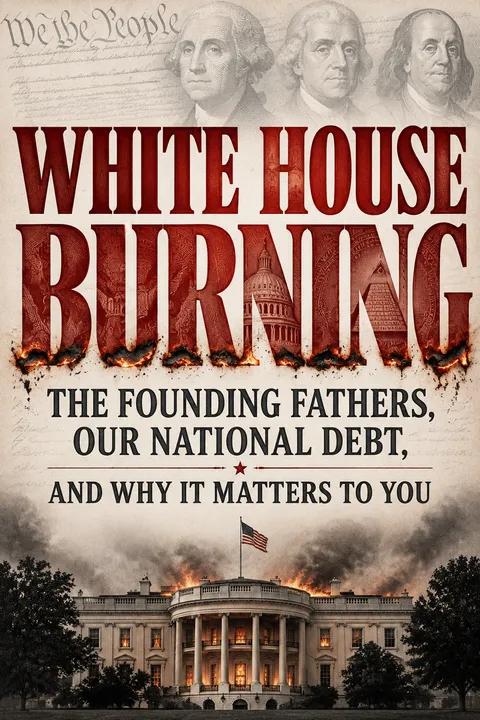
The 1812 warning. When President James Madison asked Congress to declare war on Britain, his party supported the fight but resisted the taxes Treasury Secretary Albert Gallatin said were needed to finance it. Investors hesitated to lend, and the government ran short of money. In 1813, Philadelphia banker Stephen Girard had to help underwrite a major loan because his credit was stronger than the country’s. The U.S. Navy entered the war with just 17 ships, against a British fleet of more than 1,000. British forces later burned the Capitol and White House.
The bill comes due. Congress eventually restored internal taxes, but too late to prevent serious military weakness. The episode shows that public promises, whether for war or domestic programs, require a credible way to pay for them.
The episode makes fiscal capacity concrete: money is not an accounting abstraction when it determines whether a state can defend itself. It also complicates the easy claim that lower taxes always mean greater freedom. A government unable to finance a commitment can leave citizens exposed to greater dangers than taxation would. Yet the story does not prove that every proposed public service deserves funding. It establishes a more useful test: before approving a commitment, political leaders should explain its cost, its beneficiaries, and the revenue source that makes it credible.
Credit rests on credible future taxes, not on a small debt
Britain, France, and credit. In the eighteenth century, Britain borrowed heavily to fight wars against France. Its lenders trusted repayment because Parliament could authorize taxes, and creditors had a political voice. France had a smaller debt but a weaker, less legitimate tax system; it repeatedly struggled to collect revenue and service its obligations. The contrast helped bring down the French monarchy.
Hamilton’s repair job. After the Revolution, the United States owed money it could not reliably repay. Treasury Secretary Alexander Hamilton restructured federal debt, assumed state debts, and proposed taxes to cover interest. U.S. government borrowing costs fell sharply by 1791. The Whiskey Rebellion exposed the political price: frontier farmers saw the whiskey tax as a burden serving distant investors. Credit became stronger, but its distribution remained contested.
The comparison points to institutions, not debt totals, as the foundation of public credit. A government’s ability to raise revenue depends on people believing its rules are legitimate and its commitments will be honored. This resembles the broader idea of a social contract: compliance is easier when citizens see taxation as reciprocal rather than arbitrary. Hamilton’s success also came with a distributional conflict, not a painless technical fix. Trust in credit can be built by taxation, but trust in government requires a convincing account of who pays and who benefits.
The dollar's reserve role buys time, not limitless borrowing
From gold to dollars. The Bretton Woods system, designed during World War II, let countries hold dollars as reserves and exchange official dollar holdings for U.S. gold. In 1971, President Richard Nixon ended that convertibility after foreign claims on gold threatened to overwhelm U.S. reserves. The dollar remained the leading reserve currency even without the gold guarantee.
A vast credit line. By 2011, global foreign-exchange reserves exceeded $7 trillion, with more than 60 percent held in dollars. Foreign governments and investors bought Treasury securities, helping the United States borrow at very low interest rates, even during record peacetime deficits. But this confidence rested on expectations of a growing economy and responsible policy, not a permanent legal guarantee. If investors reconsidered, borrowing could become more difficult and expensive.
Reserve-currency status is best understood as an institutional advantage, not a loophole in economic arithmetic. It allows the United States to borrow in its own currency and gives global investors a widely used safe asset. That advantage can reduce immediate pressure to adjust policy, which is precisely why it can encourage complacency. The arrangement also depends on collective belief: there is no single moment when confidence is certain to vanish, and no exact debt threshold that predicts it. Privilege is a buffer, not a substitute for political credibility.
Tax-cut politics can enlarge deficits while claiming to cure them
The changing Republican bargain. Ronald Reagan’s 1981 tax cuts were not matched by enough spending cuts, and the resulting deficits became among the largest peacetime deficits then recorded. In 1990, President George H. W. Bush accepted tax increases as part of a deficit deal, despite his campaign pledge. Newt Gingrich and other conservative Republicans opposed the compromise, strengthening an antitax position that grew more disciplined through organizations such as Americans for Tax Reform and its Taxpayer Protection Pledge.
A surplus, then a reversal. The 1990 and 1993 deficit measures, economic growth, and lower defense spending helped produce federal surpluses by 1998. The 2001 and 2003 tax cuts then reduced revenues without matching spending reductions. The 2011 debt-ceiling fight showed the resulting contradiction: politicians invoked debt while resisting either tax increases or cuts to popular programs.
The book’s political history explains why budget debates often become contests over labels rather than choices. A tax cut can be described as returning money to taxpayers, while the spending reductions needed to pay for it remain unspecified. A deficit can then be used to argue for cuts without revisiting the earlier revenue decision. This is a problem of political accountability: visible benefits attract credit, while diffuse future costs are easier to ignore. The account is strongest when it tracks incentives and institutions, though voters and parties are not uniform blocs, and budget outcomes also reflect economic shocks.
Most federal spending is insurance, not dispensable bureaucracy
Where the money went. In 2010, mandatory programs accounted for 59 percent of primary federal spending. Social Security, Medicare, and Medicaid together made up nearly half of that spending. These programs grow mainly because more people retire and health care costs rise, not because Congress routinely votes to expand every benefit. By contrast, nondefense discretionary spending had stayed near 4 percent of GDP for decades, while defense spending had fallen substantially from its Cold War share.
The hidden budget. Government also supports people through tax expenditures, deductions and exemptions that reduce taxes in exchange for certain activities. The mortgage-interest deduction, for example, was estimated to cost $94 billion in 2012. People may oppose government programs yet defend benefits they receive through tax rules. The result is a distorted picture of both the budget and the government’s reach.
This distinction improves the debate by separating budget size from the kind of influence government exercises. A cash benefit, a tax preference, and a regulation can all shape private decisions, though only some appear as spending. The hiddenness of tax benefits also matters politically: recipients may interpret them as money they earned rather than public support. Still, labeling a tax provision as spending does not settle whether it is worthwhile. Each program needs scrutiny for its purpose, distribution, and effects, not merely a different accounting label.
Judge debt by its use, the economic cycle, and servicing cost
Flow versus stock. A deficit is the yearly gap between government spending and revenue. The national debt is the accumulated amount owed. A recession can widen the deficit automatically: incomes and tax receipts fall, while unemployment benefits and other support rise. The 2007-2009 financial crisis did this on a huge scale, so its record deficits did not all represent permanent policy choices.
Borrowing has tradeoffs. Governments can borrow to support demand when households and businesses pull back, or to finance investments whose benefits exceed their financing costs. But persistent borrowing can raise interest costs and compete with private investment, a possibility economists call crowding out. In 2010, federal interest payments were $196 billion. The key question is not whether debt is inherently immoral, but whether its purpose and future cost justify it.
This framework resists two political shortcuts: treating every deficit as evidence of waste, and treating borrowing as harmless whenever interest rates are low. Timing matters because cutting spending during a downturn can weaken demand further, while borrowing that continues after recovery can carry different costs. Purpose matters too, though governments cannot reliably classify every program as investment or consumption. Social transfers may improve health, security, or economic participation, benefits that do not fit neatly into a balance sheet. Debt analysis therefore requires both macroeconomic judgment and public argument about what outcomes matter.
Preserve fiscal space before the next shock chooses your options
A crisis can rewrite the balance sheet. Ireland’s national debt was about 12 percent of GDP in 2007. When its banks faltered, the government guaranteed their liabilities, and the debt rose sharply before the country needed an international bailout. The episode showed how quickly private financial risk can become public debt.
Room to respond matters. Fiscal space means a government’s ability to borrow when a crisis requires emergency action. The United States could borrow cheaply during the financial crisis, helping stabilize the banking system and support the economy. But that capacity depends on market confidence and political willingness to act. The authors argue that debt reduction should preserve room for future shocks, including financial crises and wars. A debt-ceiling standoff can threaten that room even when investors are willing to lend.
Fiscal space has value even when it is not actively used. Like emergency capacity in medicine or disaster planning, it is difficult to measure by the calm periods in which it sits idle; its worth appears when a shock arrives. The Irish case also warns against treating public debt as a purely governmental story, since guarantees can shift risks from private institutions to taxpayers. Yet maintaining room for crises has an opportunity cost. The hard task is deciding how much insurance against uncertain shocks is worth paying for today, without pretending that the correct margin can be calculated precisely.
Aim to stabilize debt near 50% of GDP without dismantling insurance
A target, not a magic number. The authors propose bringing federal debt to about 50 percent of GDP by 2030, a level they consider a prudent buffer as the dollar’s special role could weaken. They estimate that the required deficit reduction would be about 3 percent of GDP if the Bush-era income and estate tax cuts expired, or 5.5 percent if they became permanent.
Change the structure, not just the headline. Their menu includes reducing tax breaks such as the mortgage-interest deduction, adjusting Social Security taxes and retirement rules, slowing health care cost growth, and taxing carbon emissions and financial risk. They oppose balancing the budget simply by shifting medical costs or retirement risks onto households. The package aims to raise revenue and reduce market distortions while keeping major social insurance programs broadly intact.
The proposal is distinctive because it treats deficit reduction as a design problem, not a single austerity lever. Replacing opaque tax subsidies with visible policies could improve both fairness and democratic accountability. Pricing pollution or financial risk also connects revenue collection to costs markets otherwise leave with the public. The 50 percent target should be read as a precautionary judgment, not a scientific boundary: growth, interest rates, and global demand can alter what debt level is sustainable. The authors’ detailed estimates provide a practical menu, but each item still requires political consent and careful implementation.
A debt plan is a vote on who bears risk
The choice beneath the numbers. Social Security and Medicare pool risks that individuals cannot predict well, such as disability, long life, and high medical costs. Cutting those programs can reduce federal spending, but it transfers more uncertainty to households. Raising taxes can preserve the insurance, though it changes who contributes and how much disposable income remains.
Imagine not knowing your place. The authors use philosopher John Rawls’s veil of ignorance: consider policy without knowing whether one will be rich or poor, healthy or sick, short-lived or long-lived. That perspective makes risk pooling easier to recognize as a form of protection, not simply a transfer to someone else. The book’s final argument is that public debt debates determine which risks citizens face alone and which they share through government.
The veil of ignorance is useful because it exposes how much policy preference depends on knowing one’s current position. It shifts attention from an abstract government-versus-market contest to the distribution of uncertainty across a lifetime. That does not make collective insurance automatically optimal: public programs can be poorly designed, and private choice can matter. But it places the burden of proof on proposals that remove protection, asking whether individuals can realistically buy it themselves. A serious fiscal debate must disclose both the taxes and the risks attached to each political choice.
Analysis
White House Burning is not primarily a warning that a large national debt mechanically causes collapse. It is an account of how public credit, political legitimacy, and the design of social protection depend on one another. The book’s historical spine runs from the Revolution and the War of 1812 through the gold standard, Bretton Woods, the rise of the dollar, and modern tax politics. Across those periods, the recurring question is whether a government can mobilize resources when needed, and whether citizens accept the means by which it does so.
Its strongest conceptual move is separating a government’s capacity to borrow from its willingness to tax, and separating annual deficits from the long-term commitments and economic shocks beneath them. That helps explain why the United States can face low borrowing costs and still have a serious political problem. Reserve-currency status delays immediate market discipline, while polarization weakens the prospect of an agreed revenue and spending path. The book also makes the less obvious point that apparent budget restraint may conceal large subsidies in the tax code, while cuts to insurance programs transfer risks rather than making them disappear.
The argument’s limits are instructive. Historical parallels illuminate mechanisms, but eighteenth-century Britain, revolutionary France, and modern America do not share identical institutions or economies. Debt thresholds and forecasts are uncertain, and the proposed 50 percent target is a prudential choice rather than a universal law. The authors’ preferred balance between taxes and social insurance is also normative, not dictated by economic accounting. Their most durable contribution is therefore not a single forecast or policy package. It is a better question for democratic politics: what public commitments are worth making, who should finance them, and which risks should households bear alone?
Review Summary
White House Burning receives generally strong reviews, averaging 3.87/5. Readers praise the book's accessible writing, thorough historical context tracing U.S. debt from the Founding Fathers to present day, and pragmatic policy recommendations. Many appreciate the authors' ability to explain complex economic concepts clearly for non-experts. Critics note some partisan bias, with the proposed solutions leaning center-left. Several reviewers highlight the book's enduring relevance despite being published in 2012, while others find the latter policy-focused chapters weaker than the engaging historical sections.
Glossary
Fiscal space
Room to borrow in crisesFiscal space is a government’s capacity to increase borrowing or spending when a shock requires action, without losing access to affordable credit. It depends on debt levels, economic conditions, investor confidence, and the political credibility of future revenue decisions. Because confidence can change quickly, fiscal space is difficult to measure precisely before a crisis.
Tax expenditures
Spending through tax rulesTax expenditures are deductions, exclusions, credits, and other tax provisions that lower government revenue to encourage or support particular activities. They can have effects similar to direct spending, such as subsidizing homeownership through the mortgage-interest deduction. Because they appear as reduced taxes rather than program outlays, their public cost is often less visible.
Social insurance
Shared protection against life risksSocial insurance pools risks across a broad population through public programs. People contribute through taxes or premiums, and the program provides benefits when specified events occur, such as retirement, disability, or medical need. Unlike individual savings accounts, social insurance shares risks such as living longer than expected or facing expensive health care.
Structural deficit
Deficit beyond the business cycleA structural deficit is the budget shortfall that would remain if the economy were operating near its potential. It excludes the temporary effects of a downturn, such as reduced tax receipts and increased eligibility for unemployment or safety-net programs. It helps distinguish enduring policy imbalances from deficits caused by a recession.
Crowding out
Public borrowing displaces private borrowingCrowding out is the possibility that increased government borrowing raises demand for available savings and pushes up interest rates. Higher rates can make it harder for businesses, households, and students to borrow for investment or consumption. The effect depends on economic conditions, including whether private demand for loans is already weak.
Triffin dilemma
Reserve supply undermines reserve confidenceThe Triffin dilemma describes a tension in a reserve-currency system. The world needs the reserve-currency country to supply assets for international trade and savings, often through persistent outflows or borrowing. As foreign holdings of those assets grow, holders may become concerned about whether the issuing country can preserve their value.
Generational accounting
Tracks fiscal burdens across generationsGenerational accounting estimates how taxes and government benefits are distributed among people alive today and future generations. It can illustrate how continuing policies may require future taxpayers to contribute more or receive fewer benefits. Results depend on uncertain assumptions, including long-term economic growth and the discount rate applied to future costs.
Veil of ignorance
Choose without knowing your statusThe veil of ignorance is a thought experiment associated with philosopher John Rawls. People consider rules for society without knowing their own future wealth, health, age, or social position. The device tests whether policies remain acceptable when decision-makers cannot tailor them to their own known advantage, and it supports attention to basic liberties and the least advantaged.
Download PDF
Download EPUB
.epub digital book format is ideal for reading ebooks on phones, tablets, and e-readers.








