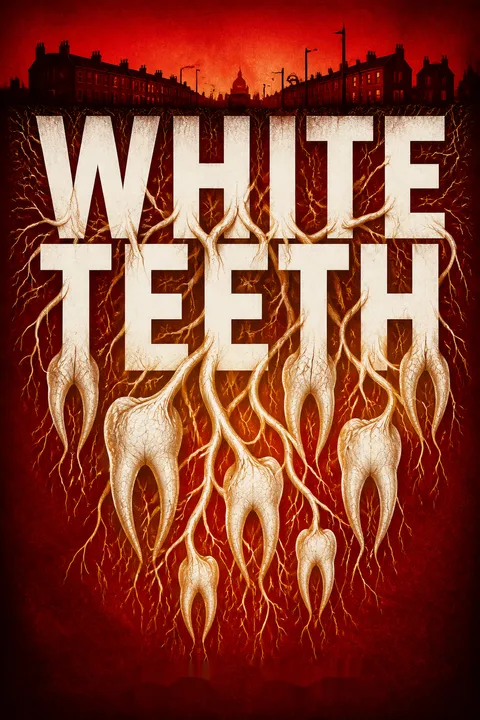


Plot Summary
A Coin Lands on Life
On New Year's morning, 1975, Archie Jones sits in his car with a vacuum-cleaner hose feeding exhaust into the cabin. Divorced after thirty years, alone in a flat above a closed chip shop, he has decided that his life has run out. Mo Hussein-Ishmael, the blunt halal butcher whose delivery space Archie has blocked, discovers him and forces the window open.
Archie gasps back into the world, suddenly grateful for time he had meant to throw away. He drives to a party advertised as the end of the world and, among its exhausted revellers, meets Clara Bowden, a nineteen-year-old Jamaican woman who has just lost her religious certainty. Six weeks later, they marry.
The rescue is deliberately ordinary: Archie survives because a butcher needs his delivery space cleared, not because he has earned or planned a revelation. That accident exposes how much of a life can turn on other people's practical interruptions. His renewed appetite for living is real, but it immediately takes the form of another impulsive attachment. Clara, meanwhile, sees salvation in a man she barely knows. Their marriage begins not with mutual knowledge but with two people trying to escape different forms of emptiness.
Clara's Lost Apocalypse
Before she met Archie, Clara had been a gangly Jehovah's Witness who believed her mother, Hortense, when she predicted the world would end on New Year's Day. She fell for Ryan Topps, a scooter-obsessed classmate, and their courtship pushed religion to the edges of her life. When Ryan joined Hortense in trying to reclaim her for the faith, his scooter crashed into a tree.
Clara lost her front teeth; Ryan walked away unharmed and took the accident as proof that she was damned. The world did not end, but Clara still mourned the God she had expected to rescue her. She married Archie partly to leave Lambeth and her mother, although Archie could offer only a modest house in Willesden, not the faraway life she imagined.
Clara's break with faith is not a simple escape into freedom. The failed prophecy removes the structure she has relied on, but it also leaves her grieving the protection and purpose she thought religion promised. Ryan and Hortense interpret the crash as divine evidence, while Clara recognizes how readily belief can make any accident confirm what its believer already thinks. Her choice of Archie answers that loss with a human substitute. The arrangement gives her a home, but its foundation is dependence and gratitude rather than shared desire.
The War They Missed
The friendship between Archie and Samad Iqbal began in 1945, inside a British tank crossing Europe after the decisive fighting had largely passed. Samad, an educated Bengali soldier with a disabled right hand, and Archie, a young driver with little confidence in his own importance, are stranded in a Bulgarian village after their tank breaks down.
They discover their remaining crew murdered, repair their radio, and learn the war has ended without them. When Russian soldiers arrive to capture Dr Marc-Pierre Perret, a French scientist who served the Nazis' eugenics and euthanasia programs, Samad takes command and leads an expedition to seize him.
He then urges Archie to kill Perret, insisting the war demands a moral choice. Archie cannot do it, and wounds himself instead, allowing Perret to survive.
The episode establishes the novel's central conflict between action and interpretation. Samad needs the war to validate his ancestry and give his damaged life a heroic shape; Archie resists the role of executioner even when his friend calls that resistance cowardice. Their friendship survives because neither fully understands the other's moral language, yet both remain beside the other. Perret's survival also plants a long fuse: the same scientist whose work made him a wartime prisoner will later stand beside a geneticist seeking to control biological futures.
Two Families, Two Sons
After Clara and Archie settle in Willesden, their marriage proves quieter and less romantic than Clara expected. Archie keeps returning to O'Connell's, the café where he and Samad have rebuilt their wartime friendship, while Clara tries to make a home with a husband who is affectionate but passive.
Samad and his much younger wife, Alsana, move north from Whitechapel after hard years of restaurant work and sewing. The two couples become neighbors, and Clara and Alsana form their own wary companionship.
In 1975, both women become pregnant. Alsana bears identical twins, Magid and Millat, while Clara gives birth to Irie, whose name means that things are all right. The children grow up close, but their parents' competing expectations already shape the lives ahead of them.
The families are linked by friendship, proximity, and shared parenthood, but not by a common idea of belonging. Archie and Samad treat their old bond as a refuge from the demands of marriage; Clara and Alsana have to build intimacy in the space their husbands leave behind. The twins make Samad's hopes for cultural continuity especially acute, while Clara's daughter represents a different kind of inheritance. The children begin as a neighborhood unit, but the adults have already loaded them with separate meanings: proof of tradition, escape from it, or simply a chance to begin again.
Samad's Forbidden Detour
By 1984, Samad works long nights at his cousin's restaurant and throws himself into school-governor debates, especially his objection to the Christian-rooted Harvest Festival. There he meets Poppy Burt-Jones, the twins' music teacher, and becomes consumed by desire. He sees the attraction as both a moral test and punishment for the compromises he has made in England.
After their first kiss, he secretly begins an affair, lying to Alsana and arranging meetings with Poppy. At the same time, he grows convinced that his sons are becoming English in ways that will estrange them from Islam and Bengali life. His shame and fear do not make him more honest with his family. Instead, they sharpen his determination to control the boys' futures.
Samad's religious anxiety is sincere, but it becomes a tool for disguising personal desire and avoiding responsibility. He can analyze festivals, doctrine, and the cultural danger of England more easily than he can admit that he is betraying his wife. His affair with Poppy is not simply a lapse in faith; it reveals how completely he has divided his public principles from his private conduct. The more powerless he feels, the more he tries to manage his sons, turning concern for their identity into a defense against his own uncertainty.
One Twin Sent East
Convinced that England is corrupting his sons, Samad decides to send one twin to Bangladesh to be raised among relatives and taught the old ways. He cannot choose between them, changing his mind repeatedly as Archie offers advice and chance seems to speak through letters and coin tosses.
At last he selects Magid, arranging for him to leave without Alsana's consent. On the night of the departure, she discovers the plan and confronts him; a violent argument follows, while the twins watch from the kitchen window.
Archie drives Magid to the airport, but the boys wake and come along, so Samad must explain the separation to both. Millat stays in England. The secret decision fractures the family and leaves each parent with a different account of what has been lost.
Samad describes the separation as a rescue, but its secrecy makes it an act of coercion. His inability to choose is displaced onto a coin, an omen, and finally a unilateral decision, as if fate could absolve him of authorship. Alsana's resistance is not only jealousy or anger; she understands that sending a child into an unstable country means exposing him to risks Samad cannot control. The twins' forced separation turns an abstract argument about cultural inheritance into a bodily loss, one that neither parent can repair by claiming good intentions.
The Son Left Behind
After Magid leaves, Alsana waits through a deadly cyclone in Bangladesh without knowing whether he is safe. News eventually arrives that he survived, though a falling vase broke his nose.
She does not forgive Samad; instead, she stops giving him direct yes-or-no answers, forcing him to live with the uncertainty he imposed on her. Samad turns Magid into an idealized, obedient son in letters and photographs, while Millat grows into a rebellious teenager, drawn to films, girls, drugs, and street prestige.
During a hurricane in London, the Iqbal family takes shelter with Archie and Clara, and the old friends retell their wartime heroics while the younger generation slips outside. Millat and Irie kiss in the storm, beginning a new complication in their childhood bond.
The cyclone makes the family's private crisis legible as more than a domestic dispute. For Alsana, danger is not metaphorical: disaster can arrive without warning and erase the people one loves. Samad treats Magid's survival as confirmation that his plan was right, while Alsana refuses to let survival become a verdict. The twins develop in opposite directions, but neither is free of the separation. Samad's idealized Magid and his criticized Millat are not neutral descriptions; they are rival constructions through which a father tries to manage the guilt of losing one son and failing to understand the other.
Irie Enters the Chalfens
As a teenager, Irie becomes painfully self-conscious about her body, her hair, and her mixed Jamaican and English inheritance. She tries to straighten her hair, damaging it badly, while her mother urges her to accept the features she has inherited.
At school, Irie and Millat are caught smoking marijuana with Joshua Chalfen, the clever son of Marcus and Joyce, a prosperous, affectionate, intellectually confident couple. The headmaster turns the punishment into an after-school study arrangement at the Chalfen home.
Irie is captivated by the family's easy talk and apparent certainty; Joshua is drawn to her and Millat, while his parents take an increasingly personal interest in the two visitors. The arrangement gives Irie academic support, but also makes her feel that she can cross into a more secure, more English world.
Irie's attraction to the Chalfens is both intellectual and bodily. She wants their fluency, their calm domestic life, and the apparent freedom to speak without inherited family wounds interrupting every conversation. Yet the Chalfens' hospitality is not neutral: Joyce reads the teenagers as projects, while Marcus's confidence in rational explanation can turn difference into a problem to be corrected. Irie's attempt to alter her hair dramatizes the cost of wanting acceptance on someone else's terms. Her new household offers opportunity, but it also invites her to mistake assimilation for self-discovery.
Roots Beneath the Names
As Irie spends more time with the Chalfens, the older families' buried histories surface. She learns that her great-grandmother Ambrosia was a Jamaican servant impregnated by Captain Charlie Durham, who then arranged lessons for her while keeping the relationship under his control.
During the 1907 Kingston earthquake, Ambrosia was trapped with the predatory Sir Edmund Glenard; she survived, but Durham's choices and the colonial order left lasting damage. The story unsettles the polished version of Glenard's charitable legacy at Irie's school.
Meanwhile, Samad and Archie argue over Samad's great-grandfather Mangal Pande: Samad sees a revolutionary betrayed by British historians, while Archie trusts accounts that portray him as a drunken failure. Irie begins collecting records, trying to claim a past no one has fully told her.
The two family histories expose how inherited identity is made from unequal records. Glenard's public reputation survives because institutions preserve his version of benevolence; Ambrosia's experience survives through family memory, often dismissed as anecdote. Samad faces a related problem with Pande, whose historical reputation is contested by the same imperial authority that shaped the family's place in Britain. Irie's research is not a quest for a pure origin. It is an attempt to see how violence, desire, and selective remembrance have been folded into the lives she thought she knew.
A Mouse With a Schedule
Marcus's research moves from the laboratory into public controversy when he develops FutureMouse, a genetically altered animal designed to express selected illnesses and physical changes on a predictable timetable.
He argues that such experiments could clarify disease and ageing; opponents fear that controlling a mouse's life presumes the power to control living beings. Joshua, increasingly alienated from his father's certainty, joins FATE, an animal-rights group led by Joely and Crispin, and grows close to Joely.
Irie works for Marcus, organizing his papers and public affairs, while planning a year of travel and a future in dentistry. Joyce tries to manage everyone around her through concern and intervention. The project gathers supporters, protests, press attention, and family resentments, all converging on its planned public launch.
FutureMouse is a device that turns a technical question into a public argument about agency. Marcus sees the mouse as a controlled experiment whose findings may benefit human medicine; his critics see the control itself as a moral trespass. Both positions contain blind spots: scientific intention does not settle the ethics of means, and alarm about the future can become a substitute for understanding the actual research. Joshua's departure from Chalfenism makes the conflict intimate, while Irie's employment puts her between competing households without giving her an easy way to judge either.
The Twin Returns
In 1992, Magid returns to England after eight years in Bangladesh, not as the devout Bengali son Samad imagined, but as a polished young skeptic eager to study English law. He has become the pen pal and protégé of Marcus Chalfen, admiring the geneticist's work and helping him explain it to the press.
Samad is dismayed; Alsana is relieved to have her son home but unsettled by his formality. Millat, now involved with KEVIN, a militant Islamic group, refuses to see his twin.
He sees Magid's partnership with Marcus as a betrayal of both family and faith. Joshua has left the Chalfen household for FATE, while Irie remains there as Marcus's assistant. The brothers' return to the same city does not reunite them; it gives their old separation new ideological stakes.
Samad's plan has produced precisely the outcome he feared, but not in the simple form he expected. Magid has gained discipline and education, yet he has adopted the secular rationalism Samad hoped to prevent. Millat's religious militancy is not a return to their father's faith either; it is a search for belonging and authority shaped by anger, popular culture, and racial exclusion. Their estrangement shows how the same paternal intervention can create opposing responses without giving either son an uncomplicated identity. Samad is left confronting the limits of parenting as cultural engineering.
A Meeting Without Neutrality
As the families try to arrange a meeting between the brothers, Irie is asked to carry a key and guide Millat to a supposedly neutral room. Her history with him overwhelms the plan: they have sex, then separate in shame and confusion.
Angered by Millat's regret and by her own long unreturned love, Irie goes to Magid and has sex with him as well. She does not know that she has become pregnant, and even after she discovers it she cannot determine which twin is the father.
The brothers eventually meet in the bare university room, but their conversation does not reconcile them. They turn desks, chairs, a projector, and other equipment into props for rehearsing their shared past and opposing beliefs, leaving the room as divided as they entered it.
The promised neutral room fails because people do not arrive there as blank subjects. Irie's desire, anger, and longing precede the meeting and reshape it before the twins can speak. Her sexual choices are not a clean resolution of a romantic triangle; they expose the pressure to find a single father, a single origin, and a single explanation for a life that refuses those categories. The brothers' argument likewise turns the room into a stage for inherited narratives. Their inability to reconcile is not caused by insufficient space, but by the histories they carry into it.
Three Causes Converge
As the FutureMouse launch approaches, Millat's KEVIN circle considers direct action against Marcus, while FATE debates whether to free the mouse or confront the scientist. Joshua, now aligned with FATE, knows his father will be present and is asked to help carry out the group's plan.
Millat is assigned to a less violent public protest, but he distrusts the retreat from action and privately acquires a gun. Meanwhile, Hortense and Ryan Topps organize Jehovah's Witnesses to sing and warn the crowd outside the Institute.
Samad, who disapproves of Marcus's attempt to alter creation but also fears what Millat may do, cannot control the factions or his sons. On New Year's Eve, the Iqbal and Jones families travel to the launch, carrying their unresolved loyalties into the same crowded venue.
The final approach is not a contest between one pure faction and one corrupt one. KEVIN, FATE, and the Witnesses each turn moral conviction into organized action, but their methods and aims differ sharply. Joshua's personal grievance against his father entangles him in a plan he has not fully examined; Millat treats political action as a chance to escape a history of powerlessness. Samad's opposition to genetic control does not make him comfortable with violence. The convergence is dangerous because every group believes it is responding to an emergency, while no one can command the consequences once the plans collide.
The Mouse Escapes
During Marcus's launch presentation, he credits his mentor, Dr Marc-Pierre Perret, the same French scientist Archie spared in 1945. Millat moves with his concealed gun as the competing groups close in. Archie recognizes the danger and steps between Millat and the men at the table, taking a bullet in the thigh.
The shot breaks FutureMouse's glass enclosure, and the animal escapes through the room as people scatter. The book leaves the immediate aftermath unsettled, then offers glimpses of possible futures: the twins face community service, Irie raises a daughter whose father remains unknowable, and the families may gather again.
Those possibilities do not erase the histories that brought them there. The final image belongs to the mouse, alive and beyond the design meant to contain it.
The climax answers the novel's opening with another involuntary interruption: Archie again puts his body between death and someone else, but this time the danger is inseparable from the family history he has spent a lifetime avoiding. The mouse's escape does not prove that science is doomed or that nature has delivered a moral verdict. It simply breaks the experiment's claim to total control. Likewise, the future glimpses remain possibilities rather than a tidy settlement. The novel ends by granting movement to the creature and uncertainty to the people who tried to define its path.
Analysis
White Teeth treats identity as an inheritance that can neither be refused nor received intact. Archie, Samad, Clara, and Alsana hand their children not a single tradition but a crowded archive of wars, migrations, religious expectations, colonial injuries, and private evasions. Each parent tries to choose which parts should survive. Samad sends Magid away to protect him from England, only to find that the son returns more committed to secular science than to inherited faith. Clara wants Irie to accept her body and background, but Irie must discover the history that makes those categories unstable. The novel's families are not simply caught between cultures; they are shaped by the stories each culture tells about them and by the gaps those stories conceal.
The book also examines the wish to make uncertainty disappear. Hortense fixes an end date for the world. Samad tries to engineer his sons' futures. Marcus programs a mouse's biological development. KEVIN and FATE each believe that decisive action can correct a system they regard as intolerable. Their motives differ, but each risks turning living beings into evidence for an argument. Archie repeatedly frustrates that logic. His coin tosses suggest passivity, yet at crucial moments he acts without guarantees, placing responsibility on himself rather than on fate or ideology.
The title's teeth gather these concerns into a bodily image. Teeth are inherited, vulnerable, and only partly under a person's control; they can signify beauty, shame, age, and the limits of repair. The generations inherit more than physical traits. They inherit choices whose consequences outlast the people who made them. But inheritance is not destiny. The escaped mouse and Irie's uncertain child leave the ending open, not because the past has vanished, but because the future has not yet been reduced to anyone's design.
Review Summary
White Teeth receives mixed reviews, with many praising Smith's wit, ambitious scope, and multicultural insights. Readers appreciate the complex characters, generational storytelling, and exploration of identity and immigration. Critics note the novel's humor, clever dialogue, and Smith's ability to capture diverse voices. However, some find the plot meandering, characters underdeveloped, and the narrative style challenging. The book's length and dense prose are also points of contention. Overall, it's recognized as an impressive debut that sparked significant discussion in the literary world.
People Also Read






Characters
Archie Jones
The reluctant survivorA mild, indecisive Englishman whose life seems to move by coin tosses, Archie is Samad Iqbal's oldest friend and Clara Bowden's much older husband. He prefers practical work, familiar routines, and the company of his friend to ideological argument. His unremarkable appearance and modest job hide a serious capacity for loyalty, although he often lets others define what a situation means. Archie is shaped by a fear that his actions do not matter, yet he keeps being drawn into decisions whose consequences reach beyond his own plans. His central tension is between passivity and the moments when compassion demands that he act.
Samad Iqbal
The divided patriarchA Bengali Muslim, former soldier, and restaurant waiter, Samad is Archie Jones's closest friend and the husband of Alsana. Proud of his education and ancestry, he longs for a life that honors his family history and his faith. He is eloquent about cultural loss, yet his private conduct often contradicts his public principles. Samad responds to uncertainty by making rules for other people, especially his sons, and by returning to inherited stories that promise a stable identity. His intelligence is genuine, but so is his need to turn complicated choices into moral tests. The conflict between the man he wants to be and the compromises he makes drives his family life.
Clara Bowden
The searching motherA Jamaican-born woman raised as a Jehovah's Witness, Clara is Hortense Bowden's daughter and Archie Jones's wife. She is warm, perceptive, and physically confident, but her early loss of religious certainty leaves her hungry for refuge and recognition. Clara values kindness more than romance and often tries to keep peace among people who are better at arguing than listening. As a mother, she wants Irie to feel at home in her own body and inheritance, although she cannot always offer a clear account of her family's past. Her life exposes the tension between choosing a new home and remaining shaped by the one she left.
Alsana Iqbal
The unsparing realistSamad's young Bengali wife and the mother of Magid and Millat, Alsana is shrewd, funny, proud, and far less submissive than her husband expects. She understands that cultural survival depends on more than repeating old customs, and she distrusts anyone who claims to know what is best for her family. Her sharp temper often protects a more vulnerable fear of losing control over her children and her place in England. Alsana's skepticism is practical rather than detached: she sees the instability of history because she has lived close to danger. She resists simple answers, even when she uses silence or anger to avoid painful conversations.
Magid Iqbal
The polished twinThe elder Iqbal twin by two minutes, Magid is observant, disciplined, and drawn to rules, science, and law. His early intelligence makes adults treat him as a promise, while his careful manners can seem almost unnaturally composed. He is closely tied to Millat, though the brothers develop sharply different styles and beliefs. Magid's desire to make the world orderly reflects both curiosity and a wish to escape the randomness of family history. He values learning and admires people who can explain complicated systems. His calm manner does not mean he is free of longing; it often conceals how intensely he wants recognition from his father and intellectual mentors.
Millat Iqbal
The restless twinMagid's twin and the younger son of Samad and Alsana, Millat is magnetic, funny, and quick to command attention. He moves easily among school cliques and street groups, but that social fluency masks a persistent sense of not belonging anywhere. He resents being treated as the lesser twin and is drawn to images of male power, whether from popular films or political movements. Millat's anger is real, though its targets and explanations shift as he searches for a form of identity strong enough to contain it. He is capable of loyalty and tenderness, but often turns vulnerability into performance, bravado, or defiance.
Irie Jones
The inheritor in searchThe daughter of Archie and Clara, Irie grows up between Jamaican, English, and Bengali households, close to the Iqbal twins. Intelligent and self-conscious, she wants both a secure identity and the freedom to remake herself. Her attempts to change her appearance reveal how strongly she feels the pressure of beauty standards and racial belonging. Irie is curious about history and science, yet wary of adults who treat her as a project. Her loyalty to Millat persists even as she begins to recognize that affection cannot make another person love her. She is the novel's clearest observer of how family stories shape the next generation.
Marcus Chalfen
The confident geneticistA successful scientist and the father of Joshua, Benjamin, Jack, and Oscar, Marcus believes that rigorous research can make life more intelligible and improve human health. He is brilliant, self-assured, and impatient with arguments he considers uninformed. His work on genetically altered mice brings him into conflict with animal-rights activists, religious critics, and members of the local community. Marcus's confidence gives his family a strong intellectual center, but it can also make him blind to how his certainty affects others. He tends to treat moral objections as failures of understanding, an attitude that leaves him poorly prepared for the public response to his work.
Joyce Chalfen
The nurturing intervenerMarcus's wife and Joshua's mother, Joyce is an enthusiastic gardener who believes care and attention can help people flourish. She welcomes Irie and Millat into the Chalfen home, hoping to guide their studies and emotional lives. Joyce is warm, frank, and generous, but her desire to help can become intrusive: she often decides what others need before asking them. She sees family life through the language of nurturing and growth, and can mistake difference for damage that her attention should correct. Her affection is real, yet the people she tries to rescue may experience it as a claim of ownership.
Joshua Chalfen
The rebel ChalfenMarcus and Joyce's eldest son, Joshua is bright, privileged, and initially shaped by the family confidence he later rejects. His attraction to Irie and Millat brings him into contact with a life less insulated than his own. As he challenges his father's scientific work, he finds purpose in animal-rights activism and joins a group willing to use direct action. Joshua's rebellion is sincere, but it is also personal: he is reacting against his father's authority and seeking a place where his own choices matter. His idealism is tested by the tension between political commitment, romantic longing, and the consequences of opposing his family.
Hortense Bowden
The apocalyptic believerClara's mother and Irie's grandmother, Hortense is a lifelong Jehovah's Witness who organizes her existence around the anticipated end of the world. She is formidable, witty, and devoted to the faith that gave her structure through hardship. Her certainty can make her impatient with ordinary life and with people who do not share her expectations. Yet beneath the prophecy and ritual is a woman who has endured abandonment and wants to believe that her suffering has a purpose. Hortense's faith shapes the family across generations, even for descendants who reject it.
Ryan Topps
The converted scooteristClara's adolescent sweetheart and later a close companion to Hortense, Ryan begins as a shy, scooter-obsessed boy with little social success. His conversion to the Jehovah's Witnesses gives his rigid temperament a mission and a vocabulary of certainty. He treats religious doctrine as a system that can eliminate ambiguity, and his earnestness can become controlling when he believes he is saving someone. Ryan's life illustrates how a search for belonging may turn a private insecurity into public conviction.
Poppy Burt-Jones
The tempting teacherThe twins' music teacher, Poppy is a friendly, appealing English woman whose attention awakens Samad's desire and intensifies his religious anxiety. She is interested in cultural exchange and in the children she teaches, though she does not fully understand the histories Samad carries into their relationship. Poppy's attraction to him is real but limited by the unequal obligations surrounding their affair. Her role reveals how private intimacy can become entangled with ideas of colonial history, race, age, and self-restraint.
Neena Begum
The sharp-tongued nieceAlsana's niece, often called Niece-of-Shame, Neena is independent, politically outspoken, and openly lesbian. She challenges her aunt's assumptions about marriage and helps Clara question the expectations placed on women. Her blunt humor can irritate Alsana, but she is also one of the few people willing to name the tensions others avoid. Neena provides a younger perspective on family, sexuality, and personal freedom without pretending that insight alone can resolve old conflicts.
Dr Marc-Pierre Perret
The compromised scientistA French scientist who served Nazi programs of sterilization and euthanasia, Perret is captured by Archie and Samad near the end of the Second World War. He is physically frail, intellectually articulate, and convinced that human beings might be perfected through scientific control. His history links wartime eugenics to later arguments about genetic engineering, without making the two contexts identical. Perret's presence forces other characters to confront the distance between scientific knowledge and moral responsibility.
Mangal Pande
The disputed ancestorSamad's great-grandfather, Mangal Pande is remembered as a participant in the 1857 Indian Mutiny. To Samad, he is a courageous ancestor whose contribution has been diminished by British accounts. Archie, relying on histories that describe Pande as unstable and ineffective, disputes that heroic image. Pande matters less as a fully known person than as a contested inheritance: the symbol through which Samad and Archie debate what history preserves, distorts, and passes to children.
Mo Hussein-Ishmael
The blunt butcherA large, forceful halal butcher in Cricklewood, Mo interrupts Archie's suicide attempt because the car blocks his delivery area. He is practical, comic, and impatient with people who bring their private crises into his working day. His intervention changes Archie's life without any intention of doing so.
Abdul-Ibrahim Shukrallah
KEVIN's founderA Barbadian convert to Islam who founds the Keepers of the Eternal and Victorious Islamic Nation, he gives the group a religious and political program. His speeches are earnest but often cumbersome, and his authority inspires followers who want a stronger response to racism and cultural marginalization.
Joely
FATE's charismatic activistA committed animal-rights activist and Crispin's wife, Joely helps lead FATE and draws Joshua into its cause. She is politically resourceful, persuasive, and deeply devoted to the animals her group seeks to protect. Her conviction gives Joshua an alternative to his father's world, though her influence is inseparable from the group's willingness to use extreme tactics.
Crispin
FATE's militant strategistJoely's husband and a senior FATE activist, Crispin favors direct action and enjoys the drama of confrontation. His commitment to animal liberation is genuine, but he is also drawn to heroic roles and theatrical gestures. Joshua's presence in the group is useful to Crispin because of Joshua's connection to Marcus.
Plot Devices
Archie's coin
Chance as a decision-makerArchie uses a coin when he cannot choose, treating its result as an answer rather than an evasion. Samad sometimes accepts this habit and sometimes resents it, especially when Archie uses chance to advise him about his sons. The coin also appears at moments when Archie faces responsibility and cannot hide behind another person's certainty. Its repeated use gives the story a concrete way to test whether decisions are fate, accident, or choices people prefer not to own.
Family histories
Inheritance through disputed memoryThe novel repeatedly travels backward through the histories of the Iqbal and Bowden families. Samad's defense of Mangal Pande and Irie's discovery of Ambrosia's past show how family stories compete with official records. Each version supplies a usable identity, but none is complete or free of distortion. These histories shape present choices without determining them neatly, making ancestry an active force in the family rather than mere background.
FutureMouse
A life made predictableMarcus's genetically altered mouse is designed to display selected illnesses and changes on a set timetable. The experiment gives scientists a way to study disease, while opponents see an attempt to treat life as controllable property. Its public launch draws the novel's scientific, political, religious, and family conflicts into one place. The mouse's scheduled life also contrasts with the human characters' inability to control their inheritances or anticipate the consequences of their decisions.
The apocalypse date
Prophecy against ordinary timeHortense's belief that the world will end on a specified date shapes Clara's adolescence and later returns through the Witnesses' preparations around the millennium. The predictions give uncertainty a timetable, transforming ordinary events into signs and obligations. When the expected end fails to arrive, Clara loses more than a forecast; she loses a framework for understanding the future. The device contrasts religious certainty with the novel's recurring accidents and unfinished histories.
O'Connell's Pool House
A refuge for old loyaltiesThe café where Archie and Samad meet becomes their shared refuge, a place where their friendship can persist without the demands of wives and children. Its mismatched identity, Irish name, Arab owners, and no-pool-table reality mirror the improvised nature of immigrant belonging. The men revisit their past there, argue about ancestry, and return to familiar routines when their families become difficult. The café offers continuity, but it can also shelter them from the changes their children are living through.
FAQ
Synopsis & Basic Details
What is White Teeth about?
- Multicultural London Saga: White Teeth follows the intertwined lives of two families, the Joneses and the Iqbals, in multicultural London, exploring themes of identity, assimilation, and the clash between tradition and modernity.
- Generational Conflicts: The novel delves into the generational conflicts within these families, as children navigate their parents' expectations and forge their own paths in a rapidly changing world.
- Complex Relationships: The story examines the complex relationships between characters, highlighting the challenges of love, friendship, and family in a diverse society, while also exploring the impact of historical events on their lives.
Why should I read White Teeth?
- Vivid Characters: Smith creates memorable and complex characters, each with their own unique struggles and perspectives, making the story both engaging and thought-provoking.
- Multicultural Exploration: The novel offers a nuanced and insightful exploration of multiculturalism in London, examining the challenges and rewards of living in a diverse society.
- Humor and Depth: Smith's writing is both humorous and profound, blending witty dialogue with serious themes, making the novel a compelling and entertaining read.
What is the background of White Teeth?
- Post-Colonial Britain: The novel is set in post-colonial Britain, exploring the experiences of immigrants and their descendants as they navigate issues of identity, belonging, and cultural heritage.
- Multicultural London: The setting of Willesden Green, a diverse London neighborhood, provides a backdrop for the characters' interactions and the exploration of multiculturalism.
- Late 20th Century: The story spans several decades, from the mid-20th century to the late 1990s, reflecting the social and political changes that have shaped modern Britain.
What are the most memorable quotes in White Teeth?
- "What's past is prologue": This quote from Shakespeare's The Tempest, which serves as an epigraph, highlights the novel's theme of how the past shapes the present and future of the characters.
- "Every little trifle, for some reason, does seem incalculably important today, and when you say of a thing that 'nothing hangs on it' it sounds like blasphemy.": This quote from E.M. Forster's Where Angels Fear to Tread emphasizes the novel's focus on the significance of seemingly minor events and decisions.
- "You have picked up the wrong life in the cloakroom and you must return it.": This quote from Samad to Archie encapsulates the theme of characters grappling with their identities and the paths they have chosen.
What writing style, narrative choices, and literary techniques does Zadie Smith use?
- Multiple Perspectives: Smith employs a multi-perspective narrative, shifting between the viewpoints of various characters, allowing for a rich and complex understanding of their experiences and motivations.
- Humorous and Satirical Tone: The novel is characterized by a humorous and satirical tone, using wit and irony to explore serious themes and social issues.
- Intertextuality and Allusions: Smith incorporates literary allusions, historical references, and cultural touchstones, enriching the narrative and adding layers of meaning to the story.
Hidden Details & Subtle Connections
What are some minor details that add significant meaning?
- The Hoover: Archie's obsession with fixing a broken Hoover symbolizes his desire to fix his broken life and marriage, highlighting his inability to let go of the past.
- The Ten Pence Coin: Archie's reliance on flipping a ten pence coin to make decisions reveals his lack of agency and his tendency to leave his life to chance.
- The Names: The names of the characters, such as "Irie" (meaning "everything is alright" in Jamaican patois) and "Magid" (meaning "glorious" in Arabic), reflect their cultural backgrounds and the themes of the novel.
What are some subtle foreshadowing and callbacks?
- The Hoover Tube: The Hoover tube used in Archie's suicide attempt reappears later, symbolizing his past and the choices he has made.
- The Tree: The oak tree that Ryan Topps crashes into foreshadows the clash between nature and technology, and the limitations of human control.
- The Pigeons: The pigeons that initially ignore Archie's car foreshadow his second chance at life, while their later presence at the butcher shop highlights the cycle of life and death.
What are some unexpected character connections?
- Hortense and Ryan: The unlikely alliance between Hortense and Ryan, both devout and rigid in their beliefs, reveals the unexpected ways in which people can find common ground.
- Clara and Alsana: The friendship between Clara and Alsana, despite their different backgrounds, highlights the shared experiences of women navigating cultural and personal challenges.
- Archie and Samad: The bond between Archie and Samad, forged in war, is tested by their differing views on life, but ultimately endures, showcasing the power of friendship.
Who are the most significant supporting characters?
- Hortense Bowden: Clara's mother, a devout Jehovah's Witness, represents the power of faith and tradition, and her influence on Clara's life is a major driving force in the story.
- Mickey: The owner of O'Connell's, a seemingly minor character, provides a space for Archie and Samad to reflect on their lives and serves as a symbol of the multicultural community.
- Joshua Chalfen: Marcus's son, who becomes involved with FATE, represents the younger generation's desire to challenge authority and make a difference in the world.
Psychological, Emotional, & Relational Analysis
What are some unspoken motivations of the characters?
- Archie's Fear of Commitment: Archie's inability to love Ophelia and his quick marriage to Clara suggest a deep-seated fear of commitment and intimacy, driving his actions.
- Samad's Yearning for Significance: Samad's obsession with his great-grandfather and his desire to be seen as a man of importance reveal his yearning for significance and recognition.
- Clara's Need for a Savior: Clara's attraction to Archie and her subsequent devotion to him stem from a deep-seated need for a savior figure, a desire to be rescued from her past.
What psychological complexities do the characters exhibit?
- Samad's Identity Crisis: Samad's internal conflict between his religious beliefs and his desires, his past and his present, reveals a complex psychological struggle with identity and belonging.
- Irie's Insecurity: Irie's obsession with her appearance and her desire to fit in highlight her deep-seated insecurities and her struggle to reconcile her mixed heritage.
- Marcus's Intellectual Detachment: Marcus's intellectual detachment and his tendency to view people as projects reveal a psychological complexity that stems from his focus on science and his limited emotional awareness.
What are the major emotional turning points?
- Archie's Suicide Attempt: Archie's failed suicide attempt is a major emotional turning point, leading him to reevaluate his life and seek a new beginning.
- Clara's Accident: Clara's accident with Ryan Topps marks a turning point in her life, leading her to abandon her faith and seek a different path.
- Samad's Confession: Samad's confession of his infidelity to Archie is a major emotional turning point, revealing his internal struggles and testing their friendship.
How do relationship dynamics evolve?
- Archie and Clara: Their relationship evolves from a quick marriage of convenience to a complex partnership marked by both affection and frustration, highlighting the challenges of love and commitment.
- Samad and Alsana: Their relationship is characterized by a constant push and pull between tradition and modernity, with Alsana's pragmatism often clashing with Samad's idealism.
- Irie and Millat: Their relationship evolves from childhood friendship to a complex mix of attraction, rivalry, and shared experiences, highlighting the challenges of growing up in a multicultural society.
Interpretation & Debate
Which parts of the story remain ambiguous or open-ended?
- The Future of the Characters: The novel leaves the future of the characters open-ended, particularly the fate of Magid and Millat, leaving the reader to ponder the long-term consequences of their choices.
- The Meaning of Fate: The novel explores the concept of fate, but leaves it ambiguous whether the characters' lives are predetermined or shaped by their own choices, prompting readers to consider the role of free will.
- The Nature of Identity: The novel raises questions about the nature of identity, leaving it open to interpretation whether it is shaped by culture, heritage, or personal experiences, or a combination of all three.
What are some debatable, controversial scenes or moments in White Teeth?
- Samad's Infidelity: Samad's affair with Poppy Burt-Jones is a controversial moment, raising questions about his morality and the complexities of desire and duty.
- The Portrayal of Religion: The novel's portrayal of religious beliefs, particularly the strictness of Hortense's faith and the radicalism of KEVIN, can be seen as both insightful and controversial.
- The Ending: The ending, with its mix of chaos and resolution, leaves some readers questioning the characters' choices and the overall message of the novel.
White Teeth Ending Explained: How It Ends & What It Means
- Ambiguous Resolution: The ending of White Teeth is not a neat resolution, but rather a chaotic convergence of the characters' lives, leaving the reader to ponder the long-term consequences of their actions.
- Cycle of History: The ending suggests that history is cyclical, with characters repeating the mistakes of the past, highlighting the challenges of breaking free from predetermined patterns.
- Hope for the Future: Despite the chaos, the ending offers a glimmer of hope, suggesting that even in the face of adversity, there is a possibility for change and growth, and that the future is not entirely predetermined.

Download PDF
Download EPUB
.epub digital book format is ideal for reading ebooks on phones, tablets, and e-readers.








