

Key Takeaways
Treat the eight-hour target as guidance, not a verdict on your character
A number becomes a rule. Leader questions why sleep is increasingly discussed as a personal performance to measure and optimize. Eight hours has a long history, but it is not a timeless prescription for every person. As the recommended amount and definitions of sleep disorders shift, an ordinary variation can start to feel like a failure. The book notes that more than seventy sleep disorders are now recognized, while mattresses, tracking devices, and sleep aids are sold as routes to a better night.
Pressure can backfire. Insomniacs often report that monitoring their sleep and worrying about meeting the norm makes sleep harder. This does not mean sleep is unimportant or that health advice is useless. It means that a target can become another demand, especially when people are already exhausted by work, caregiving, or worry.
What's striking is how a health recommendation can turn into a moral score: a poor night becomes evidence of poor self-management. That pattern appears across wellness culture, where measurable targets promise control but can also increase self-surveillance. Sleep tracking may help some people notice patterns, yet its value depends on whether the data informs a decision or fuels nightly judgment. The book's critique is strongest when aimed at commercial certainty, not at sleep research or treatment as a whole. Individual variation matters, but serious or persistent sleep problems still deserve appropriate clinical attention.
Remember that industrial work helped turn sleep into a productivity tool
The clock changed the night. Leader traces the modern expectation of one uninterrupted block of sleep to social changes around industrialization. Factory schedules and the spread of clock time made continuous work, and therefore predictable rest, valuable to employers. Sleep became something to calculate partly so workers could return ready to perform. The eight-hour workday and the idea of an eight-hour sleep may feel like natural companions, but both are tied to how societies organize labor.
Sleep entered the market. The book describes research funded by business and military interests that sought to improve workers' and soldiers' performance. It also follows the later growth of sleep products, trackers, and workplace advice. The conflict is plain: people are told to rest well while living in systems that continually claim their time and attention.
This history shifts the question from whether individuals are disciplined enough to sleep to who controls their schedules and who benefits from their alertness. That is a useful move toward social explanations of health: night shifts, long hours, and insecure work cannot be solved with a better mattress alone. Still, the industrial story should not become a single-cause account. Biological rhythms and working conditions interact, and the same workplace intervention can help one person while adding pressure for another. The practical implication is to examine schedules and labor demands alongside personal habits.
A midnight waking may be an inherited rhythm, not a disorder
Two sleeps were once ordinary. Historian Roger Ekirch found references across cultures to a first sleep, a waking interval, and a second sleep. During the interval, people might talk, pray, work, or reflect before returning to bed. The book presents this pattern, called biphasic sleep, as a challenge to the assumption that healthy sleep must be one solid block.
History is not a prescription. In an experiment by Thomas Wehr, some people kept in long periods of darkness also slept in two segments. But other research has been less conclusive, and Leader cautions against treating isolated lab conditions as proof of a universal natural rhythm. The point is not that everyone should adopt two sleeps. It is that waking during the night has not always carried the meaning of illness it often carries now.
The historical lens can reduce panic: a person who wakes briefly at night need not assume the body has malfunctioned. It also illustrates a broader lesson from medical history: definitions of normality often change with institutions and customs. But past practice does not establish what is medically best today, and historical records rarely tell the whole story of how people slept. Biphasic sleep is therefore most useful here as an alternative to rigid expectations, not as a newly discovered universal rule.
A sleep monitor cannot measure how long the night feels
Two kinds of time diverge. Sleep labs and home trackers estimate sleep through signals such as brain activity, breathing, and movement. Those measurements can show that someone slept longer than they believed. But clock time and experienced time are not interchangeable. Minutes spent waiting anxiously for a sound can feel endless, even if a device classifies some of that interval as sleep.
Being corrected may not comfort. Leader describes a patient who learned in a sleep lab that he was sleeping more than he thought. The information did not relieve him. His insomnia was connected to childhood nights spent listening apprehensively to his mother and her partner. What mattered was not only the number of hours recorded, but the experience of lying awake and feeling alone with his thoughts. Measurement describes part of the problem, not necessarily its meaning.
This distinction resembles a basic problem in measurement: a proxy can capture one aspect of an experience without capturing the experience itself. A thermometer can measure temperature, but it cannot tell someone what fever feels like. Sleep data can be clinically useful, especially when evaluating particular disorders, yet it should not automatically overrule a person's account of distress. The patient's story also shows why reassurance is not always reassuring. Information helps when it addresses the actual concern; otherwise, it can sound like a denial of what the person has lived.
Stop ordering yourself to sleep; attention itself can keep you awake
The command becomes the obstacle. The harder a person tries to make sleep happen, the more attention turns toward whether it is happening. They watch the clock, calculate lost hours, and rehearse the consequences of being tired tomorrow. Leader argues that this circular effort can keep wakefulness in focus. He also suggests that some sleepless thoughts trouble people not only because of their content, but because they seem to demand an answer.
Words can either summon or soothe. The book calls this demand-like force of language interpellation: being addressed in a way that seems to require a response. Messages, emails, and unfinished conversations can extend that feeling into the night. A bedtime story offers a contrast: it gives the listener language to follow without requiring a reply. This is a psychoanalytic interpretation, not a universal recipe for insomnia.
The paradox of trying to sleep is recognizable in many forms of performance anxiety: monitoring the outcome can interfere with the activity. The account of language adds a social dimension, since a person may feel mentally summoned by obligations even without a phone in the room. Still, attention is not always the enemy, and soothing routines or structured therapies can help some people. The useful distinction is between practices that reduce pressure and instructions that turn sleep into another task to execute correctly.
Dreams reshape distress through personal associations, not universal symbols
Dreams are not simple recordings. Leader describes dreamwork as the mind's transformation of troubling or recent material into a dream. Freud's account includes condensation, where several ideas converge in one image, and displacement, where emotional emphasis shifts to another detail. A dream about an exam might include the day's worry, while its less obvious details connect to more personal concerns. There is no fixed dictionary in which one image means the same thing for everyone.
Dreams are not limited to REM. The book reviews research finding reports of dreams after awakenings from both REM and NREM sleep, complicating the familiar idea that dreaming belongs to one stage alone. It also argues that distressing memories may appear indirectly, through a detail or borrowed image, rather than as a clear replay. These ideas invite interpretation, but they do not prove that every dream conceals a particular message.
The emphasis on personal association resists a common shortcut in popular psychology: treating a symbol as if it carried a universal translation. It also fits with the broader idea that memory is reconstructed rather than stored like a flawless recording. Yet interpretation is vulnerable to suggestion. A plausible story about a dream is not automatically evidence that the story is true. The section works best as an invitation to explore what an image means to the dreamer, not as a license for an outsider to announce the hidden meaning.
Sleep is learned in relationships before it is managed alone
Early rhythms involve other people. The book describes infant sleep as something that develops through interactions with caregivers, including feeding, touch, speech, and the rhythms of a parent's own day. Some researchers observed that the way parents and infants interacted around feeds mattered more to settling than the number of feeds alone. Around three months, many infants begin to organize sleep more consistently across day and night, though development varies.
Aloneness is not the only model. Leader notes that sleeping near others has been common in many societies, while separate bedrooms and isolated infant sleeping have become more strongly promoted in some modern settings. He argues that a person's expectations of another's presence or return can shape sleep. This does not prescribe one sleeping arrangement. It asks readers to notice that sleep habits are formed in social settings, not only by individual biology.
The relational lens connects sleep with co-regulation, the way people's bodily and emotional rhythms can influence one another. It helps explain why reassurance, caregiving, and separation may matter even when the immediate complaint sounds purely physical. But the book's psychoanalytic reading can make early relationships seem more determinative than the evidence alone can establish. Safe sleep guidance, culture, family needs, and individual temperament all matter. The insight is broader than any single arrangement: sleep develops within relationships, even when a person eventually sleeps alone.
Ask what your insomnia is carrying, not just how long it lasts
A symptom can hold a history. In one case, a young man treated a nightly waking around two o'clock as an ordinary habit. Over time, it became linked to his father leaving home at that hour, his mother's remarriage, and his own feelings of anger and abandonment. The timing of the waking had acquired meaning within his family history. Exploring that history did not immediately cure him, but the symptom eventually changed as the surrounding conflicts were worked through.
Not every case has one key. Leader stresses that chronic insomnia often gathers several concerns into one symptom, and a precise cause may not be obvious. Directly searching for a single revelation can be fruitless. His argument is that listening to a person's account may reveal details that a sleep schedule or device cannot. It is a reason to make room for personal context, not to assume all insomnia has a psychological cause.
The case demonstrates why a symptom can be both a source of suffering and a meaningful response to a person's circumstances. That possibility deserves attention, particularly when standard explanations do not fit the individual. It should not become a presumption that insomnia is symbolic or that insight alone will resolve it. Pain, breathing problems, medication effects, and other medical factors can also disrupt sleep. A careful approach keeps the person's narrative in view while remaining open to physiological explanations and appropriate treatment.
Trace bedtime guilt to obligations that cannot be neatly repaid
The day becomes an account book. Leader connects bedtime rituals and sleeplessness with the feeling that something has been left undone. People replay unfinished tasks, difficult exchanges, or perceived failures. The book calls attention to a broader sense of debt as well: obligations of love, family, and gratitude that cannot be settled like a bill. In one case, a man's insomnia began after his mother became ill and he remembered that she had worked night shifts to fund his education.
Sleep can feel undeserved. The man was not simply worrying consciously about his mother. He seemed caught in a sense that she had sacrificed sleep for him, and that his own rest was somehow in question. Leader links this to the older association of bedtime with confession, ritual, and moral accounting. This interpretation is not a diagnosis. It shows how guilt can shape a person's experience of sleep without appearing as a clear thought.
The debt metaphor gives language to an emotional burden that is hard to quantify: people may feel they owe care, loyalty, or success to those who helped them. In a culture of continuous evaluation, that accounting can become especially persistent. Still, not every guilty feeling has a hidden debt beneath it, and a metaphor should not be mistaken for a mechanism. The section is most useful as a prompt to ask whose expectations are present at bedtime, and whether those expectations can realistically be fulfilled.
Analysis
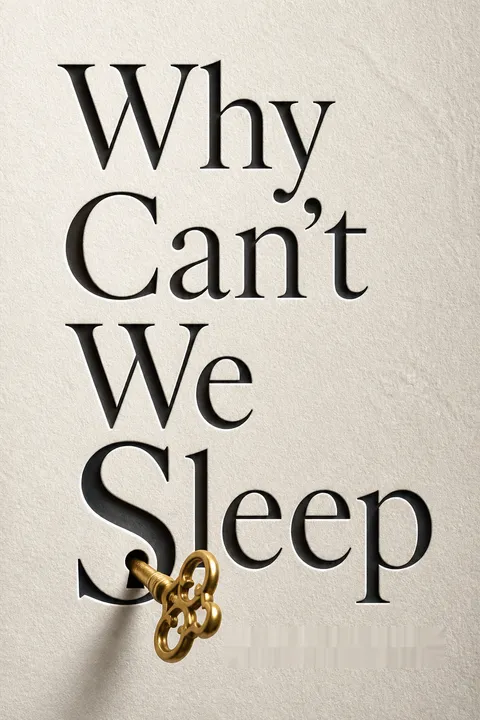
Why Can't We Sleep is less a manual for improving sleep than a challenge to the assumption that sleep is a simple biological function that individuals should optimize. Leader moves across history, sleep research, psychoanalysis, and clinical stories to show how definitions of normal sleep change with work schedules, technology, medicine, and cultural expectations. The book's central achievement is to make sleep both social and personal: an eight-hour norm, a device reading, or a diagnosis cannot fully explain what a particular night means to the person living through it.
The historical account is especially useful because it puts today's anxieties in perspective. Consolidated sleep and continuous productivity are not timeless standards. The discussion of biphasic sleep offers a possibility for interpreting nighttime waking without immediate panic, while carefully acknowledging that historical patterns do not prove a universal natural rhythm. The same caution should apply to the book's broader claims: exposing the commercial interests and limitations of sleep science does not make physiological research irrelevant. Health risks, disorders, and helpful treatments remain real even when the public language around them becomes overconfident or moralizing.
The psychoanalytic chapters offer a different kind of value. They show how an insomnia or dream may be entangled with a person's relationships, memories, and sense of obligation. The clinical stories make that argument vivid, especially when a precise sleep pattern becomes intelligible through a history that measurement alone cannot provide. But interpretation is not the same as proof. A coherent account of a symptom can be illuminating without establishing that it caused the symptom, and the book's interpretive method risks becoming difficult to test when every contradiction can be read as meaningful.
A balanced reading therefore keeps three levels in view: the body's sleep processes, the social conditions that shape time and rest, and the personal meanings people attach to waking and sleeping. None cancels the others. The most practical lesson is not to reject data or advice, but to resist treating them as a complete account of a human night. Persistent sleep difficulties merit care, yet care should include listening to the sleeper, not merely measuring the hours.
Review Summary
Why Can't We Sleep received mixed reviews, with an average rating of 3.16/5. Some readers found it insightful and thought-provoking, appreciating its critique of sleep science and exploration of psychoanalytic theories. Others felt it was rambling, unfocused, and lacked scientific rigor. Many noted the book's heavy emphasis on Freudian concepts and psychoanalysis, which some found interesting while others considered outdated. Readers were divided on whether the book adequately answered its titular question, with several mentioning it was not a typical self-help book for sleep issues.
People Also Read



Glossary
Biphasic sleep
Sleep in two stretchesA pattern in which sleep occurs in two periods, separated by a waking interval. Historian Roger Ekirch found historical references to a first and second sleep, with activities such as talking, praying, or working during the gap. Leader presents this history as a challenge to the idea that uninterrupted sleep is the only normal pattern, while noting that evidence for a universal biological rhythm is disputed.
Circadian rhythms
Roughly daily bodily cyclesRecurring biological patterns that operate on an approximately twenty-four-hour cycle, including sleep and wakefulness. Light, temperature, and social interaction can act as cues that help align these rhythms with the surrounding day. The book examines how researchers study circadian processes and questions whether charts dividing life into work and sleep adequately represent people's varied routines.
Zeitgebers
Cues that set rhythmsExternal signals that help synchronize a person's internal circadian rhythm with the environment. Light, temperature, and social interaction are examples discussed in the book. The term is used in sleep research to describe influences on biological timing, including the effects of night work or travel across time zones. Leader also emphasizes that social relationships can be part of this timing environment.
Dreamwork
Dreams' transforming processIn Freud's theory, the mental process that transforms thoughts and wishes into the often disguised form of a dream. The book describes mechanisms including condensation, where several ideas converge in one element, and displacement, where emotional emphasis shifts elsewhere. The resulting dream is not a literal replay or a universal code; its details are explored through the dreamer's individual associations.
Interpellation
Language that summons a responseLeader uses this term for the way words address or summon a person, often seeming to require a reply or action. Requests, messages, and questions can carry this force. He proposes that falling asleep may involve loosening one's involvement in this demand-like quality of language, while a bedtime story can soothe partly because the listener is not expected to answer it.
Hypnagogic phenomena
Images near sleep onsetBrief images, sounds, words, or phrases experienced while falling asleep. The book describes them as sometimes vivid and seemingly significant, even when their meaning is unclear. Leader considers them a transitional experience between waking and sleep, potentially connected to the shifting relation to language and attention. Their occurrence does not mean that a person is dreaming in the ordinary sense.
Sleep debt
Sleep framed as owed timeA phrase whose meaning has shifted. The book notes an earlier use in which sleep was treated as a cost or penalty for staying awake, and a modern use in which insufficient sleep accumulates as a debt. Leader also explores how the metaphor can carry emotional associations of obligation, guilt, and repayment, particularly in people's accounts of family sacrifice and sleeplessness.
About the Author


Download PDF
Download EPUB
.epub digital book format is ideal for reading ebooks on phones, tablets, and e-readers.








