Key Takeaways
1. Control stems from childhood blueprints
Our nervous systems are wired to seek out any threat to our physical or emotional safety, and when something is unknown or unpredictable it can feel dangerous.
Early coping mechanisms. Our innate desire for control often originates in childhood, shaped by our family dynamics. When faced with unpredictable or inconsistent environments, such as parents struggling with addiction or frequent absence, children instinctively try to "keep it all together" to feel safe. This early blueprint for coping with the unknown can lead to behaviors like striving for perfection or manipulating others, as these actions provide a perceived sense of control over chaotic situations.
Internalized beliefs. As children, we lack the resources to understand complex adult behaviors, so we often internalize inconsistencies as our fault. If a parent is unavailable, we might believe it's due to our imperfections, leading us to try harder to earn their attention. This can create a foundational belief that our worth is tied to our ability to control external circumstances, rather than being inherently valued. The author's own experience of picking unavailable partners mirrored her relationship with her father, highlighting how these early patterns become comfortable, even if unhealthy.
Breaking the cycle. To change these ingrained patterns, we must first identify their origins without blame. Understanding that our "picker" might be calibrated to familiar, even if damaging, dynamics is crucial. By asking ourselves questions like "What types of patterns do you see in your relationships?" or "Do you think love is something that has to be earned?", we can uncover the core beliefs that drive our controlling behaviors. This self-awareness is the first step toward recalibrating our responses and choosing healthier interactions.
2. Perfectionism masks a feeling of "not enough"
In my own efforts toward perfection I inadvertently highlighted all the ways in which I did something wrong.
Earning worth. Perfectionism is a pervasive form of control, often rooted in a deep-seated belief that we are "not enough" and that love or attention must be earned. The author's childhood experience of striving for perfect grades and athletic achievements to gain her father's attention illustrates this. This mindset leads to an endless cycle of pushing oneself, believing that once perfection is achieved, happiness will follow, yet it only reinforces feelings of inadequacy.
Trauma's role. This belief system frequently stems from childhood trauma, even "little-t traumas" like inconsistent love or being punished without reason. When children feel unsafe or unworthy, they try to control themselves—their actions, emotions, or even eating habits—to prevent further harm. This self-blame, born from limited resources, pushes individuals toward perfectionism as a shield against perceived flaws, leading to a constant hustle for validation that never truly satisfies.
Progress, not perfection. Breaking free from perfectionism requires shifting focus from impossible standards to consistent progress. Instead of asking, "Did I do this perfectly?", ask, "Did this move me forward?" This reframing helps interrupt the cycle of self-criticism and allows for learning and growth. It also involves acknowledging the fear of not being enough and practicing self-compassion, understanding that true worth is not contingent on flawless performance.
3. People-pleasing is a manipulative control tactic
People-pleasing behavior is simply another form of manipulation.
Fawning response. People-pleasing, often praised as kindness, is a subtle yet powerful form of control rooted in the "fawning" stress response. This behavior emerges when we believe our safety depends on keeping others happy, leading us to suppress our own needs and emotions to avoid conflict or rejection. The author's realization that her constant "giving" was a way to control relationship dynamics, rather than genuine selflessness, highlights this manipulative aspect.
Boundary erosion. Codependency and enmeshment, common in families with unclear boundaries, further fuel people-pleasing. In codependent relationships, our worth becomes tied to caring for others, while enmeshment blurs the lines between our emotions and others', making us feel responsible for their happiness. This lack of separation prevents healthy independence and self-discovery, as exemplified by Yvette, who felt lost after years of prioritizing others' needs.
Reclaiming self. To break this cycle, establishing healthy boundaries is paramount. This isn't about being mean, but about defining what we will and won't do to protect our well-being. The author's struggle to stop overapologizing or saying "yes" out of obligation demonstrates the difficulty, but also the liberation, of reclaiming personal space. Boundaries are about what we will do to care for ourselves, allowing for authentic connection rather than control-driven interactions.
4. Shrinking ourselves is a response to feeling "too much"
The feeling of being too much is contingent upon there being a correct amount of space that each of us should take up.
Invisible boundaries. The concept of "taking up space" extends beyond the physical to emotional and psychological presence. When we're told we're "too dramatic" or "oversensitive" as children, we learn to control our expression by shrinking ourselves. This belief that there's a "correct" amount of space to occupy, often passed down unconsciously, leads to self-minimization and a fear of being an inconvenience.
Trauma and parentification. This urge to disappear can stem from various experiences, including:
- Empathy: Being told we're "too sensitive" for feeling intensely for others.
- Parentification: Taking on adult emotional roles as children, leading to a belief that our needs are less important.
- Trauma/Neglect: Experiences that make us fear for our safety or feel our needs are unworthy, prompting us to try and disappear.
Ellie's story of restricting food to "be less inconvenient" for her father vividly illustrates this self-erasure.
Reclaiming space. To counteract this, we must challenge the belief that our needs are "too much" and actively make room for ourselves. This involves:
- Parts work: Identifying and integrating hidden or suppressed aspects of our personality.
- Solo time: Spending time alone to discover our true preferences and values.
- Trying new things: Challenging old assumptions and building self-esteem through new experiences.
This journey of self-discovery helps us build an inner home, allowing us to show up authentically without fear of judgment.
5. Toxic empathy leads to self-neglect
When we deeply empathize with others, it can become difficult to leave space for our own pain and suffering.
Empathy's double edge. While empathy is a powerful human connector, it can become "toxic" when overactive, leading to self-neglect and burnout. Highly sensitive individuals (HSPs) are particularly susceptible, as they process stimuli and emotions more deeply, making it hard to distinguish their own feelings from others'. This can result in absorbing others' moods like a sponge, losing control over one's own emotional state.
Boundary breakdown. Toxic empathy often stems from a lack of healthy boundaries, blurring the lines between self and other. We might believe that acknowledging our own pain deprives others, or that our worth is tied to constantly caring for everyone else. This self-denial, disguised as compassion, is a form of self-control that ultimately depletes us and prevents us from receiving the care we need.
Fact-checking emotions. To manage toxic empathy, it's crucial to create space and check the origin of intense emotions. Using cognitive behavioral therapy (CBT) tools, like focusing on facts rather than feelings, helps differentiate between our own emotional experience and what we've absorbed from others. This allows us to respond thoughtfully, set boundaries, and protect our emotional well-being without abandoning our compassionate nature.
6. Numbing out avoids uncomfortable emotions
The endless things we do to not feel uncomfortable.
Escape mechanisms. Numbing out and disconnecting are common control tactics used to avoid uncomfortable emotions like stress, loneliness, or anxiety. These escapes manifest in various forms, from seemingly benign activities like endless social media scrolling or binge-watching, to more destructive behaviors such as overfunctioning, compulsive shopping, substance abuse, or self-injury. Each offers a temporary reprieve, but ultimately prevents genuine emotional processing.
Biological wiring. Our brains are wired for survival, and these numbing behaviors provide immediate, albeit fleeting, relief by releasing pleasure hormones like dopamine or offering a mental escape (dissociation). This short-term comfort reinforces the cycle, making it difficult to break free even when the long-term consequences—debt, dependency, physical symptoms, or emotional disconnection—become apparent.
Reconnecting with feelings. To break this cycle, we must learn to "get better at feeling" rather than just "feeling better." This involves:
- Identifying numb-outs: Recognizing when we're using a behavior to avoid emotions.
- Naming emotions: Learning to identify what we're truly feeling, even if it's uncomfortable.
- The 90-second rule: Understanding that the physiological surge of an emotion lasts only 90 seconds, and sustained emotion is due to replaying the trigger.
This process helps us acknowledge emotions as messengers, guiding us toward necessary action rather than suppressing them.
7. Anger is a protective emotion, often mismanaged
Anger is often misunderstood and dismissed as a destructive force that should be avoided or suppressed at all costs.
Anger's true purpose. Anger, often perceived as a destructive emotion, is fundamentally a protective one. It acts as an internal alarm system, signaling when boundaries are crossed, disrespect occurs, or our well-being is threatened. Unlike fear or sadness, anger empowers us, providing energy and focus to defend ourselves or correct injustices. The author's childhood aversion to conflict, stemming from a lack of exposure to healthy disagreement, led her to suppress anger, making it feel wild and uncontrollable.
Misdirected expression. When anger is suppressed, it doesn't disappear; it can manifest in unhealthy ways, such as:
- Internalized anger: Self-criticism, rumination, withdrawal, or self-harm (as shared by a community member).
- Displacement: Taking out frustration on safer targets, like a spouse instead of a boss.
- Passive-aggression: Indirectly expressing anger through sulking, sarcasm, or the silent treatment.
These methods, while offering a perceived sense of control, prevent genuine resolution and can damage relationships.
Healthy assertion. The key is to distinguish between impulsive anger and constructive assertion. Assertion involves channeling anger's message into clear, respectful communication to address the issue. This requires taking a break between trigger and response, using "I statements" to express feelings without blame, and sometimes practicing "opposite action" (e.g., hugging after an argument instead of retreating). Building resilience through self-care (HALT: Hungry, Angry, Lonely, Tired) also helps manage strong emotions constructively.
8. Defense mechanisms push people away
Kati, you’re a puffer fish. You’re soft and sensitive on the inside, but whenever someone gets too close, you stick out your spines to protect yourself and keep them at a distance.
Puffer fishing. Our instinct to protect ourselves from emotional pain often leads to defense mechanisms that push people away. The author's therapist coined the term "puffer fishing" to describe her tendency to inflate defenses—like toxic independence or defensiveness to criticism—when vulnerability felt too risky. This behavior, while intended to shield, ultimately creates barriers to genuine connection and personal growth.
Common defenses. Defense mechanisms are unconscious strategies our minds use to cope with emotional discomfort. They include:
- Intellectualization: Removing emotion from an experience.
- Rationalization: Explaining away hurtful situations.
- Repression/Denial: Pushing away or refusing to acknowledge uncomfortable truths.
- Regression: Reverting to childish behaviors under stress.
- Displacement/Projection: Misdirecting emotions or qualities onto others.
- Passive-aggression/Acting Out: Indirectly expressing feelings.
- Humor: Joking to deflect from seriousness.
- Dissociation: Detaching from reality during intense situations.
- Distortion: Changing facts to avoid discomfort.
- Reaction Formation: Acting the opposite of how one truly feels.
- Sublimation: Channeling unwanted feelings into socially acceptable outlets.
These mechanisms, though protective, prevent us from being truly known and understood.
Lowering the guard. To foster deeper connections, we must acknowledge and thank these "protector parts" for their role, then gently encourage them to stand down. This involves recognizing when we're being defensive and exploring the underlying fears. The author's breakthrough came from choosing vulnerability over passive-aggression with her husband, realizing that honesty strengthened their bond. Being seen, heard, and understood requires the courage to let go of control and embrace authenticity, even if it means risking rejection.
9. The need to fit in betrays our authentic self
So much of my teenage years were spent trying to fit in with the “cool” group, focusing on controlling and hiding anything about myself that didn’t match what I thought was acceptable.
Biological imperative. The deep-seated human need to fit in and belong is a biological imperative, rooted in our evolutionary past where group acceptance meant survival. This primal drive makes rejection or exclusion feel profoundly threatening, leading us to control our quirks and hide our unique interests to avoid standing out. The author's childhood desire for specific jeans or a padded bra, and her friend Jared's "poser" experience, illustrate this early conditioning.
Losing ourselves. This constant effort to conform leads to a betrayal of our authentic selves. We prioritize others' expectations over our own desires, gradually losing touch with our inner compass and identity. Terry's struggle to answer "What makes me happy?" after years of adapting to others' preferences highlights this profound disconnection. This inauthentic living can lead to shallow relationships and a hollow sense of belonging, as we are liked for a crafted persona, not our true self.
Reclaiming authenticity. To find genuine belonging, we must first reconnect with who we truly are. This involves:
- Solo dates: Spending intentional time alone to discover personal interests and preferences.
- Value identification: Clarifying our core values, distinguishing them from societal or imposed beliefs.
- Courageous choices: Prioritizing our values and authentic self, even if it means letting go of relationships that don't align.
This journey, though challenging, builds an inner home, allowing us to attract connections based on mutual respect and genuine understanding, rather than superficial conformity.
10. Feeling stuck and depressed resists change
Change is hard. We all know that on some level, yet when we set out to improve ourselves and our lives, we somehow expect it to be linear, smooth, and logical.
The inertia of familiarity. Feeling stuck, often accompanied by depression, is a powerful resistance to change. Our brains are wired for familiarity, even if it's unhealthy, because the unknown feels riskier. This inertia makes it incredibly difficult to break ingrained habits and emotional triggers, leading to a frustrating push-pull between our current state and desired future. The analogy of "wellies stuck in the mud" perfectly captures how protective, yet limiting, old behaviors can be.
Internal battle. The process of change is an internal battle against deeply set neural pathways and long-held beliefs about ourselves. This constant effort is exhausting, leading to feelings of stagnation, hopelessness, and questioning if the effort is even worth it. A community member's struggle to make progress despite trying all therapeutic tools highlights the slow, non-linear nature of healing, where the desire for growth can feel like a burden.
Fear of loss. A significant barrier to change is the fear of losing loved ones or an old identity. As we evolve, not everyone will stay on the journey, and relationships may shift or end. This fear can paralyze us, making us cling to familiar patterns, even if they're damaging. However, depressive thoughts can also serve as a catalyst, highlighting the unbearable discomfort of the present and motivating us to seek change, even if the "want" for a better future isn't fully formed yet.
11. Letting go is not giving up, but trusting
Maybe letting go doesn’t have to be a process of detachment, where we pull away from things that matter to us.
Redefining surrender. For many, "letting go" feels synonymous with "giving up," implying a loss of control and a lack of care. This perception, often reinforced by a fear of vulnerability, leads us to cling to situations or outcomes, even when we have no power over them. The author's "octopus" analogy perfectly illustrates this: pretending to let go while still maintaining a subtle, controlling grip, leading to internal chaos and anxiety.
Courageous trust. True letting go is not about detachment, but about releasing the need to control outcomes. It's an act of courage and self-trust, allowing life to unfold without constant micromanagement. This shift in perspective means we can care deeply about our dreams and relationships without being chained to specific results. It's about trusting our resilience and capacity to adapt, even if the path is uncertain.
Building self-trust. This process is imperfect and requires consistent practice. It involves:
- Self-compassion: Accepting that change is messy and non-linear, and forgiving slip-ups.
- Intentional alone time: Journaling and walking to connect with inner thoughts and feelings.
- Listening to intuition: Recognizing and acting on small internal signals that guide us.
By building a strong foundation of self-trust, we become less reliant on external control for safety, finding inner stability that allows for genuine growth and peace, even amidst life's uncertainties.
Last updated:
Review Summary
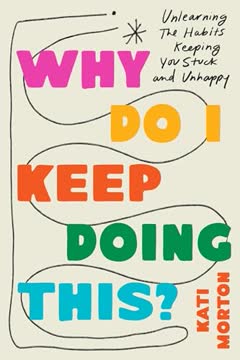
Why Do I Keep Doing This? receives mostly positive reviews (3.68/5 average), with readers praising its accessible, compassionate tone and practical exercises. Reviewers appreciate the focus on understanding patterns like people-pleasing, perfectionism, and control through childhood trauma and family dynamics. The "control challenges" and reflection questions are highlighted as valuable tools. Some readers note the content can be emotionally heavy and requires proper timing. A few criticize it for being vague or unmemorable. Most agree it offers relatable insights and works well as a self-help workbook, whether used independently or alongside therapy.