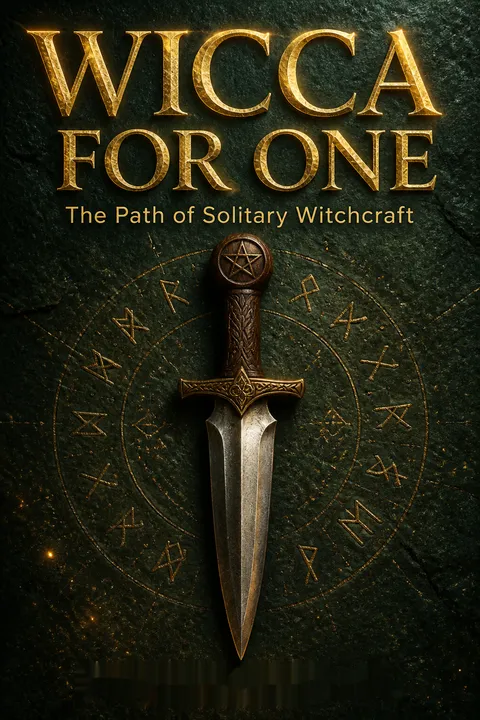


Key Takeaways
Practice Wicca alone without treating solitude as a waiting room
Solitude is a complete path. Buckland argues that a Witch need not join a coven to practice authentically. He presents solitary practitioners as older than covens, and points to historical figures who worked alone, including English Cunning Men, local healers and diviners who served their communities. His account also traces modern Wicca’s public revival through Gerald Gardner: after Britain repealed its Witchcraft laws in 1951, Gardner published Witchcraft Today in 1954, helping bring a formerly secret practice into public view.
Origins need careful reading. Margaret Murray’s early twentieth-century theory that medieval Witchcraft was an organized pagan religion helped popularize the idea of covens, but her evidence for fixed groups of thirteen was disputed. Buckland’s larger point is that historical arguments about origins need not decide whether a solitary person can build a meaningful practice.
What's striking is the book's defense of religious autonomy against a membership model: a practitioner need not be validated by an institution to cultivate devotion and discipline. This resembles forms of private prayer and home worship across many traditions. The historical case, however, is less secure than the practical one. Trial records were created by prosecutors, often under coercion, so they cannot straightforwardly prove an unbroken solitary tradition. The strongest argument is therefore not that every historical claim is settled, but that contemporary solitary practice does not require a coven's permission.
Make worship, not spell-casting, the center of a Wiccan life
Religion comes first. Buckland distinguishes Witchcraft from magic: magic is a practice that people of many beliefs, or none, may attempt, while Wicca is a religion centered on relationship with the God and Goddess. Practitioners may use different names for the deities, and may understand them as two beings or as expressions of a larger divine reality. The point is personal connection, not a required clergy or fixed naming system.
Reverence has consequences. The book ties worship to honoring the earth, its creatures, and its seasonal cycles. It recommends practical expressions of that commitment, such as reducing waste, picking up litter, and making space for local wildlife. Prayer and gratitude are not extras for special occasions. They are part of a lived religious path, alongside any ritual or spellwork.
This framing gives spiritual practice a moral and ecological center rather than making it a collection of techniques for getting things. Environmental ethics also become more durable when they are woven into identity and ritual, not left as abstract advice. The book's language of masculine and feminine divinity may resonate with some practitioners, but it should not be treated as a universal account of gender or nature. Its more transferable insight is that devotion becomes concrete through care for the world one claims to hold sacred.
Build sacred space from attention, not expensive equipment
Tools support intention. An athamé is a ritual knife, while a wand can serve a similar role; Buckland considers either optional, and even describes working without physical tools. Making or adapting an object can help a practitioner invest attention in it. Consecration, in his usage, means ritually cleansing an object and dedicating it to a purpose, often with salted water, incense, and focused thought.
Space can be improvised. A temple is simply the place set aside for ritual. A circle might be marked in an outdoor clearing, a room, or a small area beside a bed. The altar can be a table, a chest, or a flat stone. A Book of Shadows is a practitioner's personal record of rituals, prayers, observations, and study. Buckland favors handwriting it as a way to make the work personal and deliberate.
The practical wisdom here is a low barrier to entry: ritual does not depend on a specialized shop, a large home, or an approved aesthetic. In cognitive science, repeated environmental cues can help people shift attention and enter a chosen mental mode, which helps explain why a familiar altar or ritual object can feel potent without requiring supernatural claims. The book's emphasis on handmade tools is best understood as a discipline of attention, not a measure of spiritual worth. A cardboard box can serve; expensive equipment cannot substitute for purpose.
Let lunar and seasonal rites give spiritual practice a rhythm
A year becomes a ritual calendar. Buckland recommends an Esbat, a regular ritual gathering or solitary observance, at least monthly, commonly around the full moon. Sabbats are the eight seasonal celebrations: Samhain, Yule, Imbolc, Ostara, Beltane, Litha, Lughnasadh, and Mabon. Together they mark changing light, planting and harvest, and the movement between growth and dormancy.
Ritual gives the changes shape. At Samhain, practitioners may remember the dead and reflect on what they want to leave behind. At Ostara, planting seeds can represent plans they hope to nurture. The book also describes rites of passage: Wiccaning welcomes a child into a family's religious life without deciding the child's future beliefs; Handfasting marks a union; Handparting formalizes a separation; and Crossing Over honors someone who has died.
Seasonal observances translate broad ideas such as change, grief, and renewal into repeatable actions. Anthropology describes rituals as ways communities mark transitions and give shared meaning to otherwise ordinary events; solitary practice can use the same structure in private. The calendar also provides a useful counterweight to the fantasy of constant productivity: harvest, rest, and loss all belong to the cycle. These observances need not be synchronized perfectly with a particular climate or agricultural tradition. Their value lies in making local change noticeable and meaningful.
Test every spell against consent, consequences, and ordinary effort
Ethics begin with agency. Buckland treats the Wiccan Rede as a guiding principle: act freely, but do not cause harm, including harm to yourself. A spell intended to make a particular person fall in love may violate that person's freedom, even if the practitioner experiences it as harmless. His alternative is to focus on qualities desired in a relationship rather than trying to control a named person.
Magic does not replace action. The book advises doing practical work first and turning to magic only when there is a real need. It also says the person most affected is usually best placed to direct the work, because their knowledge and urgency are greatest. A solitary practitioner lacks a coven's immediate feedback, so must pause to consider who may be affected, what could go wrong, and whether the action is genuinely ethical.
The insistence on consent is a strikingly modern strength in a genre that can romanticize influence over others. It aligns with a basic distinction in moral philosophy: wanting a result does not grant authority over another person's choices. The suggestion to check ordinary routes first also resembles problem-solving methods that separate controllable actions from hoped-for outcomes. The Rede's broad wording still leaves hard cases unresolved, especially when a person's interests conflict with another's. That uncertainty makes reflection and consent more useful than treating any single rule as a complete moral algorithm.
Treat magical symbols as focus tools, not guaranteed controls
Symbols organize intention. Buckland describes magic as directing energy through focused will. In sympathetic magic, an object represents a person, quality, or desired outcome. For example, candles might stand for a practitioner and a quality they hope to cultivate; bringing the candles together can give the intention a visible form. A poppet is a figure representing a person, while a placket is a small pocket that can hold a photograph or other personal link.
Preparation matters in the system. The practitioner clarifies the goal, chooses symbols, and uses concentration, chanting, movement, or timing to build emotional intensity around it. Buckland recommends imagining the desired outcome as complete rather than merely wishing for it. He also cautions that spells can fail, and suggests examining the method, adjusting it, or accepting that the outcome may not be available.
Ritual symbols can make a vague wish more concrete, much as visualization and rehearsal help people organize goals and sustain attention. That psychological usefulness does not establish that a candle or figure can directly alter external events. The distinction matters because the book sometimes presents magical energy as fact while also acknowledging uncertainty. A reader can preserve the reflective value of the practice without promising results. When an outcome depends on other people, institutions, or health conditions, symbolic work should complement practical action rather than displace it.
Use divination for reflection, and healing with consent and care
Divination invites interpretation. Buckland describes methods such as gazing into a reflective surface, casting runes, reading cards, and using a pendulum. He recommends recording what appears and considering its possible meanings, much as someone might examine a dream. He cautions against treating a reading as fixed fate: it offers an indication, not an unchangeable script.
Healing requires boundaries. The book discusses hands-on, color-based, and distant healing, but stresses that a person should agree to receive it. It also notes that illness may involve circumstances the practitioner does not understand and explicitly says its healing material is not medical advice. Herbal knowledge demands similar caution: some plants can be poisonous or harmful when used incorrectly. Professional medical care should not be abandoned in favor of ritual.
A non-deterministic approach to divination can make it a structured prompt for noticing assumptions and possible choices, rather than a forecast that dictates behavior. That distinction helps reduce the risk of self-fulfilling predictions. The same boundary is especially important in healing: consent respects autonomy, and evidence-based medical care addresses risks that ritual practice cannot reliably assess. The book's cautions are valuable, though its claims about energy and color therapy are not established by the descriptions it provides. Spiritual support can matter without being presented as a proven treatment.
Let solitary practice evolve while keeping its ethical center
Personal practice can adapt. Buckland encourages solitary practitioners to choose deity names, tools, ritual settings, and forms of celebration that feel meaningful to them. He presents self-dedication as a private rite of entry into the Craft, rather than requiring a coven's initiation. The ritual marks a commitment, but the book makes clear that a person remains free to change direction or leave.
Learning remains part of the path. The Book of Shadows can collect rituals, prayers, and observations, while ongoing reading and practice help the practitioner decide what fits. Buckland favors learning by doing, not simply copying instructions. His advice is to avoid boasting, respect other beliefs, and keep the practice private when necessary. Independence is not a license to stop questioning; it increases the responsibility to examine one's own choices.
A tradition can remain coherent without demanding that every practitioner reproduce one exact ritual. The key is to distinguish adaptable forms from commitments that give the practice ethical continuity. This resembles reflective practice in professions: people record experience, review outcomes, and revise methods while remaining accountable to shared standards. The solitary setting offers freedom, but it can also remove corrective feedback. A journal, careful study, and trusted conversation with others can help prevent personal preference from becoming unquestioned certainty.
Analysis
Wicca for One is both an argument for solitary religious legitimacy and a practical manual. Its structure moves from historical defense to beliefs, ritual design, magical methods, ethics, and continued development. That progression matters: Buckland does not present solitary Witchcraft merely as a temporary workaround for people who cannot find a coven. He treats it as a complete spiritual life, with worship, study, seasonal observance, and ethical responsibility.
The book's most durable contribution is its insistence that access to religious practice need not depend on institutional permission or costly materials. A small altar, a chosen prayer, a monthly observance, and a personal record can make a meaningful practice. Its emphasis on agency also offers a useful boundary: magical work should not be used to override another person's will, and practitioners should consider ordinary solutions before turning to spells.
The historical narrative needs more caution than the practical advice. Buckland presents solitary practitioners as the oldest form of Witchcraft and interprets modern Wicca through a survival-and-revival story. Yet the source record for early Witchcraft is difficult: trial testimony was produced by hostile authorities, and Margaret Murray's theory of a unified, ancient coven religion has been widely challenged. Gardner's role in publicizing modern Wicca is important, but public revival is not proof of uninterrupted ancient continuity. The distinction does not weaken the case for solitary practice. It separates a modern religious choice from claims of historical certainty.
The book also treats magical energies, divination, and healing as real mechanisms without supplying evidence that establishes those claims. Readers can still value ritual as a way to direct attention, express grief, rehearse intentions, and strengthen a sense of connection, while judging supernatural claims separately. The most balanced reading keeps Buckland's humane advice about autonomy, care, and practice, but applies modern standards of evidence to claims about health and external effects.
Review Summary
Wicca For One by Raymond Buckland receives generally positive reviews, with an average rating of 4.07 out of 5. Readers appreciate its comprehensive overview of Wiccan practices for solitary practitioners, praising Buckland's writing style and the book's usefulness as a beginner's guide. Some criticize its organization and depth, while others note contradictions and a biased tone against non-Wiccan paths. Despite these criticisms, many find it a valuable resource for those new to Wicca, offering practical information on rituals, tools, and beliefs.
People Also Read
Glossary
Solitary
Witch practicing aloneA Witch who conducts religious and magical practice without belonging to a coven. In Buckland's account, solitary practice is a complete path, not simply preparation for group membership. A Solitary may choose personal rituals, names for deity, tools, and sacred space, while remaining responsible for study and ethical judgment.
Esbat
Regular Witch observanceA Wiccan ritual observance distinct from the annual seasonal festivals called Sabbats. Buckland recommends that Solitaries hold an Esbat at least once a month, often near the full moon. It can include worship, prayer, thanksgiving, divination, healing, or magical work.
Sabbat
Seasonal Wiccan festivalOne of eight annual celebrations marking seasonal and agricultural change in the Wiccan year. The festivals named in the book are Samhain, Yule, Imbolc, Ostara, Beltane, Litha, Lughnasadh, and Mabon. Their observances emphasize the turning year, nature, and themes such as harvest, renewal, and remembrance.
Book of Shadows
Personal Craft recordA Witch's record of rituals, prayers, spells, recipes, and observations connected with the Craft. Buckland describes it as traditionally handwritten, so the practitioner invests attention in the material rather than simply copying it mechanically. For a Solitary, it can also serve as a notebook for study and personal practice.
Cone of Power
Ritual space of energyBuckland's term for the protective, energy-filled space envisioned around a consecrated circle. He describes it as a globe or egg surrounding the practitioner and altar, separating sacred ritual from ordinary surroundings. The circle's visible boundary is only its base; the full space is imagined as extending above and below it.
Wiccan Rede
Principle against causing harmThe ethical principle Buckland presents as Wicca's central rule: a person may act freely so long as the action harms no one, including the person acting. He uses it to guide magical decisions, especially where a spell might interfere with someone else's choices. The principle requires judgment because harm can be difficult to predict.
Sympathetic magic
Representation-based magicA form of magic in which an object represents a person, quality, or desired outcome, and ritual actions involving the object symbolically affect what it represents. Buckland's examples include candles and figures. Such methods depend on the practitioner's focused intention and are presented in the book as one way of directing magical power.
Poppet
Figure representing a personA small figure made from cloth, wax, clay, or another material to represent a person in sympathetic magic. It may be marked with identifying details or filled with materials related to the ritual's purpose. Buckland presents poppets as tools for positive magical work, including healing, and says that healing work requires the person's permission.
Placket
Ritual pocket for a linkA small cloth pocket used in magical work to hold a photograph, writing, or other object connected to a person. The pocket's color may correspond to the purpose of the ritual, such as healing or love. Buckland describes the contained item as a way to focus the practitioner's attention on the person represented.
Self-dedication
Personal rite of commitmentA solitary ritual of entry into Wicca that functions as an initiation without requiring a coven. In Buckland's instructions, the practitioner dedicates themselves to the deities and the Craft, adopts a chosen Witch name if desired, and commits to the religion's ethical principle. The rite does not require rejecting a previous faith.
Download PDF
Download EPUB
.epub digital book format is ideal for reading ebooks on phones, tablets, and e-readers.








