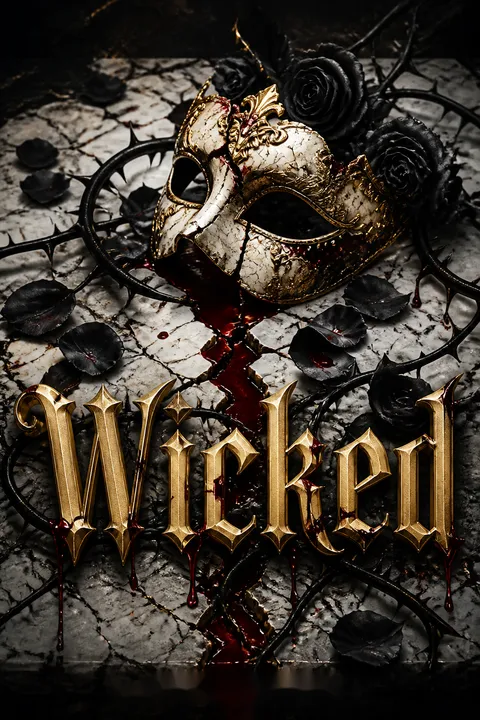


Plot Summary
Prologue
At her wedding, Ruby La Rosa is already watching Wicked across the room. He slips outside with her, tears the garter from her wedding dress, and makes their old bond impossible to mistake for a memory.
Then gunshots crack through the reception. Wicked treats the shooting as his wedding gift, leaving the reader with two questions: what has he done, and what kind of marriage can survive the truth between them?
The opening turns a wedding into a hostage scene before its danger is explained. Ruby appears to be choosing a public future while Wicked claims a private, violent intimacy with her; the gunshots make both claims unstable. The scene is not a promise of uncomplicated romantic fulfillment. It establishes the book’s central conflict between desire and ownership, then withholds the political and personal history that makes the pair’s reunion dangerous. By beginning at the apparent climax, the novel asks readers to judge Wicked’s actions before they know what he believes he is protecting.
Blood on the Carpet
At seventeen, Wicked hears his parents fighting and leaves his sister, Poppy, upstairs while he goes down with a stolen pistol. He finds his mother dead and his father, Jared, still in the room. When Jared threatens to make Poppy the next target, Wicked shoots him.
Police arrive, but Victor La Rosa, a powerful Chicago crime boss, takes the siblings away instead of letting Wicked be arrested or Poppy enter care. At Victor’s mansion, they meet his daughter Ruby, also seventeen. Victor offers them safety and a clean slate if Wicked works for him, while warning him to stay away from Ruby. Wicked accepts because keeping Poppy safe matters more than understanding the bargain.
Wicked’s first defining act is both protective and morally irreversible. He kills Jared not to claim power but to prevent the threat from reaching Poppy, and that distinction becomes the measure he uses to justify later violence. Victor’s rescue complicates the idea of freedom: the siblings escape an abusive home only by entering a household ruled by another man’s authority. Ruby’s introduction arrives inside that transaction, so attraction and danger are linked from the start. Wicked is offered belonging, but the offer comes with a warning about the one person who will eventually matter most to him.
The La Rosa House
Ruby tries to make the new arrivals feel welcome, bringing Poppy clothes and inviting her to a high-school party with Betty, Ruby’s outspoken best friend. Ruby assumes Poppy is close to her own age, then learns at the party that she is only fourteen. She takes Poppy home when the younger girl becomes drunk.
Wicked arrives on his motorcycle, furious that Ruby brought his sister out without asking him, and insists Ruby bring questions about their past to him rather than Poppy. His protectiveness irritates Ruby, but their charged exchanges leave her curious about the boy behind his guarded manner. At home, Wicked hints that he and Ruby may have known each other before, though neither explains what that could mean.
Ruby’s invitation gives Poppy a brief opening into ordinary adolescence, but the age mistake shows how little Ruby knows about the siblings’ history. Wicked’s anger is not merely possessiveness; it reflects a life in which protecting Poppy has become his only reliable form of control. Ruby, meanwhile, is accustomed to bodyguards and her father’s rules, yet she resists being managed by Wicked. Their attraction begins as a contest over who gets to define safety. The party makes the difference between Ruby’s guarded privilege and Poppy’s unprocessed grief visible without turning either girl into a simple symbol.
A Kiss, Then Silence
After Ruby and Wicked trade teasing threats in the garage, their attraction becomes physical. Ruby is inexperienced, while Wicked’s roughness and attention make their first encounter feel like a new language neither is willing to translate into commitment. He cares for her afterward, but soon accepts Victor’s invitation into the family’s hidden criminal world.
Victor takes him to an old church and warns that the initiation will change what he knows and what he can safely reveal. Wicked enters. Ruby is left with no explanation when he disappears for two weeks, and she fears her father’s influence has altered him beyond recognition. The intimacy that had briefly made them feel equal becomes another secret Ruby cannot discuss with anyone.
Their first sexual encounter creates intimacy without trust, a distinction the novel keeps testing. Ruby experiences Wicked as someone who can see past her polished role, while Wicked treats the moment as something he can compartmentalize before accepting a place in Victor’s organization. His disappearance makes that imbalance concrete: he knows what is happening, and Ruby is left to interpret his silence. The church initiation marks a threshold from private violence into institutional violence. The romance is therefore not an escape from the criminal world. It is one of the ways that world begins to reach into Ruby’s body and choices.
The Dragon's Return
Wicked returns from his initiation colder and more commanding, and Victor assigns him to stay beside Ruby at a charity gala. Ruby has been expected to marry Revio, a match meant to serve her family’s alliances, but Wicked’s presence disrupts that plan. At the gala, Ruby slips away with her cousin Giovi to a party at the La Rosa lake house, bringing Poppy along.
Wicked follows after discovering that the gathering includes unfamiliar adults and that Poppy has vanished. A message from an unknown number confirms that she has been taken and demands Ruby as part of a bargain. Wicked lies to Ruby that Poppy wants them to return to the party, then drives her away from Chicago toward the Institution that shaped his childhood.
Wicked’s return changes the romance from mutual provocation into enforced proximity. He now carries institutional authority, yet Ruby is still treated as a family asset whose marriage can be arranged for political convenience. Poppy’s disappearance turns that intimate conflict into a crisis, exposing the cost of Ruby’s incomplete knowledge of the world around her. Wicked’s lie is protective in intention but still removes Ruby’s ability to choose with full information. The drive away from Chicago is the point where the story’s domestic and mafia plots give way to the Institution’s older, more concealed system of control.
The Hedge Maze
Wicked takes Ruby to the Institution, an isolated compound governed by Skully, the masked authority who trained him and used Poppy as leverage. Ruby is drugged, placed in a hedge maze, and subjected to sexual violence while Wicked tells her that obedience is the price of seeing her father again. When a siren signals a death inside the compound, Wicked admits Poppy may be in danger and urges Ruby to run.
They reach the village too late to prevent Poppy’s apparent execution by men loyal to K Diamond, Skully’s powerful associate. Ruby tries to help Wicked fight back, but both are captured. In the aftermath, Wicked arranges for Ruby to be sent away with an envelope for Victor, while he remains behind.
The Institution makes explicit what the earlier family settings obscured: care and coercion can be performed by the same person. Wicked has been trained to obey a system that harms him and Poppy, but his role in Ruby’s abuse makes protection impossible to separate from complicity. The narrative’s treatment of sexual violence is a rupture, not a romantic test, and Ruby’s resistance does not make the violation less real. Poppy’s apparent death destroys Wicked’s central reason for enduring the Institution. The envelope becomes a small, dangerous form of communication across the separation that follows.
The Glass Den
Ruby is returned to the outside world with Wicked’s sealed message, while K Diamond confines Wicked in a transparent pod and later adds three kidnapped men, Royce, Storm, and Orson. He forces them to perform violent tasks and threatens the people they love if they refuse. Wicked has largely stopped trying to escape when a hooded figure appears at the food hatch: Poppy, alive, tells him she needs help.
K Diamond then says she is dead, keeping Wicked uncertain and trapped. After further ordeals, Wicked is finally released and meets Royce outside the compound. The two men form a bond that will take them into the Wolf Pack MC, while Wicked carries the unresolved loss of Poppy and Ruby into a new life.
The glass pod turns surveillance into architecture: Wicked can see the world around him but cannot reach it. K Diamond’s shifting claims about Poppy manipulate hope as efficiently as hunger and threats do. Wicked’s refusal to escape is not simply despair; it reflects the collapse of the purpose that once organized his survival. Yet the brief sight of Poppy interrupts that collapse and gives him a reason to keep attending to the world. Royce’s arrival begins a different kind of kinship, one based on shared captivity rather than blood or command.
A Son in Chicago
Time passes. Ruby gives birth to Wolf, Wicked’s son, and after Victor is reported dead she takes over the La Rosa organization. She keeps Wolf out of the criminal life as much as she can, while Wicked is freed and builds a place for himself beside Royce in the Wolf Pack MC. Poppy eventually reappears with Jade, a survivor who helps rescue people from trafficking and abuse.
Wicked returns to Chicago with Poppy and his MC brothers. Ruby, now a powerful but lonely young capo, sees him again at the clubhouse. Their reunion is interrupted by the truth that Wolf is his child. Wicked is furious that Ruby kept the boy from him, but he recognizes that both parents now have to protect him.
The time jump gives Ruby and Wicked parallel adaptations to loss. Ruby converts grief into authority, raising Wolf while carrying responsibilities she did not choose freely. Wicked converts captivity into a chosen brotherhood, though his MC life remains haunted by the Institution. Their reunion does not restore the past; it introduces a child who makes their history consequential beyond the couple. Ruby’s concealment is an act of protection and a breach of trust at once. Wicked’s anger is understandable, but his claim to fatherhood must now be negotiated rather than assumed.
The House Goes Dark
As Ruby and Wicked begin co-parenting, Ruby is still expected to marry Mikhail Volkov to secure peace between their families. Before the wedding, an attack at Ruby’s home leaves her mother Pearl missing and the house soaked with blood. Victor tells Ruby to stay away from the scene, warning that a wider conflict is beginning.
Ruby grieves as though Pearl has been killed, while Wicked helps care for Wolf and stays close to her. The crisis also sharpens Ruby’s suspicion that the adults around her are withholding the truth. Soon afterward, while Ruby is alone in a parking garage, Skully’s men abduct her. He claims Wicked has been working with him all along, and Ruby is drugged before she can determine what is true.
Pearl’s disappearance strips Ruby of the maternal refuge she has long taken for granted, while the blood at the house makes private grief look like a political warning. Victor’s insistence that Ruby remain uninvolved repeats the paternal control she has spent her life resisting. The abduction exploits precisely that fracture: Skully makes Wicked’s secrecy sound like proof of betrayal. Ruby cannot verify the claim while drugged, so her fear grows inside an information vacuum. The sequence links family violence with political violence, showing how those closest to Ruby can use her need for protection to control what she knows.
The Wedding Bargain
Wicked finds Ruby within hours and gets her out of Skully’s hands, but the truth remains unsettled until the wedding. At the reception, Ruby and Wicked meet outside, and shots ring through the building. Inside, bodies from the Cosa Nostra and the Bratva lie across the room. Mikhail reveals that his marriage agreement with Ruby was never meant to be binding; he and Wicked have been working toward a deal that will remove Victor and expose Skully’s designs.
A recording shows Victor arranging Ruby’s access to Skully while she was a child, treating her as an object of experimentation. Wicked explains that Skully placed him in Ruby’s life to bring her back to the Institution. Ruby refuses to kill Wicked and asks that Skully be dealt with.
The wedding gathers the book’s major systems of exchange into one room: marriage, mafia alliance, family loyalty, and the use of children as leverage. The recording is devastating because it does not merely reveal a villain’s scheme; it revises the meaning of Ruby’s childhood home and Victor’s protection. Mikhail’s false marriage agreement gives Ruby a measure of choice, though the arrangement still centers decisions made by powerful men. Wicked’s confession recasts his long silence as part of a mission, not as innocence. Ruby’s refusal to kill him is not absolution. It is a decision to pursue the truth without surrendering her own judgment.
The Twin's Price
Skully abducts Ruby again and brings her to the Institution, where he reveals that she has a twin sister hidden from her. He wants Ruby because her body may be a match for his failing health, and he intends to use her rather than let her leave. Wicked arrives and offers himself in exchange for Ruby, then presents the twin as another possible match.
Skully orders Ruby assaulted while Wicked is forced to watch, but Wicked has already arranged a counterattack with his allies. The rescue brings Pearl back alive, along with Ruby’s sister, and exposes the extent of the family’s concealed history. Wicked then takes Skully to the Wolf Pack’s barn and kills him, ending the authority that shaped his and Poppy’s childhoods.
Skully’s medical motive turns the body into both family inheritance and contested property. His demand for Ruby echoes the earlier bargain made over her childhood, while the revelation of a twin shows how thoroughly adults have concealed the women’s histories from them. Wicked’s offer to take Ruby’s place marks a change from obedience to chosen sacrifice, though it cannot erase the harm he previously caused her. The rescue also returns Pearl and the twin to the family story, where they can speak and act rather than remain hidden. Skully’s death ends his immediate power, not the damage his system has left behind.
A Family Reassembled
After Skully’s death, Ruby returns to the La Rosa home and meets her relatives, who expect her to take the family leadership Victor left behind. She accepts the obligation, though she resents the cost of inheriting a life chosen for her.
She and Wicked rebuild their relationship while raising Wolf between the mansion and the Wolf Pack clubhouse. Wicked becomes the club’s leader, and Ruby learns that its women and children have created a kind of home unlike the cold, controlled household she once knew.
They negotiate co-parenting and intimacy on their own terms, even as Ruby’s criminal responsibilities continue. The family gathers at Christmas with Pearl, Poppy, the twin, Betty, and the MC, offering Ruby a home enlarged by choice rather than blood alone.
The ending does not make Ruby’s inherited power disappear; it changes the terms on which she carries it. She accepts leadership because refusing would expose her family, not because the role has become a dream fulfilled. The Wolf Pack clubhouse offers a contrast to Victor’s mansion: its care is imperfect and communal, and its members make belonging through repeated acts rather than polished appearances. Wicked’s place as father and partner remains shaped by past coercion, so reconciliation requires more than chemistry. The Christmas gathering offers a provisional repair, not a clean slate. Ruby’s life is still dangerous, but she has more people beside her and more say in what family means.
Epilogue
At Christmas, Ruby’s relatives and the Wolf Pack gather around Wolf, while Pearl and Ruby’s newly discovered sister join the household. The celebration is warm, but Ruby’s criminal obligations remain active. In a separate Christmas Eve meeting, Mikhail tells her that a long-delayed contract requires her to kill Meraki twenty years in the future.
The hit had been assigned to Val, but Ruby takes responsibility for it to keep the target from being killed without warning. She hides the decision from Wicked, leaving their hard-won domestic peace shadowed by a debt she has chosen to carry.
The final note refuses to treat family reunion as an escape from inherited violence. Ruby has gained a partner, a child, and a wider circle of care, yet she accepts a future killing contract to protect someone else from Val’s impersonal execution of it. That decision resembles the sacrifices that once defined her parents’ generation, but it is also presented as Ruby’s own choice, made with awareness of its cost. The twenty-year delay stretches the threat beyond the immediate plot and turns peace into something provisional. The novel closes on intimacy and concealment at once: Ruby has a home, but not yet a life free of secrets.
Analysis
Wicked builds its romance around a question that dark romance often avoids: when does protection become another form of control? Wicked’s devotion to Poppy is rooted in real danger, but the habits that help him survive also make him lie to Ruby, decide for her, and participate in her abuse. Ruby’s attraction to him is not evidence that those acts are harmless. The story keeps desire and injury in the same frame, asking whether intimacy can survive a history that cannot be undone.
The family plot extends that question into institutions. Victor’s mansion, the La Rosa organization, the Institution, and the Wolf Pack clubhouse all offer forms of belonging, but each sets different terms. The Institution demands obedience through fear. The mafia turns marriage and kinship into instruments of alliance. The MC, for all its violence, gives Wicked a chosen brotherhood and gives Ruby a glimpse of communal care that is less polished and more reciprocal. These spaces reveal that family is neither automatically safe nor automatically corrupt; its moral character lies in what members are permitted to refuse.
Ruby’s arc is not a simple escape from power. She becomes a leader because the people she loves remain vulnerable, then has to decide which inherited obligations she will accept. Her motherhood intensifies that conflict: Wolf gives her a reason to protect the next generation, but not a clean way out of the world that threatens him. The final delayed hit makes the ending intentionally uneasy. Ruby has reclaimed a degree of agency, yet her future still contains violence she believes only she can manage. The novel’s resolution is therefore relational rather than political. Wicked, Ruby, and their extended family can build a more honest home, even while the systems around them remain dangerous.
Review Summary
Wicked by Amo Jones received mixed reviews, with many praising its dark, chaotic storytelling and intense chemistry between the main characters. Readers appreciated the complex plot twists and the author's willingness to push boundaries. However, some found the writing style confusing and disjointed, with plot holes and underdeveloped characters. The book's graphic content and sensitive topics were divisive. Overall, fans of dark romance and Jones' previous works enjoyed the novel, while others struggled with its pacing and narrative structure.
People Also Read



Characters
Ruby La Rosa
The polished crime heirRuby is a Chicago mafia heiress raised amid wealth, armed guards, and expectations that her private life must serve family alliances. She is socially poised and visually self-possessed, but she has an artist’s imagination and once hoped to build a life around architecture rather than crime. Her kindness toward Poppy and her loyalty to Betty show a capacity for ordinary tenderness that her public role cannot erase. Ruby resists being treated as a possession, even when she is drawn to Wicked’s intensity. Her central psychological tension is between the control that keeps her safe and the autonomy she wants, especially as motherhood and family leadership make other people’s needs impossible to ignore.
Wicked
The weapon with a conscienceWicked, whom Poppy calls Lenny, is a guarded young man whose first instinct is to protect his sister. He grew up amid violence and learned to treat patience, loyalty, and emotional concealment as survival skills. His bond with Ruby unsettles the identity he has built around control: he wants to protect her, but repeatedly makes choices for her and calls that protection. His attraction is fierce, but so is his capacity for cruelty, making trust a real problem rather than a romantic accessory. Over time, he finds a form of belonging among the Wolf Pack MC, where brotherhood gives him a different model of family from the institutions that trained him.
Poppy
Wicked's protected sisterPoppy is younger than Wicked and has relied on his fierce attention since their childhood home became unsafe. Beneath her humor and impulsive streak is a clear awareness of how much danger surrounds them. She wants freedom, friends, and experiences beyond her brother’s constant watch, but she also knows his vigilance comes from years of trying to keep her alive. Her relationship with Ruby begins with grief and awkwardness, then develops into genuine warmth. Poppy’s presence tests Wicked’s belief that he must carry every burden alone, while her own resilience gives her a life beyond being the person he protects.
Victor La Rosa
The commanding family patriarchVictor is a powerful Chicago crime boss with a polished public face and a private world governed by loyalty, secrecy, and force. He can show real warmth toward Ruby and an instinctive sympathy for a frightened young man protecting his sister, yet he also expects obedience from the people he brings into his orbit. His authority is rooted in the conviction that he understands the dangers better than anyone around him. That belief makes him protective and controlling in the same breath. Ruby’s complicated attachment to him grows from years of affection mixed with the knowledge that his choices shape her future.
Pearl
Ruby's nurturing motherPearl is Ruby’s mother, a loving presence whose warmth contrasts with the guarded life surrounding the La Rosa family. She is attentive to Ruby’s emotions and tries to protect her from adult conflicts, though protection often means withholding painful information. Her tenderness is not weakness; it is a way of preserving human connection inside a household organized by power. Pearl’s bond with Ruby offers the daughter a model of care that is not based on command, even as the family’s secrets complicate what either woman can safely say.
Skully
The masked authoritySkully is a hidden power from Wicked and Poppy’s early life, known through ritual, strict obedience, and the fear he can command without raising his voice. He teaches his wards to suppress emotion and treats suffering as a tool for shaping behavior. His influence reaches beyond the Institution into the adult world, making him difficult to separate from the rules Wicked has internalized. Skully’s controlled manner is part of his threat: he rarely needs spectacle because people around him have already learned to anticipate punishment. He represents the kind of authority that calls exploitation discipline and expects loyalty in return.
Mikhail Volkov
The Bratva negotiatorMikhail is a Russian crime-family leader whose relationship with Ruby is shaped by political necessity and a shared history of family conflict. He is controlled, strategic, and difficult to read, with a habit of using provocation to test how much power others believe they have over him. His decisions can appear cold because he treats alliances as practical instruments, but he is capable of honoring agreements when they serve a larger purpose. Mikhail’s presence gives Ruby’s family crisis an international dimension and forces her to distinguish between a personal promise and a political arrangement.
Betty
Ruby's irreverent anchorBetty has been Ruby’s best friend since childhood and remains one of the few people who can challenge her without being intimidated by her family name. She is extroverted, funny, and blunt, but her humor often serves as a way to recognize when Ruby needs company more than advice. Betty offers a link to Ruby’s teenage life outside the mafia and continues to make room for that person after Ruby becomes a mother and leader. Her loyalty is personal rather than political, which makes her a grounding presence in a world where nearly every relationship carries a cost.
Val
Ruby's trusted guardVal serves Ruby as a security man and trusted confidant, mixing youthful irreverence with competence in dangerous situations. He understands her temperament well enough to challenge her and still knows when to follow her lead. His loyalty is shaped by a connection to both the La Rosa world and the people who stand outside it, making him a useful bridge between competing families. Val brings humor to tense moments, but his work carries serious consequences. Ruby trusts him because he can be candid without pretending that the choices before them are harmless.
Royce
Wicked's chosen brotherRoyce shares a history of captivity and violence with Wicked, then becomes his closest ally in the Wolf Pack MC. He is loyal without being blindly obedient, and he can use humor to interrupt Wicked’s worst spirals without minimizing the danger around them. His relationship with Jade gives him a life beyond the club, but he remains committed to the brothers who helped him survive. Royce’s importance lies in offering Wicked a form of kinship built through mutual choice, not bloodline or institutional ownership.
Jade
The survivor who organizesJade is connected to the Wolf Pack MC and to a network that helps people escape trafficking and abuse. She is perceptive, direct, and practical, able to recognize when someone’s apparent strength is masking fear. Her friendship with Ruby grows through shared proximity to the club and the dangers around it. Jade does not romanticize survival; she turns what she has endured into organized help for others. That work gives the novel a counterpoint to the criminal networks that exploit vulnerable people.
Khaos
The club's restless younger brotherKhaos is a younger member of the Wolf Pack MC, quick with a joke and often eager to provoke the people around him. Beneath his mischievous manner, he can read a room and contribute useful ideas when a plan needs to move beyond brute force. His closeness to the club’s other members gives him the confidence to speak freely, sometimes more freely than is wise. Khaos represents the next generation of the MC, still forming its rules while learning what loyalty demands.
Lion
The club's steady presidentLion leads the Wolf Pack MC with a pragmatic sense of responsibility. He recognizes that Wicked’s criminal background can be useful, but he also understands that club members have families and cannot be treated as disposable pieces in someone else’s war. Lion’s authority rests on keeping a community intact rather than demanding personal devotion. He offers Wicked a position and a home, while setting limits on what the club can take on.
Sloane
Wicked's uneasy entanglementSloane is close to Jade and has a sexual relationship with Wicked before Ruby returns to his life. She is candid about what she wants and does not pretend that her attraction makes her the center of Wicked’s emotional world. Her confidence gives Ruby someone concrete to react to, while also exposing how little either woman knows about the private history that still governs Wicked.
Giovi
Ruby's reckless cousinGiovi is Ruby’s cousin, an impulsive young man whose appetite for parties and risk can create trouble for the family. He cares about Ruby, but his confidence sometimes outruns his judgment. His presence shows the different ways people raised around mafia power learn to perform fearlessness.
Revio
Ruby's intended matchRevio is presented as a potential husband selected within the La Rosa family’s political world. He represents the expectation that Ruby’s marriage should reinforce alliances, regardless of whether she wants the match. His role makes the pressure on Ruby’s autonomy concrete.
Ivy
A woman from the hidden pastIvy is a young woman linked to the family’s concealed history and the Bratva. Her life has been shaped by other people’s choices, but she carries her own perspective and boundaries. Her presence broadens the story’s concern with women whose identities and futures have been managed by powerful men.
Tony
Victor's longtime enforcerTony is one of Victor’s trusted men and a familiar presence around Ruby from childhood. He combines practical security work with an almost familial ease around the La Rosas. His loyalty reflects the personal networks that make the organization feel like a household as well as a criminal outfit.
Pearl's twin daughter
The hidden sisterRuby’s twin sister has been kept apart from the family and raised under circumstances she did not choose. She arrives with her own history, rather than as a simple mirror of Ruby. Her presence makes the family’s concealed past visible and gives the story’s theme of stolen identity a human face.
Jared
Wicked's abusive fatherJared is the violent head of Wicked and Poppy’s childhood household. His control relies on intimidation and the threat of harm to those his children love. He shapes Wicked’s early understanding of protection as a matter of decisive force.
Plot Devices
The Institution
A factory for obedienceThe Institution is the isolated system where Wicked and Poppy grow up under Skully’s authority. Rituals, punishments, masked roles, and assigned acts of violence train children to obey before they understand the full purpose of their obedience. It explains Wicked’s emotional restraint and his ability to function amid brutality, while also exposing the limits of that conditioning: Ruby’s presence makes his loyalties conflict. The Institution is more than a setting. It is the machinery that links the romance, the family secrets, and the later criminal conflict.
Wicked's Envelope
A message across captivityBefore Wicked is left behind, he sends Ruby back to Victor with a sealed envelope and tells her to deliver it without reading it. The message carries information that Ruby cannot yet access and ties their separation to the larger conspiracy around her childhood. Its meaning becomes important only after years of secrecy, when Ruby has to reconsider what Wicked knew and why he made her the messenger. The envelope turns an intimate parting into evidence, giving the plot a physical object that can survive the characters’ distrust.
The Marriage Alliance
Politics wearing wedding clothesRuby’s expected marriage to Mikhail is presented as a way to stabilize relations between powerful families. That obligation turns her romantic life into public policy and makes her personal consent inseparable from the threat of wider conflict. The wedding’s apparent legitimacy is later challenged by the men who negotiated it, revealing how much of Ruby’s future has been arranged without her knowledge. The device allows the book to stage the conflict between political duty and personal choice in a single public ceremony.
The Hedge Maze
A test with no safe exitThe maze at the Institution confines Ruby physically while drugs and threats distort her ability to understand what is happening. Wicked uses it to force her into his hidden world, but his own involvement makes the experience both a rescue attempt and a betrayal. The maze’s paths mirror the larger plot: every apparent route toward safety passes through someone else’s control. Its repeated association with coercion prevents the setting from becoming a neutral adventure challenge and keeps the consequences of Ruby’s captivity in view.
The Delayed Hit
Violence deferred into peaceA criminal contract assigns Ruby a future killing, with a date set far enough ahead to outlast the immediate conflict. When Mikhail explains that the target would otherwise be killed by Val, Ruby takes responsibility for the hit herself. The contract complicates the family Christmas ending: Ruby’s new domestic stability does not free her from the violent systems she has inherited and chosen to navigate. Its delayed deadline also leaves the future deliberately unsettled.
About the Author



Download PDF
Download EPUB
.epub digital book format is ideal for reading ebooks on phones, tablets, and e-readers.








